
Ask three installers to finish the same oak floor and you get three different floors, because finish covers two families: film formers and penetrating oils.
The answer is the chemistry that matches the room: water-based polyurethane for clear, fast work, oil-based for amber warmth, hardwax oil for spot repair, UV-cured and aluminum oxide for factory floors, moisture-cure for the hardest site-applied film.
The Two Finish Families: Film Versus Penetrating
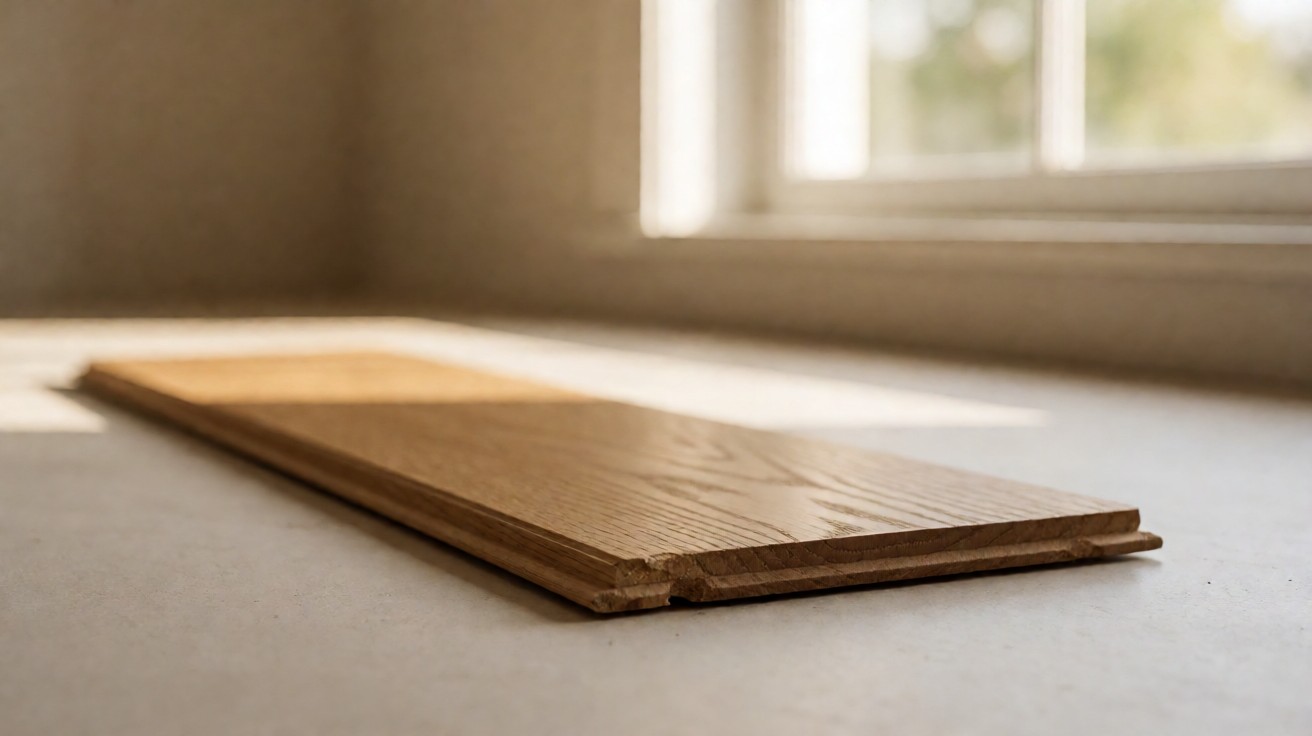
Hardwood floor finishes split into two families at the first question: does the product build a skin on top of the wood, or sink in? A film finish dries into a continuous skin, three coats deep on a site-finished floor. A penetrating oil soaks into the fibers and leaves no layer to peel.
That single difference decides how the floor ages. Film wears through in traffic lanes and is restored by screening the whole room and adding a coat. Oil wears thin in patches, never peels, and is restored one board at a time.
Neither family is more durable in the abstract. A film finish shrugs off grit that would burnish an oiled surface, while an oiled floor survives a deep scratch that would leave a white scar in polyurethane.
Does a Film Finish Always Outlast an Oil?
No. A film finish protects better while it is intact, but it fails visibly once wear reaches the wood, and a worn-through film cannot be recoated without sanding back to bare wood.
An oiled floor has no film to break through. It dulls gradually instead, and a maintenance coat every year or two restores the color without a drum sander touching the boards.
| Family | What sits on the wood | How it fails | How it is repaired |
|---|---|---|---|
| Film-forming | Three coats of polyurethane, urethane or varnish | Wears through in traffic lanes; scratches read white | Screen the room and recoat before bare wood shows |
| Penetrating | Oil and wax cured inside the grain | Dulls and burnishes unevenly; water leaves rings | Sand one board, re-oil, blend into the field |
Water-Based Polyurethane
Water-based polyurethane is a waterborne polymer dispersion that dries clear and stays clear. A two-component product such as Bona Traffic HD carries 150 grams per liter of VOC, about 32 percent solids, and covers 350 to 400 square feet per gallon.
It handles like a fast system: two to three hours between coats, a four-hour pot life once the components are mixed, and three days to full cure. Light foot traffic is fine after 24 hours, though rugs and heavy furniture should wait out the full cure.
The look stays close to raw wood, with almost no amber shift, which matters on pale maple, ash and white oak. The film is hard, but hardness is not toughness: a dropped tool leaves a white fracture mark rather than a dent.
Is Water-Based Polyurethane Good for Busy Rooms?
Yes, if the room is not a wet room. It resists scuffs and spills well, but standing water at a sink or a dishwasher leak will cloud the film if it sits overnight.
Oil-Based Polyurethane
Oil-based polyurethane is a solvent-borne alkyd-urethane that lays down a thicker-feeling film and cures by solvent evaporation plus reaction with air. Products sold as 550-VOC comply with a 550 gram per liter limit, and coverage runs about 500 square feet per gallon.
Recoating is slower: eight hours between coats, a 120-grit screen to give the next coat a key, and 30 days before rugs or heavy furniture go back. Solvent content also means the odor lingers for days in a closed house.
The amber cast is the reason many people choose it. It warms red oak and hickory, and it turns pale maple distinctly yellow within a year. That shift is permanent, and no maintenance coat removes it.
Oil-based film is flexible and forgiving of seasonal movement, which is why it survives old floors that move with the seasons. If the floor is old and gapping, that flexibility is worth more than clarity. The next family skips the film entirely and works inside the grain.
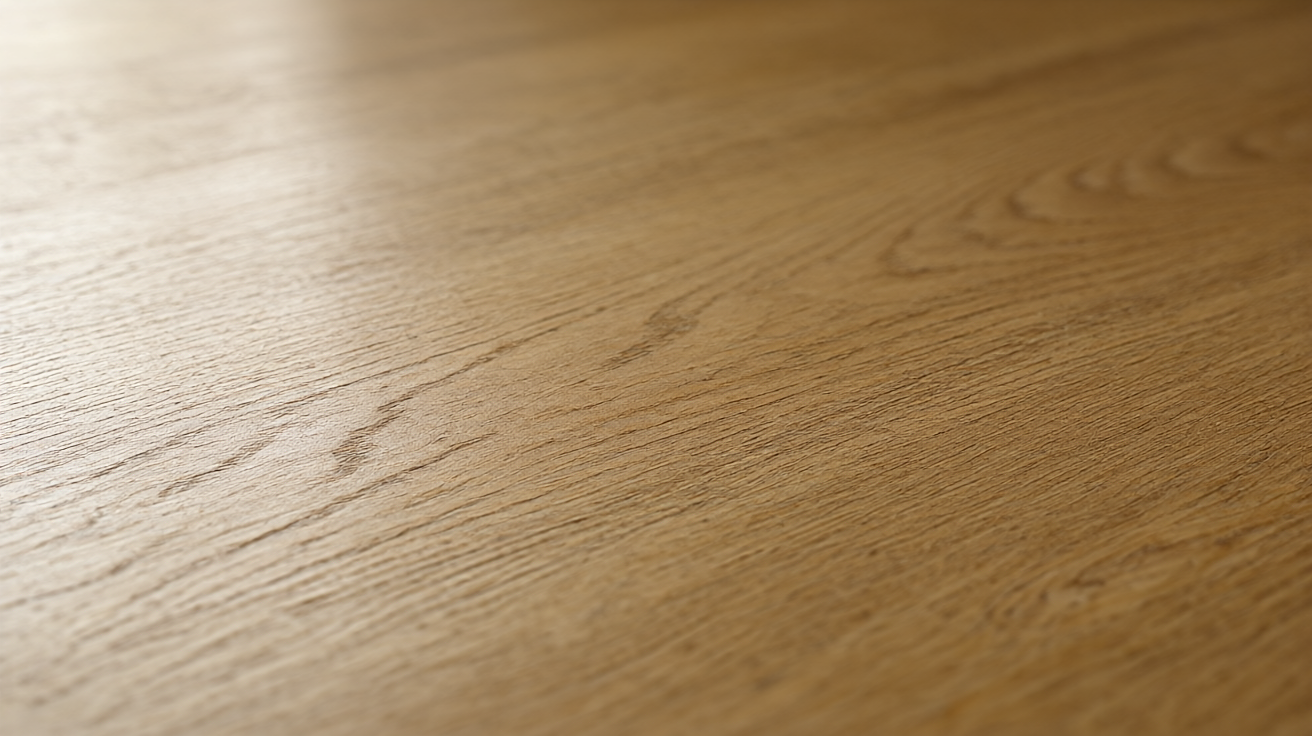
Hardwax and Penetrating Oils
Hardwax oil is a blend of drying oils and waxes that penetrates and cures inside the wood. Rubio Monocoat’s Oil Plus 2C reports 0 grams per liter of VOC, 300 to 500 square feet per liter, one coat, 24 hours to dry and five days to full cure.
Application conditions are tighter than for film finishes: 35 to 60 percent relative humidity and wood moisture content between 8 and 12 percent. Outside that window the oil cures unevenly and leaves shiny patches.
Because nothing sits on top, there is no peeling edge and no white scratch halo. A scuff is sanded locally, re-oiled, and blended into the surrounding board within an hour.
The trade-off is a thinner shield. Grit and dog claws burnish the surface instead of scratching a film, and standing water left overnight can leave a dark ring that only sanding removes.
Can You Spot-Repair an Oiled Floor Without Sanding the Room?
Yes, and that is the main reason to choose it. A single board is cut back with a fine abrasive, re-oiled, and wiped dry; the repair blends because the oil does not build a layer with an edge.
UV-Cured and Aluminum Oxide Finishes
Both of these belong to the factory. Aluminum oxide is a mineral mixed into the wear layer of a prefinished board, and UV-cured coatings harden in seconds under ultraviolet lamps rather than in air. Neither can be applied on site.
The performance is genuinely different from site-applied film. Aluminum oxide sits near the top of the hardness scale, and manufacturers back it with 25-year residential wear warranties on multi-layer finishes.
Read the warranty closely. Wear warranties cover the finish wearing through to bare wood, not surface scratches, dents, or the loss of gloss that follows normal cleaning. A 25-year promise is not a 25-year appearance guarantee.
Why Can’t Aluminum Oxide Be Applied On Site?
Because it is fired into a factory coating line, not stirred into a can. The mineral is dispersed in a wear layer cured under controlled heat or UV, and refinishing later means sanding through a very hard surface.
That is separate from the prefinished vs unfinished hardwood decision, which turns on site conditions and wear-layer thickness.
Moisture-Cure and Conversion Finishes
Moisture-cure urethane hardens by reacting with water vapor in the air, which makes it unusually resistant to moisture and solvents. One professional-grade product carries 574 grams per liter of VOC, 32 percent volume solids, and 513 to 525 square feet per gallon.
It touches in one to two hours and can be screened after six to eight, which is fast for a solvent finish. The film is clear with a slight amber cast and is usually specified in gloss.
Compatibility is the trap. Moisture-cure urethane will not bond over an existing polyurethane film, so if the history is unknown the floor needs a test patch and often a full sand.
Conversion varnish is the shop-floor cousin: a two-part acid-catalyzed finish with high chemical resistance, mixed, potted and sprayed under controlled conditions rather than rolled out in a living room.
Sheen: Matte to Gloss and What Each Hides
Sheen is a measurement, not a mood. A gloss meter reads reflected light at 60 degrees under ASTM D523, and the number it returns decides whether a finish is called matte, satin, semi-gloss or gloss.
The industry bands sit at roughly 25 gloss units and 75: below 25 is low gloss or matte, 25 to 75 is semi-gloss, and above 75 is high gloss, with polished black glass as the 100-unit reference.
Waterborne ranges show how narrow those bands are in practice: 7 to 10 units for extra matte, 15 to 20 for satin, 40 to 45 for semi-gloss, and 65 to 70 for gloss. A matte floor and a satin floor differ by less than 10 units.
Lower sheen scatters light, so it hides scratches, dents, dust and the slight ripples left by a subfloor. If the subfloor is not flat, gloss will find every dip. High gloss behaves like a mirror and shows all of it, plus footprints and grit.
Matte is not invisible: it shows oily fingerprints more than satin, and it cannot be buffed shinier.
| Sheen | 60-degree reading | What it hides | What it reveals |
|---|---|---|---|
| Extra matte | 7 to 10 units | Scratches, dents, subfloor ripple | Fingerprints and oily smudges |
| Satin | 15 to 20 units | Light wear and dust | Directional traffic patterns |
| Semi-gloss | 40 to 45 units | Color variation and grain contrast | Scuffs and fine scratches |
| Gloss | 65 to 70 units | Almost nothing | Every mark, footprint and board edge |
Does Matte Hide Scratches Better Than Satin?
Yes, but the gap is small: 8 units against 18, visible mainly in raking light from a window.
Durability and Maintenance: How Each Finish Ages
Durability is two different questions: how long the surface resists wear, and how cheaply it comes back when it does not. Film finishes score well on the first and poorly on the second.
A screen-and-recoat refreshes a film floor before wear reaches the wood. Once bare wood shows in a traffic lane, the whole floor needs a sand, because a new coat will not bond to worn-through edges.
Oiled floors invert that math. They never need a full sand for wear alone, but they ask for a maintenance coat when the surface looks dry, which in a busy kitchen might be annual.
Humidity drives all of it. NWFA guidance holds a house at 60 to 80 degrees Fahrenheit and 30 to 50 percent relative humidity year round to keep boards from gapping and cupping. If the finish is unknown, test a closet corner before committing to the whole room.
Abrasion testing tells you which film is tougher. ASTM D4060 runs coated panels on a Taber abraser and reports a wear index in milligrams lost per 1,000 cycles, so a lower number means a more abrasion-resistant film.
Once the floor is in use, the how to clean hardwood floors routine matters more than the finish label, because grit is what wears every family down.
| Finish | Wear character | Recoat or repair | Cure time |
|---|---|---|---|
| Water-based polyurethane | Hard film, surface scratches read white | Screen and recoat whole room | 3 days |
| Oil-based polyurethane | Flexible amber film, resists deep dents | Screen and recoat whole room | 30 days to full hardness |
| Hardwax oil | No film, burnishes in traffic lanes | Spot repair and periodic re-oil | 5 days |
| UV-cured or aluminum oxide | Very hard factory wear layer | No spot repair; screen or sand | Cured at the factory |
| Moisture-cure urethane | Hardest site-applied film, amber cast | Screen and recoat whole room | 24 hours |
How to Choose a Finish for Your Room
Start with water and sunlight, then traffic, then timeline. If the room is a bathroom, laundry or kitchen, choose a finish that tolerates standing water: moisture-cure urethane or a water-based system with a moisture-resistant topcoat.
If the room takes direct afternoon sun, water-based keeps pale floors pale. Oil-based will amber further in ultraviolet light, and no blind fully stops the shift on a south-facing wall of glass.
If the house has dogs or heavy grit, matte aluminum oxide or a hardwax oil both hide wear better than semi-gloss polyurethane. On textured boards the choice narrows, because hand-scraped vs wire-brushed surfaces hold coating differently.
If the schedule is tight, water-based is the only site-applied family that lets you coat three times in a day and walk on the floor the next morning.
For example, take a 1,200-square-foot floor. Water-based at 400 square feet per gallon needs 3 gallons per coat, or 9 gallons for three coats; at 150 grams per liter that is about 5.1 kilograms of VOC.
Oil-based at 500 square feet per gallon needs 2.4 gallons per coat, or 7.2 gallons for three; at 550 grams per liter that is about 15 kilograms, roughly three times the solvent load for the same floor.
The hardwood flooring cost line is mostly labor, so the finish you pick moves the material budget less than the number of coats does.
For the wider sequence, from subfloor flatness to acclimation, the hardwood flooring guide covers the steps that come before any finish goes down.
What Not to Mix
Finish families do not stack at will. Polyurethane will not bond over hardwax oil, wax polish or silicone, and a coat applied over any of them will peel in sheets rather than fail gracefully.
Moisture-cure urethane cannot go over an existing polyurethane film. Oil-based polyurethane over fresh water-based needs the full three-day cure plus a test patch, because the solvent can soften a film that felt dry.
Can You Switch Finish Types Between Rooms?
You can, but the seam shows. Sheen and color drift differently with age, so two finishes meet at a doorway as a visible line within a year, and one finish throughout avoids that patchwork.
Test before you commit. ASTM D3359 cross-hatch tape testing rates adhesion from 0B to 5B, and anything below 4B means the old finish has to come off before a new one goes on. If you are coating a single room, match the sheen and chemistry of the adjoining floor so the doorway does not become a seam.
Sand stearated coatings and contaminated edges back to bare wood, and never coat over a floor cleaned with oil soap; the residue lives in the grain and kills adhesion in exactly the traffic lanes you are trying to protect.