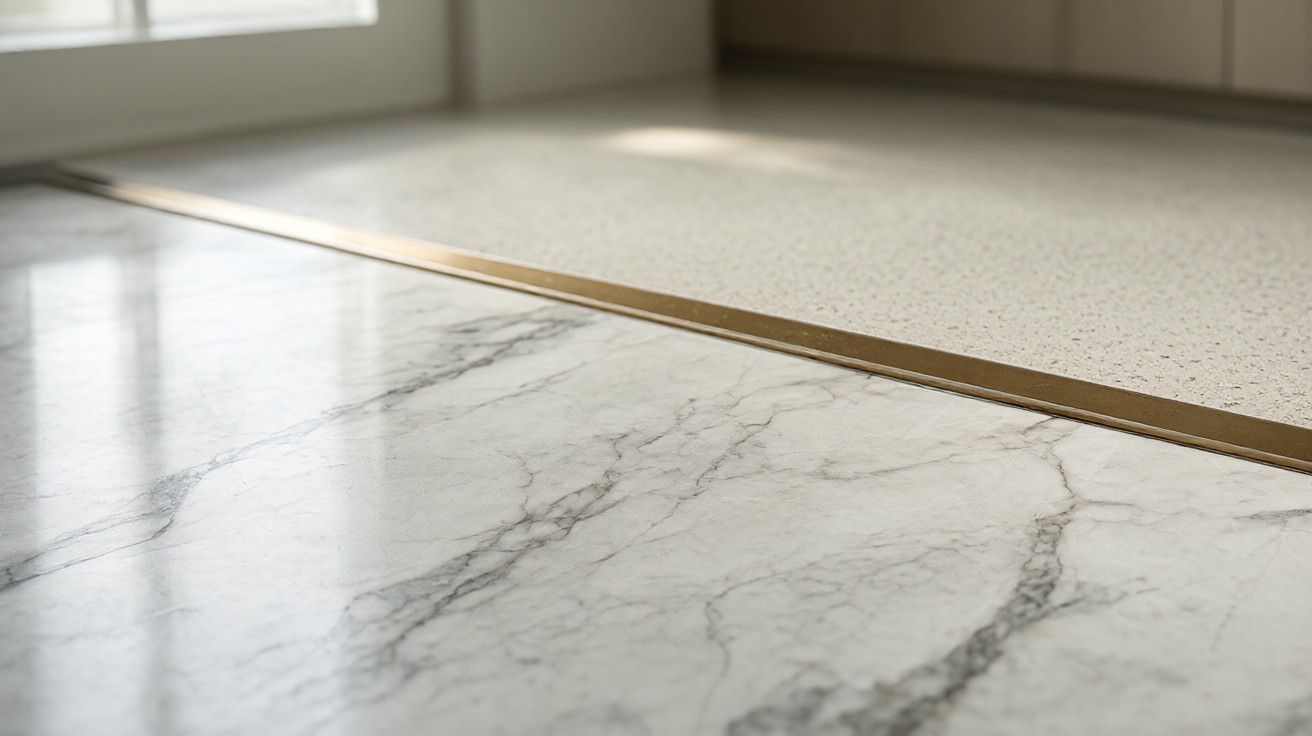

Terrazzo promises a floor that outlives the house, yet the sales pitch rarely mentions the cold, the hardness, or the concrete slab that decides everything.
Choose terrazzo when you will own the building for decades, the concrete slab is sound, and you want a seamless surface you can refinish instead of replace. Skip it when the budget is tight, the room needs warmth underfoot, or the timeline is short. Three conditions decide the verdict, not the speckled look.
The Short Answer: Is Terrazzo Worth It for Your Space
The pros and cons of terrazzo flooring resolve into three questions: how long you will keep the floor, what the substrate can carry, and whether the room tolerates a hard, cold, reflective surface.
If all three line up, terrazzo is the best answer among hard floors. If one fails, a different material is the right answer, and no amount of design appeal fixes it.
Ownership horizon matters first, because terrazzo rewards decades of use and punishes short holds. Substrate matters second, because a thin bonded system inherits every crack and moisture problem below it.
Room tolerance matters third, because bedrooms, play areas, and quiet home offices want cushion and warmth that terrazzo does not give.
That is the whole decision. The rest of the evidence explains why.
The Case for Terrazzo
Terrazzo earns its reputation on lifecycle, not on first cost. A worn floor can be re-ground and re-polished back to a like-new surface, so the material stays in service while other floors get torn out.
Published comparisons credit properly maintained terrazzo with a 75-year-plus service life, and floors installed between the 1920s and the 1960s are still carrying traffic today.
The design range is genuinely unmatched among hard floors. Aggregate size, chip color, binder tint, and divider layout are all variables, so a floor can carry a logo, a gradient, or a field of color that no tile line reproduces.
For a designer placing a signature surface in a lobby or a hallway, that latitude is the point. If the material itself is new to you, read what terrazzo actually is before weighing the trade-offs.
A sealed, non-porous epoxy surface resists stains, bacteria, and moisture, and the seamless field leaves no grout lines to harbor mold. Recycled glass and marble aggregate are common, and resin systems can be formulated with zero VOC content.
That seamless field is a format choice, not a material property: precast terrazzo tile carries grout joints, and the poured terrazzo versus terrazzo tile comparison sets out when each wins.
Refinishing instead of replacing also changes the replacement cycle, which is the strongest version of the sustainability argument. The floor contributes to indoor air quality rather than detracting from it.
What refinishing actually involves, and what it costs by scope, is covered in the terrazzo restoration and repair guide.
None of that is free. The case against is just as concrete.
The Case Against Terrazzo
The price band sits above every other hard floor. New terrazzo installation runs $18 to $60 per square foot across all formats, while general flooring installation averages $4 to $15 per square foot.
Complex multi-section designs with several aggregate mixes can reach $100 per square foot and more. If the budget is the binding constraint, terrazzo is the wrong answer before any other factor enters.
The surface is hard and cold underfoot. It does not retain heat well in winter, so bare feet read it as cold unless an insulator or radiant system sits below.
There is no cushion, which matters in bedrooms and play areas where people stand, sit, or fall. A hard floor is durable precisely because it does not give, and that rigidity makes it unforgiving to live on.
Poured terrazzo is specialist work: a crew mixes, pours, grinds, and polishes on site. That is why it belongs in new builds and gut renovations rather than a weekend refresh in an occupied home.
It is not a DIY floor, and the grinding and curing time is the reason a short timeline disqualifies it.
The thin bonded system also inherits the slab below it, so settlement, joint movement, and moisture can telegraph through as cracks. Reflective cracking from an uncontrolled slab joint is the most common failure, and it is a substrate problem before it is a terrazzo problem.
Control joints should follow ACI 302.1R spacing, roughly three times the slab depth in feet, so a 4-inch slab gets joints at a maximum of 12 feet.
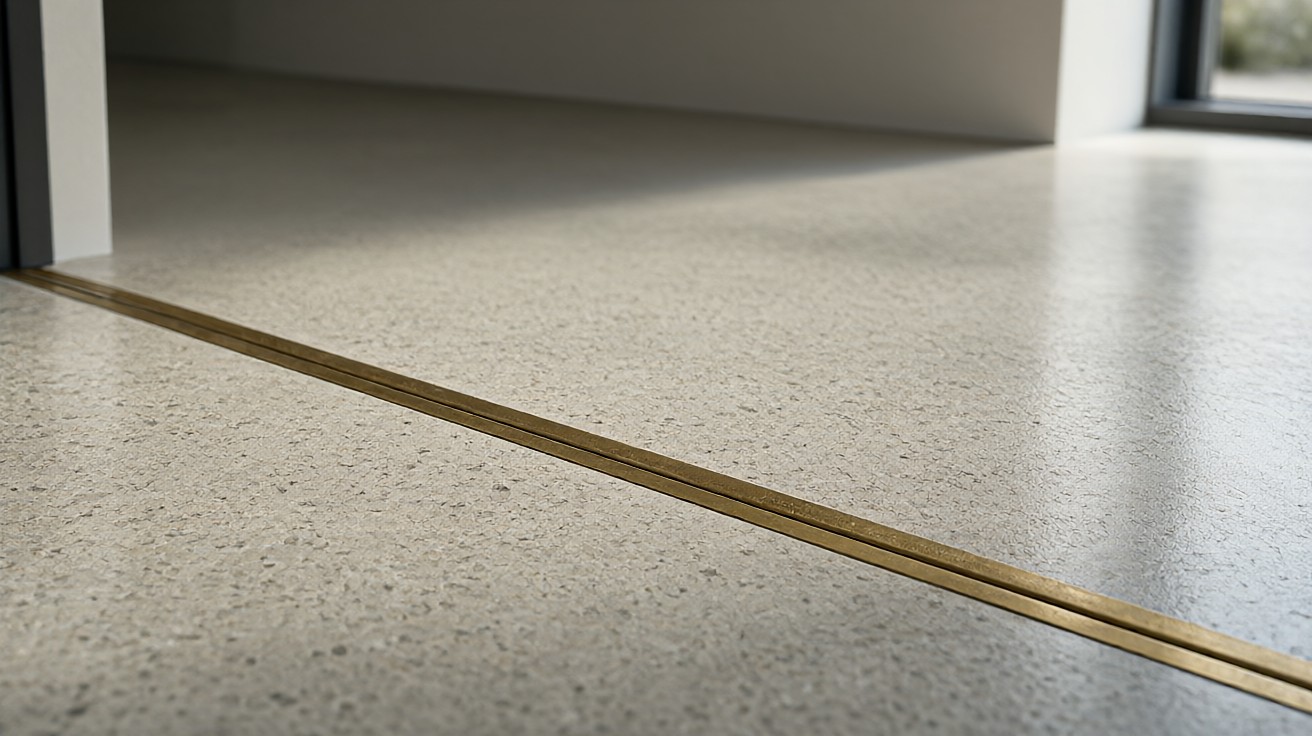
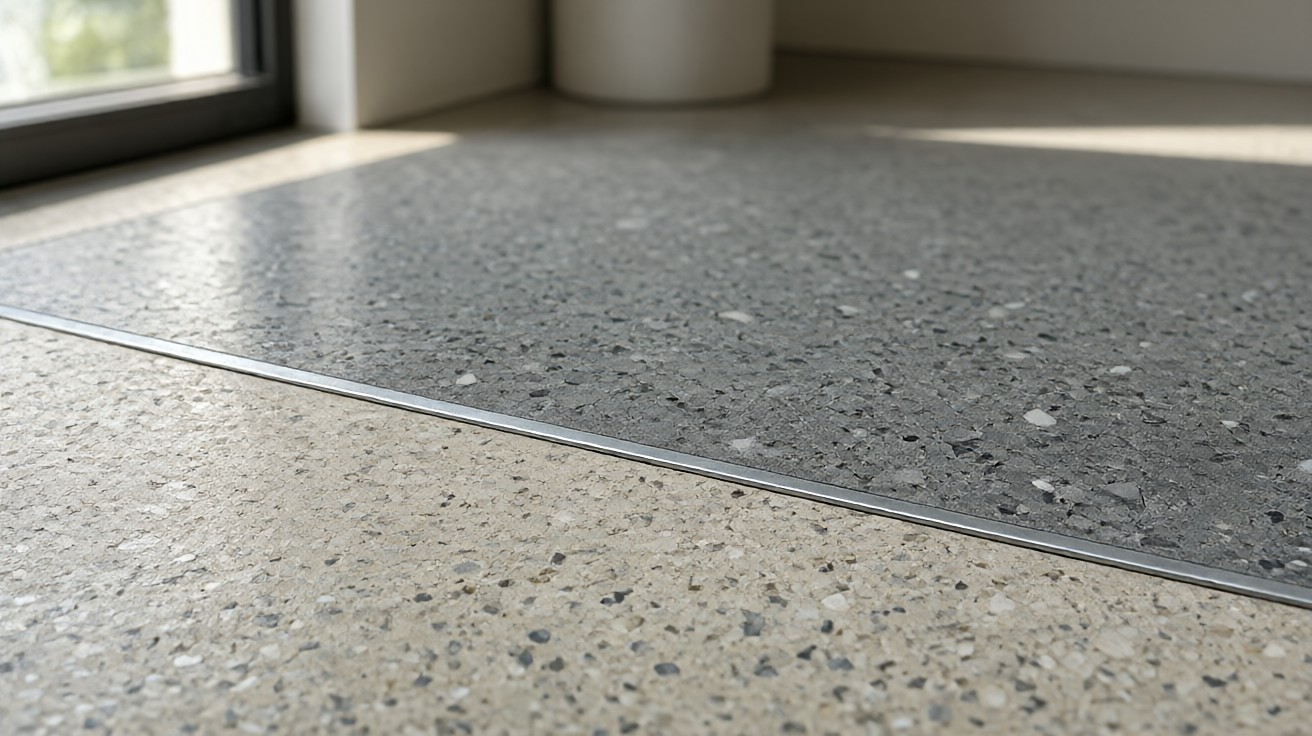
Divider strips should sit precisely above those joints, and a flexible membrane can absorb some horizontal movement. Decorative dividers alone do not prevent cracking.
The honest list of rooms it does not suit is short but real: tight-budget flips, bedrooms and play areas that want warmth, sun-exposed outdoor areas if the binder is epoxy, and any project on a damp or moving slab without mitigation.
Service Life: Four Published Numbers and What Each Measures
Service life is where the marketing gets slippery, because four different numbers circulate and they measure four different things. Averaging them into one lifespan is the mistake.
Each number below carries its own scope, and the scope is what tells you whether it applies to your floor.
| Published number | What it actually measures | Scope |
|---|---|---|
| 75-plus years | Observed service life of historic floors still in use | Floors installed from the 1920s to the 1960s, properly maintained |
| 40 to 100 years | Expected system life for one poured-in-place epoxy product | Epoxy terrazzo specifically, longer with proper care |
| 60 to 80 years | Age of surviving original floors in public buildings | Government building floors still in service |
| Up to 100 years | Upper bound conditional on care and maintenance | Terrazzo generally, potentially longer |
Read the scopes, not the headlines. The 75-year-plus figure is an observation about surviving historic floors, and the 40-to-100-year range is a manufacturer expectation for one epoxy system.
The 60-to-80-year figure is the age of public-building floors still in service, and the up-to-100-year figure is an upper bound conditional on care. They agree on direction and disagree on magnitude because they measure different things.
Two documented cases, both recorded by NTMA, anchor the claim better than any range. At Northrop Auditorium, a 1929 landmark renovated in 2011, the original 85-year-old terrazzo in Memorial Hall was refinished rather than replaced.
At the 1932 Potter County Courthouse in Amarillo, preservation crews expanded and reinforced more than 200 feet of underfloor utility tunnels rather than disturb the historic terrazzo above. The floor outlasted the building systems around it.
That is the lifecycle argument in two buildings, not in a brochure.
What It Costs Up Front and What It Costs Over Time
Upfront cost depends on format and design complexity, so keep the scope labels attached. Installed terrazzo averages $20 to $50 per square foot; poured systems run $20 to $70 and tile runs $15 to $35.
Installers bill $35 to $45 per hour on average. A floor with several sections and different-colored aggregate mixes can reach $100 per square foot and more, because each color change means a separate pour, grind, and polish pass.
Is terrazzo worth the cost?
The honest answer is conditional on how long you keep the floor. Spread over a 75-year service life, the upfront premium amortizes to a small annual figure, and published lifecycle comparisons credit terrazzo with the lowest cost per year of any flooring system.
But that math only works if the floor survives and you avoid the tear-out cycle. If you will sell in five years, the premium is unlikely to come back.
A building itself may be functionally obsolete after 40 to 50 years, long before the floor wears out, so the hold period and the building’s life both cap the payback.
Full pricing by format, region, and design complexity lives in the terrazzo floor cost per square foot breakdown. This page owns the trade-off, not the quote.
Upfront is the barrier. Over time, the floor can be the cheaper habit.
How Terrazzo Compares Against the Alternatives
The comparison below is one restoration contractor’s published side-by-side, and the bands vary by region, finish, and substrate. Treat the cost column as a band, not a quote.
The lifespan column is a published expectation, not a warranty. The point is the shape of the trade-off, not the exact dollar.
| Flooring | Published service life | Upfront cost per sq ft | Maintenance | Seamless surface | Repairability | Comfort underfoot |
|---|---|---|---|---|---|---|
| Terrazzo | 75-plus years | $18 to $60 | Low | Yes | Excellent | Hard |
| Ceramic tile | 20 to 30 years | $6 to $24 | Moderate (grout) | No (grout lines) | Moderate | Hard |
| Hardwood | 20 to 40 years | $10 to $30 | Moderate to high | No (seams) | Moderate | Moderate |
| Polished concrete | 30 to 50 years | $6 to $18 | Low | Yes | Difficult | Hard |
| Luxury vinyl | 10 to 20 years | $4 to $12 | Low to moderate | No (seams) | Replace only | Comfortable |
Terrazzo wins on service life, seamless surface, and repairability, and loses on upfront cost and comfort underfoot. Polished concrete is the closest rival on lifecycle and cost, but it is harder to repair and offers less design range.
The terrazzo versus polished concrete decision usually turns on whether you want aggregate color and a refinishable wear surface. Hardwood and luxury vinyl buy comfort and a lower entry price at the cost of a shorter life and a replacement cycle.
No row is universally best. The right row depends on the room and the hold period.
Hardness, Cold Feet, and Comfort
A hard slab reads as cold because stone and concrete conduct heat away from your foot faster than wood or vinyl, and the surface does not retain heat well in winter.
The floor is not actually colder than the room; it pulls heat from your skin faster, so your nerves report cold. That is why the same terrazzo feels fine in a heated lobby and punishing in an unheated bedroom.
Is terrazzo cold underfoot?
Yes, unless something below it changes the heat flow. Radiant heating works well under terrazzo because the material conducts warmth evenly and its thermal mass holds and releases heat, making the underfloor system more effective.
An insulating underbed or a sand cushion also slows the heat loss. Without one of those, expect a cold surface in winter and plan rugs or footwear accordingly.
The hardness is measurable: cured epoxy resin tests at 60 to 85 on the Shore D scale per ASTM D2240, and the system carries a minimum tensile strength of 3000 psi per ASTM D638.
A traditional cement system can run 2 to 3 inches thick including its underbed, while epoxy is a thin-set veneer as thin as 1/4 inch. That rigidity is why terrazzo survives traffic and why it does not cushion a fall.
A sand cushion system, with its sand layer and mesh underbed, adds a slightly softer step and some sound dampening, but it does not turn the floor into a resilient surface.
Picture a mid-century hallway in January: the floor looks like confetti set in stone, and your bare feet register it as a cold slab before you reach the kitchen.
Bedrooms and play areas are where this drawback decides the material.
Sound: Clarity Versus Impact Noise
Acoustics split into two problems that terrazzo answers differently. A dense, hard surface reflects rather than absorbs sound, because there are no pores or fibers to trap the wave, so airborne sound bounces and the room stays lively.
That is an advantage where clarity and projection matter, and a liability where quiet matters.
At St. Joan of Arc Catholic Church in Lisle, Illinois, a centennial renovation replaced carpet with a five-color terrazzo floor, and the hard surface improved clarity and resonance for organ, piano, and congregational singing.
The floor made the room louder in the useful sense: more projection, more presence. In a house, that same reflection makes a hallway echo and a home office feel noisy.
Impact noise is a different problem, and the finish alone does not solve it. Footfall and dropped objects transmit through the structure, so the fix is the assembly, not the surface.
At Northrop Auditorium, new terrazzo was installed over a 3/8-inch resilient pad of recycled rubber to stop impact noise from upper floors and public areas. The terrazzo stayed hard and reflective; the pad underneath did the quieting.
A thick cement system adds mass, and mass dampens sound transmission, which is why traditional cement terrazzo is credited with acoustic dampening in busy buildings.
But mass helps transmission differently than a soft surface helps absorption. If quiet is the goal, specify the underlayment and the assembly, not just the finish.
Clarity and quiet are not the same purchase. Decide which one the room needs.
Slip Resistance With a Number Attached
Slip resistance is a specification question, not a vibe. ANSI A326.3 classifies hard-surface flooring into five use categories.
The 2021 revision sets a minimum dynamic coefficient of friction of 0.42 for interior dry and interior wet conditions, with wet-plus, exterior wet, and oils-and-greases categories left to manufacturer declaration.
The dynamic coefficient of friction, or DCOF, measures the force needed to keep a surface sliding divided by the normal force; it is a comparative number, not a guarantee.
Is terrazzo slippery when wet?
A polished terrazzo floor can be slippery when wet, and a honed or textured finish changes that. Published finish data lists polished and honed terrazzo at a static coefficient of friction up to 0.6 wet, and textured finishes up to 0.8.
One terrazzo tile product is published at a DCOF of 0.51, above the 0.42 interior-wet threshold. The finish you specify, not the material name, decides the wet performance.
TCNA is explicit that DCOF and slip resistance are not synonymous: slope, footwear, contaminants, maintenance, and drainage all affect whether a slip occurs, so the measured value alone should not decide suitability.
Traction also depends on cleanliness and moisture, and no single number describes every terrazzo floor. Specify the finish for the use category, then maintain it, because a contaminated surface can drift from its tested value.
If the installed floor is too slick, slip resistance can be raised by widening the grout joint on tile or applying an anti-slip treatment after installation.
Textured and rustic finishes are the default for exterior and wet areas, and a slip-resistant sealer plus mats at entries handles the rest. Never accept a bare claim that terrazzo is slip resistant without the number, the standard, and the finish attached.
The threshold is 0.42. The finish is the variable you control.
Staining, Porosity, and Hygiene: The Binder Changes the Story
The binder changes the maintenance story more than any other variable. Cement terrazzo is porous because the cement matrix and many aggregate chips absorb liquid, so spills wick in and stain unless a sealer fills the pores.
Epoxy terrazzo is non-porous, so it resists stains, bacteria, and moisture without the same sealing burden. That single choice decides whether your year includes periodic resealing or mostly sweeping and mopping.
Resealing frequency tracks traffic: a busy public floor may need resealing twice a year, while a private residence may go five years between applications.
Acidic spills such as vinegar, citrus, or wine can etch the marble chips in either system, so pH-neutral cleaning is the rule and acidic cleaners are out.
The seamless field helps hygiene because there are no grout lines to harbor mold or bacteria, but the sealer is what keeps the cement surface from absorbing the spill.
Day-to-day care lives in the terrazzo cleaning and sealing routine guide, and the binder decision lives in epoxy versus cement terrazzo. Choose the binder for the spill it will face, not for the color alone.
A hygienic floor is a sealed floor. The binder decides how often you reseal.
Repair and Refinishing: Excellent Floor, Less Excellent Spot
Repairability is excellent for the floor as a whole and less excellent for one damaged spot. A worn terrazzo field can be re-ground and re-polished to expose fresh aggregate and restore the sheen, which is why the material stays in service for decades.
Chips and cracks can be filled with color-matched resin, and damaged sections can be cut out and replaced. The whole-floor reset is the superpower.
Can a terrazzo patch be made seamless?
Often not. The aggregate is a mined product that varies by lot, an old mix is hard to color-match, and a patch reads as a repair even when it is flat.
Intricate patterns and rare aggregates make the match harder, which is why keeping leftover material from the original installation is the practical advice. The floor refinishes beautifully; the spot repair is a compromise you should expect rather than a surprise.
Epoxy systems bond at 300 psi to concrete per ASTM D7234, so a repair that debonds is usually a substrate or moisture problem rather than a resin problem.
Cement patches can be harder to blend because the matrix color and chip distribution shift with the pour. On tile formats, a damaged module can be replaced individually, the cleanest spot repair terrazzo offers, though the grout line still reads.
Refinish the field. Expect the patch to show.
Where Terrazzo Is the Wrong Answer
Terrazzo is the wrong answer when the budget demands the lowest upfront cost, when the room needs a warm cushioned surface such as a bedroom or play area, or when the timeline is too short for specialist pouring and curing.
Room by room, the conditions that flip the verdict are set out in the where to use terrazzo flooring guide.
It is also the wrong answer for a DIY refresh in an occupied home. Outdoors, epoxy is the wrong binder because it is sensitive to sun exposure and limited to interior use; cement and rustic finishes handle exterior work.
A damp or moving slab disqualifies the thin bonded system unless it is mitigated. Resinous flooring should not go down until moisture vapor emission is at or below 3 pounds of water per 1000 square feet in 24 hours per ASTM F1869.
The concrete should also be cured and prepared to a proper profile. If the slab cannot meet that, the terrazzo will inherit the failure, and no finish choice rescues it.
For a kitchen, terrazzo can work if the binder is non-porous epoxy and the slab is sound, but it is not the automatic best choice. The best flooring for kitchens comparison weighs comfort, cost, and water exposure room by room.
In a quiet home office or a bedroom, the reflection and the cold usually outweigh the design appeal. Match the material to the room’s job, not to the photograph.
The verdict checklist is short. Choose terrazzo if you will keep the floor for decades, the slab is sound and dry, the room tolerates a hard reflective surface, and the budget carries the premium.
Skip it if any one of those fails, and choose the material that fits the room instead. The floor is excellent at being permanent, refinishable, and seamless; it is poor at being cheap, warm, quiet, or quick.
That is the honest trade. Decide which side your room is on.