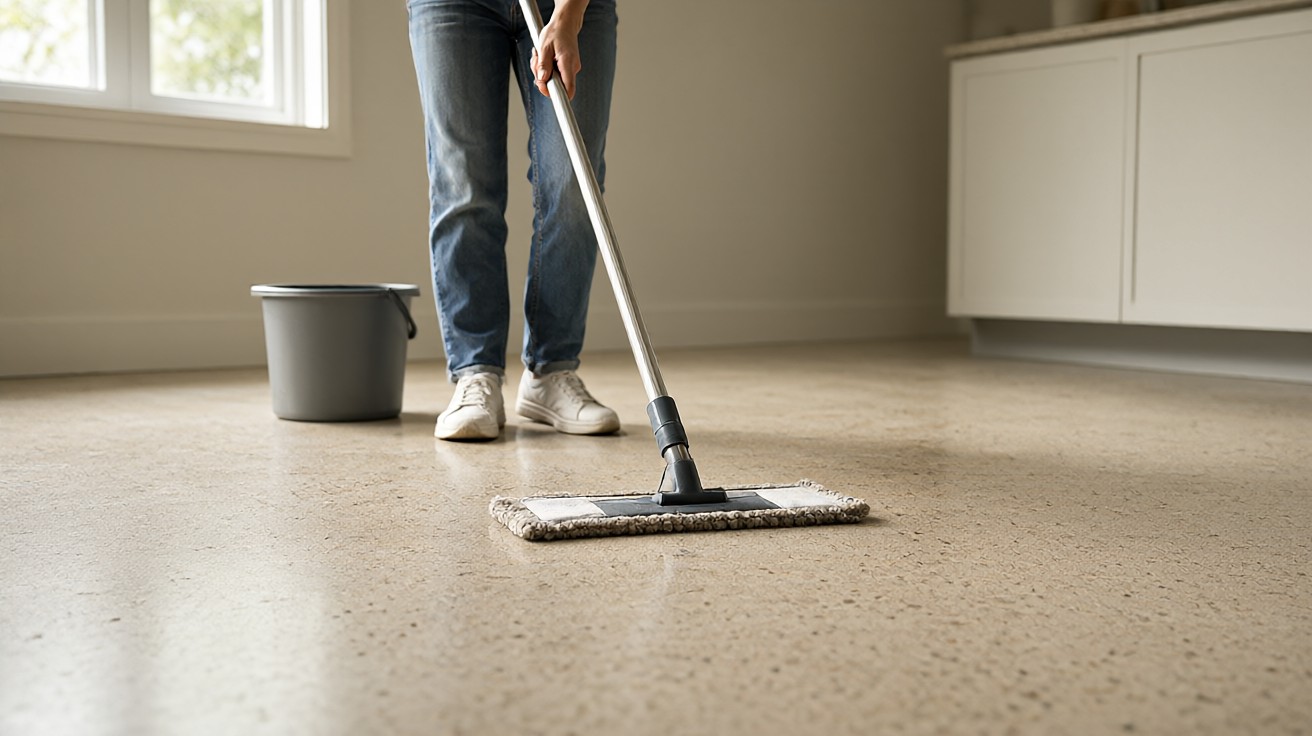

Clean terrazzo floors with a daily dust mop and a weekly damp mop using a pH-neutral cleaner, because acid etches the marble chips and dulls the finish.
That routine is simple, but the chemistry behind it is not optional. Terrazzo is marble chips locked in a cement or epoxy binder, and each part reacts differently to what you mop it with. Use the wrong cleaner and no amount of scrubbing brings the shine back.
The Short Answer: How to Clean Terrazzo
Start with a daily dust mop and a weekly damp mop using a pH-neutral cleaner made for stone. Wipe spills the moment they happen, keep the sealer current, and buff occasionally to restore gloss.
That is the whole routine the National Terrazzo and Mosaic Association (NTMA) describes, translated for a home. Daily dust mopping lifts the grit that scratches the finish; weekly damp mopping removes the soil grit leaves behind.
If your floor is large, an auto-scrubber with a white pad does the weekly job faster. Everything else in terrazzo care supports these two habits.
The rules that matter most are negative: no vinegar, no bleach, no ammonia, no degreasers, no abrasive pads. NTMA lists these household chemicals among the products that damage terrazzo. When in doubt, pick a pH-neutral stone cleaner over any all-purpose product. The practical rule is simple: nothing acidic, nothing alkaline, nothing gritty.
Why Terrazzo Needs Its Own Chemistry
Terrazzo is a composite of marble chips set in a binder, and how terrazzo is built decides how it reacts to cleaners. The binder is Portland cement, polyacrylate-modified cement, or epoxy resin.
The polished surface is at least 70% marble chip. That one fact explains almost every cleaning rule, because marble is calcium carbonate, the same mineral in limestone and travertine.
Calcium carbonate dissolves on contact with acid. When vinegar, lemon juice, or an acidic bathroom cleaner touches a marble chip, it eats the polished surface and leaves a dull, rough spot called an etch mark.
Etching is surface loss, not a stain, so no cleaner brings the gloss back; the mechanical route is set out in the terrazzo restoration and repair guide.
This is not a stain you can mop away. The stone itself is gone.
Etching is why a natural vinegar cleaner is the worst thing you can put on terrazzo: the acid does not clean the marble, it corrodes it.
NTMA’s maintenance guidance explicitly lists vinegar, bleach, ammonia, and degreasers among the household chemicals to keep off the floor. Strong alkalis and crystallizing salts cause a different harm.
Stay away from all-purpose cleaners and soaps containing water-soluble inorganic salts, harmful alkali, or acids, because they degrade the surface and leave residue. A pH-neutral cleaner reacts only with the soil, not the stone, which is the whole reason to spend a few dollars more on a stone-specific product.
The binder matters too. Portland cement is porous, so it drinks up spills and needs a sealer as primary protection. Epoxy resin is essentially non-porous, so there the sealer mainly protects the aggregate and enhances gloss. NTMA draws this distinction directly, and it is the difference between a floor that needs sealing and one that mostly needs protecting.
The Daily and Weekly Routine
Dust mop every day. NTMA is blunt about why: dust, dirt, and grit scratch the finish, which reduces both gloss and cleanability. Underfoot, that grit acts like sandpaper.
Use a clean microfiber or treated dust mop, and change the head when it loads up with dirt. One habit most people skip: vacuum the fine dust out of the mop frequently, so you are not redistributing grit.
In a kitchen or entry where traffic is heavy, dust mop more than once a day. Anything that traps grit at the door reduces scratching.
Once a week, damp mop with a pH-neutral stone cleaner. A neutral terrazzo-tile cleaner concentrates to roughly 1 part cleaner to 64 parts warm water for light duty, or 1 to 32 for heavy duty. Mix it fresh; the label is the authority.
Let the solution dwell. A neutral cleaner needs several minutes on the floor to loosen soil, and the terrazzo care guidance we checked all calls for letting it soak for a few minutes. Agitate with a mop or soft nylon brush, then remove the dirty solution and rinse with plenty of clean water.
Keep the floor wet throughout, and never let the cleaner dry on the surface. If it starts to dry, re-wet it before it leaves a film. Change your mop water when it turns cloudy.
Rinse well. Leftover cleaner residue can become slippery, so dry the floor with a clean microfiber cloth or let it air dry. Mopping in a semicircle while walking backward keeps you off the wet floor and keeps the dirty water moving away from where you just cleaned.
For larger areas, an auto-scrubber with a white pad replaces the mop. Diamond-impregnated pads have no place in routine scrubbing; those are restoration tools, not cleaning tools.
How often should you damp mop terrazzo?
The answer is that traffic decides. Cleaning frequency follows how many people cross the floor each day, and NTMA ties the interval to that same daily foot traffic. A quiet hallway might need a damp mop every week or two; a busy kitchen may need it twice a week.
Dust mop daily regardless, and let visible soil set the pace. There is no fixed calendar that fits every home.
Sealers: What They Do and How Often
Does terrazzo need to be sealed?
Yes, but the reason depends on the binder. On cement terrazzo the porous binder absorbs spills, so the sealer is primary protection. On epoxy terrazzo the binder is non-porous, and there the sealer mainly protects the aggregate and enhances appearance.
A sealer buys you time; it does not make marble acid-proof.
Spills must still be wiped immediately, because repeated or long exposure stains, and even standing water can eventually damage some sealers. A sealer slows the damage; it does not cancel it.
The beading you see on a sealed floor is a cushion, not a shield. Two families of sealer do the work, and they behave differently.
Penetrating, or impregnating, sealers soak below the surface and resist stains without adding gloss; a quality penetrating terrazzo sealer is the classic example. Topical water-based acrylic finishes sit on top, add sheen, and wear with traffic. Water-based sealers are the most common choice today, and the reason is grip: a glossy film can turn slick when wet.
Do not expect a sealer to create shine. Gloss is the result of polish plus sealer, and most sealers are low-solids liquids that do not produce a high-gloss sheen on their own.
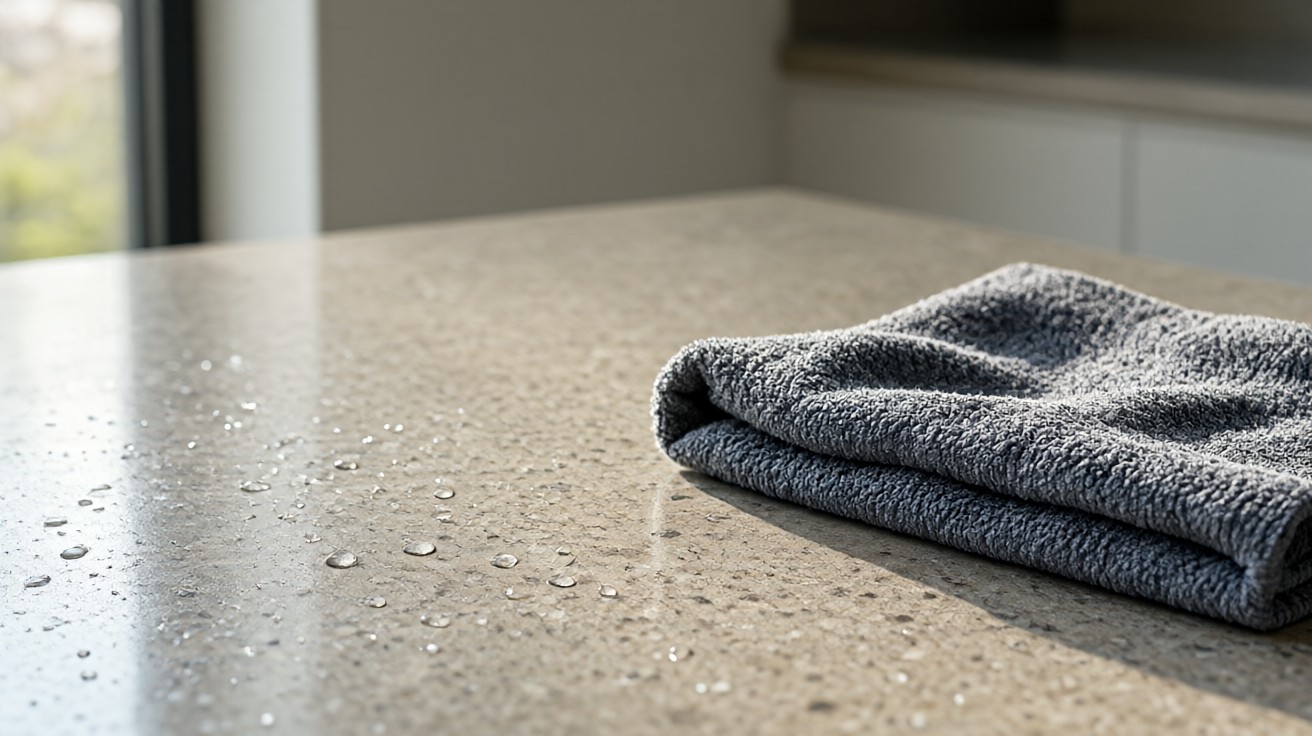
Here is the homeowner’s cadence check. Sprinkle water on the floor and wait about 5 minutes. If it beads, the sealer is still working. If it soaks in and darkens the stone, the penetrating sealer has worn and it is time to reapply.
The same water test is how porosity gets judged. Reapplication cadence follows the binder and the traffic, not a fixed calendar, and the sealer manufacturer’s instructions always win over any calendar on a chart.
| Binder | Why it is sealed | Sealer type | Reapply when |
|---|---|---|---|
| Portland cement | Porous binder absorbs spills; sealer is primary protection | Penetrating sealer, optional water-based finish | Water soaks in and darkens the stone; finish wears with traffic |
| Polyacrylate-modified cement | Cementitious binder, still porous | Same as cement terrazzo | Per manufacturer; same water test |
| Epoxy resin | Non-porous binder; sealer protects aggregate and gloss | Penetrating sealer or water-based acrylic | As needed for stain protection and sheen |
One caution from NTMA: apply only sealers made for terrazzo, in thin coats rather than one heavy coat, letting each coat dry before the next. Most sealers go on best with a microfiber pad.
A sealer should also meet the slip-resistance rating your local code asks for, especially in a wet area. That is part of why water-based terrazzo sealers dominate today.
Caring for a New Terrazzo Floor
A new terrazzo floor has one enemy for its first few months: construction dust. It stays airborne long after the contractors leave and settles into the surface.
Scrub a new floor about once or twice a week for the first 2 to 3 months, and at least twice a week while construction dust is still settling. After that, once a week is enough for most homes, depending on foot traffic.
Always rinse well so cleaner residue does not build up and turn slippery. Dry the surface with a cotton or microfiber cloth after rinsing.
Seal early. NTMA specifications call for a sealer immediately after the final polishing. A new floor normally needs 2 or more coats of water-based acrylic sealer, holding a good sheen for about 45 to 60 days before additional coats.
If your terrazzo is tile rather than poured, the grout needs cure time before traffic. Allow 48 hours after grouting before walking on it, and 7 days before rolling loads.
Protect rolling loads with 1/2 inch exterior-grade plywood over construction paper. Never roll steel wheels across terrazzo tile, and keep heavily loaded forklifts off it entirely.
For a poured floor, let the installer’s cure schedule govern. Give a new installation at least 72 hours to cure before applying sealer.
Honed vs Polished: Upkeep Differences
Honed and polished terrazzo are the same material with different surface finishes, and they clean the same way: neutral cleaner, soft pads, no acid. The difference is how they show damage and how you maintain the sheen.
A polished floor is a mirror; a honed floor is matte.
Polished terrazzo shows etch marks and micro-scratches readily, because any disruption of the mirror surface scatters light.
Honed terrazzo hides fine scratches and dull spots better, but it is not immune to acid; the marble chips etch on either finish. If you have a polished floor, be stricter about spills.
To restore gloss lost to traffic on a polished floor, spray buff with a product designed for that purpose, following the supplier’s directions. A honed floor does not need buffing for shine; its upkeep is even cleanability and a current sealer.
For high-traffic areas, the choice is coating versus polishing, and the two are not interchangeable. You can maintain a sacrificial coating matched to your burnishing schedule, or polish the stone and protect it. A two-coat stone floor protector resists stains, scuffs, and scratches.
Slip resistance is the other difference, and it is measurable. The Tile Council of North America points to ANSI A326.3, which sets a wet DCOF benchmark of 0.42 for level interior floors expected to be walked on when wet.
DCOF is not the same as slip resistance, but maintenance affects it. Cleaner residue, worn sealer, and soap buildup all change how a floor grips when wet. Monitor DCOF over time with a floor friction tester and compare each reading against the 0.42 benchmark.
If a polished floor feels slick when damp, that is a maintenance signal, not a reason to wax it.
Terrazzo Tile: The Grout Lines Change the Job
Poured terrazzo has divider strips and control joints, not grout lines. Terrazzo tile has cement grout joints, and that changes the job. Thin-set epoxy terrazzo has no grout joints or seams; tile does.
Grout is porous enough to stain independently of the tile. Clean it with the same neutral stone, tile, and grout cleaner you use on the tile; a cleaner formulated for stone and grout is built for exactly this.
Work the cleaner into the joints with a soft nylon brush, let it dwell, then rinse. The same principles drive grout and sealer maintenance across the whole floor.
Seal the grout too. Cement grouts in polished terrazzo tile become more stain-resistant with a penetrating sealer, and sealing the tile before grouting makes cleanup easier.
On absorbent tile, a pre-grout sealer coat prevents grout from staining the stone. When grout gets deeply soiled, an alkaline heavy-duty cleaner lifts it, but these products degrade or strip sealer.
Plan to reseal afterward. Heavy-duty cleaning can strip the sealer, so reseal to keep the surface stain- and slip-resistant.
One tile-specific warning: do not use diamond polishing pads on terrazzo tile. Diamond pads are too aggressive for tile and panel surfaces and can damage them. Use soft white or red pads instead.
Spill and Stain Response
Speed is the whole game with terrazzo spills.
Picture a glass of red wine tipping onto a polished terrazzo kitchen floor. You have seconds, not minutes, before the acid begins to etch the marble.
Clean spills as quickly as possible, because repeated or long-term exposure is what causes staining. Even standing water can eventually damage some sealers.
Blot, do not rub; rubbing spreads the spill and grinds it into the surface. For most spills the response is the same: blot, neutral cleaner, dwell a few minutes, rinse with clean water, dry.
| Spill | Immediate action | Never use |
|---|---|---|
| Water or standing water | Wipe up and dry the area | Nothing harsh; standing water can damage some sealers |
| Wine, coffee, citrus, juice | Blot, neutral cleaner, dwell, rinse, dry | Vinegar or acidic cleaners, which etch marble |
| Vinegar, lemon, bathroom cleaner | Blot, rinse with clean water, dry; etching may need a pro | More acid or abrasive scrubbing |
| Oil or grease | Blot, neutral cleaner with dwell, agitate, rinse | Solvent degreasers, which NTMA lists as harmful |
| Ink, dye, paint | Blot, do not rub; neutral cleaner; stubborn stain to a pro | Abrasive pads or miracle cleaners |
| Grout haze on new tile | Alkaline grout-haze cleaner per label, test first | Diamond pads on tile, or acid on marble |
Some stains do not come out, and that is not your failure. NTMA’s restoration specification is plain about the limit: not all staining in existing terrazzo can be removed.
If a spill has etched the marble or penetrated deeply, cleaning will not reverse it. That is a job for mechanical restoration, not a stronger cleaner.
Mistakes That Ruin Terrazzo
Can you use vinegar on terrazzo?
No. Vinegar is acetic acid, and acid dissolves the calcium carbonate in marble chips. Every pass with a vinegar solution etches a little more of the polished surface, leaving dull spots no cleaner can restore.
NTMA lists vinegar among the household chemicals to keep off terrazzo. The natural-cleaner advice that works elsewhere is simply wrong for this floor.
Bleach and ammonia are also out. NTMA names both, along with degreasers, as products that damage terrazzo. Highly alkaline, acidic, ammonia-based, and abrasive cleaners or bleach can harm the tile and degrade the sealer.
Soap-based and all-purpose cleaners leave a different problem: residue. Soaps containing water-soluble inorganic or crystallizing salts build a film that dulls the floor and can turn slippery.
If your terrazzo looks cloudy after mopping, cleaner residue is the likely cause. Never wax terrazzo with a pure surface wax or an all-purpose sealer; both create a slippery surface.
Terrazzo’s gloss should come from polish and a terrazzo-specific sealer, not a layer of wax that traps dirt. Abrasive pads and aggressive scrubbing grind the finish.
Aggressive black stripping pads can unintentionally sand or grind the floor, and diamond-impregnated pads have no place in routine scrubbing. Use white pads for cleaning, and save diamond pads for the occasional scuff.
Finally, dirty mop water re-deposits the soil you just lifted. Change water when it becomes cloudy and clean the mop often. If you are mopping with gray water, you are polishing grit into the finish, not cleaning it.
Equipment and Products That Are Safe
The safe kit is small: a clean microfiber dust mop, a microfiber damp mop, two buckets so rinse water stays clean, a soft nylon brush, white scrub pads, and a pH-neutral cleaner formulated for natural stone.
That is enough for almost any home terrazzo floor. For larger areas, an auto-scrubber with a white pad earns its keep. Scrub at least once a week with clean water and a white pad.
A wet/dry vacuum helps you remove dirty solution and rinse water completely. When you shop for a cleaner, match it to the material rather than the marketing; our flooring cleaners by material roundup sorts pH-neutral options by surface.
Can you steam mop terrazzo?
Here the honest answer is uncertainty. The terrazzo care guidance I verified, including NTMA’s, specifies dust mopping, damp mopping, and auto-scrubbing with neutral cleaner; none of it lists steam mopping as an approved method for terrazzo.
Steam forces heat and moisture into a porous cement binder and grout lines. What is verified is the damp-mop routine above. Until your installer or sealer manufacturer confirms steam is safe for your floor, treat it as unverified.
If you do test it, test a hidden spot first and watch for dulling or grout damage. And if your floor is actually polished concrete rather than terrazzo, it has no marble chips to etch; cleaning polished concrete floors follows a different routine.
When Cleaning Is Not Enough
Cleaning maintains a floor; it cannot restore one.
If your terrazzo has etch marks, deep dullness, scratches, or cracks, no mop or cleaner will fix them. Etching is missing stone, and the only remedy is mechanical re-grinding and re-polishing.
That is restoration, not maintenance, and it is a separate job. NTMA’s guidance sets a clear homeowner limit for the small stuff: a fine 100 grit diamond pad can remove an occasional scuff or scratch.
If a 100 grit pad does not clear the mark, call an NTMA terrazzo contractor rather than keep grinding. Do not overuse diamond pads.
Stripping old sealer is also a pro job in most cases. Properly maintained floors rarely need stripping, not all sealers are strippable, and aggressive black pads can sand the floor.
When you hire, hire an NTMA contractor member. NTMA’s restoration specification calls for a contractor in good standing with at least 5 years of documented experience, and color matching existing aggregate may not be exact.
For everything short of that, the routine holds: dust mop daily, damp mop weekly with neutral cleaner, wipe spills fast, keep the sealer current, and keep acid off the marble. Do that and terrazzo outlasts almost every other surface in the house.