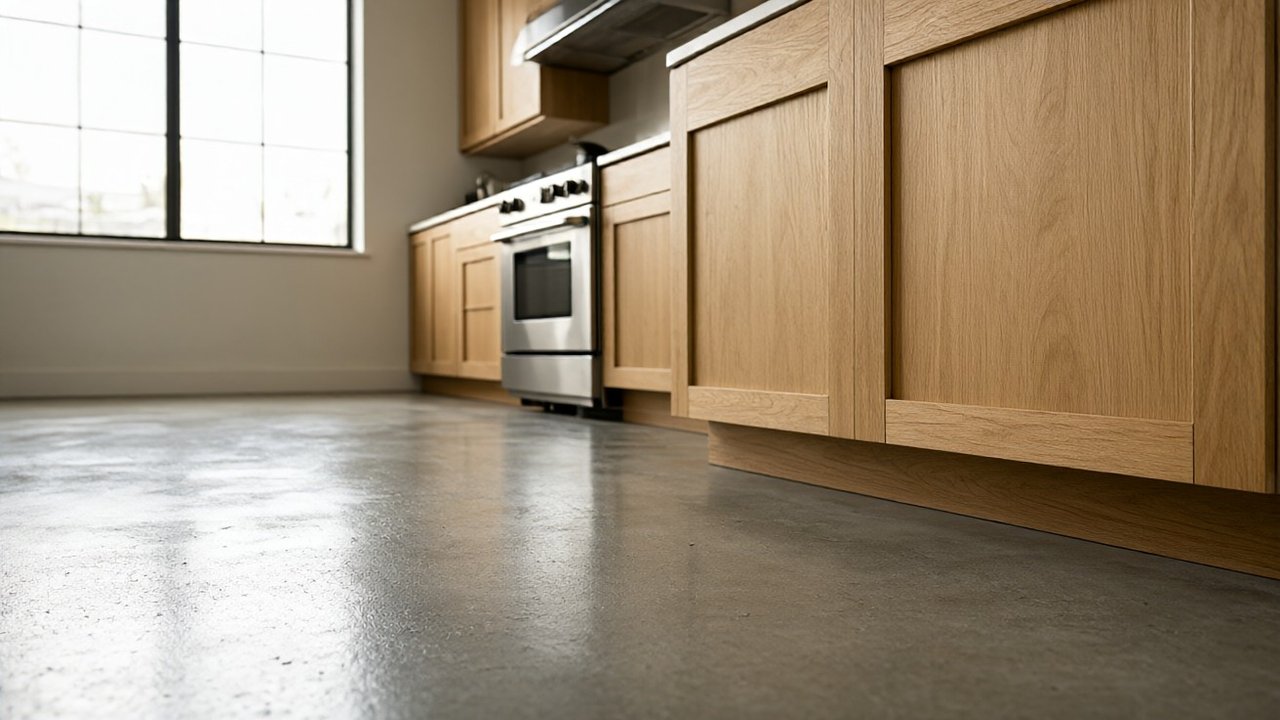

A polished concrete floor that looks cloudy under the lights is not usually dirty but chemically dulled, and scrubbing makes the dull spot worse.
The answer is a pH-neutral cleaner, a soft white pad, and a clean water rinse, worked in that order. Acids etch the cement matrix the way they etch marble, so a floor dulled by acid has to be ground back, not cleaned off.
Why Polished Concrete Is Cleaned Differently From Every Other Floor
Grinding a concrete slab does not cover it in a new material. It removes the soft paste at the surface and exposes the cement matrix and the aggregate inside it, so the floor you walk on is still cement and stone.
That matters because cement is alkaline and reactive. Vinegar, citrus cleaners, and bathroom scale remover all carry acids, and an acid etch on cement matrix dissolves calcium hydroxide out of the paste.
The surface goes dull and slightly rough in the same way an acid spill dulls a marble countertop. The difference is that a marble counter is usually replaced, while a concrete floor is ground.
Once the paste is gone, no amount of mopping brings it back. Polishing removes the damaged layer, so the repair means grinding, and that is a contractor job rather than a Saturday.
Ceramic and porcelain tile behave differently because the glaze is fired glass and does not react to most acids. Cleaning ceramic and porcelain tile is a different problem with a different set of rules.
Is Polished Concrete Just Concrete?
Yes, and that is the whole issue. A polished slab is the same material as a garage floor, ground down to expose the stone in it and then hardened.
How the floor was made is covered in our guide to polished concrete flooring. What matters for care is that the surface is cement and aggregate, not a coating.
That single fact drives every rule below.
Know Which Finish You Have Before You Buy A Cleaner
Three finishes look almost identical on the day they are installed and then respond to cleaners in completely different ways. Guessing wrong is the reason people think polished concrete cannot be maintained.
A densifier only is a chemical hardener that reacts with free lime in the cement matrix and leaves no film on the surface. The floor stays matte, and water beads on it.
A penetrating sealer soaks in and slows how fast the slab absorbs water and oil. It usually leaves the gloss alone, and it is the finish on most residential polished floors.
A topical sealer sits on the surface as a film and carries the shine. A full epoxy coating is a thicker version of the same idea, and both behave like a coated floor rather than like concrete.
Terrazzo is a different animal again. The aggregate is the star and the cement matrix around it is just the binder, so terrazzo responds to acid in the same way concrete does.
| Finish | What it looks like | Safe daily cleaner | Never use |
|---|---|---|---|
| Densifier only | Matte, water beads | pH-neutral cleaner, damp mop | Acid, ammonia |
| Densifier plus penetrating sealer | Low sheen, no film | pH-neutral cleaner, white pad | Acid, abrasive pads |
| Topical sealer | Visible film, gloss | Neutral cleaner, soft pad | Acid, black scrub pad |
| Epoxy coating | Continuous film, color | pH-neutral cleaner only | Acid, solvent, abrasive pad |
Ask the installer which of the four you have before you buy anything, and keep the answer with the floor paperwork.
If nobody can tell you, treat the floor as the most fragile option until a test patch proves otherwise.
The Daily Routine: Dust Mop First, Damp Mop Second
The order of operations does more for a polished concrete floor than the brand of cleaner on the shelf. Grit and abrasive dust left on the floor are what scratch it.
Start with a dry dust mop or a vacuum with a soft floor head, and get the grit up before anything gets wet. Wet grit turns into a sanding compound under any pad you put on it.
Then damp mop with a clean microfiber or cotton mop and a pH-neutral cleaner diluted to label strength. The mop should leave the floor barely damp, and you should dry it rather than let it air dry.
On a large floor, an auto scrubber with a soft white pad and a clean solution tank does the same work faster. Keep the pad clean, because a dirty pad is a scratch pad.
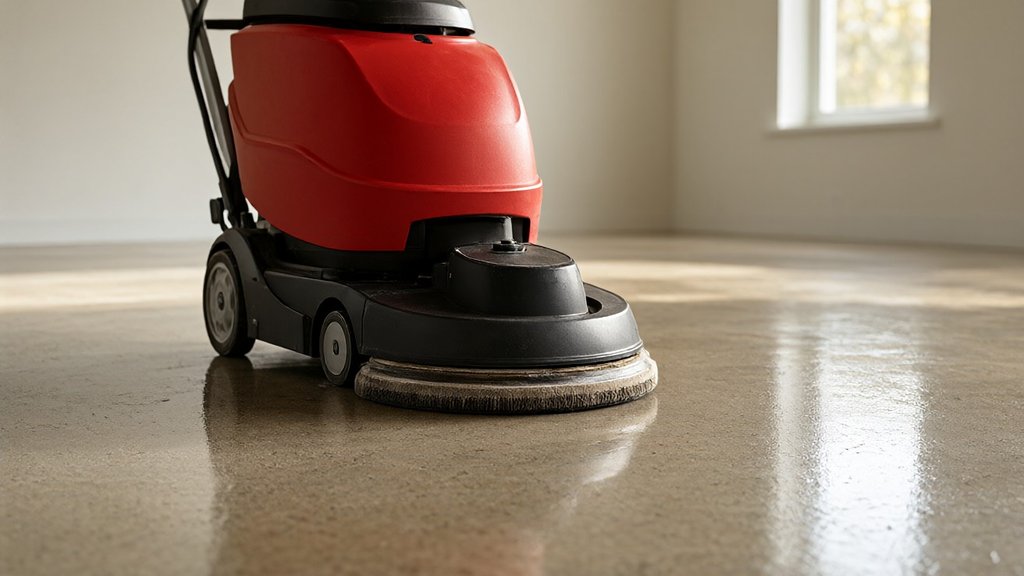
Change the solution when it turns cloudy, and rinse the floor with clean water once the mop is no longer leaving a film.
That last rinse is what stops the haze that makes a clean floor look permanently dull.
Do not leave a wet mop sitting on the slab. Water under a dirty mop is how a clean floor develops a stain in a doorway overnight.
The Neutral Cleaner Rule And Why Vinegar Is The Expensive Mistake
A pH-neutral cleaner sits near pH 7 and does not react with cement, coating, or sealer chemistry. That is the whole reason it works, and it is why anything acidic or strongly alkaline is a bad substitute.
Vinegar is acetic acid, typically about 5 percent, and it is the single most common reason a polished concrete floor gets damaged in a home. People use it because it works on mineral deposits and they assume concrete is mineral too.
It is mineral. That is the problem. An acid etch on cement matrix dulls the gloss permanently, and the dull spot grows every time somebody tries to scrub the mark off.
The repair is not a re-seal either, because the sealer sits on top of a surface that has been chemically removed. It is grinding, and grinding costs several times what a bottle of vinegar costs.
Keep bleach and ammonia cleaners off the floor as well. They will not etch cement, but they will break down some topical sealers and dull a gloss finish faster than ordinary wear does.
Ventilate while you clean. The EPA notes that indoor air pollution can be as high as outdoor levels and advises minimizing the indoor use of cleaners and pesticides, which means opening windows and running exhaust fans while you work.
Keep humidity between 30 and 50 percent while you work, the same range the EPA recommends for a healthy indoor environment.
Reading A Dull Patch: Dirt, Seal Wear, Or Worn Finish
The trade diagnostic is simple, and it saves real money because only one of the three causes of a dull spot is fixed by cleaning.
A dull patch in the middle of the room, in a shape that matches your mop, is almost always a film left behind by too much detergent. Rinse it with clean water and a clean mop, then dry it.
A dull patch at the door, in the traffic lane, or in front of the sink is sealer wear. Traffic strips the sealer and the gloss with it, and no amount of cleaning brings it back.
A dull area that follows a spill, especially one involving oil or a citrus product, is chemical damage. That one gets diagnosed the same way, but the repair is grinding, not a re-seal.
| Where the dull patch is | What it almost always is | What to do | What not to do |
|---|---|---|---|
| Middle of the room, mop-shaped | Detergent film or over-application | Rinse with clean water, dry | Add more cleaner |
| Doorway and traffic lane | Sealer and gloss wear | Reseal or burnish the area | Scrub harder |
| Under a spill or leak | Acid etch or chemical damage | Grind and reseal | Try a stronger acid |
| Whole room, uniform | Wrong cleaner used everywhere | Grind, densify, reseal | Keep mopping |
Gloss level is the number the trade uses to describe how sharp a reflection the floor throws back, and it is measured, not guessed. The Concrete Polishing Council chart records a distinctness of image value from 0 to 100, where 100 is a perfect reflection.
The same chart grades four levels, from Exposed/Flat through Exposed/Satin, Polished, and Highly Polished, and holds haze below 12 across every one of them.
Polished Concrete Council of Australia Position Statement No. 3 puts it another way, grading gloss from 0 up to 3 and pairing each grade with the tooling that usually reaches it, from less than 200 grit for a flat matte finish to 1,500 to 3,500 grit for a sharp mirror finish.
That statement also warns that grit alone does not guarantee a gloss level, because porous or carbonated concrete can never reach a high gloss no matter how fine the diamond goes.
Measure it with ASTM D5767, which returns a DOI value from 0 to 100 where 100 means perfect image clarity, and read haze with ASTM D4039, which computes the haze index from the difference between specular gloss at 60 degrees and at 20 degrees.
So a finish that reads as a soft satin will not look like a mirror even when it is perfectly clean. Judge the floor against its own gloss level, not against a photograph of someone else’s floor.
Grit, Pads, And Machine Cleaning Without Scratching
Every scratch on a polished floor is a piece of grit that somebody left under a pad. Machine cleaning works because the grit stays suspended, not because the pad is soft.
Use white pads for routine scrubbing. When a spot needs more, escalate one step to a red pad and no further. Black pads and diamond impregnated pads will take the gloss off a sealed floor permanently.
Coval’s technical data sheet for its polished concrete sealer is blunt about it: do not use heavy abrasive pads on auto scrubbers, and a soft brush or white buffing pad is enough to remove stains once the coating has cured.
The same sheet is clear that neutral pH cleaners, disinfecting cleaners, and degreasers will not damage the finish and can be used regularly.
Burnishing, which is a high speed burnisher running a pad at 1,200 rpm or higher, puts the shine back on a floor whose gloss has been scuffed off by traffic.
Before a coating or a sealer goes down, the surface profile has to be right. The ICRI concrete surface profile CSP chips run from 1 to 10, and the reference chips sit in the concrete surface profile guide published with ICRI Guideline No. 310.2R-2013.
CSP 1 is acid etched and nearly flat, CSP 5 is a medium shot blast, and CSP 10 is the rough end of the scale at a handheld breaker followed by abrasive blasting. A sealer wants a specific number, and the specifier names it.
The chips are about 16 square inches, or 3.5 inch by 4.5 inch, so you can hold one up against the slab and call the profile by eye.
For a repair, the contractor measures that profile with the method the specifier called for. ASTM D7682 uses a 1.5 inch epoxy putty replica and takes 10 readings, while ASTM D8271 uses a depth micrometer and takes at least 15 readings within a 6 inch by 6 inch area.
Which Pad Should You Use?
White for routine work, red only for a stubborn spot, and never black or diamond impregnated.
If you are unsure, start white and stay there.
Resealing, Burnishing, And When Neither Is The Answer
Three outcomes are possible for a dull floor, and picking the wrong one wastes the money you spent fixing it.
Burnishing restores gloss to a floor that still has its sealer and has only been scuffed. It takes about 20 pounds of head pressure on the pad and works the surface to a temperature 20 degrees above ambient, which is what brings the gloss back up.
Resealing is for a floor whose sealer has been worn through. The floor is cleaned, the old sealer is stripped if it is failing, and a new one goes on. Manufacturer instructions are specific about cure times.
Coval’s sealer is dry to the touch in 2 to 4 hours, takes foot traffic in 4 to 6 hours, heavy traffic in 24 hours, and reaches full chemical resistance cure in 7 days. Hot tire resistance is measured at 72 hours.
Laticrete’s concrete sealer, a densifier and sealer in one product, carries a pH of 10 to 12 and cuts moisture absorption by 81 percent in 24 hours under ASTM C642, with abrasion resistance up 225 percent under ASTM C779.
It also states the waiting period plainly: 3 days minimum for fresh concrete before application, and 7 days recommended for the best result.
Grinding is the third option and the only one that fixes acid damage, because grinding removes the etched cement matrix and exposes sound material underneath. A level 3 polish needs roughly 800 grit or finer, and a level 4 needs 3,000 grit or a burnishing step.
If the floor has been etched, resealing without grinding is like painting over rust. It looks better for a week and the dull patch comes straight back.
Sealers go on between 40 and 90 degrees Fahrenheit with relative humidity at or below 90 percent, so check the slab temperature, not just the air temperature, before you start.
Do You Need To Reseal Or Just Burnish?
Burnish when the gloss is scuffed but the sealer is intact. Reseal when the sealer has worn through to bare concrete in the traffic lane.
Handling Oil, Salt, And Water Spills On A Concrete Floor
Oil is the everyday problem in a garage or a workshop, and a penetrating sealer slows it down but does not make it disappear.
Blot fresh oil with a clean absorbent pad rather than spreading it. Once the oil is in the matrix, a degreaser and a soft brush will usually lift it, and any residue comes out with a machine and a white pad.
Salt is the one that quietly ruins floors near a garage door or an entry mat. Chloride salts get pulled into the damp matrix as the floor dries, and they keep working after the visible white powder is gone.
Shake salt off with a stiff nylon broom instead of dissolving it with a warmer and a stronger cleaner. If the salt has already soaked in, the repair is grinding, and no neutral cleaner reaches it.
For standing water, remove it fast and dry the slab. Water that sits for days carries dirt into the matrix and can leave a stain that looks like a sealer failure.
On an epoxy coating, spills are easier because the film does not absorb. Let them sit briefly, then lift with a soft pad, and never use a metal scraper on a coated surface.
A Maintenance Schedule For A Polished Concrete Home
Consistency is what keeps a polished floor looking the same in year five. A short routine on a fixed schedule beats a long rescue every few months.
| Frequency | Task | Product | What you are preventing |
|---|---|---|---|
| Daily | Dust mop, then damp mop | pH-neutral cleaner | Grit tracked in and ground into the gloss |
| Weekly | Scrub traffic lanes with a white pad | Neutral cleaner, auto scrubber | Sealer wear building up unnoticed |
| Monthly | Spot check the doorway and under the sink | Clean water and a white pad | Dull patches being missed until they spread |
| Annually | Burnish the traffic lanes | Burnisher with a soft pad | Gloss loss in the lanes |
| Every 3 to 5 years | Reseal worn areas | Manufacturer sealer | Sealer breaking down on the surface |
Walk mats are the cheapest maintenance tool you own. Placing them at the door and in front of the sink keeps the grit that does the most damage out of the traffic lane.
Keep a record of what was used and when. When a dull patch shows up two years from now, the log tells you whether it is wear, film, or a spill, and that determines the repair.
Any cleaner you try for the first time goes on a small spot in a closet first. If the gloss changes in 24 hours, you have your answer before you have a problem.
For the wider comparison of cleaning methods across floor types, our flooring cleaning and maintenance guide lays out the same four methods for every material.
Terrazzo And Epoxy Coatings: When The Rules Change
Terrazzo has a cement matrix just like a concrete slab, with the aggregate sitting in it. Acid etches terrazzo the same way, so the vinegar rule applies without exception.
The difference is the surface you feel. Terrazzo is harder and more forgiving underfoot than a ground concrete floor, but the matrix between the chips is still reactive.
An epoxy coating is a film on top of the slab, and a film behaves differently from concrete. It has no cement matrix to etch, but it has a surface that a black pad will scuff and an acid can stain.
On a coated floor, a pH-neutral cleaner and a soft white pad are the entire routine. Heavy machine work that would be acceptable on bare concrete is not acceptable on an epoxy coating.
If you are not sure what is underfoot, look at the edges of the floor at a doorway or a garage threshold. Exposed gray paste means concrete, visible chips means terrazzo, and a uniform colored film means a coating.
Preparing a slab for a new floor covering is a different job entirely, and it is covered in our guide to preparing concrete for new flooring.
A Quick Checklist Before You Clean
Before a mop comes out of the closet, answer five questions. If any of them is unclear, the wrong product is a real possibility.
Is the finish a densifier alone, a densifier with a penetrating sealer, a topical sealer, or an epoxy coating? Each one has its own list of safe products.
Is the dull area in a traffic lane or in the middle of the room? Location separates sealer wear from a detergent film in about a minute.
Is the cleaner on the label described as neutral or pH balanced, and is it free of vinegar, citrus, ammonia, and bleach? If the ingredients are not listed, buy a different one.
Is the pad white or red? A black pad on a polished concrete floor is the fastest way to remove the gloss you paid for.
Has anyone used vinegar or a bathroom cleaner on this floor in the last year? If so, suspect a chemical dull spot and get it looked at before you clean anything else.