
Every flooring sample you own looks like the right floor. That is the problem: you still cannot tell which one you will like in the evening light.
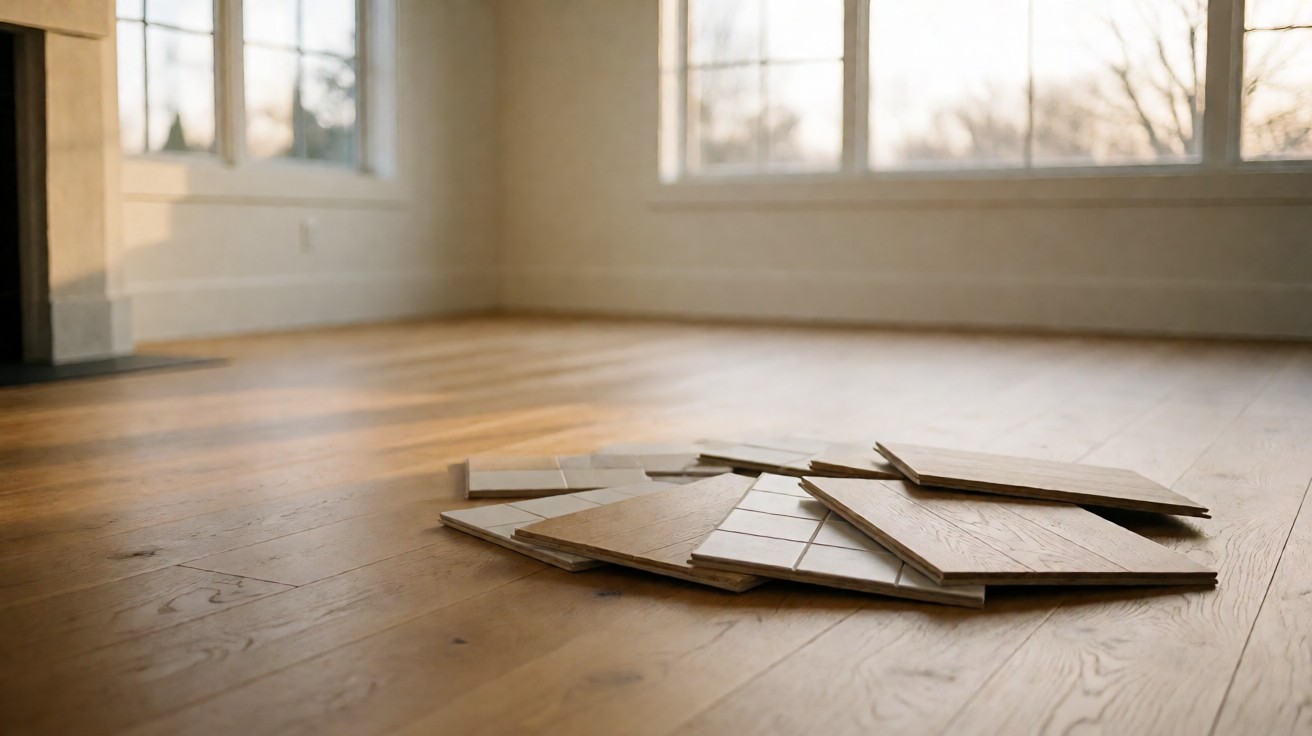
A sample settles three things well: colour under your room’s real light, surface texture, and hand weight. Sound, long-term wear, and how a pattern repeats come from a rated assembly, not a board. Go with a protocol: more than one piece of each product, laid where the floor goes, left to change temperature, then judged under morning and evening light.
What A Sample Can And Cannot Settle
Carrying a stack of swatches around the house and deciding on the spot fails in a predictable way. A sample is a physical object with a temperature, a moisture state, and a fixed area, and none of those change when you move it from one room to another.
What does change is the light striking the surface and the eye doing the looking. That is why the same oak board approved at noon on a Saturday can be a different colour at nine on the same night, with nobody moving anything.
What A Sample Settles Reliably
Colour is the one thing a sample is genuinely good at, and only when it stays put. Appearance depends on the light hitting the surface and on your eye adapting to that light, so a board judged under showroom lighting has been judged against that light and nothing else.
Texture, weight, and stiffness also transfer. A piece you can lift, flex, and rub hard with a thumbnail tells you more about how the floor will feel underfoot than any photograph, screen swatch, or screen colour ever will.
If a sample feels thin, hollow, or too light in the hand, it will feel that way underfoot for the life of the floor. That is one of the few impressions a photograph genuinely cannot give you.
What A Sample Cannot Settle
Most of what a purchase decision needs sits outside what a hand-held board can tell you. Sound cannot be judged from a sample at all, and long-term wear is a function of wear layer thickness in mils and years of traffic rather than one abrasive event.
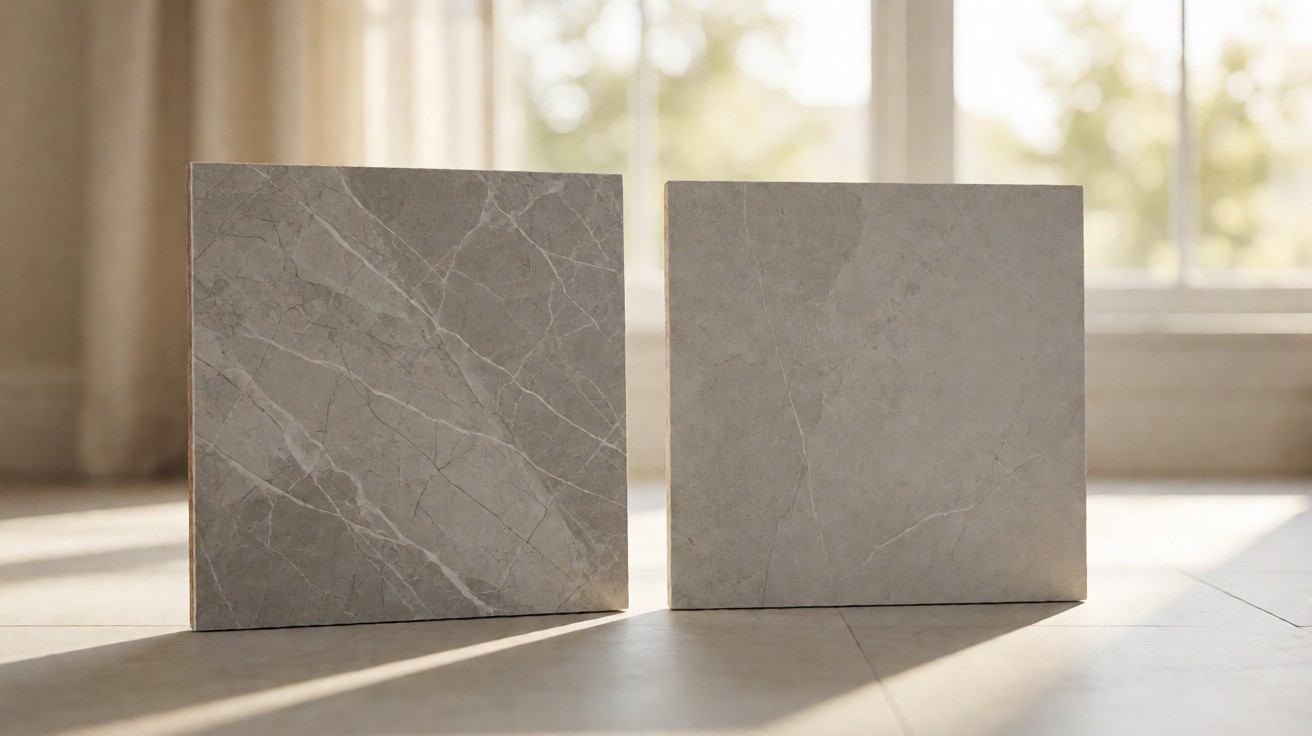
A pattern also needs area to become visible, because a repeat only shows up once there is enough surface for the eye to find it. Two boards side by side tell you colour and grain figure, and nothing about what four hundred square feet will look like.
Emissions move too, in ways that have nothing to do with the product on the board. The US EPA notes that formaldehyde levels in indoor air vary with temperature, humidity, and air exchange rate, so the same flooring can read high on a hot humid day and low on a cool dry one.
Products also off-gas over time, which means the level in a room that has stayed closed up for weeks is not the level you will live with once the windows are open.
Can A Small Sample Show You A Repeat?
No, and this is the most common way a sample misleads someone. Plank end joints, tile grout lines, and carpet pile direction only become readable once enough surface area is present for the eye to find the pattern at all.
A board one foot long has no full repeat in it.
| Question | Can A Sample Settle It? | What Actually Settles It |
|---|---|---|
| Does the colour suit this room? | Yes, after several days in the room | The sample itself under the room’s own light |
| Is the surface smooth, brushed, or embossed? | Yes, by sight and by touch | The sample in your hand |
| How heavy and stiff is it? | Yes, in part | Lifting and flexing a full piece |
| How loud will the floor be underfoot? | No | A rated assembly tested to ASTM E492, rated per ASTM E989 |
| How long will the finish last? | No | The wear layer figure in mils against expected traffic |
| How does the pattern repeat across a room? | No | Area, not a board. Ask for a room-sized display |
Where Samples Come From, And What Each Channel Sends
Sample quality is settled before the sample ever arrives, by the channel that sent it. If the material decision is still open, sorting by room and by how the household actually lives comes first, and the guide to choosing the right flooring covers that upstream call.
The Three Channels, And What Each One Sends
A flooring retailer or showroom normally cuts samples in house from the display stock in front of you. That is the best channel for colour, because the display you handled is the floor you are buying. Ask whether the piece is cut from the lot you will receive, and have the lot number written down.
A manufacturer or distributor ships samples by mail, usually free on request. These are frequently smaller than a retailer’s, sometimes printed swatches rather than the real surface, and always a different lot from the one that ships to your job.
That channel is useful when no local showroom carries the line, and less useful for judging texture. If the mail swatch is a printed card, treat it as a colour reference and ask to handle a real piece instead.
A contractor or installer sources samples for a client project, and the interest behind it is different. The sample is chosen so the order can be released quickly, not so you can study it for a week on the living room floor.
Ask which room it was intended for and what the alternative was. A contractor narrowing a choice for you is worth listening to even when it is not worth copying, because they see how the line behaves once it is installed.
Ask when the piece was cut, not just for which line.
How Do You Ask For Samples Without Naming A Colour?
Ask in the tone of the finish rather than the colour, because it is the tone that varies. Warm, cool, grey, and honey survive the trip through a room’s light. Beige does not, and it is the tone most often described in showroom lighting that looks flat at home.
Ask for two or three pieces per line, at least one from a lighter and one from a darker board. A single cut hides the variation a full floor will show, which is why some rooms look streaky after installation even though every board looked right alone.
What To Ask For Before The Samples Ship
- Two or three pieces of each product, not one, so variation inside the line is visible.
- A piece large enough to show a plank end joint or a full tile edge.
- The wear layer figure in mils, the plank or tile dimensions, the finish type, and the total thickness.
- Confirmation of whether the delivered product will come from the lot the sample was cut from.
- A photograph of a laid floor in daylight, if the showroom has one, since area is the thing a sample cannot supply.
The Five Step Comparison Protocol
The sequence below is what turns a stack of boards into a decision, and it runs in order for a reason. You cannot judge colour on a sample that has not settled, and you cannot record a decision about a product you never laid out.
1. Ask For More Than One Piece Of Each Product
One piece is a colour. Three pieces of the same line is a material, because the differences between them are the variation you will live with once every board sits in a different patch of daylight.
Lay them side by side and find the board that reads lightest and the one that reads darkest. Then decide whether you are comfortable with that gap, because the gap is what a room full of the product will look like.
If the retailer can send only one piece, ask for a photograph of that exact product installed in a room with daylight in it. Treat the single board as a colour reference, and do not read pattern, wear, or sound from it.
2. Lay Them Out Where The Floor Will Go
Put every candidate in the room where it will be installed, flat on the floor, in the part of the room you will actually sit or walk in. A sample held up to a window is being judged against the brightest light in the house.
Lay the pieces at their real width and put them edge to edge, so joints and seams show the way they will show once the floor is full. Turn one piece around and notice whether the grain or pattern direction changes how the colour reads.
Over a slab or a concrete subfloor, do the same comparison in the same place. A floor installed over concrete reaches a different temperature and a different moisture state than one installed over wood.
3. Leave Them Long Enough To Change Temperature
Acclimation is the process of bringing wood flooring to the moisture content that matches the conditions the room will actually be in. The measure of it is equilibrium moisture content, where a piece of wood is neither gaining nor losing moisture to the air.
A board that has not reached that point is still telling you about the truck it rode in on. Acclimation recommendations usually state a minimum of three days with no stated maximum, and the three days is not really the test at all.
The real test is that the moisture reading has stopped changing. Heating and air conditioning should be running at least five days before installation, and a sample that has sat through a system switched off is not comparable with one that has not.
The target range for interior wood flooring is 30 to 50 percent relative humidity at 60 to 80 degrees Fahrenheit, which corresponds to an equilibrium moisture content of 6 to 9 percent. At 70 degrees and 40 percent relative humidity, that works out to about 7.7 percent.
If your room sits outside that band year round, the geographic exceptions NWFA describes matter more than the numbers do. A coastal house is not a failed acclimation, it is a different condition to plan around.
Tropical species generally need longer, because their density, oil, and resin content make moisture readings harder to take accurately. Material acclimated outside the room it will be installed in has gained nothing, since it never shared the air with the space.
4. Look At Them Under More Than One Light
A north-facing window and a south-facing window deliver different colour temperature and different intensity through the day, so a surface can read warm at midday and cooler at dusk. Evening artificial light adds its own colour cast on top.
Give every candidate at least three viewings: morning, late afternoon, and after dark with the lamps you actually use. Move between the light source and the room rather than standing in one spot, because your eye adapts and the sample shifts as you do.
If a colour only looks right in one window at one hour, it is a colour that will disappoint you. That is not a lighting problem to solve later with a different bulb; it is a product that reads unevenly across a day.
| When You Look | What The Light Does | What To Check Before You Approve |
|---|---|---|
| Mid-morning | Cool, direct, low intensity | Whether the tone reads cool without going grey or green |
| Midday | Bright, and often warmer | Whether honey or yellow tones are stronger than you want |
| Late afternoon | Low, raking, longest shadows | Texture and grain relief, and how the seams will read |
| After dark | Artificial only, with its own cast | How the floor looks under the lamps you actually use |
5. Weigh What You Can Test By Hand
Pick each piece up. Flex it lengthwise and across the width, and notice how much force it takes before it gives. Heavier and stiffer means more solid material underfoot and a different sound, and thinner means a different feel.
Rub a thumbnail across it hard enough to mark it if the finish will take one, and check whether the mark stays. That tells you how hard the surface is, which matters in a kitchen, and it tells you nothing about how long the floor will last.
A vinyl sample also tells you more about how it is made if you know where to look. The wear layer, core, and backing can be compared by feel at the cut edge, and the guide to evaluating vinyl flooring construction and quality covers what those layers do.
How Large Should Each Piece Be?
Bigger is better, up to the point where the piece is large enough to show a repeat. The NWFA sampling guidance for a flooring job is about 40 boards for every 1,000 square feet, which is a useful check on a small showroom display.
If the showroom gives you three pieces for a 400 square foot room, you are looking at a colour rather than at a pattern. Ask what the display is cut from and whether the piece includes an end joint.
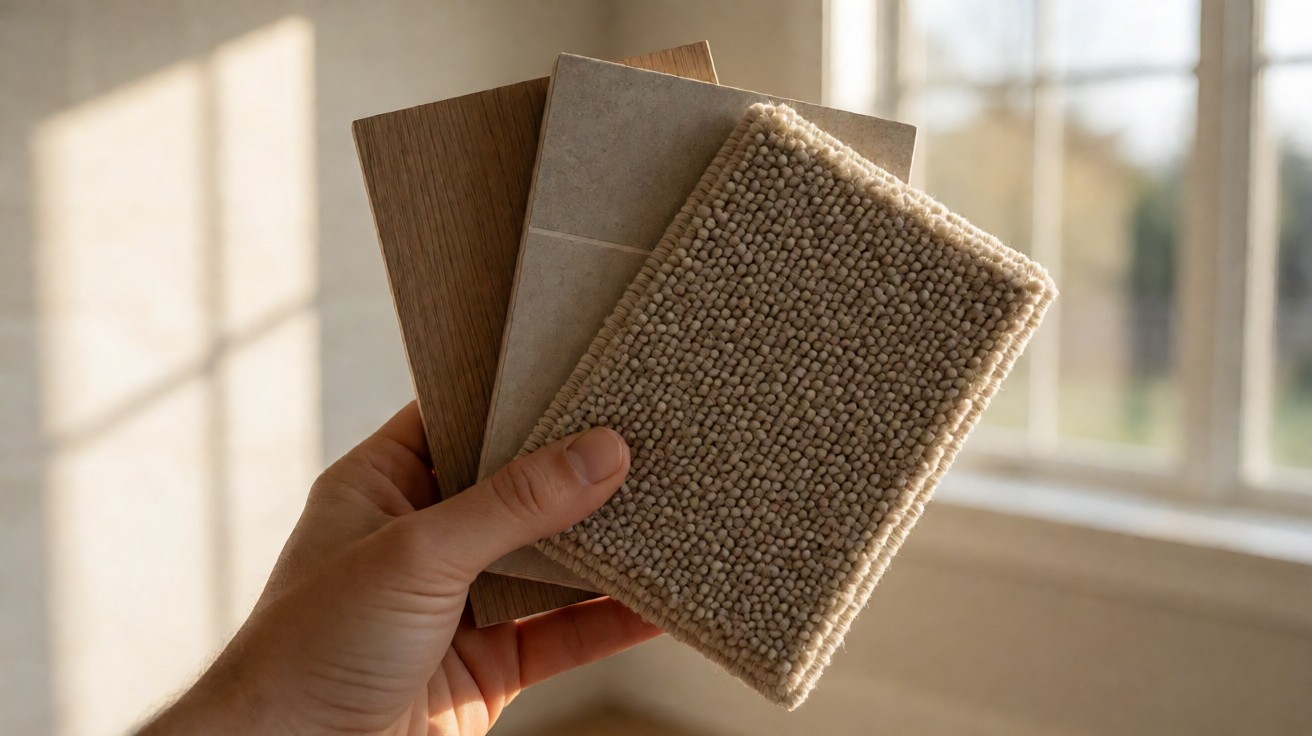
For plank products a piece with the joint visible tells you how the stagger will read, and for tile, a full grout line width does the same job. For carpet, ask to stand on the sample rather than look at it, since pile direction changes both colour and feel underfoot.
What A Wood Sample Says About Moisture
If the product is wood, the sample can be measured, and the measurement is more informative than any opinion about how it feels. A pin-type resistance meter needs multiple readings across multiple boards to produce an accurate average, so one reading on one piece means very little.
A pinless meter with adjustable depth settings is faster and fine for comparing two products against each other. It is less useful for an absolute number, which is why the difference between the flooring and the subfloor matters more than either figure alone.
Before installation, properly acclimated solid strip flooring under 3 inches wide should be within 4 percent of the subfloor moisture content. Wide-width solid flooring at 3 inches or wider should be within 2 percent, because a wide board moves more across its width than a narrow one.
That 3 inch boundary is worth understanding rather than memorizing. It is where seasonal movement across the width of a board becomes large enough that the installer tightens the board further to control cupping.
Do the comparison on the sample and again on the subfloor, over a spread of the room. A dry corner and a damp corner will produce different answers, and the wetter reading governs whether you install at all.
Do You Need A Moisture Meter For A Small Job?
Not to choose between two boards. Any pin-type or pinless meter will tell you which of two samples is wetter, and that is often enough to break a tie. What it will not tell you is whether the flooring and the subfloor will be within 2 percent of each other across a whole room.
That question needs a meter and someone who knows how to take readings in a spread rather than a single spot. If the room is small and the installation is straightforward, ask the installer to record the readings before they start, and keep the numbers with your sample record.
| Reading | Figure | What It Means For Your Decision |
|---|---|---|
| Interior relative humidity | 30 to 50 percent | The band a wood floor is expected to live in, held before, during, and after installation |
| Interior temperature | 60 to 80 degrees Fahrenheit | Heating and air conditioning running at least five days before installation |
| Equilibrium moisture content | 6 to 9 percent | The target band for the flooring itself |
| EMC at 70 F and 40 percent RH | About 7.7 percent | The worked example, useful when checking a table against a real room |
| Flooring to subfloor difference, solid strip under 3 inches wide | No more than 4 percent | Narrow solid boards tolerate a wider gap before installation |
| Flooring to subfloor difference, solid 3 inches or wider | No more than 2 percent | Wide boards move more across the grain, so the tolerance tightens |
What A Tile Sample Says About Absorption
A water drop put on a tile sample is a real test of a real property, but it is not the test the industry runs. ANSI A137.1:2022 defines porcelain tile as ceramic tile with water absorption of 0.5 percent or less, measured by ASTM C373-18.
A single drop on one corner of one piece does not reproduce that procedure. PTCA certification tests five samples and requires the average to be 0.5 percent or less, which is a different exercise from watching a bead of water on a showroom piece.
That gap is why the Tile Council of North America warns that plenty of tile is advertised and sold as porcelain without meeting the standard. If porcelain matters to your decision, ask for the absorption figure in writing rather than relying on a drop.
What the drop does tell you is relative behaviour. If water darkens one face and beads on a companion sample, the two are behaving differently, and that difference survives installation better than a colour difference does.
Note that a glazed surface and unglazed stone will not behave the same way regardless of their rating, so compare like with like before drawing any conclusion from the bead.
Why A Sample Cannot Answer For Sound
Sound is a property of an assembly, not of a product. What you hear underfoot comes from the flooring, the underlayment, the subfloor, and the structure beneath all of them, and it changes when any one of those changes.
A board on a table tells you nothing about that combination, which is why a sample cannot settle a noise question no matter how long you hold it. The measurement is IIC, tested with a tapping machine under ASTM E492 and rated per ASTM E989.
The rating is produced across a frequency range of 100 to 3150 Hz, and an IIC of 50 is generally the minimum considered acceptable for occupant satisfaction in residential buildings. You need the rated assembly to know how a floor will sound.
If noise is why you are hesitating, ask which assembly was rated and what the number applies to. Over a bedroom, a second layer or a resilient underlayment changes the rating far more than the choice between two wood species will, and it is invisible in a sample.
Why A Scratch Mark Predicts Nothing
A scratch drawn on a sample shows how that one finish responded to that one object on that day. It is a reasonable way to feel whether a finish is matte, satin, or hard, and it is worth doing because texture is one of the three things a sample settles.
What it cannot do is predict a wear rate. Wear is a function of the wear layer thickness, expressed in mils, and of the traffic the floor sees over years, so one abrasive event tells you nothing about the other.
Two products with visibly different scratch behaviour can wear at similar rates if their wear layers are the same thickness, and two that scratch the same can differ by years of service life. Compare the mils, not the mark.
The mark tells you about today.
Recording The Decision So The Order Matches
Write the decision down while the sample is still in the room, because the reference you hold when the pallet arrives is the board rather than your memory of it. The NWFA is explicit that warranty coverage generally requires jobsite conditions to stay between 30 and 50 percent relative humidity.
That range has to be held before, during, and after installation, and failure to comply can void the warranty. It is a documented reason a delivered floor has to match what was approved, and a documented reason the humidity reading is worth keeping.
Record six things: the colour and sheen name as printed on the sample, the wear layer figure in mils, the plank or tile dimensions, the finish type, the total thickness, and the lot or batch identifier. Those fields are the ones the guide to comparing flooring product specifications sorts products into.
Take a photograph of the sample in place, in daylight, with something for scale. When the delivery arrives, lay one piece from the delivered lot next to your sample and compare them in the same light on the same day, before a single box is opened.
If they do not agree, that is the moment to raise it. Comparing in the same light on the same day matters because a colour that matches at noon can still differ at dusk, and the dispute you want to avoid is the one that starts after the floor is down.
When To Walk Away From A Sample
Walk away, or ask for another piece, when the product changes colour between morning and night, when the variation between boards in the same line is wider than you will live with, or when the sample is too small to show a joint in it.
None of those is a lighting problem to solve later.
Ask for another sample rather than another opinion when the only thing holding you back is a question the board cannot answer. Sound, long term wear, and pattern repeat all belong to that category, and a fresh look at the same piece will not settle any of them.
Take the decision you can make from the board, and carry the rest to the specification sheet and the rated assembly. If the answer is not written down anywhere, it is not a specification yet.
One more reason to keep looking: if you cannot find two pieces of a line that you would both accept, the line is wrong for the room rather than merely unfamiliar. Most flooring disappoints later because it was approved in the wrong light, in the wrong week, on a board that had not settled.
Turning The Decision Into An Order
Once a sample has survived the protocol, the rest is mechanics rather than judgement: confirming the lot, checking the delivery against your record, and matching quantities to each room. That sequence is covered in the flooring buying guide.
The sample record is the part worth keeping, because every step after it depends on it. A piece that was laid in the room for several days, looked at in three lights, handled, measured where the product allowed it, and written down with its lot number is a small amount of work.
It is also the only part you control before a truck is loaded.