
Under the floor you are pulling up is a slab that is not on the quote, and the cost of finishing it is a range set by the slab, not the grinder.
Polished concrete runs about $4 to $10 per square foot on a slab that is already there, and the finish is the whole project: the slab you already have is not in that number. Porcelain tile runs $8 to $16 installed and engineered hardwood runs $8 to $14, and both still leave the slab underneath to be prepared.
Why the Slab, Not the Finish, Sets the Price
The price here is the polished finish, and the polished concrete flooring explained page covers what the finish itself is.
On a sound slab the answer is that polished concrete is the cheaper floor, and the gap is the material and the labour, not the slab.
The slab is the material, and the finish is the labour. A tile job buys material and lays it over a surface you already own. A polished job buys almost no material and spends the money on machine time.
The densifier, the diamonds, and the sealer run $1 to $3 per square foot. The grinding labour runs $1.50 to $4 per square foot, and a two-man crew charges $85 to $150 per hour.
On a sound slab that is three days of work. On a slab that needs repair it is a week, and the extra days are the quote.
That is why two identical rooms two streets apart can carry quotes $4,000 apart. The finish does not change. What changes is the slab the crew has to work around.
The Finish Levels: Standard, Honed, and Polished
Three levels come back on a quote, and the difference between them is the last grit on the floor and how much of the aggregate shows through the reflection.
Standard is a honed, matte surface. The slab is ground to 100 or 200 grit, densified, and sealed, and it runs $4 to $6 per square foot. It hides the most and costs the least.
Honed is satin: 400 to 800 grit, densified and sealed, $6 to $9 per square foot. It is the default in most houses, because it reads as finished without showing every footstep.
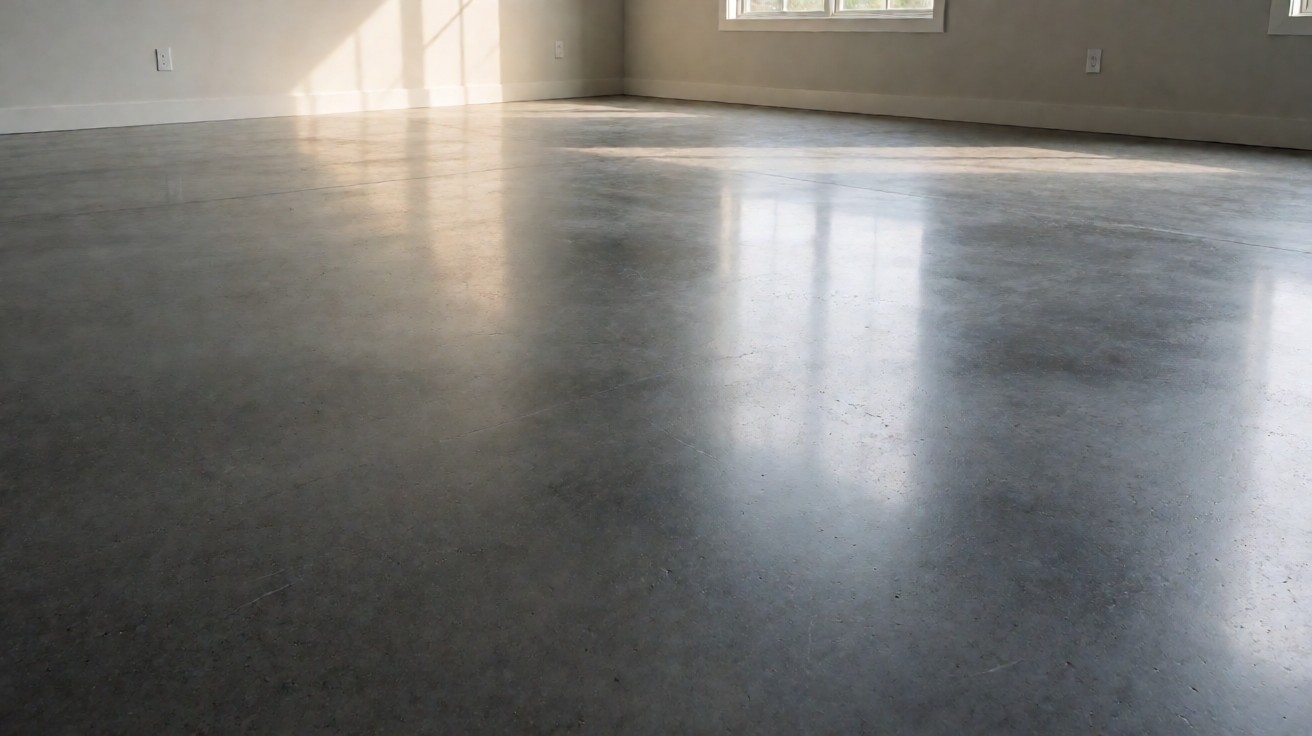
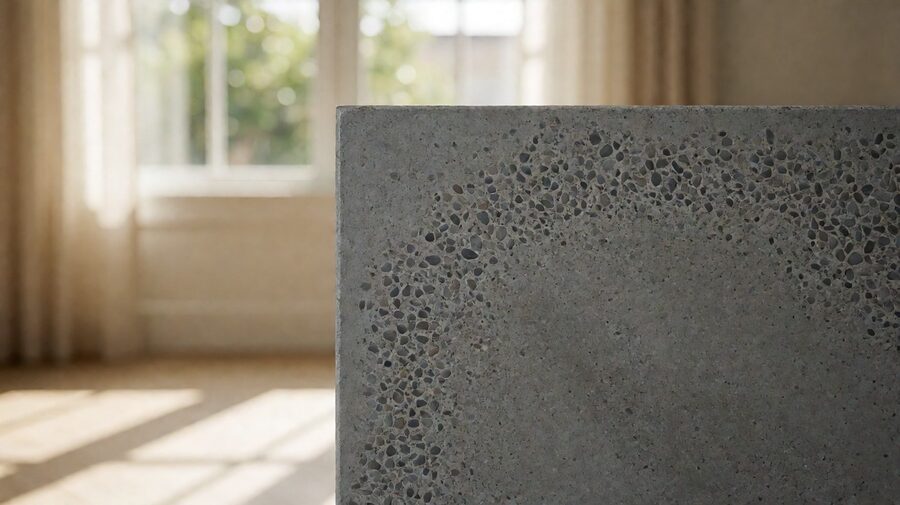
Polished is the glossy end: 1,500 to 3,000 grit on the same sequence, $8 to $12 per square foot, and $10 to $16 when the spec asks for exposed aggregate. A floor that mirrors the light is usually 3,000 grit plus a hardener.
Each step in the sequence is roughly $0.30 to $0.70 per square foot. A standard job runs three or four steps, from 30 or 40 grit metal bond to the densifier. A polished job runs six or seven.
| Finish level | Final grit | Installed cost | What it shows |
|---|---|---|---|
| Standard | 100 to 200 | $4 to $6 per sq ft | Matte, hides joints and patches |
| Honed | 400 to 800 | $6 to $9 per sq ft | Satin, the practical default |
| Polished | 1,500 to 3,000 | $8 to $12 per sq ft | Gloss, mirrors the room |
What the Slab Has to Satisfy Before the Grinder Arrives
ACI 318 is the building-code requirement for structural concrete, and it is what the slab was designed to. Before a finish goes on, the slab has to be at its specified strength, usually 3,000 to 4,000 psi in a house, and it has to be sound.
A residential slab-on-ground is typically 4 in, or 100 mm, thick, and the grind removes 1/32 to 1/16 in. Anything thinner than 4 in is a structural question before it is a flooring question.
Flatness is measured in F numbers, and the test method is ASTM E1155. The instrument takes an elevation reading every 12 in along a line, and the curvature over 24 in gives the FF flatness number.
The levelness over 10 ft gives the FL number. FF 25 is roughly a 1/4 in variation under a 10 ft straightedge, and FF 50 is 1/8 in.
ACI 302.1R puts numbers on the surface classes a slab is built to. FF 20 with FL 15 is a conventional pour, FF 25 with FL 20 is moderately flat, and FF 35 with FL 25 is the class written for thin-set flooring.
Minimum local values are usually 60 percent of the overall figure.
That is the threshold that decides the job. Where the slab comes in under FF 20, the grinder head rocks on the low spots and the gloss follows the dips instead of the room.
The fix is not more grinding. It is a screed or a self-levelling compound laid first, and that is a different line on the quote.
The Full Cost Breakdown, Line by Line
The invoice runs in this order: removal, disposal, grinding, patching, joint sealing, densifier, sealer, and colour. Anything outside that list is a change order.
Removal of vinyl or carpet runs $1 to $3 per square foot, and tile with adhesive runs more. Disposal is $150 to $400 for a dumpster, or $0.50 to $1.50 per square foot.
Control joints are saw cut every 8 to 12 ft in each direction, so a 20 by 15 ft room carries 4 to 6 joints. Sealing them runs $8 to $15 per linear foot, which is $100 to $200 in that room.
It is one of the lines people forget to ask about.
Patching a slab with repair areas runs $2 to $6 per square foot. A self-levelling compound laid where the slab is out of tolerance runs $2 to $4 installed. Densifier and sealer run $1 to $3 per square foot, and colour adds $1 to $5.
Put together, a sound slab with a normal joint count lands at $6 to $10 per square foot, and a slab with 20 percent repair area lands at $10 to $16. The material versus installed price page carries the same breakdown for the other families.
| Line item | Typical range | What moves it |
|---|---|---|
| Remove the old floor | $1 to $3 per sq ft | Tile adhesive costs more than carpet |
| Disposal | $150 to $400 | Access, room count, dumpster size |
| Grinding labour | $1.50 to $4 per sq ft | Repair area and final grit |
| Joint sealing | $8 to $15 per linear ft | Joint count and joint width |
| Densifier and sealer | $1 to $3 per sq ft | Below grade needs a barrier |
| Colour or stain | $1 to $5 per sq ft | Acid stain costs more than dye |
Where a Slab That Is Not Flat Moves the Number
If the slab is not flat, the cost is not grinding. It is the screed or the self-levelling compound that goes on first, and that is the line that turns a $4 job into an $8 one.
The arithmetic is worth doing before the quote. A 20 by 15 ft room is 300 sq ft, and if the whole room needs an average 1/4 in of fill, that is 6.25 cubic feet of compound.
At $2 to $4 per square foot installed, the bill is $600 to $1,200 on top of the grind.
If only the low third needs it, the bill is $200 to $400, and the crew will usually charge a minimum visit on top of the material.
Here is the part people miss. That $600 to $1,200 goes on the tile quote too, because a tile layer also needs the surface within tolerance, usually 1/8 in over 10 ft, and gets there the same way.
The slab repair is a shared cost. It does not decide between the two finishes. It only decides the total.
Colour, Stain, and What They Add
Colour is a material line, not a labour line. Integral dye mixed into the densifier runs $1 to $3 per square foot. Acid stain, which reacts with the cement and gives the mottled look, runs $2 to $5 and needs a second sealer coat.
The risk is not the colour. It is the patch. A repair area has a different cement content and a different porosity from the surrounding slab, and it takes dye at a different rate. The result is a permanent outline where the repair was.
As long as the slab has been patched, skip the colour and take the satin finish. If colour matters more than uniformity, the terrazzo comparison is worth reading, because terrazzo is designed to be uniform from the pour.
The Sealer: Finish Layer or Moisture Barrier
Above grade, the sealer is a finish layer. A lithium silicate densifier is worked into the surface, a penetrating sealer goes on top, and the pair runs $1 to $3 per square foot.
The sealer does not stop water. It slows oil and dirt, and it wants reapplying every 3 to 5 years at $0.75 to $1.50 per square foot.
ASTM C1315 is the standard for membrane-forming compounds, and it grades them on moisture loss and reflectance. A compound that fails the moisture-loss test lets the surface dry out and chalk, and that chalk is the white haze you see a year after the job.
ANSI A326.3 measures the slip resistance of the finished surface as a DCOF number, and 0.42 is the threshold most wet-area specs write in. A high gloss sealer raises the reflection and lowers the friction, so that rating decides whether the floor is safe around a pool.
Below grade, the sealer is not a finish layer. It is a moisture barrier, and the cost is different. ASTM F2170 is the test: a probe goes into the slab and reads the relative humidity. Where the reading is over 80 percent, most adhesive and coating systems will not bond.
Then a two-part moisture-vapor barrier at $3 to $6 per square foot becomes a mandatory line rather than an option. ACI 302.1R covers curing and sealing practice for slabs and is the reference a contractor should be working from.
What You Are Actually Comparing Against Tile and Hardwood
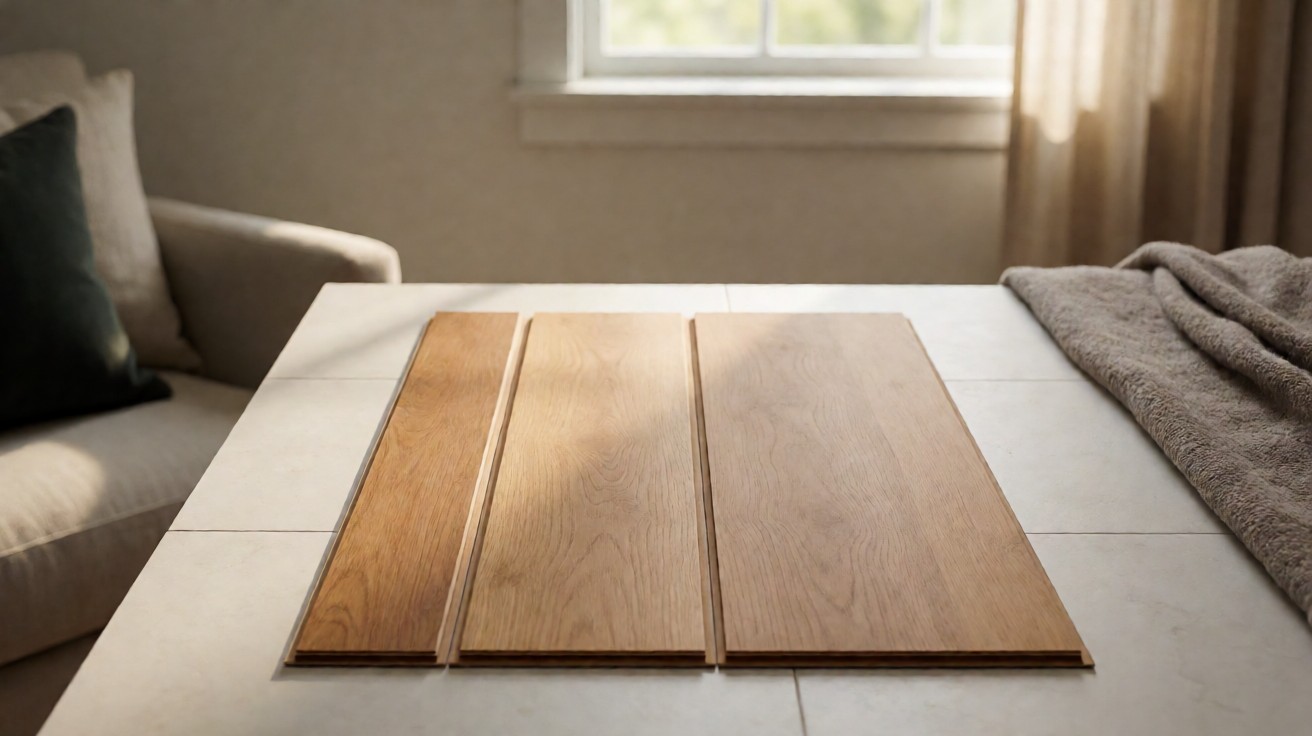
The material difference is the slab you already have. Tile and hardwood are materials laid on top of a substrate. Polished concrete is the substrate. That is the whole reason it is cheaper.
Porcelain tile runs $4 to $8 per square foot for the material and $6 to $12 to install. Engineered hardwood runs $5 to $12 for the material and $4 to $8 to install. Both numbers assume a prepared surface underneath.
Take a 20 by 15 ft room, 300 sq ft, with the old floor coming out either way. Polished concrete at $6.50 per square foot for grind, densify, and seal is $1,950. Removal at $1.25 per square foot is $375. Disposal is $300.
Joint sealing on 5 joints at 10 ft each is $500. The total is $3,125.
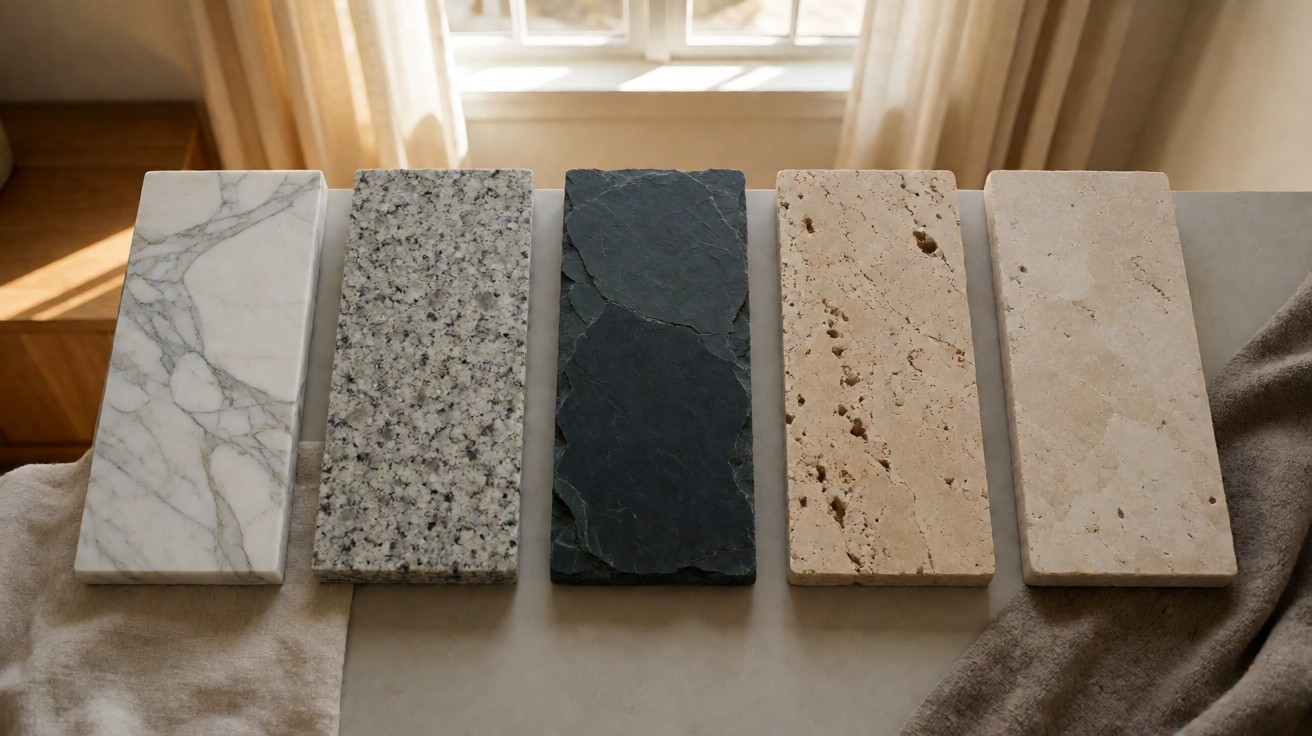
Tile in the same room: material at $5 per square foot is $1,500, installation at $8 is $2,400, removal $375, disposal $300. The total is $4,575, so the difference is $1,450, about 32 percent. That gap is the material and the labour, not the slab.
If the slab is out of tolerance, add $2.50 per square foot of levelling to both totals: $750 each, and the gap stays $1,450. The prep is shared. What changes the gap is the finish itself.
The square footage calculator page is the tool for getting the room area right before you price either option.
| 300 sq ft room | Polished concrete | Porcelain tile |
|---|---|---|
| Material | Slab is the material | $5.00 per sq ft |
| Installation | $6.50 per sq ft | $8.00 per sq ft |
| Remove old floor | $375 | $375 |
| Disposal | $300 | $300 |
| Joint sealing | $500 | 0 |
| Total | $3,125 | $4,575 |
What It Is Not Good For
It is not a good floor for every slab. Where the slab is below grade and the humidity test reads over 80 percent, the barrier is mandatory and the price moves toward tile. Where the slab is scaled or delaminated, grinding makes it thinner and does not make it sound.
It is also the wrong answer where comfort is the point. Concrete is hard and cold underfoot and it does not absorb sound, so a bedroom or a nursery is better served by a floor that gives a little. In a kitchen or a hallway the hardness is the feature.
If the slab is older than 1978 and the previous floor was a 9 by 9 tile, test the adhesive before the demo. That tile was often set in asphalt mastic that contains asbestos, and the test decides whether the removal line is $1.50 per square foot or a licensed abatement job.
And where the slab is wavy, a high gloss finish is the most expensive way to show it. A satin finish hides the dips; a mirror finish advertises them. Where the slab is the problem rather than the asset, the best flooring over concrete slabs page is the next read.
DIY Versus Professional for the Grind
A 7 in grinder rents for $60 to $90 a day, a diamond sequence costs $100 to $200, and densifier is about $0.50 per square foot. A garage or an outbuilding is a legitimate weekend job at that price.
The breakdown is the machine size. A 24 in walk-behind grinder, the kind a crew uses, is not a rental at residential scale in most markets, and a 4 in hand grinder cannot hold the flatness a wide machine holds.
A scratch left at 80 grit is still there at 800 grit, and the densifier has to go on inside a moisture window that a slow first pass misses.
On a main living area the risk is not the work. It is the resale. A patchy, uneven gloss is harder to sell than a floor that was never polished, and correcting it means hiring the crew you were trying to avoid.
How to Read a Quote Line by Line
Ask what the price includes before you compare anything. Removal, disposal, joint sealing, densifier, and the touch-up after the trades have been through are the five lines that get left off the cheap quote.
Ask for the grit sequence. A quote that stops at 200 grit and calls it polished is a honed floor at a polished price. Ask whether the price is per square foot of floor or of grindable area, because a room full of closets has less floor than the plan shows.
Ask who owns the slab repair, and what happens when the slab is worse than expected. Ask what FF number the crew needs to hit the quoted finish. A quote that answers those questions is a quote you can compare against a tile price.
Where the Money Is Not Worth Spending on This Finish
High gloss in a family room is the first place to stop. It costs the most grit steps, it shows every scuff and every footprint, and the reflection that looks good in a showroom reads as wear in a house with dogs.
Exposed aggregate on a repaired slab is the second. The repair area has different aggregate and a different cement content, so the chip pattern will not match, and the polish makes the difference more visible rather than less.
A moisture barrier you do not need is the third. Test with ASTM F2170 first. Where the reading is under 80 percent, the barrier is $3 to $6 per square foot spent on a problem that is not there.
A full-room self-leveller where a local patch would do is the fourth, and it is the most common one.
The money is worth spending on the prep, the densifier, and the joint sealing. Those are the lines that decide how the floor looks in five years. The polish level and the colour decide how it looks on the day the crew leaves.