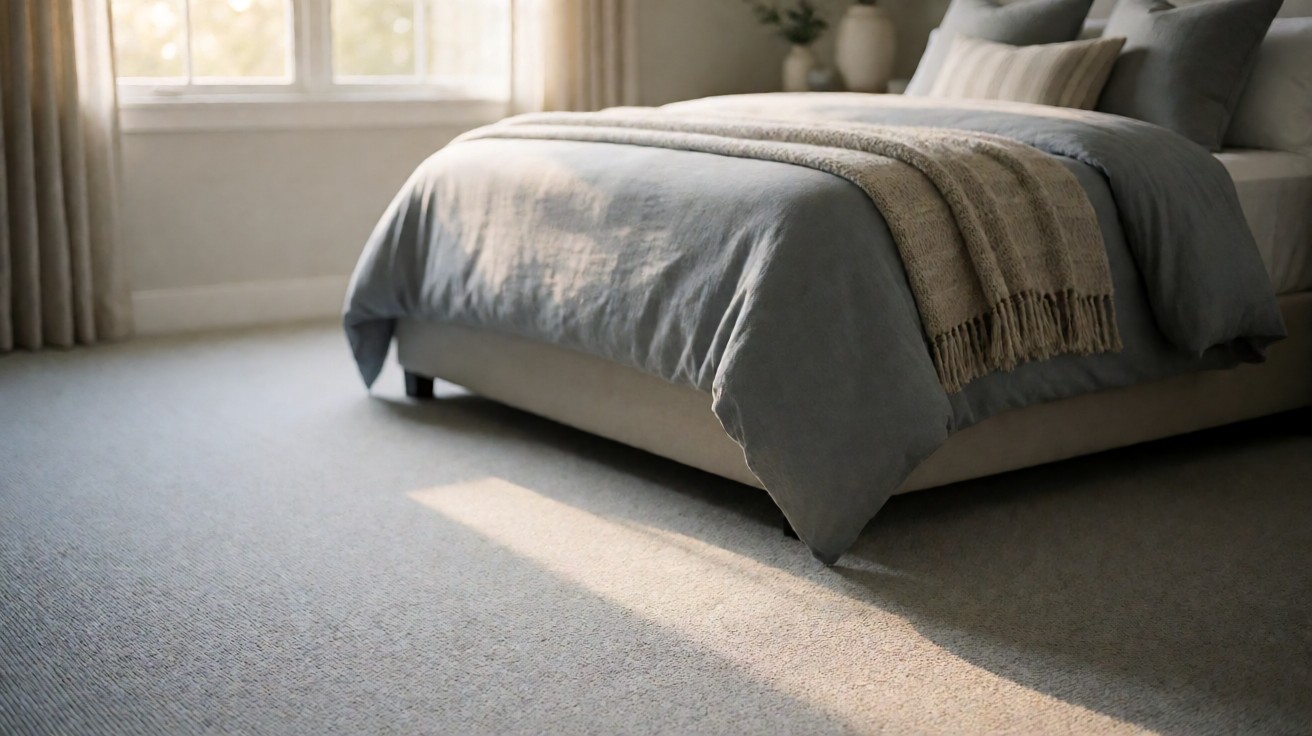

Your carpet quote lists the material at $2.80 a square foot, the pad at 50 cents, and a labour line you cannot verify against anything you know.
Carpet installation runs $3 to $8 per square foot installed across most of North America, and the pad is worth 80 to 120 cents of that total. A thin pad over hardwood will not hold its cushion past year five and the doors stop closing by year two.
What A Carpet Quote Is Actually Made Of
Carpet is sold by the roll, not by the square foot of room. A standard broadloom roll is 12 to 15 feet wide and 25 to 30 yards long, which means one roll covers 3,000 to 4,500 square feet of installed carpet.
The installer buys a fraction of that roll for your room and charges for what they used, plus the waste they cut off. A 12-by-16-foot bedroom is 192 square feet, or about 21 square yards. The installer buys 30 square yards to cover seams and the 40 to 60 percent waste that pattern matching and roll edges create.
Labour is the part of the quote that varies most. It runs 40 to 60 percent of the total installed cost and covers stretching, seaming, tacking down, and the walk-through. If the labour line is under $1.50 per square foot, the installer is not including removal, disposal, or stair work in that number.
A single-room installation for standard broadloom runs $50 to $100 in most US and Canadian markets. That covers a room up to about 200 square feet. A room wider than the roll adds $25 to $50 for the second strip and the extra seam.
The Full Cost Breakdown Line By Line
Every line on a carpet quote maps to a physical part of the job. The table below lays out the standard lines and what a number that is off means.
| Line Item | Typical Cost | What It Covers |
|---|---|---|
| Carpet material | $1.50 to $15.00 per sq ft | Fibre, backing, dye lot |
| Pad | $0.50 to $2.50 per sq ft | Cushion density and CRI rating |
| Labour | $1.00 to $3.00 per sq ft | Stretch, seam, tack, walk-through |
| Tack strip | $0.50 to $1.00 per linear ft | Edging around room perimeter |
| Removal | $0.25 to $1.00 per sq ft | Old carpet and pad pull-off |
| Disposal | $150 to $300 per job | Haul-off and dump fees |
Removal of old carpet and pad runs $0.25 to $0.50 per square foot for a standard pull-off. If the old carpet is glued down or layered, the removal line jumps to $0.75 to $1.00 per square foot because the installer is scraping adhesive off the subfloor.
Disposal is a flat $150 to $300 per job, or per truckload when you have more than two rooms. Tack strip runs $0.50 to $1.00 per linear foot around the room perimeter. A 12-by-16-foot room has 56 feet of linear perimeter, so tack strip adds $28 to $56 to the quote.
Seaming on a wide room adds $15 to $25 per seam. A 14-foot-wide room with a 12-foot-wide roll needs two strips and one seam. When the carpet is a pattern match, the waste allowance jumps from 10 to 15 percent and the seam line costs more because the installer has to align the texture direction.
Underlayment is not the same as pad. It is a thin membrane or foam that goes over the subfloor before the pad. It adds $0.15 to $0.30 per square foot. It matters when the subfloor is concrete, where moisture wicks up through a standard pad and rots the backing.
Carpet Pads Are The Most Underpriced Line
Pad is where the carpet quote hides money, because most homeowners glance at the material line and the labour line and skip the pad. Standard residential pad runs $0.50 to $1.50 per square foot. High-density commercial grade goes to $2.50 per square foot.
The CRI 105 padding test measures how a pad holds its thickness after 1,000 compression cycles. A pad that passes must retain at least 80 percent of its original thickness. If your pad is below that spec, it compresses flat in three to five years and the carpet loses its cushion.
Standard residential pad is 0.75 inch thick at 3.0 to 4.0 pounds per cubic foot. A high-traffic bedroom wants 1.0 inch at 4.0 to 5.0 pounds per cubic foot. Where the carpet goes over hardwood and the doors close tight, the pad has to be low-profile, under 0.5 inch, or the door will bind.
If you skip the pad and install the carpet directly on the subfloor, you are also voiding the manufacturer warranty on the carpet itself. Every carpet maker that sells in North America requires a certified pad under the carpet for the warranty to hold.
Carpet Tiers And What Actually Moves The Number
Entry carpet runs $1.50 to $3.00 per square foot for the material. Mid-range is $3.00 to $7.00. Premium and designer tiers start at $7.00 and run past $15.00 per square foot before you add pad and labour to the total.
| Tier | Material per Sq Ft | Face Weight | Best For |
|---|---|---|---|
| Entry | $1.50 to $3.00 | 40 to 45 oz/sq yd | Low-traffic bedrooms |
| Mid | $3.00 to $7.00 | 55 to 65 oz/sq yd | Family rooms, corridors |
| Premium | $7.00 to $15.00 | 70+ oz/sq yd | High-traffic, designer look |
What actually moves the number from one tier to the next is fibre type and face weight. Nylon 6,6 fibre is the standard for residential carpet, and the face weight, measured in ounces per square yard, separates a $3 carpet from a $6 carpet.
A face weight of 40 to 45 ounces is entry. 55 to 65 ounces is mid-range. 70 ounces and up is premium. Pile height matters less than face weight. A short-pile carpet at 65 ounces will outlast a tall-pile carpet at 30 ounces in a high-traffic corridor, even though the tall pile looks better in the showroom.
The cut versus loop pile guide covers the trade-offs between the two in more detail.
Cut Pile, Loop Pile, And Carpet Tile: What Each Is Priced For
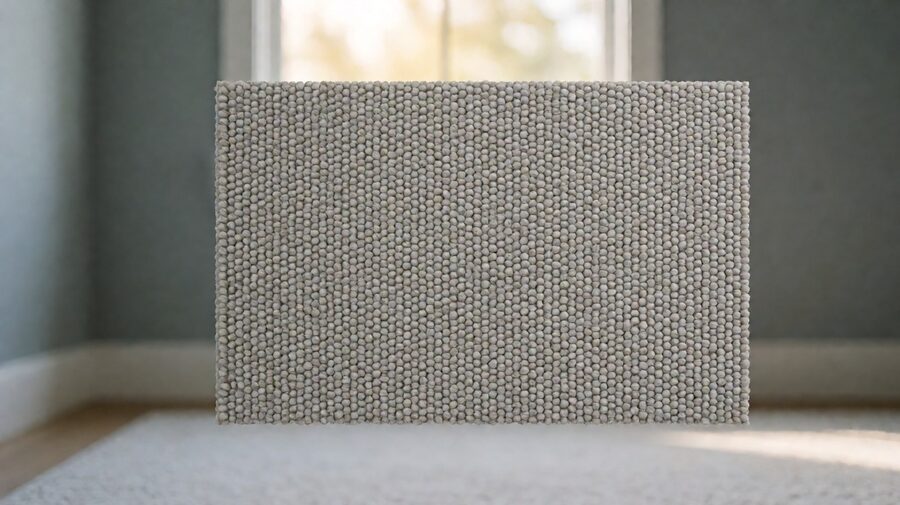
Cut pile is the soft, plush carpet most people picture when they think of carpet. It is priced for comfort and looks, not for traffic. Loop pile is the tight, textured carpet that holds up in corridors and on stairs. Carpet tile is priced for replacement: when one tile gets stained, you swap that tile, not the whole room.
ASTM F2751 defines loop count as the number of loops per linear inch of carpet face. A carpet with 40 or more loops per linear inch is dense enough for a high-traffic hallway.
Below 20 loops per linear inch, the carpet is open loop and will mat and flatten within two to three years in a busy room. The consequence is that you are buying a family-room carpet that will look worn by the time the wall paint has dulled.
Carpet tile runs $1.00 to $3.50 per square foot for the material, which is cheaper per square foot than broadloom at the same tier. The tile versus broadloom comparison explains where the tile price advantage stops and where the pattern matching cost catches up.
Stairs: The Line Item Most Quotes Skip
If the job includes stairs, the quote stops being per square foot. A standard flight of ten steps, including nosing and tread work, runs $150 to $300 for material and labour. Provided that the quote includes stair nosing, that number holds. Without nosing, add $200 to $400 because the installer has to build a separate edge for each tread.
Carpet on stairs uses less material than you would think. Ten steps with 7-inch risers and 8-inch treads needs 150 linear inches of carpet, or 12.5 feet. A 30-inch-wide stairway needs 37.5 square feet of carpet for the treads and risers. The labour is the real cost: a good installer charges $25 to $40 per step for a clean fit with nosing.
Where the stairway is more than 36 inches wide, the roll width becomes the constraint and the installer has to seam the stair carpet, which adds $50 to $100 to the stair line. If the flight has more than 12 steps, the quote is usually per step rather than per flight, at $20 to $35 per step.
Where A Carpet Quote Hides Money
The waste allowance is the first place money hides. A roll with 10 percent waste on a standard room is normal. A roll with a pattern match, a colour lot, or a directional texture needs 15 to 20 percent.
If the quote says 10 percent waste on a patterned carpet, the installer is underbuying and will come back for more material mid-installation. The second roll is always from a different dye lot, and the colour shift will show as a visible line under the lamp.
Door trims are the second place. Where a room has three doors and the carpet runs under all of them, the installer trims the carpet 1/4 inch under the door threshold. That is not billable unless the quote says it is.
If the threshold is more than 1/4 inch thick, the installer has to cut into the door jamb. Some installers will charge $50 to $100 per door for that extra work.
Removal of old carpet and pad is the third place. Only if the old carpet and pad were both professionally removed does the disposal line stay under $200.
If the old carpet is layered, if there is foam padding under the pad, or if the carpet is glued down, the removal line jumps to $0.75 to $1.00 per square foot. The disposal becomes a second truckload.
The full carpet guide walks through each of these line items with photos of what they look like on a real quote and what the numbers should say.
Is Carpet Actually Cheaper Than The Hard Floor It Competes With
In the same room, carpet is cheaper than hardwood, tile, or luxury vinyl in the installed cost almost every time. A mid-range carpet with pad and labour comes in at $4 to $6 per square foot installed. Comparable hardwood or LVT runs $8 to $14 per square foot installed.
The material versus installed pricing guide breaks down that gap for each floor type.
The place where carpet stops being the cheaper option is where the hard floor saves you on the pad, on the underlayment, and on the labour.
A concrete subfloor that needs a moisture barrier and a self-leveling compound under tile costs the same as a hardwood subfloor that needs sanding and a low-profile pad under carpet.
The installed-cost gap narrows to $1 to $2 per square foot when you count the full prep work on both sides.
Carpet also loses the cost advantage in a moisture-heavy space. If the room is a basement that stays above 75 percent relative humidity, the carpet and pad will wick moisture for their entire life and the cost of replacing the pad every five years will eat the saving over 15 years.
DIY Vs Professional: Where Seaming Breaks Down
You can stretch and install carpet on a single room by yourself. You need a knee kicker, carpet stretchers, a utility knife, and tack strip, and the total tool cost is under $80. A 12-by-16-foot bedroom takes a competent DIYer three to four hours from start to finish.
Seaming is where DIY breaks down. When a room is wider than the roll, or when the carpet is a two-tone or a directional texture, the seam has to be heat-fused or tape-bonded under pressure. A seam done by hand will show a visible ridge within a month of foot traffic.
The DIY versus professional installation guide covers the tool list and the point at which you hand the job over to the installer.
If you are doing it yourself, use the square footage calculator to get the roll count right. Buying short is the most common DIY mistake, and a second roll from a different colour lot will show as a visible line under the lamp by the end of the first week.
How To Compare Two Carpet Quotes Line By Line
Line up the quotes in the same order: material, pad, labour, removal, disposal, tack strip, seaming, stair work, and waste allowance. If two quotes use different waste percentages, the higher-waste quote is not necessarily the higher quote. It may be the one that covers the pattern match you asked for.
The pad line is the one to check hardest. A quote with a 0.5-inch pad at 80 cents per square foot and a quote with a 1.0-inch pad at $1.40 per square foot are not the same job. The second one will last twice as long in a bedroom and will not need replacing when the carpet is.
When you see two quotes that look the same on paper but differ by $300 to $500, the gap is almost always in the waste percentage, the stair line, or the removal scope. Ask both installers to itemize those three lines and the difference becomes visible.
Where The Money Is Not Worth Spending On Carpet
Premium carpet in a basement is the first place. The moisture wicks up through the pad, the carpet smells by year three, and the $7 to $15 per square foot premium is paying for a fibre that cannot handle the environment. A $3 carpet with a 0.75-inch CRI-rated pad will outlast a $12 carpet in that space.
High-loop carpet in a room with pet claws is the second. The loops snag and pull, and the $1.50 per square foot you saved choosing loop over cut pile costs you a patch within two years. Where the pets have claws that reach the loops, the cut pile at the same tier is the cheaper floor.
Thick pad in a room with tight door clearance is the third. A 1.0-inch pad adds 1/4 inch of floor height. If the doors already close with 1/8 inch of clearance, the pad will bind the door and you will be paying to shim the frame or replace the threshold.
IICRC S100 is the standard for cleaning water-damaged textile carpets and rugs. If a carpet was wet for more than 72 hours and was not cleaned to that standard, the pad underneath has absorbed moisture.
The organic load in the pad will promote mould growth for as long as the pad stays in place. A pad that has held water past 72 hours is structurally compromised and will not spring back, even if the carpet surface looks fine to the eye.