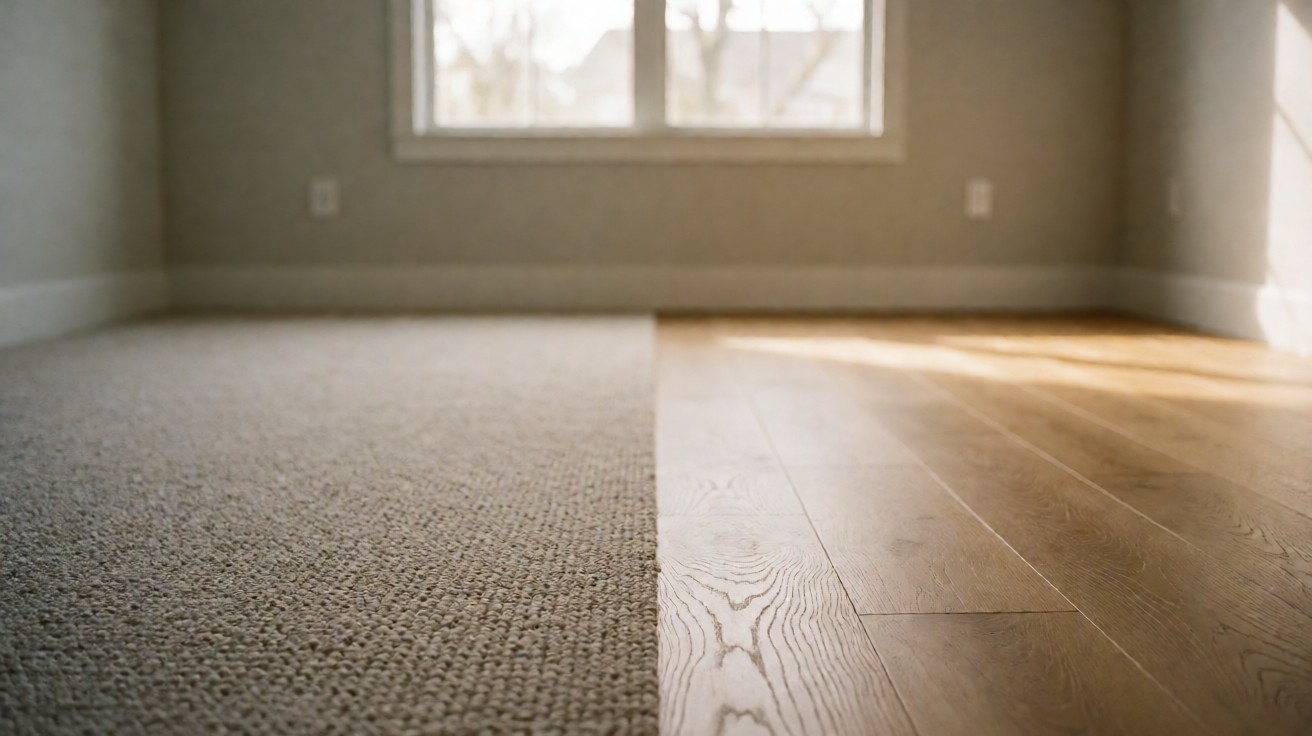

Carpet and hardwood are the two floors most often weighed against each other, and they disagree on almost every axis that a buyer actually cares about. They disagree about comfort, about noise, about water, about cleaning, about resale, and about how the floor should feel underfoot at seven in the morning. What they agree on is narrow: both are quiet underfoot relative to tile, and both are the correct answer in a house with no particular constraint. Everywhere else this is a genuine trade rather than a ranking, and the deciding question is almost always the household rather than the room.
What the Two Are
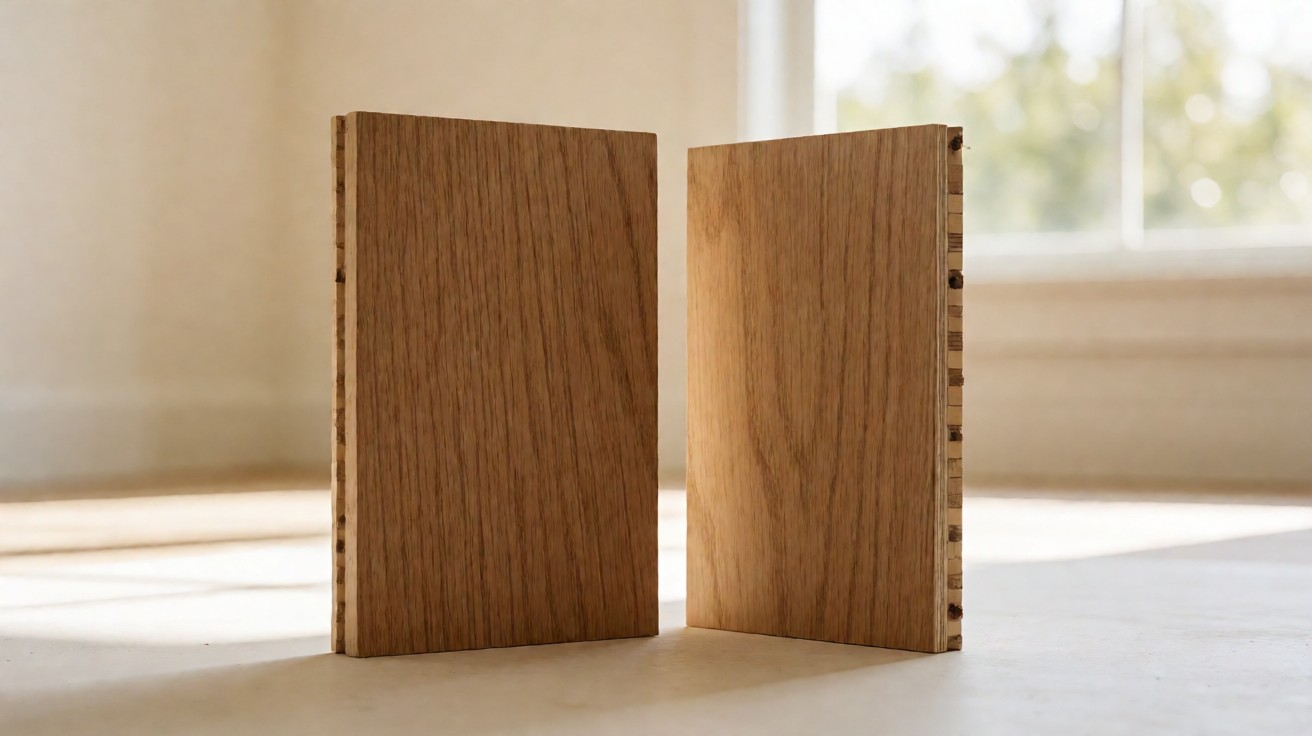
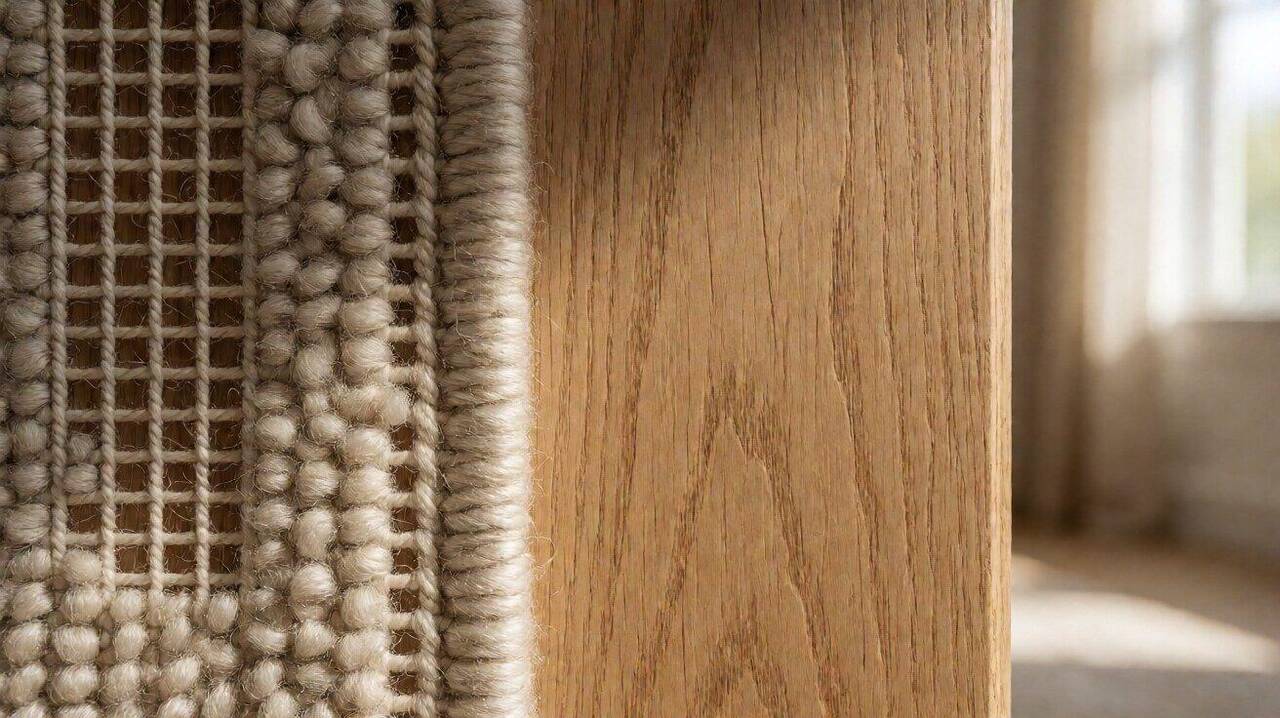
Carpet is a textile floor covering: face yarn tufted or woven into a backing, installed over a separate pad, and stretched or glued down. It is the only soft flooring in mainstream residential use, and that single fact is the source of nearly every difference below. Hardwood is a milled timber floor, either solid or an engineered veneer over a core, installed either nailed or stapled down, or floated as engineered. The carpet guide and the hardwood guide each cover their material in full.
Comfort, Warmth, and How the Room Feels
This is where carpet wins and where the answer is not close. A carpet floor is warmer underfoot in winter, quieter underfoot at every hour, and materially more forgiving to a child or an older adult walking on it. Hardwood is hard and cool and transmits footfall to the floor below. The difference is not subtle and it is not something a buyer forgets once the floor is in; it is the reason people who have lived on both tend to say the same thing about which they would rather walk on.
Hardwood’s advantage is that it feels finished rather than soft. It reads as a permanent surface in a way carpet does not, and in a room where the architecture is the point that matters more than bare feet. There is no correct answer here, only a preference, and the honest way to make it is to stand barefoot on both in a showroom rather than to reason about it.
Water, Spills, and Cleaning
Carpet and hardwood disagree completely here, and this is usually the decisive axis in a family house. A spill on hardwood sits on the surface and can be blotted or wiped up. A spill on carpet penetrates the fibre and the pad, and the stain is not reliably removable, which is why the single most common flooring mistake in a family home is choosing carpet for a room with an eating surface. The best flooring for kitchens page makes the same point from the room side.
Cleaning separates the two just as sharply. Carpet needs vacuuming several times a week and periodic professional extraction, and it holds odour and allergen in a way that a sealed hard floor does not. Hardwood needs a dry or barely damp mop and nothing else, and it is the easier floor to keep genuinely clean. In a household with allergies, asthma, or pets, that difference is frequently the deciding one rather than a footnote.
| Situation | Better Choice | Reason |
|---|---|---|
| Bedroom, long hold | Carpet | Warm, quiet, and the floor is not seen |
| Living room with children | Carpet | Impact and noise absorbed rather than transmitted |
| Living room, no children | Hardwood | Finished look, easier cleaning, better resale |
| Kitchen or eating area | Hardwood | Spills wipe up; carpet stains permanently |
| Dining room | Hardwood | Spills and chair traffic are routine |
| Basement or over slab | Hardwood | Engineered tolerates slab moisture; carpet traps it |
| Home with allergies or asthma | Hardwood | Nothing embedded to hold dust and allergen |
| Stairway or upstairs landing | Carpet | Noise to the room below is the binding constraint |
| Rental or short hold | Carpet | Cheapest to install and cheapest to replace |
Noise in Both Directions
Carpet is measurably better at impact noise, which is footfall and dropped objects, and it is the usual answer for a floor over a bedroom or a room where silence matters. Hardwood is not dramatically worse and a resilient pad closes much of the gap. The comparison that surprises people is airborne sound, sound travelling through the floor structure rather than being absorbed at the surface, and there carpet has a smaller advantage than most expect because the transmission is dominated by the assembly rather than the finish.
The reverse direction matters too. Hardwood is markedly louder underfoot in the room itself: a dropped object on a hardwood floor is an event, and on carpet it is muted. For a house with a sleeping child on the same floor as a playroom, that is a real consideration. Both floors are quieter than ceramic or porcelain, and both are quieter than stone.
Durability, Repair, and What Happens After Fifteen Years
Hardwood can be refinished, and this is the argument that most favours it over a long ownership. A solid hardwood floor can be sanded and recoated several times across a fifty-year life, and each refinish returns it to new. Carpet has no equivalent: worn carpet in a traffic lane is replaced, and the most that can be done is a professional extraction, which improves appearance briefly and does not restore the fibre.
Repair runs the other way for local damage. A gouged hardwood board is replaced by lifting the surrounding boards, which is routine. A cut in carpet is patched, and a patch taken from a scrap offcut is visible in a good light under a raking beam. Neither repair is invisible, and the hardwood one is easier to do.
Acoustic and Thermal Comparison
Thermally the two are opposites. Carpet is an insulator in the useful sense: it feels warm underfoot in winter and it holds heat in the room rather than conducting it to a slab. Hardwood is a moderate conductor that still feels cold to a bare foot early in the morning. In a cold climate over a concrete slab that difference is felt immediately. Over a heated floor in a warm climate the warmth advantage of carpet is irrelevant.
Acoustically carpet wins on impact and is close on airborne, and hardwood with a good underlayment is respectable but not comparable. A carpeted bedroom over a living room is the quiet arrangement. A hardwood bedroom over a living room with an acoustic underlayment is workable and noticeably less quiet. The carpet pile styles page covers how the pile construction changes both of these.
Which One a Resale Agent Will Say
Buyers and their agents treat hardwood as a premium feature and carpet as a budget one, and that perception shows up in the listing conversation every time. A house with hardwood in the main living spaces is described differently from a house with carpet in the same rooms, and it is described that way regardless of the quality of either floor. For a sale inside ten years, hardwood carries a real advantage that has little to do with the floor and everything to do with how buyers read it.
The perception softens with wear. A hardwood floor that has dulled slightly with traffic reads as a hardwood floor that has been lived in, which buyers accept. Carpet that has flattened in the traffic lanes reads as carpet that needs replacing, which buyers discount for. Over a long ownership the resale gap narrows, and a hardwood floor that has been refinished once reads very well indeed.
| Dimension | Carpet | Hardwood |
|---|---|---|
| Warmth underfoot | Warm | Cool to cold |
| Footfall noise in the room | Very quiet | Loud |
| Impact noise transmitted | Best in class | Good with a pad |
| Spill behaviour | Stains, often permanently | Wipes up if caught |
| Cleaning | Vacuum often, extract periodically | Damp mop, nothing else |
| Allergen and dust holding | High | Low |
| Restoration | None | Sand and refinish, repeatable |
| Local repair | Patch, visible | Replace board, near invisible |
| Typical service life | 7 to 12 years busy | Life of the building with refinishes |
| Resale read | Budget | Premium |
Cost and Cost Per Year
Material and installation for carpet commonly run $3 to $7 per square foot and hardwood $6 to $15, so carpet wins clearly on the invoice. The twenty-five-year calculation is less one-sided. Carpet in a family living room lasts 7 to 12 years before it needs replacing, hardwood in the same room lasts the life of the house with one or two refinishes. Over a quarter century the hardwood floor is often the cheaper floor, and the crossover point is usually somewhere around year fifteen.
The other cost is the one nobody budgets: carpet carries an ongoing maintenance and replacement cycle that hardwood does not, and in a rental that cycle is a recurring expense rather than a one-off. For an owner who will hold the property, hardwood wins on the arithmetic. For a tenant who will not, carpet is the cheaper floor for a reason that is entirely about who absorbs the eventual replacement.
The Stairs Case
Stairways deserve separate treatment because the comparison is decided by two requirements that a living room does not have. The first is safety: a tread surface that stays underfoot, where carpet over a pad is forgiving and a polished hardwood tread can be slippery when dust or moisture is present. The second is noise: a stair is the single loudest floor in a house, and carpet on the treads is the difference between a family that does not need to be told to be quiet at night and one that does.
Hardwood on stairs is entirely reasonable and is common in period homes, but it requires anti-slip treatment on the nosing, a durable finish that will not show wear at the nosing line where every foot lands, and generally more care. A carpeted stair needs a separate carpet runner for the same wear reason, because the treads take the traffic that the rest of the floor does not. For a house where someone sleeps directly below the stairs, carpet is the clear answer.
Choosing
Carpet when the room is a bedroom, when the household has young children, when the floor sits above someone who needs quiet, when the budget is the binding constraint, or when the priority is a room that feels soft rather than a room that looks finished. Hardwood when the floor will be seen and the design matters, when there is an eating or cooking surface nearby, when someone in the house has a respiratory condition, when the house will be sold inside fifteen years, or when the plan is to keep the floor for as long as the building lasts.
The mistake in both directions is the same, which is choosing on appearance. Hardwood chosen for a busy family room with a dog and a dining table looks marked within two years. Carpet chosen for a kitchen stains in the first year and cannot be recovered. Both are fine materials and both are wrong in the wrong room, and the room is decided before the material is.