
Microcement and resin floors are thin cementitious or synthetic coatings laid over a substrate, and the whole choice sits in two millimetres of thickness. That sounds trivial until you understand what it means: there is no plank, no tile, and no structural flooring product in the room at all. What you walk on is a coating applied directly to the concrete slab or to a levelling compound, and every performance property, every failure mode, and every repair option follows from that fact. The polished concrete guide covers the alternative approach of grinding the slab itself, and the difference between grinding a slab and coating it is the first decision to make.
Microcement and Resin Are Not the Same Product
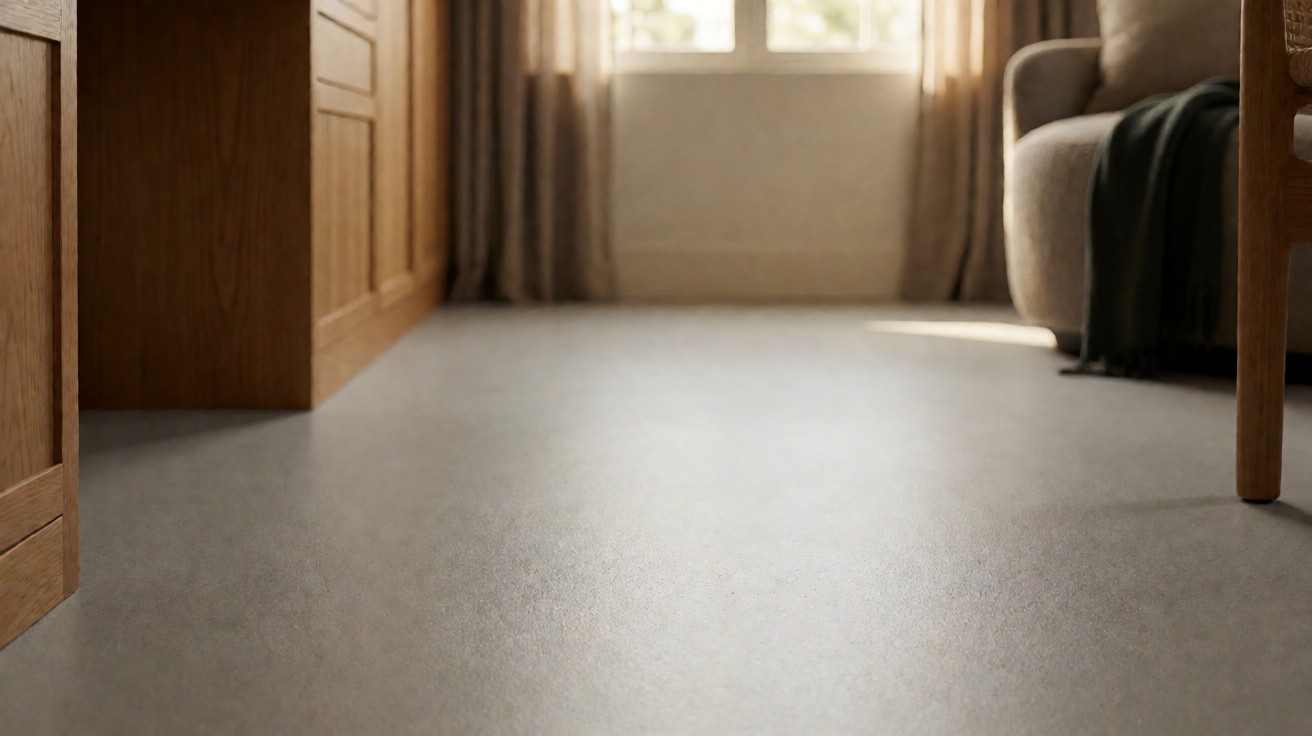
The name covers two families that are often quoted together and are genuinely different. Cementitious microcement is a polymer-modified cement, sand, and water applied in thin coats, chemically bonded to the substrate. It is mineral, matte by nature, and it wears by developing a fine even polish over years. Resin flooring is a poured epoxy or polyurethane system, a synthetic liquid that cures to a continuous film. It is glossier, harder, and more colour-stable than microcement, and it can carry decorative aggregate through the full thickness of the coating rather than just at the surface.
The practical split is this: if the brief calls for a matte, mineral, natural-looking floor that will soften and burnish over time, cementitious microcement is the material. If the brief calls for a seamless floor with high colour saturation, a deep gloss, and chemical or wear resistance that a mineral coating cannot deliver, resin is the material. They are both sold as “seamless resin flooring” by different suppliers, so the specification has to say which one is actually being installed, and the answer changes the price by a wide margin.
| Property | Cementitious Microcement | Poured Resin |
|---|---|---|
| Composition | Polymer-modified cement and sand | Epoxy or polyurethane liquid |
| Typical thickness | 2 to 3 mm | 2 to 4 mm |
| Finish | Matte to satin, burnishes over time | Gloss or satin, hard from day one |
| Colour range | Narrow, earthy, cloud-like | Wide, including saturated hues |
| Aggregate | Surface broadcast, sand in the mix | Full-depth, no limit |
| Failure mode | Crazing or lifting at a weak substrate | Yellowing (epoxy) or delamination |
The Substrate Is the Whole Project
Every credible installer will tell you that a seamless coating lives or dies on the substrate, and this is where most failed microcement jobs come from. The coating is two millimetres thick. It has no ability to bridge a defect, absorb movement, or level a significant high spot. Whatever is wrong with the slab is what the floor becomes. A slab with a crack, a patched area, a construction joint, or a high spot produces a floor with a crack, a visible patch, a joint line, or a hollow area, and there is no finish system that will hide any of it.
The substrate requirement in practice is that the slab be mechanically sound, flat to roughly 3 mm over 2 metres, free of laitance, and free of any movement. A slab that meets that standard still needs to be prepared: diamond grinding or shot blasting to open the surface so the coating bonds into it, not onto it, and a primer matched to the coating system. Slab preparation is where a disproportionate share of the budget goes on a microcement project, and it is the line item worth interrogating, because a cheap quote that skips it is quoting a coating that will lift.
Where Microcement Works and Where It Fails
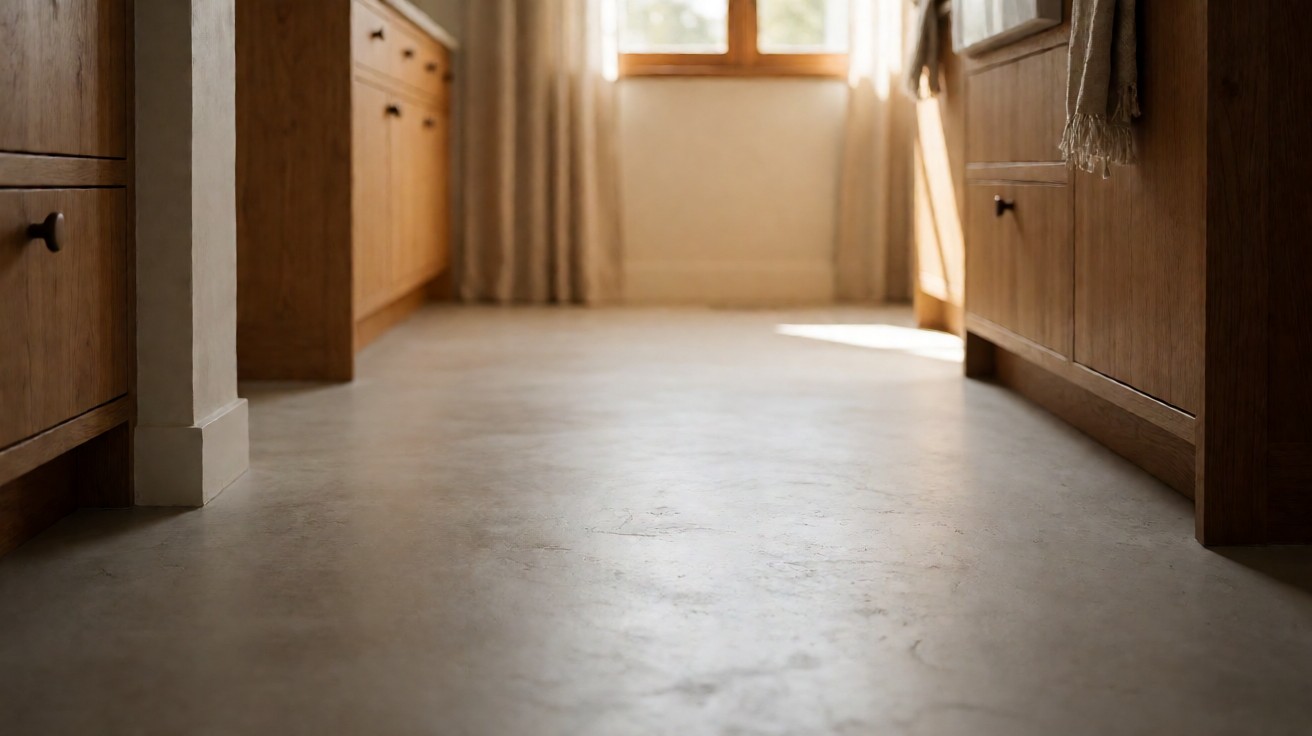
The honest case for microcement is a floor that has to be completely continuous with no joints, in a space where the architecture is the point. It is the standard answer for a kitchen with a long uninterrupted run of cabinetry, a bathroom with a curbless shower that runs into the floor, a small powder room, and a retail or hospitality space where the floor must read as one surface. In those rooms there is genuinely nothing else that delivers the same result, and the fact that the floor is also waterproof is a bonus rather than the reason to choose it.
It is a poor choice in a room with heavy point loading, in a house where furniture is dragged regularly, and anywhere the slab is known to move. A basement slab that flexes with seasonal moisture, an older slab with a history of heaving, and a slab over poorly drained fill are all environments where a rigid coating will craze. The crazing that results is not fixable with a spot repair, and it is why the substrate assessment should happen before a contract is signed rather than after the first coat goes down.
| Space | Suitability | Key Condition |
|---|---|---|
| Curbless bathroom | Excellent | Membrane continuity, not just the floor |
| Kitchen, unbroken run | Excellent | Slab flatness is the limiting factor |
| Powder room | Excellent | Small area, low risk, high visual payoff |
| Retail or hospitality | Excellent | Specify resin if gloss and colour matter |
| Heating underfloor space | Good | Confirm movement tolerance with the system |
| Basement on poor or unknown fill | Poor | Coating will crack with slab movement |
| Room with dragged furniture | Poor | Point loads craze a 2 mm film |
Durability, Maintenance, and What Actually Happens Over Time
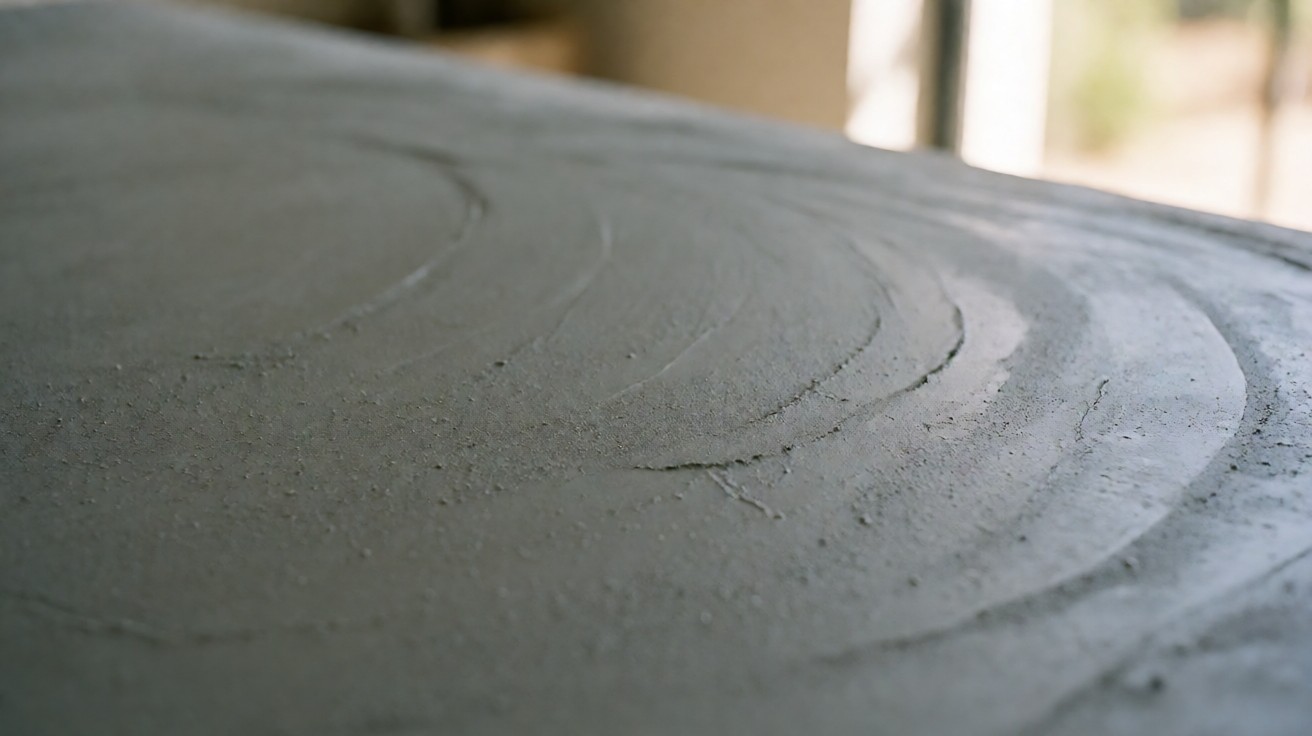
A properly specified and properly installed cementitious microcement floor has a functional life measured in decades, and most of them are still in service. But the material is not maintenance-free, and it ages in a specific way. The finish is typically a matte or satin sealer over a mineral coating, and the sealer is the weak layer. Traffic lanes wear the sealer first, which shows as a difference in sheen between the walked path and the edges of the room long before the coating underneath is affected. That appearance change is normal and is the main reason the surface reads as “worn” when it is structurally fine.
Maintenance is a damp mop with a pH-neutral cleaner and periodic resealing of the topcoat, on a schedule the applicator should specify in writing. Resin behaves differently: epoxy is harder and needs less maintenance, but yellows under UV exposure, which is why a residential kitchen with a south-facing window wants a UV-stable polyurethane rather than an epoxy despite the higher cost. Neither material needs waxing, and neither should be steam-cleaned, because steam drives moisture into the coating at the slab interface, which is exactly where the failure happens.
Colour, Tint, and Getting the Shade You Want
Colour in a cementitious microcement floor comes from pigment mixed into the cement, and that means the shade is created in the material rather than applied over it. The consequence is that a cloud-like, slightly uneven appearance is not a defect, it is the characteristic of the material, and any sample that shows perfectly uniform colour should be treated with suspicion because it is probably a different system. Pigments are also alkali-sensitive, and an unstable pigment will shift or fade in the presence of the alkaline cement binder, so the pigment should be alkali-stable and the supplier should say so.
Resin colours differently. Epoxy and polyurethane take pigment and, in the resin case, decorative flake or aggregate dispersed through the full thickness, which is why resin offers saturated colours and a depth that microcement cannot match. The trade is that the two materials age toward different endpoints: a matte mineral floor burnishes to a soft sheen and stays looking natural, while a gloss resin floor keeps its gloss but needs periodic re-sealing and, in the case of epoxy, will yellow. Choosing between them is partly choosing which of those two futures you want.
Slip, Water, and Wet-Room Detail
A seamless floor in a wet room is really a waterproofing system with a decorative top, and the detail that decides whether it works is the continuity at the wall junction. The coating must turn up the wall and meet the waterproof membrane without a gap, and the floor-to-wall transition needs a cove detail rather than a hard 90-degree angle, because that angle is where the coating cracks first. A curbless shower needs the same continuity across the whole wet area with no interruption at the threshold.
Slip resistance needs specifying rather than assuming, in the same way it does for polished concrete or tile. A glossy resin floor in a shower is a slip hazard, and the fix is a slip-resistance aggregate broadcast into the coating with a measured coefficient of friction under ANSI A326.3, not a visual choice. The threshold in that standard is a measured wet DCOF of 0.42 or greater for a level interior space expected to be walked on when wet. Below that, the standard treats the surface as suitable only where it will be kept dry when walked upon. The standard also states plainly that a DCOF figure is a comparison tool and is not by itself a prediction that a floor will not slip, because contamination, drainage, footwear, and maintenance all move the number in service. For a residential bathroom the common approach is a fine aggregate broadcast in the resin or microcement and a matte topcoat, which costs a little more and removes the hazard entirely.
Repair, Refurbishment, and End of Life
A seamless coating has one significant advantage over tile and plank: a damaged area can often be made to match. A local patch, ground back and recoated with the same system, will be visible to a close eye at a light angle but will usually disappear into a floor whose finish has already burnished with age. That makes spot repair a realistic option rather than a theoretical one, which matters in a room where a small area is likely to take a real impact.
End of life is the weaker part of the picture. Cementitious microcement is largely mineral but the polymer modifier and the sealer are not, so the whole assembly is normally disposed of as waste rather than recycled. Resin is a thermoset and does not remelt. Neither material is biodegradable or compostable, and neither decomposes in a landfill, so a project that is specifying a seamless floor should say so honestly rather than claiming a circular end of life that the chemistry does not support. The genuine argument for these materials is design continuity and substrate efficiency, not sustainability.
Cost and What the Quote Is Missing
Installed cementitious microcement typically runs $8 to $18 per square foot, and poured resin runs $10 to $25 per square foot. Those numbers only mean something alongside what the quote includes, because the cost is dominated by preparation and detail rather than by material. The line items worth reading carefully are slab preparation and grinding, the primer and membrane system, the number of coats, the wall junctions and coving, and the topcoat specification. A quote that includes those at named quantities is a quote you can compare against another quote.
The other half of cost is that this is a thin system on a critical surface, so a failed installation is not repairable locally. The realistic remedy for a lifting or crazed microcement floor is removal back to the slab and starting again, which means the downside of a bad subcontractor is the entire floor plus the work. That asymmetry, more than the price, is why the substrate assessment and the applicator’s track record matter more here than in almost any other flooring decision.
Questions to Ask Before You Sign
The first question is whether the applicator has installed this specific system before, on a slab like yours. Seamless coating is specialist work and it is not transferable from a wall to a floor or from a new-build slab to a fifty-year-old one. The second is what the substrate preparation includes and whether it is measured. The third is what happens to the warranty if the slab moves, because most product warranties cover material defects and explicitly exclude substrate movement, which means the risk sits with the homeowner unless the contract says otherwise.
Ask for the thickness in millimetres and the number of coats, ask for the topcoat to be named, and ask what the coefficient of friction will be in a wet area if there is one. Then ask what the floor looks like in five years and whether the answer is burnishing or a spot repair. An applicator who answers these specifically has done the work many times. One who talks about the product catalogue has not.
Choosing Between Microcement, Resin, and the Alternatives
The alternative worth naming honestly is a large-format porcelain tile with a narrow joint, which delivers a continuous-looking, completely waterproof, dimensionally stable floor with none of the substrate risk. It has grout lines, and that is the trade: the grout is the weak point that microcement removes and the guarantee that microcement cannot offer. For a bathroom where waterproofing certainty is worth more than visual continuity, large-format tile is often the better engineering answer even when it is less fashionable.
Against polished concrete the comparison is substrate versus coating: grinding uses the slab and adds nothing that can delaminate, while microcement adds a thin layer that gives more colour control and design flexibility in exchange for a failure mode. Against poured resin the comparison is mineral versus synthetic, matte and burnishing versus gloss and colour-stable. Both of those materials have their own pages, and choosing between them is a question about the substrate and the aesthetic rather than about durability, where the honest answer is that both last a long time when specified correctly.