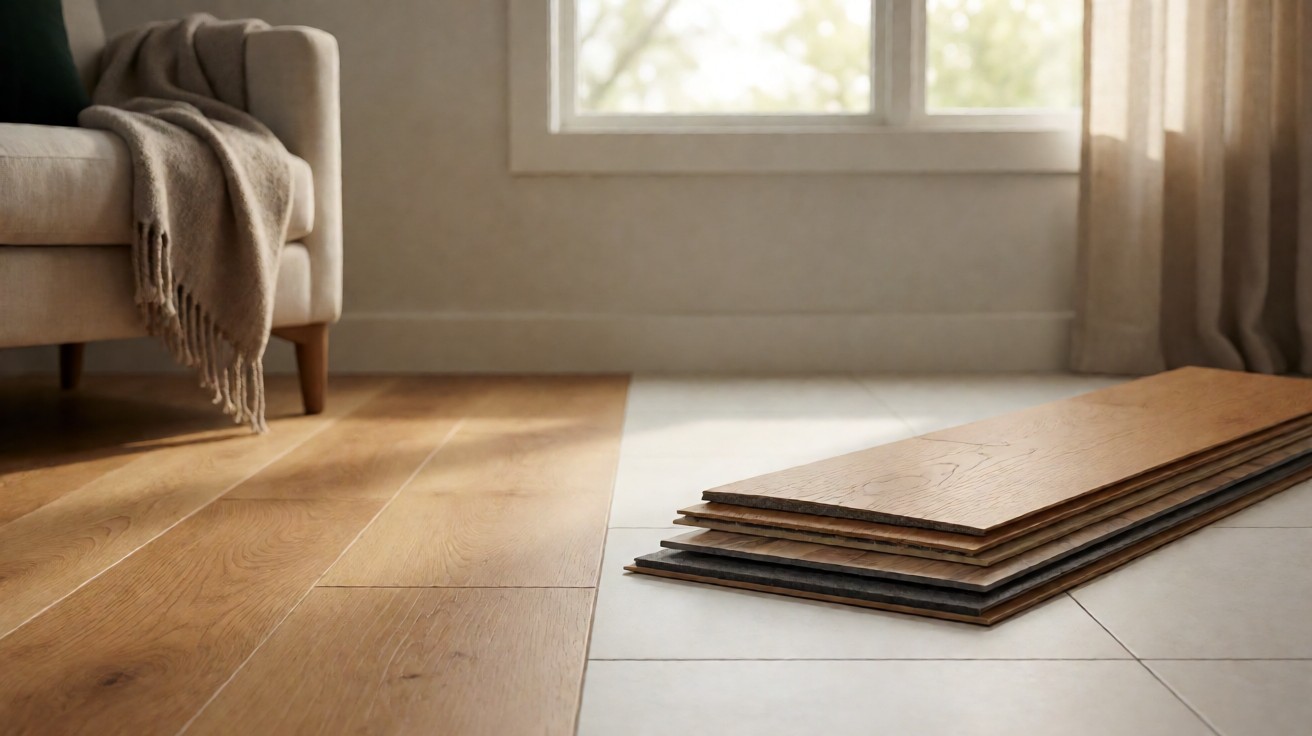

Every vinyl floor is four layers stacked in a fixed order, and almost everything a retailer claims about a floor comes from one of those four specific layers.
Once you can name those layers, a vague spec sheet stops being vague. A thick wear layer is the durability claim. A rigid core is the waterproof claim. A foam backing is the comfort and sound claim. The construction is the specification, and reading it is far more reliable than reading the adjectives on the front of the box.
This guide walks through the four layers from the top down, explains what each one does, and shows you how the choice between a thin sheet and a thick rigid core changes what the floor is actually good at.
If you are trying to evaluate a floor you are about to buy rather than understand one in general, the evaluation checklist covers the showroom checks in order. And if you have not settled on vinyl at all, the vinyl flooring guide is the place to start.
What a Vinyl Floor Is Made Of
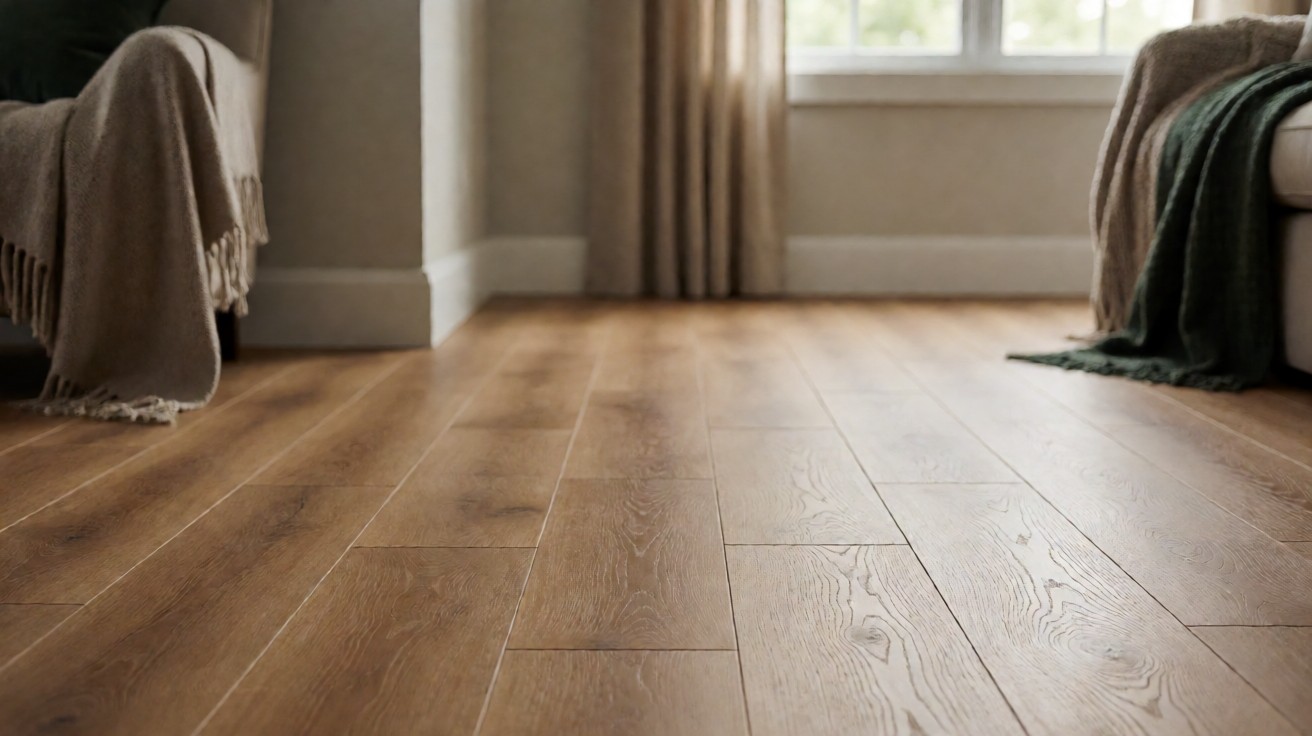
Working down from the surface, a vinyl plank or sheet is built in a consistent order. On the top is a clear protective layer, then the printed design, then the body of the product, and at the very bottom a backing.
Two of those layers matter more than the other two for most buyers, and it is worth knowing which is which before you walk into a showroom.
The two that decide how the floor behaves are the wear layer, which takes every footstep, and the core, which decides whether the product is stiff and waterproof or soft and warm. The printed film is decoration, and the backing is comfort and sound. When a seller says a floor is durable or waterproof, they are almost always describing the wear layer and the core.
Everything in this guide follows from that structure. A different core changes the feel, the weight, the water resistance and the install method, and it is the single most consequential choice in the product.
The Wear Layer and What Mils Mean
The wear layer is the clear, transparent coating on the very top of the floor. You cannot see it, but it is the only thing standing between a dragged chair leg and the printed design underneath. Its thickness is measured in mils, where one mil is a thousandth of an inch, and that single number is the most important specification on a vinyl spec sheet.
Residential vinyl typically carries a wear layer somewhere between 6 and 20 mils, and the commercial range runs from 20 mils upward. The number scales with durability almost linearly for normal wear: a 20-mil floor outlasts a 6-mil floor in a busy room by a wide margin, because it simply has more clear coat to wear through before the design is exposed.
The practical advice is to match the wear layer to the traffic rather than to the price. A quiet bedroom is fine at 6 mils. A family room with two dogs, or a hallway, wants 20 mils or more. Anything under 6 mils in a residential setting is a thin product and will show wear through within a few years in a busy spot.
The Core and Why It Decides Feel and Water Resistance
The core is the body of the product, and it is what turns “vinyl flooring” from one thing into several very different things.
A flexible sheet vinyl has a simple PVC core with a foam backing. It is soft, warm, cheap, and easy to damage, and it is the format that still wins in small bathrooms because it has no seams.
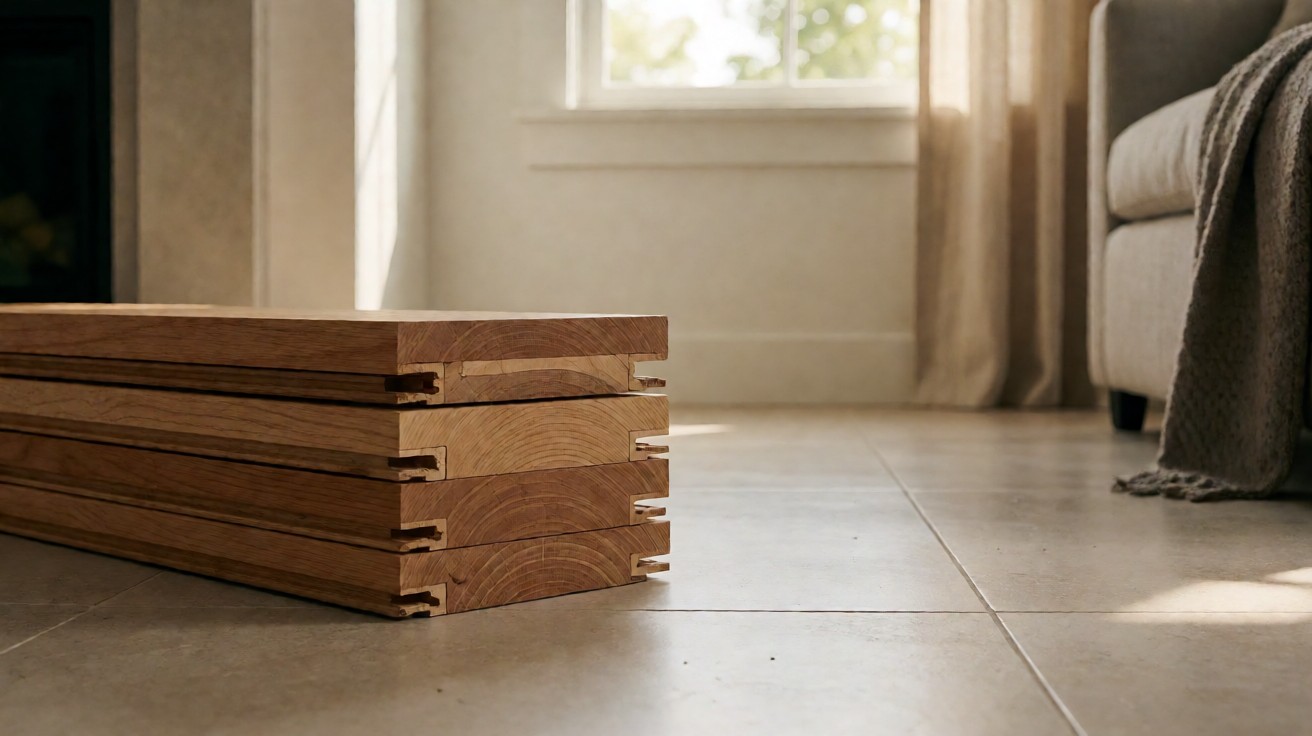
A rigid-core plank has a much denser body: a stone powder and plastic composite in SPC, or a wood fibre and plastic composite in WPC.
That density is why a rigid plank will not absorb water, will not cup or gap across a season, and feels hard underfoot like a thin tile. The SPC explainer covers the mineral version and the WPC explainer covers the wood-filled one.
So when a retailer describes a floor as waterproof or as easy underfoot, they are describing the core, not the vinyl in general. A flexible sheet and a stone-core plank are both correctly called vinyl, and they behave nothing alike.
The Backing and the Foam Under the Plank
The bottom layer is the backing, and it does less glamorous work that matters more than most buyers expect. On a rigid plank it is usually a foam or a cross-linked polyethylene layer, sometimes with cork for extra sound absorption, bonded to the underside during manufacture.
Its job is to absorb the sound of footsteps and to give the plank something slightly compressible to sit on, which softens the edge of the impact and takes some of the hard, thin feel out of a rigid product. It also adds a little thickness and a little grip against the subfloor.
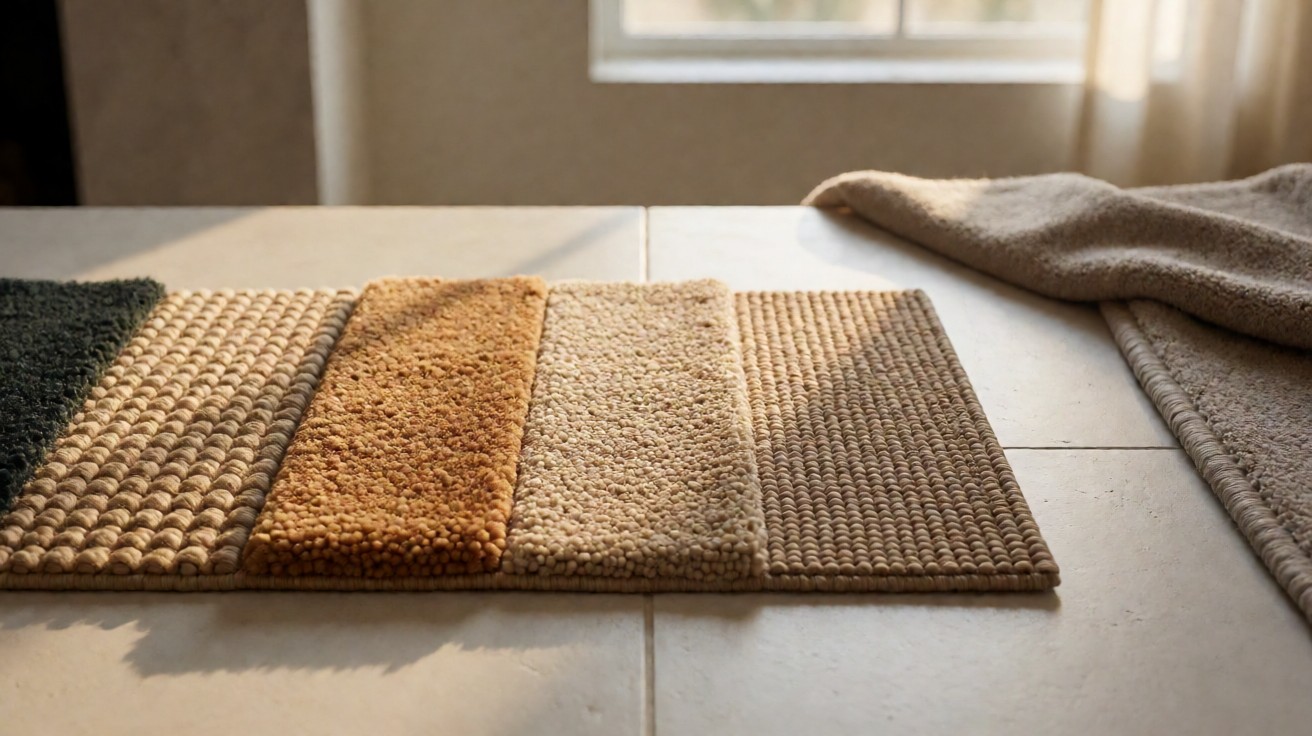
On a sheet vinyl, the backing is the felt or foam layer that gets bonded to the adhesive, and it is what makes a sheet floor feel warmer and softer than a bare glue-down.
A plank with a thin or missing backing feels harder and louder than a sample photographed in good light, so it is one of the things worth pressing with your hand when you are comparing two products at the same price.
Thickness: Thin Sheet vs. Rigid Core
Total thickness in millimetres is the fastest way to see what you are holding. A flexible sheet vinyl is usually 2 to 3 millimetres thick, nearly all of it backing. A rigid-core plank is usually 5 or 6 millimetres, nearly all of it core.
That difference is not cosmetic, because it changes what the floor is for. A 2-millimetre sheet is soft, quiet, warm, and unforgiving of a bad subfloor, and it cannot handle a heavy point load. A 5-millimetre rigid plank is stiff, durable, and waterproof, but it bridges any unevenness in the base and needs a flat subfloor to look right.
The other consequence is installation. A thin sheet is bonded with adhesive and trimmed to the room, which needs a skilled installer and produces a floor with no edges to lift. A thick rigid plank is clicked or glued together and can usually be lifted and relaid intact, which is why it suits a DIY project or a floor you might move.
Layer Facts at a Glance
The construction explainer is reference; this table turns it into a room assignment. This table makes that assignment concrete.
| Situation | Rating or build | Reason |
|---|---|---|
| Small bathroom or laundry | Thin sheet with a backed foam | Soft, warm, seamless, cheap |
| Kitchen | Rigid-core plank, thick wear layer | Waterproof, hard-wearing, easy to wipe |
| Basement over a slab | Rigid core, SPC preferred | Will not absorb or gap |
| Busy family room | Rigid plank, 20 mil wear layer | Takes pets and real traffic |
| Bedroom | Thin cushioned sheet or plank | Quiet and soft matter more than wear |
| Rental, floor may be lifted | Click-lock rigid plank | Can be taken up and reused |
| Hallway with heavy traffic | Rigid plank, 20+ mil | Maximum abrasion where feet go |
Reading Thickness on a Box
One practical shortcut is worth having, because it settles the format question before you start comparing cores.
Turn the sample over and look at how thick it is and what proportion of it is core. If the board is roughly 5 or 6 millimetres and the body is visibly dense and mineral or fibrous, it is a rigid-core plank.
If it is around 2 or 3 millimetres and gives slightly under your thumb with a foam layer underneath, it is a cushioned sheet or a thin plank, and it belongs in a different part of the house.
This matters because the two formats get shelved next to each other and priced similarly, and they are not substitutes. A rigid-core plank and a cushioned sheet can both be called vinyl, both can carry a wear layer figure, and both can look similar in a sample, while differing in almost every practical respect.
The Layers at a Glance
| Layer | What it is | What it decides |
|---|---|---|
| Wear layer | Clear top coat, measured in mils | How long the floor resists abrasion |
| Printed film | Decorative image of the wood or stone | The look; wears through before the wear layer |
| Core | PVC sheet, or stone/wood composite | Feel, weight, waterproofing, stability |
| Backing | Foam, IXPE, or felt | Sound, comfort, grip |
| Total thickness | 2 to 3 mm sheet, 5 to 6 mm rigid | Which format you are actually buying |
Layer Choices by Room
The layers above are the reference. This table turns them into a room assignment, which is usually faster than reasoning about mils and millimetres in the abstract.
| Room | Build | Why |
|---|---|---|
| Small bathroom or laundry | Thin cushioned sheet | Soft, warm, seamless, cheap |
| Kitchen | Rigid-core plank, thick wear layer | Waterproof, hard-wearing, wipes clean |
| Basement over a slab | Rigid core, SPC preferred | Will not absorb water or gap |
| Busy family room | Rigid plank, 20 mil wear layer | Takes pets and real traffic |
| Bedroom | Thin cushioned sheet or plank | Quiet and soft matter more than wear |
| Rental, floor may be lifted | Click-lock rigid plank | Can be taken up and reused |
| Hallway with heavy traffic | Rigid plank, 20 mil or more | Maximum abrasion where feet go |
How the Construction Changes What the Floor Is Good At
Put the layers together and the product choice becomes obvious. A thin, well-backed sheet with a moderate wear layer is the right answer where softness, low cost and a seamless finish matter: a small bathroom, a laundry room, a rental where the floor will be lifted at the end of the tenancy.
A rigid-core plank with a thick wear layer is the right answer where water, traffic and longevity matter: a kitchen, a basement, a hallway, a family room. The same product list, but the layers are completely different, and the two floors will not be confused once you are holding them.
The one thing that is the same across both formats is the order to read a spec sheet in. Check the wear layer first, because durability is the claim most likely to be overstated. Check the core second, because it decides the feel and the water resistance. Treat everything else on the label as marketing until one of those two numbers backs it up.
How do I know if a vinyl floor is good quality?
Read the two numbers that matter. A wear layer of 12 mils or more is a decent residential floor and 20 mils is a genuinely durable one, and anything under 6 mils will show wear in a busy room.
Then check the core: a rigid stone or wood composite core means the floor is waterproof and stiff, while a simple PVC sheet is softer and suits a dry, low-traffic room. Everything else on the label is secondary to those two.
Does a thicker vinyl floor last longer?
Not automatically, because thickness can be anywhere in the product. A thicker sheet with a thin wear layer is still a soft floor, and a thin-looking rigid plank can be extremely durable because all of its thickness is core.
What determines lifespan is the wear layer, not the total thickness. Check the mils on the wear layer, and treat the overall millimetres as a clue about the format rather than about quality.
How This Fits With the Rest of the Choice
This page explains what a vinyl floor is made of. It does not tell you how to inspect one in a showroom, and it does not settle which core or which install method to pick.
If you are standing in front of a floor you intend to buy, the construction evaluation checklist is the page to read. If you want the core types in detail, the SPC guide and the WPC guide cover the two rigid cores. And if you are still weighing vinyl against the other materials, the material comparison sets the families side by side.