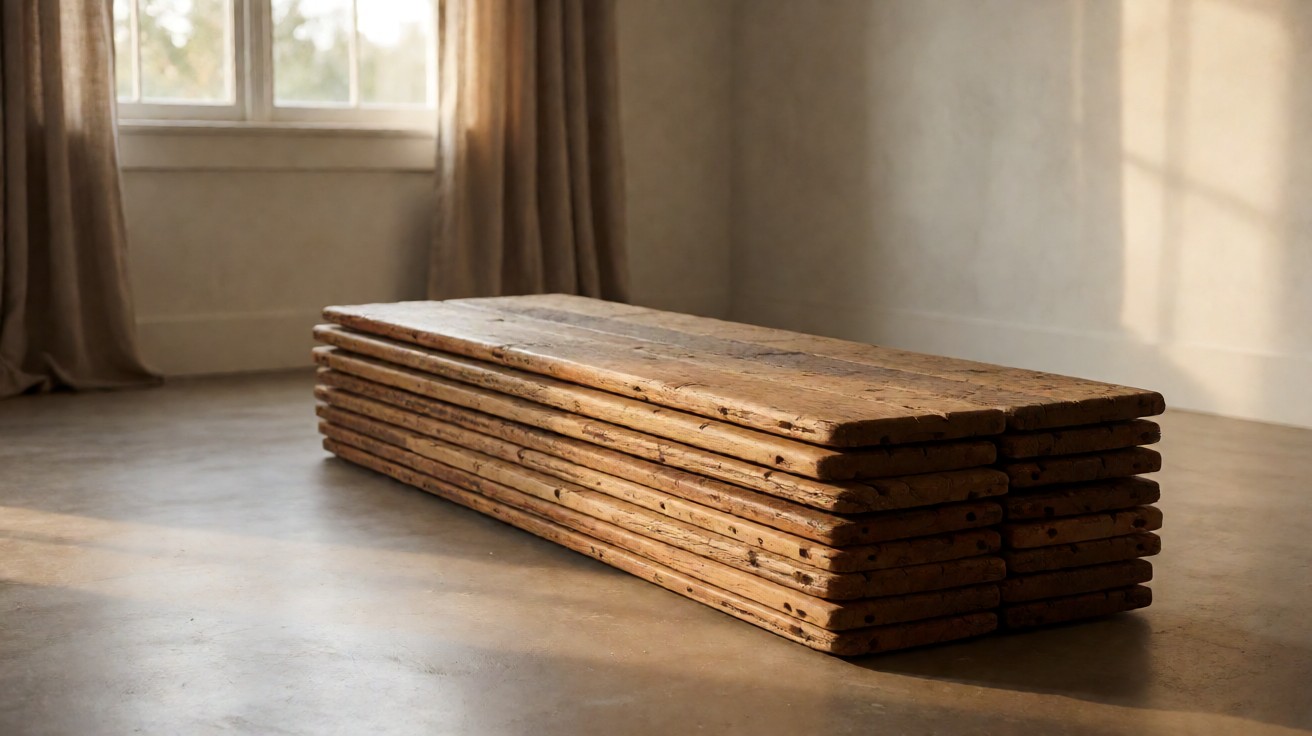

Reclaimed wood flooring is old structural timber pulled out of a building and turned back into a floor. The boards might have been in a Victorian warehouse, a farm barn, a schoolhouse, or a dock on a river.
Antique wood is the same idea, pushed further back in time, into wood that was felled a century or more ago. Both are real, and both are a different product from new hardwood in a way that matters more than the word suggests.
The defining fact is that reclaimed wood’s irregularity is the product, not a defect. New hardwood is graded for consistency, so every board is the same colour, the same thickness, and close to the same width.
Reclaimed wood is graded for character, so no two boards match. Every plank carries the history of the building it came out of, including the wear, the patina, and the nail holes.
That makes the buying question flip. With new wood you shop for the least variation. With reclaimed wood you shop for the most character, and you accept that a matching batch may not exist.
This guide covers what reclaimed and antique wood actually are, how to tell real reclaimed from a marketing word, what condition means for the floor, and what to check before you buy.
Is Reclaimed Wood Right for Your Project?
Choose reclaimed wood if you want a floor with genuine age in it, you like visible variation between boards, and you are willing to pay more and wait longer for a specific character. It is the right choice for a room where the floor is meant to be a feature and imperfection is welcome.
Choose new hardwood if you want a uniform, predictable floor, you need a large area matched in one colour, or the budget and timeline are firm. Nothing is wrong with wanting a consistent floor; it is simply not what reclaimed wood is for.
The honest dividing line is whether you are shopping for consistency or for character. Reclaimed wood is excellent at character and cannot deliver consistency. Decide which one you actually want before you start looking, because it will save you from being disappointed by a perfectly good floor for being the wrong floor.
What Reclaimed and Antique Wood Actually Is
Reclaimed wood is structural lumber and flooring board taken out of an existing building and reused as a floor. The sources are ordinary and unglamorous: demolished factories, old schools, barns, churches, mill buildings, and waterfront docks. The timber was structural, so it was dense, well-seasoned, and mostly hidden in walls or under other floors for most of its life.
Antique wood is the older end of the same category. Antique means the wood itself is a century or more old, which usually means it came from old-growth timber that was standing before the modern lumber industry existed.
Old-growth wood is denser and more stable than anything cut today, because the trees grew slowly over a much longer period. That is why antique reclaimed wood is prized and why it costs the most.
The distinction that gets blurred in marketing is between genuine reclaimed wood and a new board that was made to look old. Genuine reclaimed wood carries physical evidence of its previous life, and that evidence is the most reliable way to tell.
The Tell of Real Reclaimed Wood
There are four physical tells, and any one of them proves the board was not made yesterday.
The first is nail holes, and specifically the pattern of them. Old buildings were framed with square-cut hand nails, which leave small, square, slightly ragged holes, often in a regular pattern where a board was fastened to joists. Modern pneumatic nails leave round, clean holes. A board with a regular grid of small square holes was pulled out of a framed building.
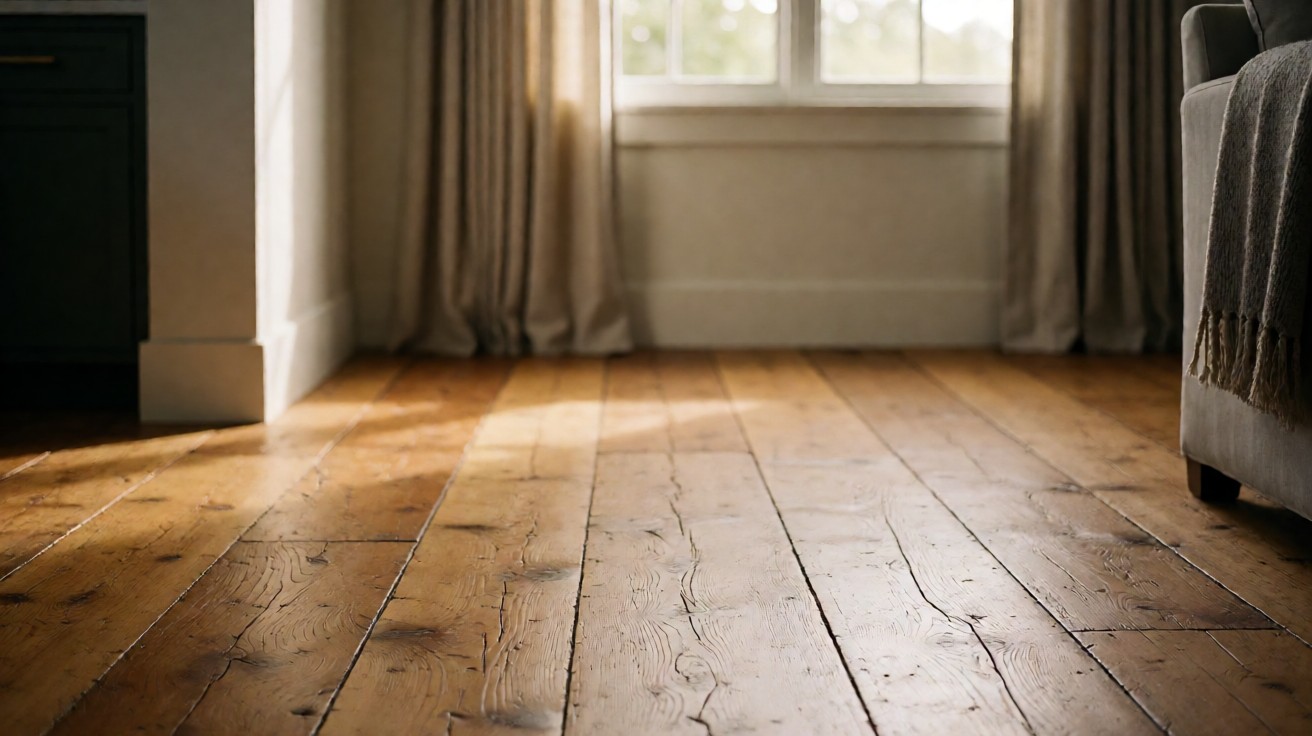
The second is the patina, which is the darkened, slightly uneven colour that decades of dirt and light leave in the wood. It is deeper in some places than others and it does not sand out evenly.
The third is checking, the network of small age cracks that run along the grain as wood dries and moves over a century. On old pine and oak it is expected and it is part of the character.
The fourth is the thickness at the wear surface. In a building that was walked on for a century, the top of the board is often thinner than the bottom, because the original finish and some of the wood itself were worn away. That wear taper is a record of use that nothing manufactured can fake.
Condition, Patina and Checking
Reclaimed wood is graded, and the grade tells you how much of the character you are getting and how much work the floor will need.
The best grade is the sort you will want if you are paying premium money: mostly clear, sound boards, with good patina and light character, and checking that is present but not splitting the board.
The lower grades have more knots, more sapwood, more wear taper, more checking, and more colour variation, which can look wonderful in a rustic room and out of place in a formal one.
Two things need checking before you commit. First, insect activity, which is the most common problem with salvaged wood and is not always visible. Any reputable supplier will have treated the stock with borate or an equivalent, and you should ask.
Second, moisture, because old wood that has sat in a damp demolition pile will pick up moisture and will move after installation if it is not properly seasoned.
On treatment specifically, borate treatment is applied to protect against insects and it is a standard part of preparing reclaimed wood. It is not a defect and it does not affect the appearance, but the supplier should tell you it has been done.
Re-milling and Why Thickness Matters
Old building lumber rarely arrives in modern dimensions. A board pulled from a joist might be seven inches wide and an inch and a half thick, with a warped surface and forty nail holes.
To become a floor it has to be re-milled, which is the process of running it through a planer to give it a flat, even face and a modern width and thickness.
Thickness is the important consequence. Old structural timber was thick, and even after re-milling there is usually more wood in a reclaimed plank than in a modern engineered plank.
That is the main reason reclaimed wood is almost always nail-down rather than floated or glued, because it is too thick and too irregular to sit as a floating floor. It also means a reclaimed floor cannot easily be taken up and relaid the way a click floor can, so it is a much more permanent commitment.
The second consequence is that a lot of material is lost in re-milling. The board is cut down to an even thickness and the surface is taken flat, so a large share of every reclaimed board ends up as sawdust. That lost material is one reason reclaimed wood costs more than new wood of the same species.
Inconsistent Colour and Tone
This is the single biggest difference between reclaimed and new hardwood, and the one that surprises people most.
With new wood, a floor from one order is a matched batch, so it is essentially one colour across the whole room. With reclaimed wood, every board came from a different room, a different floor, and sometimes a different building. The colours range from pale to almost black, the species and grain may vary within a single run, and the ageing differs board by board.
Installers handle this by sorting. Good reclaimed flooring is laid out before installation, boards grouped by tone, and the floor is laid so that the variation reads as a deliberate pattern rather than a random patchwork.
That layout is skilled work and it is part of why the labour is higher. It is also why you should insist on seeing the actual floor laid out, or at least a large sample of the batch, before the installer starts.
There is a practical warning here too. Because the supply is limited, a reclaimed floor is hard to extend later. If you do five square metres now and add to the room in four years, you will be matching a building that has since been demolished.
If you might extend, buy the whole area now, and ask the supplier to hold a reserve of the same batch.
Lead Time, Cost and Availability
Reclaimed wood costs more than new hardwood, and the premium is not primarily about scarcity. It is about the handling: sourcing it, sorting it, treating it, drying it, and re-milling it, all before it becomes a floor.
Lead time is also longer. New hardwood can usually be ordered and delivered within a couple of weeks.
Reclaimed wood often has to be sourced from a demolition site, sorted, treated, and milled, so you should expect several weeks and you should be prepared for the specific batch to sell before the job starts. If you love a particular reclaimed floor, order it before you finalise the rest of the project.
Availability is genuinely limited and it is not repeatable. Two loads of reclaimed oak are never the same. That is the appeal and the risk, and it is the reason you should always buy reclaimed from a supplier who will let you see the actual material, not a photograph of it.
The comparison below sets reclaimed and new hardwood against each other across the factors that actually decide the choice.
| Factor | Reclaimed and antique wood | New hardwood |
|---|---|---|
| Origin | Demolished buildings, barns, docks | Newly milled timber |
| Colour consistency | Every board different | One matched batch |
| Character | Patina, checking, nail holes, wear taper | Clean and uniform |
| Typical thickness | Thick, heavy, solid | 3/4 in solid, or thin engineered |
| Installation method | Almost always nail-down | Nail, glue, or float |
| Can be lifted and relaid | No, very permanent | Yes, if floating |
| Lead time | Weeks; batch may sell out | Weeks, restockable |
| Cost | Higher (handling and lost material) | Lower per square foot |
| Extendable later | Hard to match a future batch | Easy, same product still made |
| Best in | Rustic, historic, feature rooms | Uniform, formal, whole-house floors |
What to Check Before You Buy
The comparison above sets the options against each other. This table turns the choice into a room-level assignment, which is usually faster than reasoning about format in the abstract.
| Room or situation | Choice | Why it fits |
|---|---|---|
| Historic home, character wanted | Reclaimed | Age and patina are the point |
| New build, uniform look | New hardwood | Consistency and a repeat order |
| Small budget | New hardwood | Lower cost, no sorting labour |
| Fast timeline | New hardwood | Weeks, restockable |
| Entire ground floor | New hardwood | Matching batch across the house |
| One feature room | Reclaimed | Character worth the premium |
| Might extend later | New hardwood | Same product still made |
| Wet or damp room | Neither | Use waterproof LVT instead |
What to Check Before You Buy
Ask for the batch, not a photograph, and check it in person if you can. Look for the four tells, and check the insect treatment and the moisture content. If a supplier will not let you see the actual material you are buying, that is a reason to buy elsewhere.
Ask what the thickness is after re-milling, because that decides whether it is nail-down and how heavy the floor will be. Ask how much checking and knot there is, and whether you can see a large laid-out sample. Ask whether they can hold a reserve of the batch if you may extend the floor later.
Finally, be honest about the finish. Reclaimed wood takes a finish differently from new wood because it is more porous and more varied, and the patina will read through a clear finish differently than through a stain.
If you want the age to show, a matte clear finish over the natural colour is usually more honest than trying to stain it to match new wood. A good flooring contractor will show you both on a sample board before the floor is finished.
Is reclaimed wood better than new hardwood?
Neither is better, they are different. Reclaimed wood has genuine age, character, and density that new wood cannot match, and it appeals because every floor is unique.
New hardwood has consistency, availability, a predictable price, and the ability to extend the floor later. Choose reclaimed if the room wants character and you value permanence. Choose new if you want uniformity and the freedom to change your mind later.
How thick should reclaimed wood flooring be?
Thicker than a modern engineered plank, usually. Old structural timber was thick, and even re-milled it keeps more wood than an engineered floor, which is why reclaimed wood is almost always nailed down rather than floated. The exact thickness varies by supplier, so ask what the milled thickness is. That single number decides the installation method and how permanent the floor is.
How This Fits With the Rest of the Choice
This page covers reclaimed and antique wood as a material: where it comes from, what condition means, why it costs more, and what to check. It does not cover the plank dimensions, the environmental trade-offs, or the installation procedure, which are separate pages.
If you are still choosing the material, the hardwood flooring guide is the place to start. If you are weighing dimensions, the plank thickness, width, and length page covers how to read a spec. And if you want to see how wood stacks up against the other materials, the material comparison sets every option side by side.