
Your terrazzo quotes name two binders, epoxy and cement, but skip the moisture, sunlight, and thickness limits that actually decide which floor survives.
On a dry interior slab, we would specify epoxy thin-set at 3/8 inch for color, strength, and speed. Outside, over damp concrete, or against a pre-1970s historic field, cement terrazzo is the answer. The binder, not the marble chip, sets those limits.
The Short Answer: Which Binder Fits Your Project
Epoxy terrazzo vs cement terrazzo is a binder decision before it is a design decision. Both embed marble, granite, or glass chip in a matrix and grind flat, as our terrazzo flooring guide explains. The chemistry holding the chip is what differs.
That chemistry settles four questions. How damp is the substrate? Does the floor see sun or weather? How thick can the build-up be? And must it match an existing historic field?
If the slab is dry, interior, and flat, we would specify epoxy. If any part is exterior, damp, or historic, we would specify cement. Those four constraints, not the chip pattern, decide the binder.
The Chemistry: Resin vs Portland Cement
The epoxy resin binder is a two-part thermoset, typically a modified bisphenol-A, mixed with aggregate at roughly 1:8 by volume. It cures by chemical reaction, not by drying.
As a 100 percent solids system, epoxy does not shrink as it hardens, which is why it is more crack resistant than cement. The hardened resin is non-porous.
The Portland cement binder cures hydraulically: water reacts with the cement, then evaporates. That evaporation causes shrinkage, and the matrix stays porous, so moisture vapor passes through it.
Porosity is the single property that explains most of the differences that follow.
It governs moisture tolerance, staining, sealing, and whether the floor can breathe over a damp slab.
Is epoxy terrazzo stronger than cement?
Yes, by a wide margin on paper. Published epoxy compressive strength runs 13,260 psi against roughly 4,000 psi for cement, with tensile strength of 9,580 psi versus 400 to 600 psi.
Both systems still reach Class A, the lowest abrasion-loss tier, under ASTM C501 wear testing. Strength alone does not decide the floor; exposure and moisture do.
One boundary worth drawing: terrazzo is a placed chip-and-binder topping, not the structural slab ground smooth. Weighing terrazzo against polished concrete? That distinction matters more than the binder; see terrazzo versus polished concrete.
NTMA System Families and Thicknesses
NTMA names terrazzo systems by binder and bond method, not just epoxy versus cement. The family determines thickness, weight, and where the floor can live. The table uses NTMA’s 2025 Terrazzo Systems Reference Guide.
| System | Binder | Nominal thickness | Weight (psf) | Where it fits |
|---|---|---|---|---|
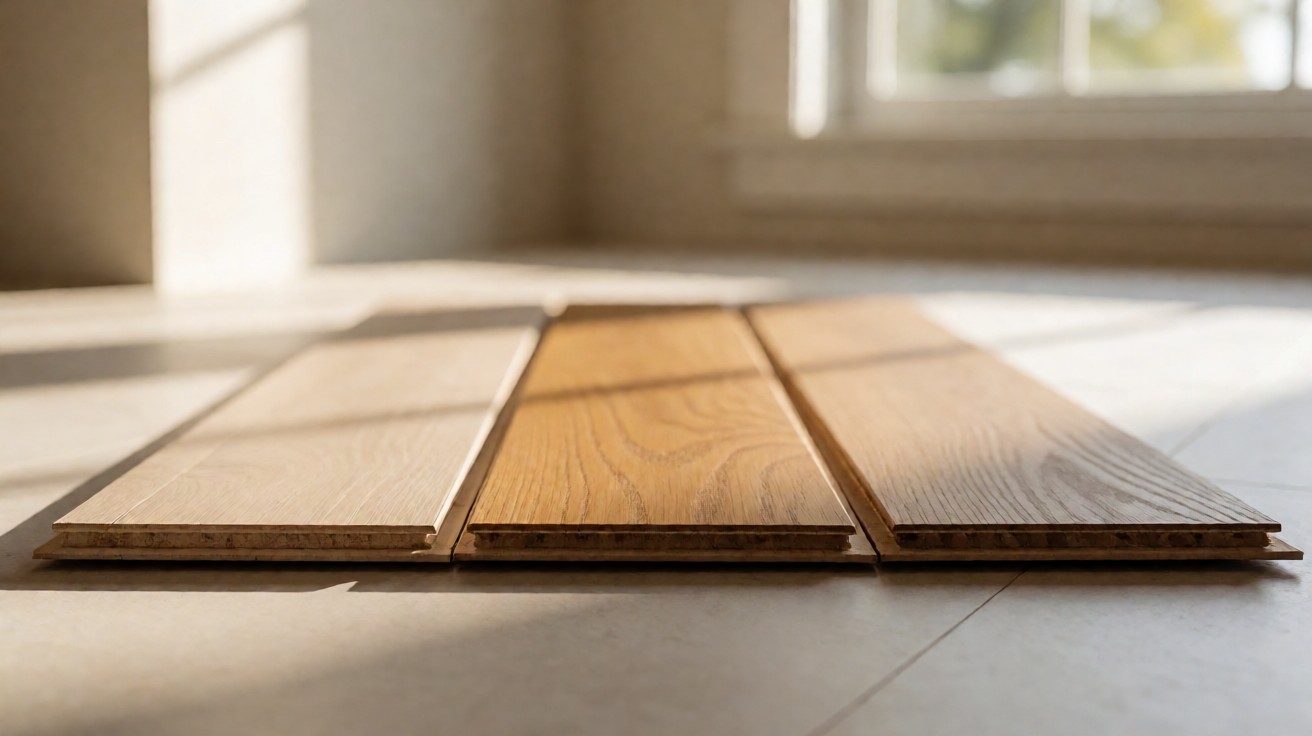
| Epoxy thin-set | Epoxy resin | 3/8 inch (1/4 inch optional) | 5 to 6 | Interior, flat slab |
| Monolithic | Portland cement | 1/2 inch topping | 5 to 7 | Interior, sound slab |
| Bonded | Cement plus underbed | 2-1/4 inch total | 18 to 22 | Interior and exterior, recessed |
| Sand cushion | Cement plus underbed | 3 inch total | 25 to 30 | Interior, unbonded over rough slab |
| Polyacrylate | Polymer-modified cement | 3/8 inch | 4-1/2 | Interior, high moisture vapor |
| Rustic | Cement, textured | 1/2 to 6 inch total | Varies by system | Exterior, skid resistant |
Thickness is not cosmetic. A 3/8 inch epoxy veneer carries only fine chip, while sand cushion terrazzo floats a coarse marble blend over an isolation membrane and wire mesh, independent of the slab (NTMA).
Bonded terrazzo needs about 1-3/4 inch of recess plus the 1/2 inch topping. Monolithic terrazzo bonds a 1/2 inch topping straight to a sound slab and is the most economical cement option (NTMA).
Sources disagree on the cement depths. NTMA’s 2025 guide lists bonded at 2-1/4 inch and sand cushion at 3 inch total, while other published guides list bonded at 1-3/4 to 2-1/4 inch and sand cushion at 2-1/2 to 3 inch. Confirm total depth with the installer before setting slab recesses.
Two families deserve a note. Polyacrylate terrazzo is a polymer-modified cement, thin like epoxy but breathable, and NTMA flags it for high moisture vapor areas.
Rustic cement terrazzo is left unground for a textured, skid-resistant exterior deck, built on bonded, monolithic, or sand cushion bases (NTMA).
Moisture: The Constraint That Decides Many Jobs
Moisture vapor moving up through a slab has nowhere to go under a non-porous epoxy resin binder. Pressure builds at the bond line until the floor blisters or delaminates.
A porous Portland cement binder lets that vapor pass, which is why cement tolerates damp substrates that would ruin epoxy. This is the mechanism behind most epoxy floor failures.
Two ASTM tests set the limit. ASTM F1869, the calcium chloride test, measures the moisture vapor emission rate. ASTM F2170, in-situ probes, measures internal relative humidity.
| Test | Measures | Epoxy threshold | Above threshold |
|---|---|---|---|
| ASTM F1869 (calcium chloride) | Moisture vapor emission rate | 3 lb per 1,000 sq ft per 24 hours | Mitigate or switch to cement |
| ASTM F2170 (in-situ RH probe) | Internal relative humidity | 75 percent | Mitigate or switch to cement |
Epoxy needs a slab that reads under 3 pounds per 1,000 square feet per 24 hours and 75 percent relative humidity. The NTMA resinous terrazzo guide specification gives the same two limits.
The common in-situ RH threshold is 75 to 80 percent, and ASTM F2170 is the preferred test (NTMA Technical Bulletin T-3). On a post-tensioned slab you cannot drill probes, so ASTM F1869 stands in.
That calcium chloride test is not valid on lightweight aggregate concrete (NTMA T-3). Run tests with the HVAC operating at use temperature and humidity, and confirm limits with the resin supplier.
Can epoxy terrazzo go over a damp slab?
Not without mitigation. If readings exceed the limits, either install a moisture-mitigating epoxy barrier as a separate bid item, which adds 10 to 14 days, or specify cementitious terrazzo, which breathes.
A slab-on-grade without a Class A vapor retarder per ACI 302.2R will usually exceed epoxy’s tolerance for the life of the building. A vapor barrier is mandatory for slab-on-grade epoxy work (NTMA).
Picture a 1962 ranch on a damp slab: the epoxy floor looks fine for three years, then 1 to 3 inch hemispheric blisters pop along every expansion joint. Test first; our subfloor moisture testing guide covers the method.
Cure Time and Project Schedule
Epoxy cures chemically in 12 to 18 hours and is ready to grind the next day, with foot traffic in 12 to 24 hours. APT gives 18 to 24 hours to cure.
The whole prep-to-seal window typically runs 5 to 7 days, and NTMA calls epoxy the quickest pour-to-grind system. Speed is epoxy’s clearest schedule advantage.
Those windows sit inside a longer sequence of slab checks, strip setting, pouring and grinding, which the terrazzo floor installation guide walks through step by step.
Cement is slower because hydration takes time. APT describes covering fresh cementitious terrazzo with water or polyethylene and curing 3 to 4 days before grinding, then 28 days to full strength.
Cement grinding starts at days 5 to 7, and the total scope runs 10 to 14 days. The gap is simple: cement takes roughly four to five times longer to cure than epoxy.
If the building is still being mudded and the slab is not primed and cured, epoxy is at risk. It needs 60 to 85 degrees F at the substrate and relative humidity below 75 percent.
Cement tolerates wider temperature and moisture. On landings, vestibules, and stair towers that cannot wait for finish-stage work, cement is often the de-facto choice.
UV, Exteriors, and Freeze-Thaw
Which terrazzo works outdoors?
Cement terrazzo works outdoors; epoxy does not. Epoxy is a thermoset that will yellow, embrittle, and eventually spall under UV and freeze-thaw, and it transmits no vapor.
UV yellowing is chemical degradation of the resin, not a surface stain you can polish out.
Once the binder embrittles, the chip loses support and the surface spalls.
The Portland cement binder is UV stable and breathable, and historic exterior cement installations survive worldwide. Freeze-thaw regions need air-entrainment agents in the cement mix (APT).
NTMA lists bonded terrazzo for interior and exterior use, and rustic cement terrazzo as the standard skid-resistant exterior deck. Sand cushion terrazzo is an interior system.
If any portion of a floor is an entry plaza, covered walkway, or exterior stair landing, that portion must be cementitious, even when the main field is epoxy.
Polyacrylate terrazzo can go exterior in warmer climates, but it is susceptible to freeze-thaw damage and is rarely used in the north (APT). Do not treat it as a cold-climate exterior substitute.
Aggregate and Color Range
Aggregate chip size is governed by thickness. The chip scale runs from 0 to 8 (APT). Epoxy thin-set terrazzo at 3/8 inch takes #0 through #2.
NTMA’s gradation table shows #0 passing a 1/8 inch sieve and #2 passing 3/8 inch. Cement systems carry coarser marble: standard #1 and #2, intermediate #1 through #4, and Venetian cement up to #8 (APT).
Glass, shell, and metal chip belong in epoxy. NTMA reserves glass for resinous systems, and the epoxy row also lists plastics and metal. Epoxy bonds well with glass, metal, and shells.
Cement’s dense, shrinking matrix can dislodge specialty aggregate, so smaller and specialty chips should be limited or avoided there. Mother-of-pearl is an epoxy option.
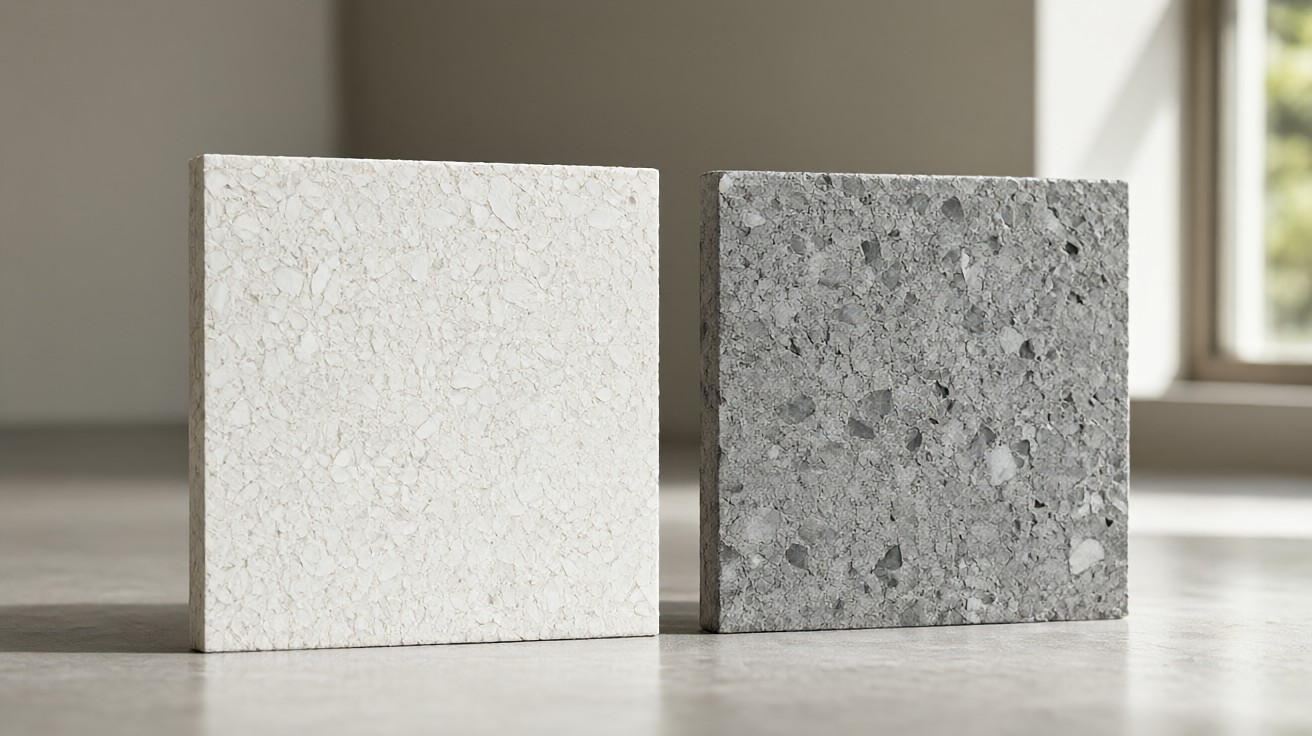
Color is where epoxy pulls ahead. The pigmented epoxy resin binder matches virtually any color, consistently, batch to batch. The Portland cement binder is limited to earthy tones.
White and gray cement may not be uniform in color; water-cement ratio, temperature, and curing all shift the shade. If the design calls for a bright, uniform, multi-color field with glass or metal accent, specify epoxy.
Divider Strips and Joints
Divider strip metal is not interchangeable. NTMA lists zinc and brass for cement, and zinc, brass, plastic, and aluminum for epoxy. APT is more cautious about two of those combinations.
Aluminum has no place in a Portland cement matrix, because the alkaline environment exacerbates corrosion and promotes cracking (APT). Brass has no place in epoxy, because it can blue-green stain in reaction to the curing agents.
So the safe specification is zinc or brass for cement, and aluminum, zinc, or plastic for epoxy. Use brass in epoxy only after the resin manufacturer confirms compatibility.
APT adds that aluminum is safe in epoxy provided it does not touch uncured Portland cement substrate. Cement strips are typically 16 gauge; NTMA lists widths from 18 gauge to 1/2 inch.
Joints follow the slab, not the pattern. Joint placement follows ACI 302.1 concrete practice, with joints running off corridor intersections and corners (NTMA). Divider strips not over a concrete joint are strictly decorative.
APT places control joints directly over saw-cut substrate joints, extending through the full underbed depth, at column lines and breaks in continuity. Spacing differs by binder.
Epoxy allows unlimited shapes with 15 to 20 foot spacing, while cement is limited to squares and rectangles at about 4 feet. NTMA caps sand cushion panels at 4 by 4 feet or less, rectangles under 25 square feet, aspect ratio at most 1.5 to 1.
Weight and Structural Load
Weight follows thickness. NTMA’s 2025 guide lists epoxy thin-set at 5 to 6 pounds per square foot, monolithic terrazzo at 5 to 7, and polyacrylate at 4-1/2 pounds per square foot.
Bonded terrazzo runs 18 to 22 pounds per square foot, and sand cushion terrazzo 25 to 30. Epoxy runs lighter, at 3 to 4 pounds per square foot, so design load spans roughly 3 to 6.
Run the load on a 1,000 square foot floor. Sand cushion at 25 to 30 pounds per square foot adds 25,000 to 30,000 pounds; epoxy at 5 to 6 adds 5,000 to 6,000 pounds.
That five-fold gap is why epoxy is the multi-story choice and why sand cushion needs a recessed slab and a structure that can carry it. If the floor is an upper story or a retrofit with no recess, specify epoxy thin-set or monolithic terrazzo.
If you have 1-3/4 inch of recess and want a bonded cement floor, bonded terrazzo fits. Sand cushion is heaviest and needs the most depth, but it floats over a rough slab and resists mirroring substrate cracks (NTMA).
Cost Positioning
Installed cost usually runs higher for epoxy indoors: published ranges put epoxy at $40 to $60 per square foot and cementitious at $35 to $50. The slab decides the real number. Epoxy needs a flat, primed slab to ASTM E1155 FF35/FL25, so leveling can add cost; cement tolerates a rough slab but builds deeper. See terrazzo floor cost for pricing.
Historic Renovation Matching
If you are matching a pre-1970s floor, the answer is cement. Cementitious terrazzo has been installed in the United States since the 1890s, and resinous systems did not reach regular use until the 1970s (APT).
An epoxy patch in a cement field reads as obvious as a vinyl-tile patch in marble. Historic slabs often lack a vapor retarder, so the breathable Portland cement binder is the compatible repair.
Can you patch a cement terrazzo floor with epoxy?
APT treats in-kind cementitious matching as the preservation standard, and a petrographer can identify the original binder, chip size, and pigment so the new mix matches. Even then, aggregate is a mined product, so an exact color match may not be possible (NTMA).
There is a real tension. Epoxy patches offer better color match and less shrinkage, and skilled cement installers are disappearing, so epoxy may become the only repair option on some jobs (APT).
If you must patch cement with epoxy, isolate the patch with a divider strip at a transition rather than mid-field, where the matrix shift reads as a mistake. One dating clue: brass divider strips arrived in 1919, introduced by L. Del Turco and Brothers of Harrison, New Jersey (APT).
Decision Rules by Project Type
Choose by site condition, not by preference. For an interior commercial field on a dry, flat, 28-day-cured slab with moisture vapor emission rate under 3 pounds, specify epoxy thin-set terrazzo for color, strength, and speed.
For a residential retrofit over an existing slab with no recess, epoxy thin-set or monolithic terrazzo keeps the build-up thin and the load light. If the slab is damp or on grade without a vapor retarder, switch to cement or budget a mitigation barrier first.
For exterior plazas, covered entries, and freeze-thaw exposure, specify cement, with rustic cement terrazzo for skid resistance. For wet zones such as commercial kitchens and locker rooms, we would specify cementitious with integral coving.
For wide-temperature service such as loading docks and mechanical rooms, use cement or an industrial coating, not epoxy. For a historic match, use cement.
Radiant heat is possible under both binders, but confirm epoxy compatibility with the formulator first (NTMA Technical Bulletin G-20). Heating elements sit in the slab or underbed, never the topping, within 2 inches of the finished surface.
G-20 also holds that metal divider strips never touch the heating elements, and thermostatic control must keep the floor below 100 degrees F, ramping about 1 degree F per hour to avoid thermal shock.
When two binders meet on one project, match the aggregate blend exactly and separate the systems with a divider strip at a natural transition, such as an exterior threshold. The matrix color shifts slightly; at a transition that reads as intentional, mid-floor it does not.