
Cork floors collect spills, grit, and scuffs faster than most homeowners expect, and much of that damage comes from the mop you use, not the floor.
You should use a damp microfiber mop and a neutral pH cleaner. Never a soaked mop, never a steam cleaner, and never an ammonia-based cleaner, because on cork those three habits attack the granule surface and the joints instead of the dirt. The whole care routine for cork follows from that one rule.
What Cork Is Made Of And Why That Decides The Cleaner
Cork flooring is pressed bark granules, not a milled board, and that fact decides how it behaves under water and under chemistry. Damage to a cork floor does not show up as a scratch in a hard film. It shows up as swelling at the joints and a dull, matted surface where the embossed grain used to catch the light.
A cleaner that would be unremarkable on a laminate or a vinyl plank can be genuinely destructive here. The pattern is always the same. Liquid gets into the seams and the embossed grain, the granules swell, and the surface goes flat and rough instead of soft and warm.
How the material is built matters here. A cork granule wear layer over a cork backing absorbs water and chemical attack differently than a synthetic film does, which is why cork needs a gentler routine than the rest of the resilient family.
Finish matters too. Some cork planks carry a UV polyurethane finish, a factory-applied layer that wipes clean and dulls easily. Solid cork tiles often carry a wax finish instead, which shrugs off grit better but has to be maintained rather than stripped.
Either way, the care rules are about keeping liquid out of the seams rather than about scrubbing hard. That is the whole difference between cleaning cork well and cleaning it badly.
Three Cork Products, Three Different Cleaning Rules
Most cork cleaning advice is written for one product and applied to all three, which is where it goes wrong. The wear layer thickness and the finish chemistry decide which cleaner is safe, so the first thing to establish is what you actually have underfoot.
| Cork product | What the top layer is | Water exposure | Cleaner that works |
|---|---|---|---|
| Cork-backed resilient plank | 0.55 mm cork granule wear layer per ISO 24340 over a cork backing | Keep the seams dry, no standing water | Dilute neutral pH cleaner, damp mop only |
| Floating click-lock cork plank | 6 mm nominal board thickness per ISO 24346, cork granules pressed with a recycled polymer | Swelling limit of 15 percent per ISO 24336, so mopping is safer than soaking | Neutral pH cleaner applied with a well-wrung microfiber mop |
| Solid cork tile with a wax finish | No separate wear layer, the wax itself is the sacrificial surface | Most sensitive of the three, water sits in the seams | Damp mop only, then a maintenance wax or polish coat |
Ask for the wear layer thickness in millimetres.
The 0.55 mm wear layer figure comes from the Amorim technical data sheet for its floating cork plank, and it is the number most useful when you are planning a routine. Below roughly half a millimeter, a wear layer does not survive long enough in a busy room to be worth relying on.
Use level is the other half of the picture. The same product carries class 23 for residential use and class 33 for commercial use under ISO 10874, the classification system that rates a floor by practical requirements for areas of use and intensity of use. A kitchen rated 23 will not get the traffic of a small shop rated 33.
Dimensions matter for the mop as well. Squareness under ISO 24342 is limited to 0.50 mm and straightness to 0.30 mm, so a well-made plank has tight seams, while the opening between panels is held to 0.20 mm by EN 14085. Tight seams give the water less room to sit in.
The Daily Routine That Protects A Cork Floor
Two minutes a day is enough on most floors. Cork needs less, because the embossed grain traps grit that a flat surface would shed. The order of operations is what matters.
Vacuum or sweep first, every time.
Loose dirt that gets wiped around with a damp mop grinds into the embossing and the joints, which is exactly where it does the most damage. The manufacturer cleaning instructions for cork say the same thing in plainer words: remove loose dirt before wiping, so it cannot penetrate the embossing and the seams.
Then mop with a well-wrung microfiber mop, not a dripping one. A microfiber pad holds its solution and releases it evenly, and it lifts grit without needing abrasive pressure. If your mop leaves a visible wet trail behind it, it is too wet. Cork floors must only be damp-mopped.
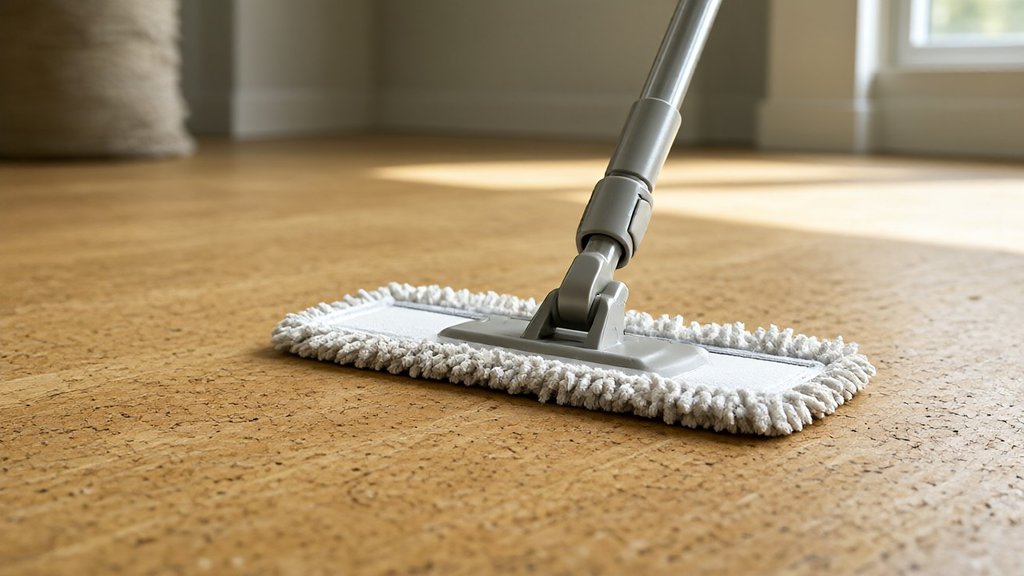
Follow the mop with a dry pass on any area that still looks wet, and let the floor dry fully before anyone walks on it. A floor that has not dried picks up grit from shoes the moment somebody comes through the door.
Use two buckets, one for the solution and one for the rinse water.
Change the water when it turns grey. The mop and bucket routine that works on cork is simple. Keep the second bucket for rinsing the pad, and dirty rinse water puts the grit you just lifted right back onto the floor.
Protect the floor at the edges of the room. An entry mat keeps most of the dirt outside, and a mat with a rubber or latex back can stain the surface, so choose felt or a woven fiber pad instead. Felt pads under furniture legs keep the weight from crushing the cork permanently.
Choosing A Cleaner That Is Safe On Cork
Safe cleaners for cork are boring, which is the point. A neutral pH cleaner diluted in warm water does the job, and a pH-neutral concentrate at 50 to 100 milliliters per 10 liters, or 2.6 gallons, is a realistic working dilution for a full bucket.
Everything else on the shelf needs a decision. The table below is the short version, and the reasoning in the right column is the part worth remembering.
| Product | What it does to cork | Verdict |
|---|---|---|
| Neutral pH cleaner | Holds pH near 7, so it does not etch the finish or swell the granules | Use this, diluted as directed |
| Ammonia-based cleaner | Attacks cork as a natural product and can dull or haze the surface | Do not use |
| Abrasive powder | Scours the embossed grain flat and leaves residue in the joints | Do not use |
| Vinegar or dilute acid | Etches a wax finish and dulls a UV polyurethane finish over time | Avoid |
| Steam cleaner | Forces hot moisture into the seams and can lift the surface | Do not use |
| Oil soap | Leaves an oily film that traps dirt and can yellow the surface | Avoid |
Two habits from the manufacturer’s own guidance are worth repeating, because most people get them backwards. Vacuum before you mop, every single time. And let the floor dry completely after mopping, then do not wipe it again with plain water, which is the step that leaves a dull film behind.
On the products themselves, follow the label. The manufacturer cleaning instructions always outrank a generic list, because a cleaner approved for one cork finish can still be wrong for the finish you have. If you use a maintenance product the manufacturer does not recommend, choose one that is pH-neutral and approved for cork, and test it on a hidden corner first.
Ventilate the room while you clean. EPA guidance on indoor air quality lists cleaning supplies among the common sources of volatile organic compounds in a home, and it recommends ventilating whenever you clean, sanitize, or disinfect.
How Wet Is Too Wet: Water, Joints, And Swelling
Water tolerance is a specification, not an opinion, and the numbers come from the same technical data sheet that lists the wear layer.
Here is where it lands. Thickness swelling for cork is limited to 15 percent under ISO 24336, which measures how much the board itself grows when it takes on moisture. Dimensional stability under changing humidity is limited to 5 mm per EN 14085, and joint swelling under moisture exposure shows no visible effect when tested to IHD 423.
That last figure is the encouraging one, and the first two are the caution. A cork floor handled according to spec barely moves. A cork floor with water sitting in it swells unevenly, because the edges of a plank dry faster than the middle, and the result is a cupped edge that no amount of mopping fixes.
If a spill happens, blot it rather than scrubbing it, and dry the whole area rather than only the wet spot. Where a spill has soaked in, dry the floor slowly and evenly with fans and good airflow, because a slow dry is what brings a cupped plank back flat.
Wet rooms need a different plan. If you have cork in a bathroom or a laundry room, treat it as a dry room. Keep bath mats down, keep the toilet base dry, and fix leaks as soon as they appear, because one standing leak will undo a maintenance schedule that took months to build.
Steam Mops, Vinegar, And Other Habits To Break
Steam is the habit that ends careers. It looks like the hygienic choice, and it is the fastest way to get moisture into a cork seam, because the steam carries water vapor into the joint and condenses there.
Is vinegar safe on a cork floor?
No. Vinegar is a mild acid, and it works well on a sealed hard floor, but on cork it etches a wax finish and dulls a UV polyurethane finish one pass at a time. The damage is slow enough that nobody connects it to the cleaning routine.
Can you steam mop cork flooring?
No, and the reason is physical rather than chemical. Steam carries water vapor into the joint and condenses it there, so the moisture ends up in the seam whether you wanted it there or not. The plank swells from the inside out, which is where the lasting damage comes from.
Bleach and ammonia-based cleaner belong in the same category, with one difference. Ammonia is called out directly in the manufacturer’s guidance for cork, which warns against strong abrasives and ammonia-based products precisely because cork is a natural material. Bleach dulls the finish and can bleach the granules themselves.
Baby powder and any other dry powder swept across the floor is another quiet habit to break. A powder is an abrasive powder once it gets between the granules and the mop pad, and it works like fine sandpaper on the embossing.
Wet-vacuuming is the last one. A vacuum that sprays cleaner and pulls it back through a full-width pad puts cleaner into the seams and leaves detergent behind, and the pad then drags that residue across the surface.
Removing Scuffs, Gum, And Adhesive Residue
Scuff marks on cork are usually two things at once: a dark rubber deposit from a shoe sole, and a light abrasion of the embossed grain beneath it. Treat them as two problems.
For the rubber deposit, a cloth barely dampened with warm water and a drop of pH-neutral cleaner, worked in with the grain, will lift most of it. Work in the direction of the grain, and change the cloth as soon as it is dirty, because a dirty cloth grinds the deposit across the surface instead of lifting it.
How do you get gum residue out of embossed cork?
Freeze it first. Hardened gum on a cold floor is brittle, and a plastic scraper lifts it in one piece where a cloth would only smear it. If the gum has soaked into the grain, warm water and a neutral cleaner soften what is left, and patience finishes the job.
Adhesive residue comes from install tape, carpet tape, or a leftover furniture pad, and it is the one that quietly damages a floor, because people keep scrubbing it. Adhesive should be left to the manufacturer, and if you find residue after installation, ask the supplier what product they recommend before you experiment.
One caution on all of it. If a scuff has worn through the wear layer rather than dirtied it, no cleaning will restore it, and that is a replacement question rather than a cleaning question.
The Maintenance Coat: When A Cork Floor Needs One
A maintenance wax or polish coat is not the same as mopping, and it is not the same as waxing a car. It is a sacrificial film that takes the traffic so the cork surface underneath does not.
You need one when the floor starts to look flat and tired, rather than when a calendar says so. The manufacturer’s guidance is that the frequency of maintenance depends on the traffic and on the visual aspect of the floor, and that is the correct standard for cork too. A busy hallway in a house with dogs is a different schedule from a quiet bedroom.
How often should a cork floor be polished?
Every 6 to 12 months in a home, or whenever the sheen is gone. The procedure is short. Clean and dry the floor first, apply one even coat with a short hair mop or wax applicator, and let it dry completely, which takes about 30 minutes. Coverage for a typical maintenance polish is 3 liters per 100 square meters, or 1000 square feet.
Do not polish over a dirty floor, because you seal the dirt in. Do not polish twice in a row either. If the floor has lost its sheen and old coats have built up, the answer is a strip, not another coat.
A pH-neutral stripper handles that job. Dilute it 1 part to 20 parts of water for a heavy soiling, work it with a pad, and remove the dissolved dirt with clean water before it dries.
Keep the solution on the floor for no more than 5 minutes, because a stripper left to sit is a stripper working on your finish instead of on the old wax.
After stripping, the floor will look dull. That is expected. Clean it with a mop dampened in clean water, let it dry, and then apply a fresh coat of maintenance polish, which restores the original appearance.
Tools And Products Worth Keeping On Hand
A small kit covers almost everything, and every item in it has a specific job on a cork floor.
A vacuum with a bare floor attachment or a soft brush head lifts grit without beating the embossing. A microfiber mop with a flat pad applies cleaner evenly and picks up what a string mop leaves behind. A spray bottle lets you work in sections, so you are not mopping a whole room wet and hoping it dries in time.
A soft cloth, a plastic scraper, and a clean white pad handle scuff marks, gum residue, and stripping. Keep a pH-neutral cleaner concentrate, a maintenance polish, and a pH-neutral stripper on the shelf, and skip the shelf space for abrasive powder, ammonia, and acid cleaners.
Change mop heads and cloths often.
A pad used on half the floor and then turned over picks up what it just deposited, and if you launder it, wash it without fabric softener, because the residue from softener leaves a film that attracts dirt.
What To Do When The Finish Is Already Damaged
Some problems are cleaning problems, and some are not. The distinction decides whether you spend money on products or on a repair.
A dull, uneven surface that responds to a clean damp mop is a cleaning problem. A matte patch that stays matte after two cleanings is finish damage, and more mopping will not fix it. Worn joints that catch a fingernail are wear, and the answer is a board replacement rather than a product.
White hazing around the edges of a room usually means standing water did its work.
A surface that has gone flat and hard is a different signal. Dry the floor completely, keep it dry, and watch it for two weeks. If the haze is still there after that, the surface has been chemically or physically damaged and needs a floor care professional.
For a professional job, look for a company that follows IICRC S250, the standard for professional cleaning and maintenance of resilient floor coverings. It defines the methodology for inspecting resilient flooring to identify and apply the appropriate cleaning and maintenance processes, which is exactly the diagnosis you want before anyone sells you a product.
When the floor is coming up, the seams and the edges fail first, and that is usually an installation issue rather than a cleaning issue. The cork flooring installation guide covers expansion gaps and click-lock assembly, the two things that decide whether a cork floor stays flat over a decade.
A laminate floor is a different material with a different film over its core, so its water tolerance is a different question entirely. The guide to cleaning laminate floors covers that material on its own terms.
A Care Schedule You Can Actually Keep
The schedule below assumes a residential cork floor with normal household traffic. A commercial space rated class 33 under ISO 10874 needs the same daily steps and a shorter polish interval.
| Frequency | Task | Product or tool | Time |
|---|---|---|---|
| Daily | Vacuum or dry mop to pick up grit | Vacuum with a soft head or a dry microfiber pad | 2 minutes |
| Weekly | Damp mop in sections and let the floor dry fully | Neutral pH cleaner, 50 to 100 milliliters per 10 liters | 10 minutes |
| Monthly | Spot-treat scuff marks and check under furniture legs | Damp cloth, pH-neutral cleaner, felt pads | 15 minutes |
| Every 6 to 12 months | Apply one maintenance coat when the floor looks tired | Maintenance wax or polish, 3 liters per 100 square meters | 30 minutes to dry |
| Only when coats build up | Strip old polish, then re-polish | pH-neutral stripper diluted 1 to 20, off the floor in 5 minutes | 1 hour |
Two final checks before you start. Confirm the cleaner is neutral pH and safe for the finish you have, and confirm your mop is damp rather than wet. Everything else on this list follows from those two.
The broader method, including how cleaning methods differ across floor types and where steam never belongs, is covered in the flooring cleaning and maintenance guide. Cork behaves like that guide says a resilient floor should, as long as you keep the water out of the joints.