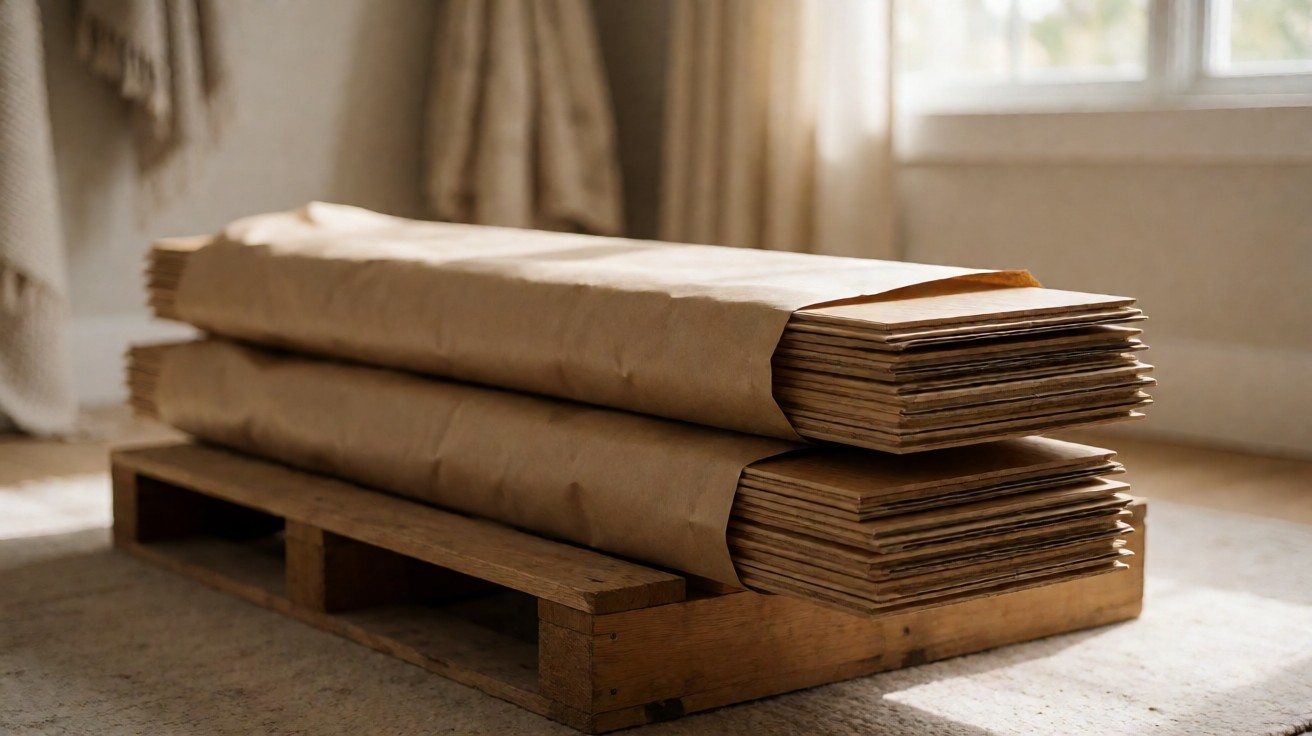

A stack of leftover planks sits in the garage for three years, and the day a board cracks you find the replacement has cupped, gapped, or faded past matching.
Store leftover flooring indoors between 30 and 50 percent relative humidity and 60 to 80 degrees Fahrenheit, stacked flat with spacers, and acclimate any plank for 48 hours before it goes back down. The answer is the most stable conditioned room in the house, not the garage.
Why Storage Conditions Decide Whether A Repair Board Matches
A repair board is not a spare part you can grab later. It has to sit in the same room, at the same moisture level, and look like the planks around it. Storage decides all three. The board you pull from a damp garage in year three is not the board that came off the pallet.
What Does A Repair Actually Need From Storage?
Two things have to survive the wait. The board must stay dimensionally stable, and its color and sheen must still read as the same floor. Dimensional stability is about moisture. Color and sheen are about light, and about how long the finish sits under pressure.
If either fails, you install a board that gaps, crowns, or shows a visible patch in the middle of a room, and the repair stands out more than the damage did.
The Match Problem Nobody Plans For
A floor is a random mix of boards from one dye lot. Once that lot is gone, no new plank will match it exactly, even from the same manufacturer and the same product line.
The reserve you keep after installation protects you here, and how much leftover flooring to keep is worth deciding before the crew cleans up. The purchase decision is separate, and how much extra flooring to buy sets the ceiling on what you can ever save.
The Relative Humidity Band, By Material
Relative humidity is the number that decides whether stored flooring stays flat. Temperature matters, but humidity is what the material actually responds to, because wood and laminate both exchange moisture with the air around them.
Each material has a band. Stay inside it and the board comes back the same size. Drift outside it and the board moves before you ever cut it.
Wood, Laminate And Vinyl Each Have Their Own Band
Wood flooring performs best between 30 and 50 percent relative humidity and 60 to 80 degrees Fahrenheit, per NWFA. That is also the comfort range most homes already hold.
Laminate is wider in practice. EPLF calls for 40 to 75 percent relative humidity, with a minimum room temperature of 18 degrees Celsius, about 64 degrees Fahrenheit.
Rigid core vinyl is the most tolerant. Most SPC products want 35 to 70 percent relative humidity and 60 to 90 degrees Fahrenheit indoors, which is close to a normal house.
| Material | Relative Humidity | Temperature | Failure Outside The Band |
|---|---|---|---|
| Solid wood | 30 to 50 percent | 60 to 80 degrees F | Cupping, gapping, cracks |
| Engineered wood | 30 to 50 percent | 60 to 80 degrees F | Delamination, face checking |
| Laminate | 40 to 75 percent | 64 degrees F minimum | Swollen core, joint swelling |
| Rigid core vinyl (SPC) | 35 to 70 percent | 60 to 90 degrees F | Warped planks, cracked tongues |
Temperature, Seasonal Swing And The Garage Problem
Average conditions are not the same as worst conditions. A room that reads 45 percent in October can read 20 percent in January and 70 percent in July.
Wood moves with each swing. The damage comes from the cycle, not from any single reading, and the joints and the finish take the stress first.
Can You Store Leftover Flooring In A Garage?
A garage is the worst default in most homes.
NWFA is explicit: garages and exterior patios are not acceptable places to store wood flooring.
The reason is the swing. An unconditioned garage often swings from near freezing in January to above 90 degrees Fahrenheit in July.
That swing drives relative humidity from near zero to near saturation. A board that cycles like that for three years will not go back into a floor.
Why A Seasonal Swing Does More Damage Than A Bad Average
A constant 60 percent is survivable for many products. A swing between 20 and 70 percent is not, because the board never reaches equilibrium.
Each cycle adds stress at the joints and in the finish. Enough cycles and the board cups, checks, or loosens at the lock, and none of that is fixable after installation.
This is where the timing of the work matters. Scheduling the installation around your household keeps the leftover stack in the room that stays conditioned, not the one that does not.
Flat Stacking, Spacers And The Load Limit
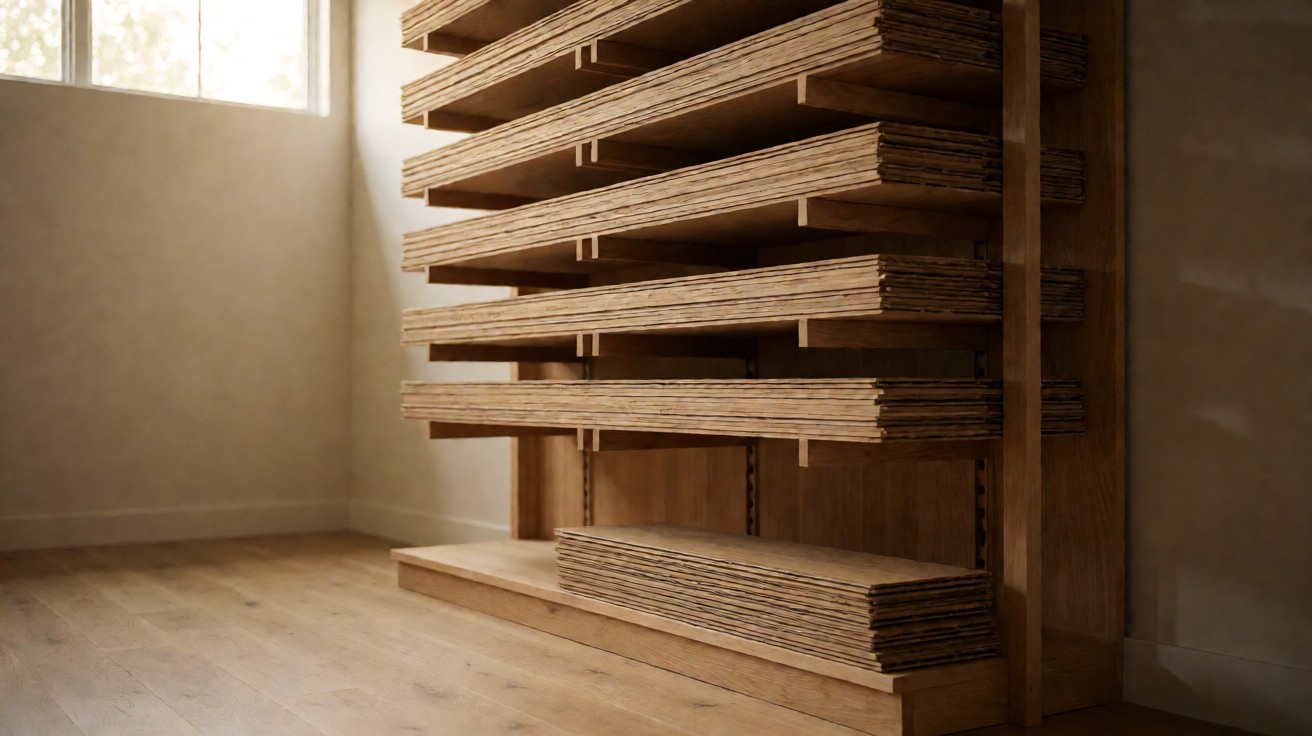
How a stack is built decides whether air reaches every board. A solid pile of cartons is a moisture trap, not a storage method.
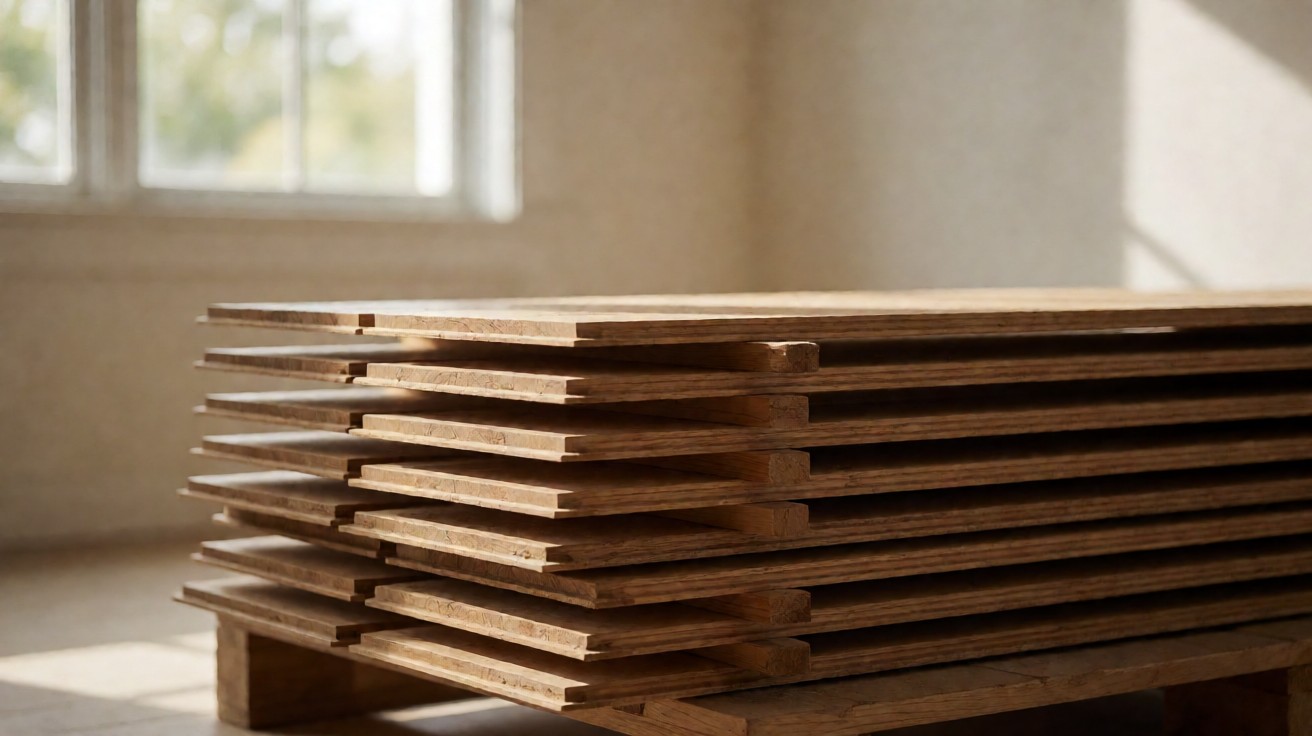
The rules are simple. Keep the stack flat, separated, and not too tall. Store cartons and loose planks flat, never leaning against a wall. EPLF warns against leaning packaging units against walls during conditioning.
1. Keep The Stack Flat
Lean a tall stack and the weight bows the boards at the bottom. Bowing becomes a permanent set in laminate and vinyl, and a bowed board will not lock flat again.
2. Separate Layers With Spacers
Cross stack loose boards with stickers between layers. NWFA calls for 3/4 inch to 1 inch spacers to let air circulate on all sides, so every board sees the same conditions.
Spacers also keep the finish from touching the board above it. Finish stuck to finish is a repair you cannot fix, and it happens inside the stack where you never see it.
3. Respect The Load Limit
Keep the stack short, in the range of three to four cartons. Higher than that and the bottom cartons carry the whole load, and cardboard fails long before the boards do.
Cardboard crushes, boxes shift, and edges get damaged. Heavy cartons belong on the bottom, light ones on top. Put the heaviest cartons on a pallet, never directly on the slab.
Wrapping, Ventilation And What Shrink Wrap Does
Original cartons and shrink wrap are designed for transit, not for years of storage. They seal the stack in whatever it shipped with, good or bad.
If a pallet sat in a humid warehouse before delivery, the wrap holds that moisture against the boards. Plastic film is a vapor barrier, so a damp board stays damp and a wet spot spreads.
Why Does Shrink Wrap Trap Moisture?
Open the cartons and let the stack breathe. Keep the wrap for transport, not for the long term. If you must cover the stack, use a breathable cover and leave the ends open.
Trapped air is the problem, not the dust. A stack that cannot exchange air with the room sits at whatever humidity it had when it was closed up.
Light, Ultraviolet And Fading In Storage
Ultraviolet light does not care whether a floor is installed. It fades the surface and can yellow the finish on stored planks, and the effect is cumulative over years.
Direct sun can bleach the top boards of a stack over a season, and the bleaching is permanent. The boards on top fade first, while the ones underneath stay dark.
Can Sunlight Through A Window Fade Stored Planks?
Light exposure is a tested failure mode. NALFA LF-01 includes light resistance in its performance requirements for laminate flooring, which is why manufacturers treat stored product as a risk.
Keep stored flooring out of direct sun and away from UV sources. Do not use clear plastic over a stack near a window, because clear film concentrates light and makes the fade worse.
Pests, Mold And Moisture Intrusion
Cardboard cartons are food for insects and a sponge for damp air. A stack sitting on a slab in a humid basement is a mold risk, and the cartons hide the early signs.
Both problems are caught early or not at all, which is why a stored stack needs a check-up on a schedule rather than whenever you happen to look at it.
What Does Mold Need And How Do You Deny It?
Mold needs moisture, a food source, and still air. EPA lists high humidity at 60 percent relative humidity as a common moisture problem in buildings.
Cardboard and wood supply the food, and dry air with moving air denies it. Keep the stack dry, elevated, and in moving air, and a small hygrometer on the pallet tells you the number instead of guessing.
Inspect the stack every three months. Look for musty odor, dark spotting on cartons, and frass from insects, and note the hygrometer reading each time.
If you find mold on the cartons, move the boards out, wipe the affected faces, and let everything dry before restacking. Do not seal damp boards back into a carton.
Concrete Floors And Pallet Isolation
Concrete is never a neutral shelf.
A slab holds moisture and releases it into anything sitting directly on it, and a board in contact with a slab can pick up enough moisture to swell at the edges before you ever see it.
Is A Concrete Slab Ever A Safe Shelf?
No. Even a dry-looking slab moves moisture.
A slab in a basement moves more than one upstairs, because it is in contact with the ground.
Keep every stack on a pallet, on stickers, or on a raised shelf, with four inches of clearance as the working minimum. A 6 mil polyethylene sheet under the pallet adds a vapor break between the slab and the stack.
ASTM F2170 measures relative humidity inside the concrete, and 75 percent is the limit many manufacturers set for porous substrates. A stack stored over a slab above that limit sits on a moisture source.
Acclimating A Plank Before It Is Reused
A board that has sat in storage is not ready to install. It has to come back to the room it will live in, and skipping that step is the most common repair failure.
The rules for the original install still apply, and acclimating flooring before the original installation covers the full method.
For a single repair board, the same physics governs, just on a smaller scale. Bring the plank into the room where it will be installed, and leave it there. Do not install straight from the garage, and keep it flat and away from heat sources and exterior walls.
1. Move It Into The Room
Set the board flat on a clean surface, out of direct sun and away from a radiator or a forced-air vent. Heat sources drive moisture out of a plank faster than the room can replace it.
2. Let It Sit For 48 Hours
EPLF calls for at least 48 hours of conditioning in the installation room before laminate goes down. Wood needs similar time, because a board that moves after installation will gap or crown.
Do not open the carton early. Condition the sealed package, then open it when you are ready to cut, so the board does not take a second shock.
3. Check Moisture Content Before You Cut
A pinless moisture meter tells you whether the board has caught up. Wood flooring is manufactured at 6 to 9 percent moisture content, and NWFA allows a 4 percent difference between solid strip flooring and a wood subfloor, and 2 percent for plank.
If the reading is outside the band, give the board more time. Cutting early is how a repair becomes a second repair, and the second one is harder to hide.
When the board is ready, the flooring installation sequence for the repair is the same one the original crew followed.
How Long Each Material Holds In Storage
Storage life is not infinite, and it is not the same for every material. Wrapped wood holds for years, while laminate and vinyl have shorter limits.
The limit is set by the material, the packaging, and how well the room held its band. Wrapped wood is the most patient, and laminate and vinyl are the least.
| Material | Check Interval | Storage Limit | What Ends It |
|---|---|---|---|
| Wood, sealed carton | Every 6 months | 0.2 percent moisture drift per month | Humidity cycling, finish aging |
| Wood, out of the carton | Every 3 months | Inspect for end checking | Cupping, warp |
| Laminate, sealed carton | Every 6 months | Stable while dry and flat | Swollen core, faded decor |
| Rigid core vinyl | Every 6 months | Stable in a dry room | Warped planks, cracked tongues |
Mitigation When There Is No Conditioned Space
Most homes have one conditioned room and a lot of space that is not. If the only option is a basement or garage, you can still reduce the risk.
The goal is not perfection.
It is keeping the stack dry, elevated, and checked, which is most of the protection a stored board needs.
What Can You Do In A Basement Or Garage?
Run a dehumidifier and keep it set below 50 percent relative humidity. A small unit in a closed room holds a band that a whole house cannot.
Raise the stack on a pallet with a 6 mil vapor sheet underneath. Keep it away from exterior walls and floor drains, where a slab runs wettest.
Seal the cartons with tape after inspection, and log the hygrometer reading each time you check so you can see a trend instead of a snapshot.
Where the space cannot hold the band, plan to use the reserve sooner. A board stored badly for two years is worth less than one stored well for five.
The Reuse Checklist Before You Cut A Repair Board
Before you cut, walk the board through a short check. It takes ten minutes and it catches the failures that show up later.
Most of this is the same discipline as planning a flooring replacement project, applied to a single board, and it takes about ten minutes.
1. Inspect For Mold And Pests
Look at both faces and both ends, and check for dark spotting, musty odor, and insect frass. Any board with active mold or pest damage goes in the discard pile, not in the floor.
2. Confirm Dimensional Stability
Lay the board flat on a clean surface and sight down the length. Look for cup, bow, and twist. If the board rocks on a flat surface, it will not sit flat in the floor.
Check the moisture content with a pinless meter. Wood should read in the 6 to 9 percent range, per NWFA, and the installed floor should read close to it.
3. Verify Color And Sheen Still Match
Hold the board next to the installed floor in daylight, not under a warm lamp, because color differences hide under artificial light. Check the finish sheen at the same time, since a faded plank will read matte against a satin floor.
If the match is close but not exact, place the repair in the least visible part of the room. A board that matches well enough in a closet beats one that matches badly in the middle of a hallway.
Stored flooring is a real asset when it is kept right.
The band, the stack, and the check-up are what make a repair board installable years later.