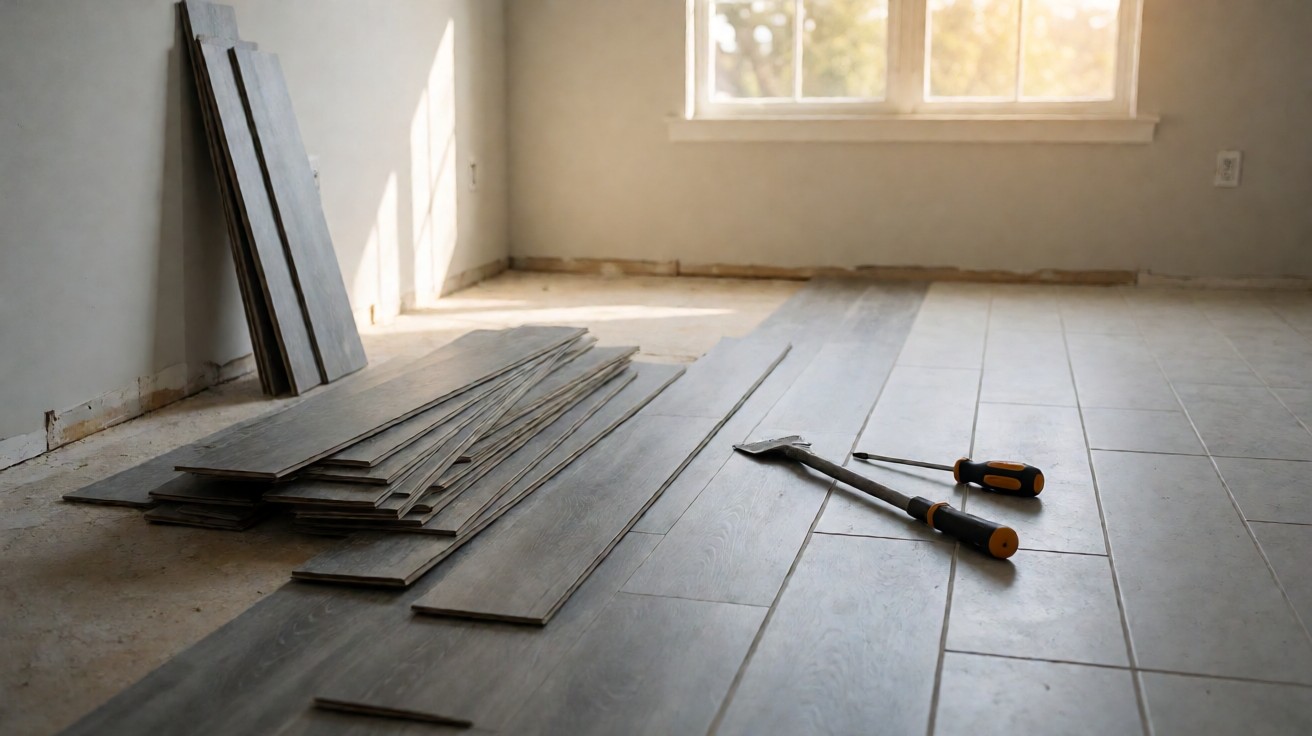

Three quotes for the same 450 square foot room arrive at $3.90, $5.40 and $8.10 per square foot installed, and all three name the same rigid core plank.
The answer is the wear layer, not the format. A 20 mil wear layer on a 6 mm plank lands between $5 and $8 per square foot installed across most of North America, and anything under $3.50 buys a wear layer thinner than one you still own in ten years. LVP and LVT are the same family, so both searches belong in one comparison.
What LVP Is Made Of, And Why The Wear Layer Sets The Price
Rigid vinyl plank is a sandwich, and each layer does one job. A clear wear layer sits on a printed film, the film sits on a rigid core, and a backing layer closes the bottom. The core is either WPC, a wood plastic composite, or SPC, a stone plastic composite loaded with calcium carbonate.
The wear layer is the transparent top film measured in mils. One mil is 0.0254 mm, so a 20 mil layer is about 0.5 mm of clear PVC, and it is the only part of the floor that gets walked on and worn through. Everything below it is structure.
ASTM F1700 is the standard written for solid vinyl sheet and tile, and its wear layer is measured the same way, in mils. Rigid plank and rigid tile share that convention, which is why one spec sheet reads correctly whichever shape the flooring arrives in.
That is the number to argue about.
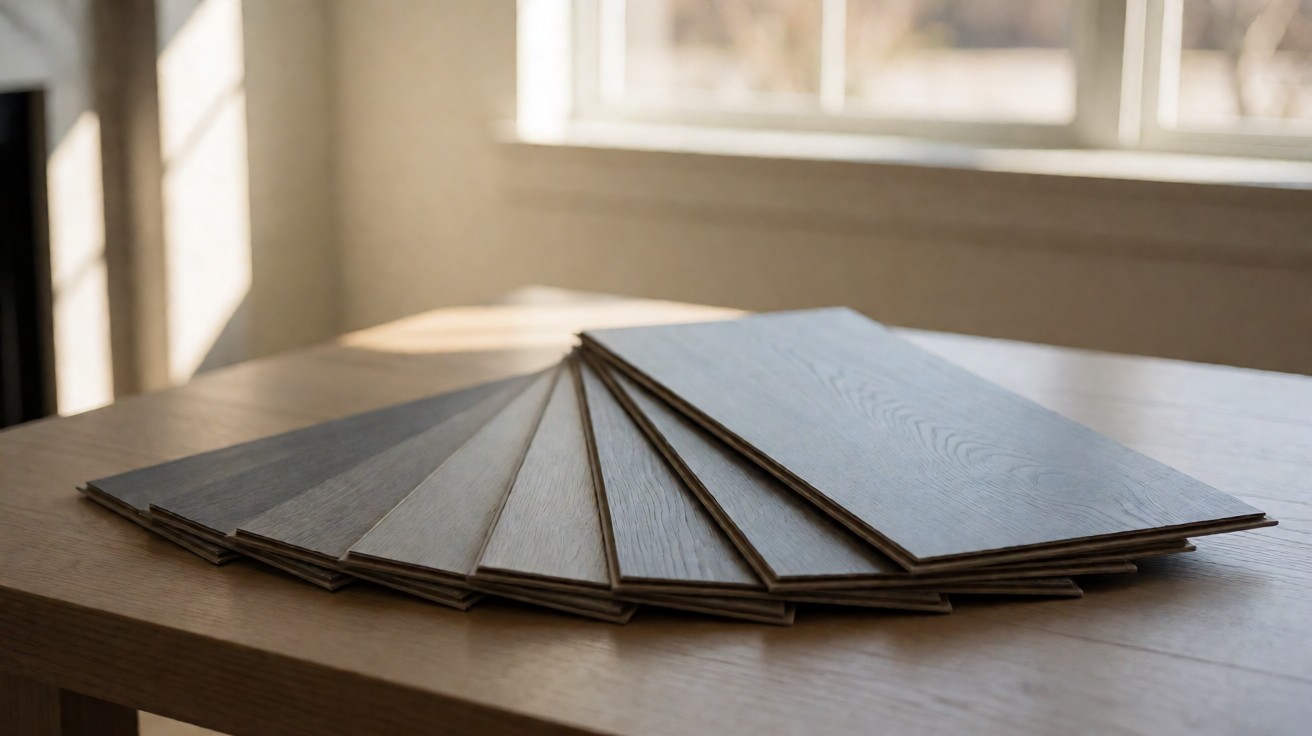
Entry plank runs about 5 mm total with a 6 or 8 mil layer. Mid grade runs 5 to 6 mm with a 12 or 20 mil layer. Premium plank runs 6 to 8 mm with a 30 mil layer. Thickness past that buys rigidity you can also get by levelling the floor underneath.
One box of twenty planks at 6 by 48 inches covers 5.5 square feet, so a 450 square foot room takes 82 boxes before a single cut. That box size is what drives the rounding line on every quote you read.
If the rest of the property still has no flooring chosen, the vinyl guide sets the families against each other first.
What LVP Flooring Costs Per Square Foot
Material alone runs $1.80 to $2.60 per square foot for entry grade and $4.00 to $7.50 for a 30 mil commercial product. Installed, those same products land between $3.50 and $5.00, and between $7.00 and $10.00.
| Product tier | Wear layer | Material per sq ft | Installed per sq ft |
|---|---|---|---|
| Entry WPC plank | 6 to 8 mils | $1.80 to $2.60 | $3.50 to $5.00 |
| Mid grade SPC plank | 12 to 20 mils | $2.50 to $4.00 | $5.00 to $7.00 |
| Premium SPC plank | 20 to 30 mils | $4.00 to $7.50 | $7.00 to $10.00 |
| LVT tile, 2 to 2.5 mm | 12 to 20 mils | $2.60 to $4.50 | $5.50 to $8.00 |
| Small room, many cuts | 30 mils | $5.00 to $8.00 | $9.00 to $14.00 |
The gap between those columns is labour, and the material versus installed price breakdown shows where it goes.
Anything under $3.50 per square foot installed needs one question: what is the wear layer in mils. If the answer is 6 mils, the floor suits a bedroom and fails in an entry hall where grit arrives on shoes.
A quote at $11 per square foot is not automatically better. Sometimes the extra dollars buy a thicker core the room does not need. Sometimes they buy a membrane and levelling compound on a slab that genuinely required both.
Where The Money Goes On A Quote
A typical installed quote breaks into six lines: material, underlayment or adhesive, labour, trim and transitions, removal, and waste. Underlayment and adhesive ride together because the install method decides both.
| Line item | Typical cost | Share of total | What moves it |
|---|---|---|---|
| Material | $2.50 to $4.00 per sq ft | 42 to 65 percent | Wear layer in mils |
| Labour | $1.80 to $3.00 per sq ft | 30 to 50 percent | Cuts, stairs, flatness |
| Underlayment or adhesive | $0.25 to $0.75 per sq ft | 4 to 12 percent | Click lock or glue down |
| Trim and transitions | $1.00 to $3.00 per linear foot | 3 to 8 percent | Doorways and corners |
| Removal and disposal | $1.00 to $2.50 per sq ft | 5 to 15 percent | What is already down |
| Waste | 8 to 15 percent of material | 5 to 12 percent | Cut count and pattern |
Labour is the number that surprises people, running 35 to 50 percent of an installed quote. In a small room needing four cuts per plank it can outrun the material, because a 60 square foot bathroom is mostly perimeter.
Material is often the smallest line on a well built quote.
When two quotes differ by more than $1 per square foot, the difference is almost never the plank. It is preparation, perimeter work, or the hours the installer expects the room to take.

Why LVT And LVP Get Priced Differently
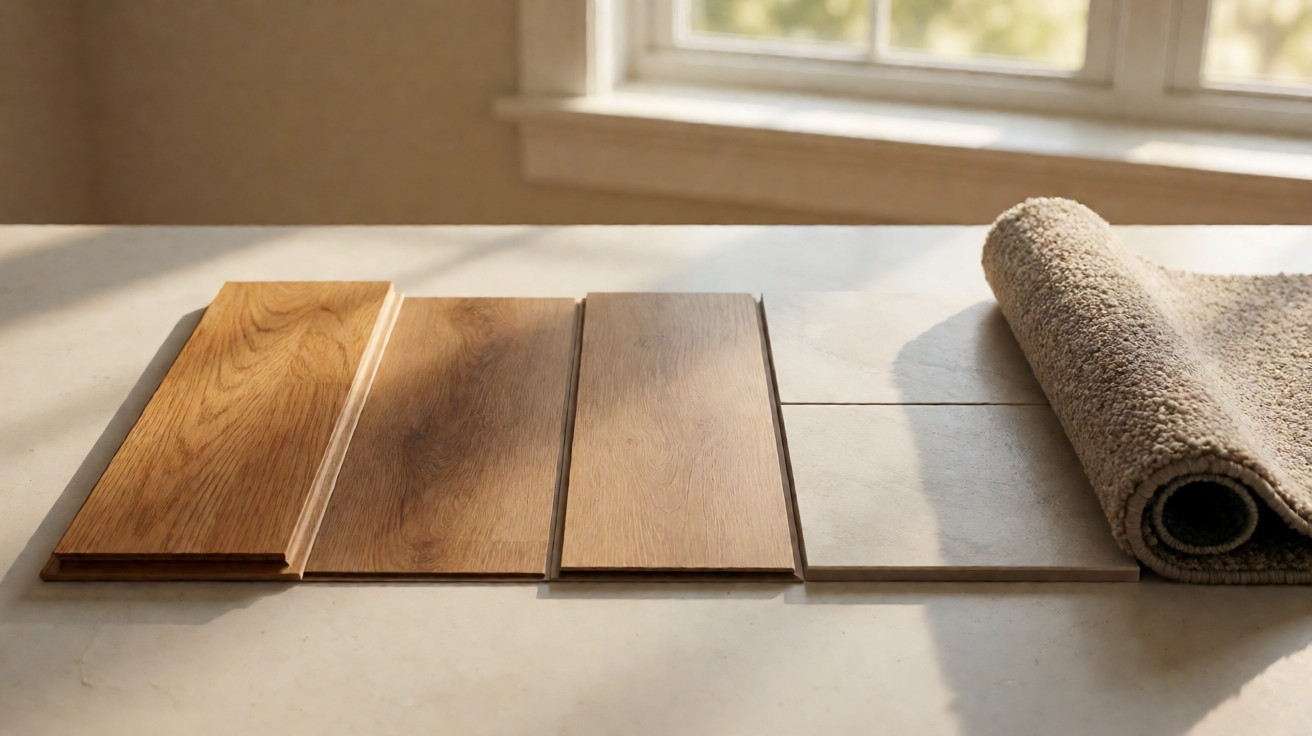
LVT is the same sandwich sold as tiles rather than planks, typically 2.0 to 2.5 mm thick. Stone and marble looks need a better print layer with tighter registration between film and surface, and they usually carry a 20 mil wear layer where wood look planks at the same gauge run 12.
| Format | Thickness | Wear layer | Installed per sq ft |
|---|---|---|---|
| LVP plank, wood look | 5 to 6 mm | 12 to 20 mils | $5.00 to $7.00 |
| LVP plank, stone look | 5 to 8 mm | 20 to 30 mils | $7.00 to $10.00 |
| LVT tile, 12 by 12 inch | 2.0 to 2.5 mm | 12 to 20 mils | $5.50 to $8.00 |
| Herringbone tile | 2.5 to 3.0 mm | 20 to 30 mils | $8.00 to $12.00 |
The format changes the price far less than the wear layer does. A 6 mm plank with a 6 mil wear layer is the wrong buy whatever shape it arrives in.
Herringbone and chevron are the exception, because pattern repeat pushes waste past 15 percent and the extra cuts push labour up. Installed tile then costs more than the plank it was meant to replace.
What Moves A Quote Up Or Down
Five things move the number, and only one of them is the product itself.
The wear layer is first. Moving from 12 mils to 20 mils can add $1.00 to $2.50 per square foot, because a thicker clear film costs more to cast than a thin one.
The core is second. SPC is roughly twice as dense as WPC, which is why it carries both a higher price and a higher impact rating. ASTM E492 sets the impact insulation class test, and most condo bylaws ask for a Delta of 50.
The install method is third. Click lock is faster, but it needs a pad the manufacturer will warranty, and glue down bonds directly to the subfloor in a way no floating floor can match. Where the room sits over concrete, that bond is worth more than the labour you saved.
Plank length is fourth. A 48 inch plank costs more per square foot than a 36 inch plank and cuts less often, which matters once the labour rate reaches $3.00 per square foot.
Cut count is fifth, and it is geometry rather than product. A 9 by 13 foot room produces more offcut per row than a 9 by 30 foot room, even where the total area is identical.
When a quote rises as the room shrinks, you are looking at labour, and that is normal. When it rises as the room grows, look for pattern repeat or a stair line instead.
Concrete Slabs And The Extra Line Items They Create
A slab adds three checks and two possible line items that never appear on a plywood quote. None of them is padding, but all of them belong on the page.
Test moisture in place with an RH probe, which ASTM F2170 covers. Under 75 percent relative humidity most manufacturer limits are satisfied. Between 75 and 85 percent the floor still goes down over a moisture tolerant adhesive or a membrane. Above 85 percent the slab is wet at the source.
The calcium chloride test in ASTM F1863 reports moisture as pounds per 1,000 square feet over 24 hours, and a reading above 3 means mitigate first. It is unreliable on a slab wetted from below, which is exactly the slab you were worried about.
Flatness is the other half. Grinding runs $0.50 to $1.50 per square foot and self levelling compound runs $1.50 to $3.50. Where the slab varies more than a quarter inch over 20 feet, no plank thickness rescues the installation.
Expansion joints get filled with semi rigid polyurethane rather than rigid grout, because rigid filler transmits movement into the plank instead of absorbing it.
Where the slab is the whole project, flooring over concrete slabs lists what each material actually requires.
Over a slab most installers prefer glue down to click lock for that reason. If you want a floating floor, ask for an underlayment rated for concrete rather than standard foam and film.
Wet Rooms, Warranties, And The Standards Behind Them
Water resistance belongs to the product, not to a promise. A 20 mil wear layer with a factory finish handles a wet bathroom floor for years, provided the perimeter is not the weak point.
Slip resistance is measured as a dynamic coefficient of friction under ANSI A326.3, and 0.42 is the figure accessibility codes reference for a level interior walking surface. Read that precisely: the 0.42 has to hold when the surface is wet, so a dry reading off a fresh sample proves little.
That number is why polish is not a repair. Every coat changes the friction reading, and a factory finish already measuring at or above 0.42 dry needs no sealer to pass.
ASTM F1820 covers recyclability and content in resilient flooring, and it is the standard to cite when an owner wants to know what is inside the floor rather than how long it lasts.
IICRC S100 is the cleaning protocol used to read a warranty, because most manufacturers void coverage when a solvent cleaner replaced the neutral pH cleaner named in their system.
If the floor goes into a commercial kitchen or a public entry, ask for the friction reading from the actual product lot rather than the brochure, since finishes vary between runs.
Where Quotes Hide Money
Square footage is the first hiding place. Measured area is the finished floor. Estimated area is usually room dimensions multiplied out, with no deduction for closets and no addition for the alcove.
Waste is the second. A straight rectangular room needs 8 to 10 percent, a room with a peninsula and 30 degree corners needs 12 to 15, and herringbone needs 15 to 20 because the offcuts come up short.
Trim is the third, and the line that quietly doubles on renovation work. Baseboard removal and replacement runs $1.00 to $3.00 per linear foot, while quarter round and matching transitions are quoted separately by some installers and buried in a labour rate by others.
Stairs, thresholds and door jambs are the fourth. Undercutting a jamb runs $15 to $30 per door, and a stair step runs $3 to $10 depending on whether the nosing is reused.
Removal and disposal are the fifth. Lifting carpet or old glued tile runs $1.00 to $2.50 per square foot, and disposal is sometimes priced by area and sometimes as a flat $150 to $400 load fee.
A square footage calculator that asks for dimensions and a waste percentage catches all of this before the quote does.
Ask for each of these as its own line. A quote with six lines you can price separately is a quote you can argue with.
Reading Two Quotes Line By Line
Lay the two quotes side by side and compare in this order: product, wear layer in mils, thickness in millimetres, install method, preparation, trim, removal, waste percentage, and labour basis.
Start with the product line. If the wear layers differ, the quotes are not comparable and the higher number may simply be the correct one.
Check the labour basis next. One installer prices at $2.20 per square foot and another bills by the hour, which turns a slow first plank and an out of level subfloor into your money rather than theirs.
As long as both quotes carry the same wear layer and the same scope, the difference is arithmetic and you can settle it yourself. Only once the product lines match does it make sense to argue the waste percentage down.
Arguing waste on a 12 mil product buys less of it, not more. Have each installer write the wear layer, the thickness, the underlayment or adhesive by name, and the waste percentage on the quote itself.
A Worked Example For A 450 Square Foot Room
Here is the shape of a quote you can redo. Room area is 450 square feet, a plain rectangle, carpet to remove, no stairs.
Add 10 percent waste, so you are buying 495 square feet. At 5.5 square feet per box, 495 divided by 5.5 is 90 boxes. At $2.90 per square foot, material is 495 times 2.90, which comes to $1,435.50.
Underlayment at $0.55 per square foot is 450 times 0.55, so $247.50. Labour at $2.45 per square foot is $1,102.50. Trim at $1.60 per linear foot over 62 linear feet is $99.20. Two transitions at $9 are $18.
Add them: $1,435.50 plus $247.50 plus $1,102.50 plus $99.20 plus $18 equals $2,902.70. Divided by 450 square feet, that is $6.45 per square foot installed.
Labour is 38 percent of that total.
Change one variable. A 20 mil wear layer at $4.05 per square foot adds $569.25 to the material line and lifts the installed figure to $7.72. For a hallway where grit arrives on shoes that is money well spent, and in a bedroom it is $569 left in the shop.
If you would rather verify that than trust it, the box count holds for any room: area times 1.10, divided by the square feet per box printed on the carton.
DIY Or Hire An Installer
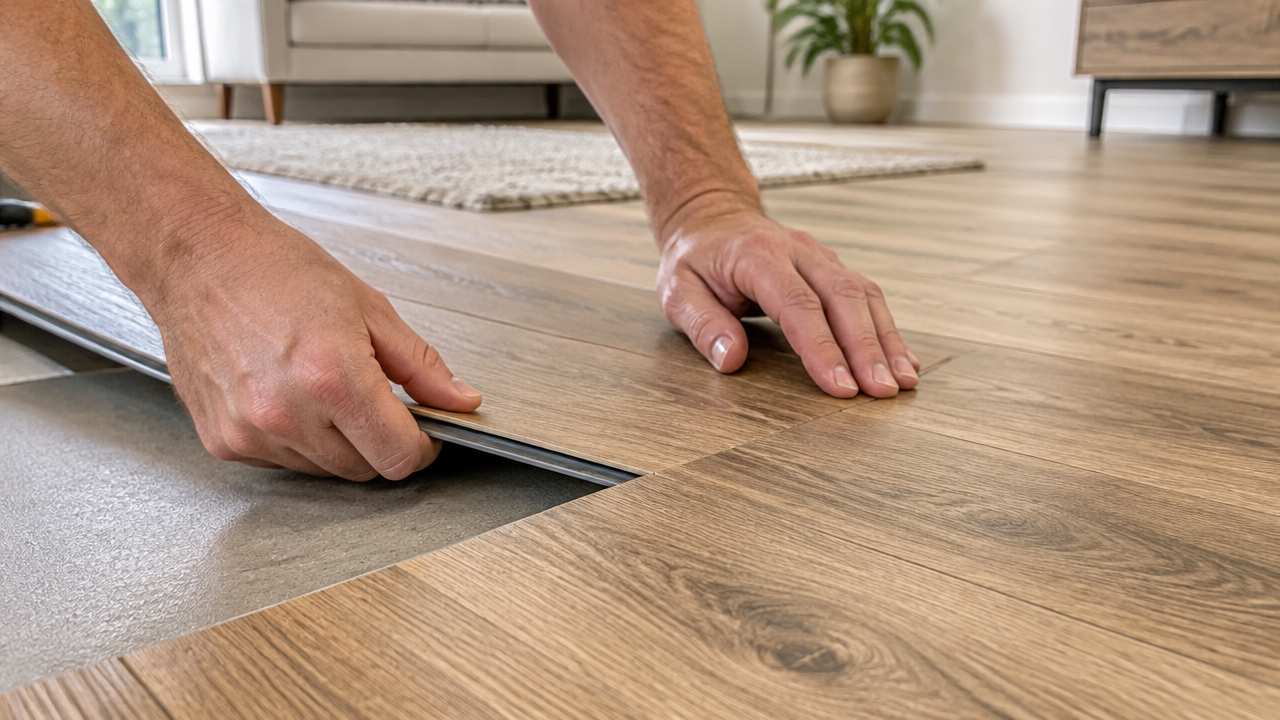
Click lock LVP is the most forgiving product in the trade, and for a straight rectangular room over flat plywood it is a reasonable weekend.
The plank is not the hard part. Getting the first two rows straight and plumb is, because every later row inherits the error. Leave a three-eighths inch expansion gap, about 9.5 mm, at every wall, and never cut the last row narrower than half a plank.
A circular saw with a 60 tooth carbide blade or a fine tooth jigsaw cuts this material cleanly. A utility knife scores the top layer and snaps it for straight cuts. You also need a tapping block, a pull bar, spacers and a chalk line.
Over concrete the trade changes completely. A do it yourself job with no moisture test is the most common cause of LVP failure, because the failure arrives a year later as cupping or a lifted seam that no warranty covers.
Glue down demands a notched trowel, an adhesive matched to the slab, and a working open time. Hire that unless you have laid a sheet of vinyl before.
The wider trade offs sit in diy versus professional installation, and the arithmetic is simple: an installer at $2.45 per square foot across 450 square feet is $1,102.50 for the labour line.
If your time is worth less than that hourly and the room is genuinely simple, do it yourself. If the room is not simple, the saving is the smallest of the risks you are taking.
Where The Money Is Not Worth Spending
This material punishes overspending more than most. Every added dollar should buy a specification that changes the life of the floor, not one that changes the photograph.
A 30 mil wear layer in a guest bedroom is money with nowhere to land. Spend it in the entry hall, where grit off shoes does the work of an abrasive.
An 8 mm core does not fix a slab that varies by half an inch. Preparation does. When a quote is padded on the core and stingy on levelling, the money sits in the wrong line.
Extra underlayment beneath a glue down install adds no strength. The full contact bond through the adhesive is the structural layer, and a pad under it only adds cost and a hollow sound.
Polish does not restore a worn wear layer. Once the clear film is through, no coating brings it back, so a floor down to 10 mils in a busy hall needs replacing rather than restoring.
If the real question is whether vinyl suits the property at all, solid versus engineered hardwood is a better use of an afternoon than another wear layer upgrade.
Where the money does belong: flatness, the wear layer in the one room that takes the abuse, and trim that matches. Those three outlive every other line on the quote.