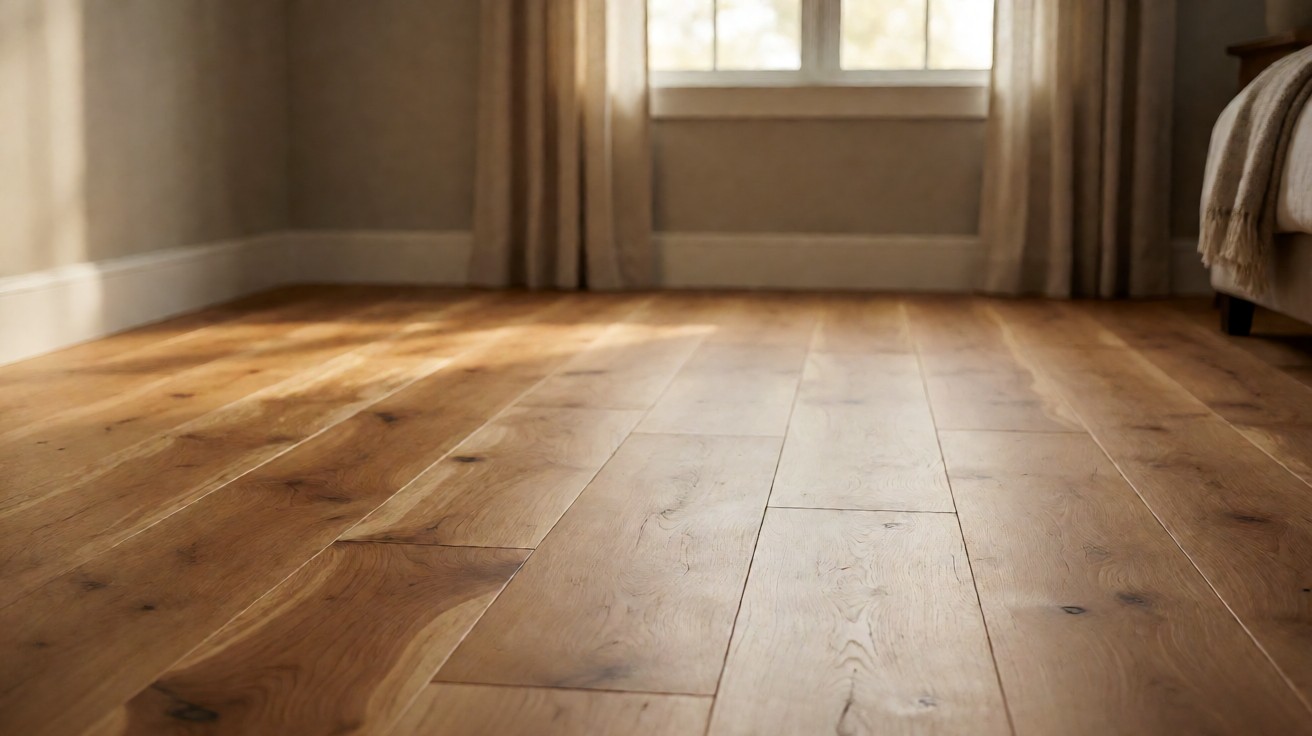

Hardwood and laminate both look like a wood floor from across the room, and only one of them is real wood that responds to what happens on its surface. That difference is invisible until something happens to the floor: a dropped pan, a dog, a spilled drink, a scratch from a dragged chair. Hardwood absorbs the event and records it as a patina or a mark. Laminate absorbs the event as a scuff in a plastic layer that can often be ignored for years. Everything that follows, from price to repair to resale, comes from that single fact rather than from how the two look side by side in a showroom. The hardwood guide and the laminate guide cover each material separately.
What Each One Is
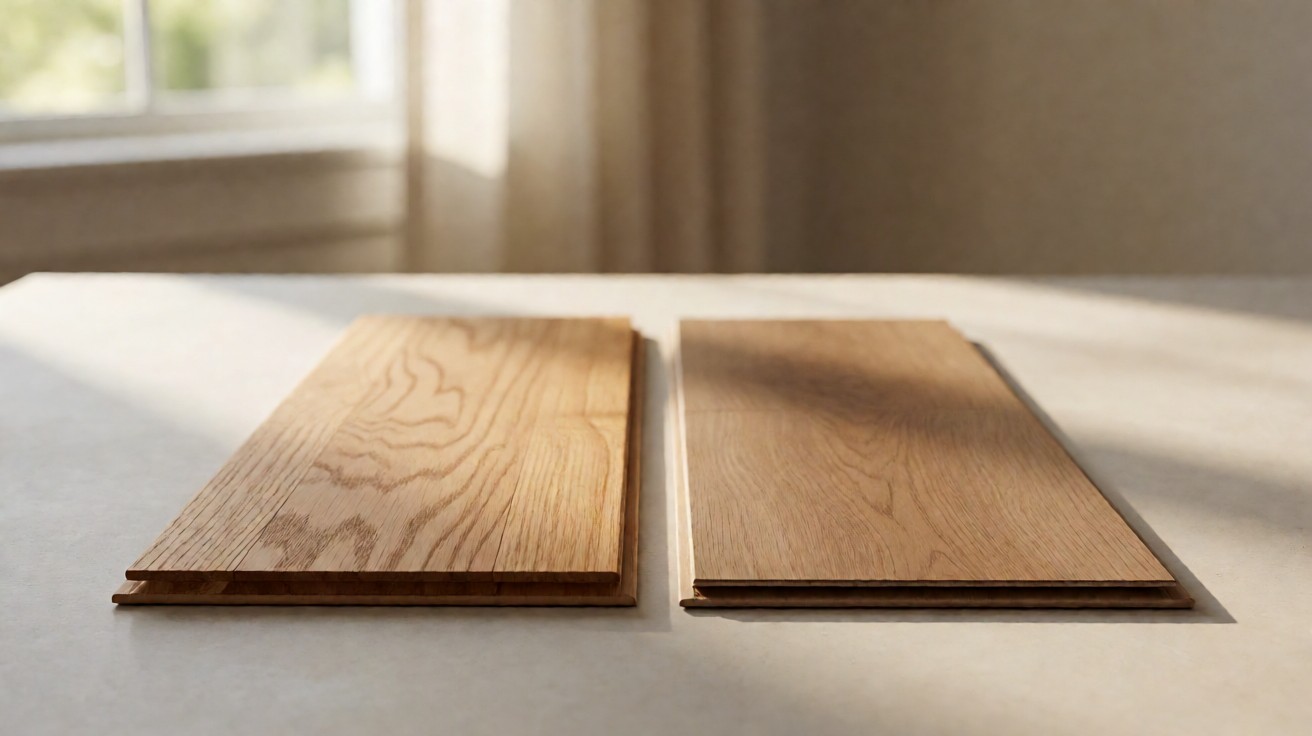
Hardwood flooring is milled from the trunk of a tree, sawn into boards, and finished with a surface coating. Solid hardwood is one piece of timber from top to bottom and can be sanded repeatedly. Engineered hardwood is a thin veneer of real hardwood bonded to a plywood or HDF core, which makes it dimensionally far more stable and which is covered separately in the engineered construction page. Both are real wood in the sense that matters to this comparison: they scratch, they dent, they swell with moisture, and they can be refinished.
Laminate is a printed paper or vinyl layer bonded to a fibreboard core, with a clear overlay above it. The wood appearance is a photograph printed and reproduced, not a grain structure. There is no wood anywhere in the product, which is why laminate is dimensionally very stable, why it does not swell in the way hardwood does, and why it cannot be sanded when the surface wears through.
How Each One Handles Damage
This is the practical heart of the comparison. A scratch in solid hardwood is a surface abrasion that can be screened and refinished as part of a whole-floor refinish, or spot-repaired with a wax stick if the board is otherwise clean. A scratch in laminate is a scratch in a plastic overlay. It can often be ignored, it can be filled with a touch-up pen, and once it cuts through the overlay into the printed paper, it cannot be repaired at all and the board has to be replaced.
A dropped cast-iron pan behaves differently on each. On hardwood it will dent, and a dent in hardwood is permanent because the wood fibres have crushed. On laminate it will either mark the overlay or chip the board, and a chip is permanent for a different reason. The hardwood grades page covers what different timber quality tolerates, which matters for the same reason.
Water and Where Each One Belongs
Neither material should go in a wet room, and the specification to look for is the water resistance rating rather than a promise of waterproofing. Laminate with a high water resistance rating tolerates occasional splashes and spills better than hardwood, because the fibreboard core is sealed and the overlay does not absorb, and it recovers from a wet mop where a hardwood board would hold moisture at the joint. Neither tolerates a flood, a leak left overnight, or a bathroom floor.
For basements and rooms over slab, the comparison is close enough that the answer usually comes down to the slab rather than the floor. Both are floating options over a moisture barrier in most basement specifications, with engineered hardwood and laminate both performing acceptably. The best flooring for kitchens page covers the wet-adjacent room in more detail.
| Situation | Better Choice | Reason |
|---|---|---|
| Formal room, long ownership | Hardwood | Can be refinished and will outlast the house |
| Young children, active household | Laminate | Overlay shrugs off scuffs that mark real wood |
| Pets with claws | Laminate | Resists scratching that would gouge hardwood |
| Rental or short hold | Laminate | Lower cost, no refinishing needed |
| Sunroom or unheated space | Laminate | Dimensionally stable across temperature swings |
| Main living room, family | Engineered hardwood | Wood feel with better stability over a slab |
| Entryway with grit | Laminate | Takes abrasion from tracked grit |
| House kept 25 years or more | Solid hardwood | One refinish at year twenty extends it another twenty |
What Is on the Box
Both categories are unusually well served by marketing language that describes an appearance rather than a product. A laminate box will say things like European wood look or hand-scraped surface, and none of those words distinguish laminate from anything else. What identifies it is the construction: fibreboard core, decorative paper layer, clear overlay. An AC rating on the box is the durability number, and it is worth reading; the laminate durability guide covers what those ratings mean.
A hardwood box will say solid or engineered, and that is the distinction that actually matters here. It will also carry a species name, and the species determines the colour, the hardness, and how the floor responds to beading and light. A first-grade oak floor and a fourth-grade oak floor are the same species with very different appearance, which is covered on the hardwood grades page.
Comfort, Sound, and Repair
Hardwood is warmer underfoot than laminate, and marginally quieter, and it is the more forgiving surface to live on barefoot in winter for the same reason cork is. Neither is close to carpet on either measure, and a rug solves both more cheaply than changing the floor. The honest statement is that the difference is real but modest, and it is not the reason most buyers end up choosing one material over the other.
Repair runs in the opposite direction. A damaged laminate board is replaced by lifting surrounding boards, which is a half-day job if the rest of the floor is the same product. A damaged hardwood board is replaced the same way. The real asymmetry is refinishing: hardwood can be restored to new condition any number of times, and laminate cannot be restored at all once the overlay is worn through. Over a thirty-year ownership, that is the difference between a floor that looks better in year thirty and a floor that needs replacing in year twenty-five.
Installation and Who Can Do It
Laminate is a click-lock product in almost every instance, which means one person with a mallet and a tape measure can lay a room in a day and the floor goes down over an existing surface as long as it is flat and firm enough. Hardwood in nail-down or staple-down form requires a flat subfloor, a nailer, and a level of care that a first-time installer can learn but is unlikely to get right on a first job in a visible room.
Engineered hardwood changes that balance considerably, because it installs with the same adhesive or click-lock methods as laminate and is far more forgiving over a slab. Solid hardwood is the one genuinely skill-dependent floor in this comparison. If the room is going to be done by a contractor, the labour difference narrows considerably; if it is a homeowner project, it does not.
| Dimension | Solid Hardwood | Laminate |
|---|---|---|
| Core material | Timber from top to bottom | High-density fibreboard |
| Appearance layer | The grain itself | Printed paper or vinyl |
| Scratch behaviour | Absorbs, can be refinished | Marks the overlay, cannot be refinished |
| Dent behaviour | Permanent crush | Chips or dents the board |
| Water tolerance | Swells, needs conditioning | Tolerant of spills, not floods |
| Impact sound over a pad | Better | Often better |
| Repair of one board | Replace board | Replace board |
| Full-floor restoration | Sand and refinish, repeatable | Not possible |
| Typical lifespan | 50 to 100 years | 15 to 25 years |
| Resale read | Premium | Budget |
Acoustic Ratings and What They Are Worth
Both products are rated under the same IIC and ASTM E90 impact sound class framework, and here the laminate result is genuinely surprising. Good laminate with a proper pad routinely outperforms hardwood on impact noise, because the fibreboard core and the pad together damp the transmitted sound more than hardwood over the same assembly. Airborne sound, the conversation you can hear through the floor, is better in both when a resilient pad is used, and hardwood is the better of the two there.
The practical consequence is that laminate over a pad is a reasonable answer to an upstairs floor over a downstairs room, and it is frequently the cheaper one. The acoustic advantage evaporates entirely if either floor is installed directly with a cement board or a thin adhesive and no pad, which is the configuration that produces the worst results in both products.
Cost and What the Price Buys
Laminate runs roughly 40 to 60 percent less than solid hardwood per square foot and somewhat less than engineered hardwood. Material is only half the difference; installation is where hardwood’s price actually shows, because nail-down or staple-down solid hardwood is slower, needs a flat subfloor, and carries a higher labour rate than a click-lock laminate. For a 15-by-15-foot living room, the all-in difference is commonly $1,500 to $3,500, and that gap is the entire argument on price.
Against it sits the twenty-five-year number. A laminate floor in a family living room that has to be replaced in year twenty-five means the cheaper option cost more, and the comparison against hardwood is fairer than the comparison against a thirty-year-old floor. The break-even calculation depends on traffic and household, and it is worth doing before treating the upfront saving as a saving.
Resale and the Recognition Problem
Hardwood is universally recognised as a premium floor and laminate is not. In an appraisal conversation, a house with real hardwood in the main living spaces is described in a way that a house with laminate is not, and buyers and agents treat the two differently even when the laminate is a good product at the same price point. This is a market perception rather than a material fact, and it is the single strongest financial argument for hardwood if the house is likely to be sold.
That argument weakens considerably over time, because a good laminate floor stops reading as laminate the harder it is walked on. Surface wear on a laminate overlay dulls the printed pattern, and the floor gradually reads as a wood floor that has lived. It is worth weighing alongside the refinishing argument rather than in place of it.
Choosing Between Them
Hardwood if the house will be held long, if the floor will be in a formal or lightly trafficked room, if an unfinished look matters, and if a refinish in fifteen years is part of the plan rather than a surprise. Laminate if the household is active, if there are pets or young children, if the room sees grit and spills, if the budget is the binding constraint, or if the installation needs to be fast and simple over an existing floor.
The most common regret in this category is laminate specified in a formal room of a house that will be held for decades, because it looks fine for fifteen years and then has no second life. The other is hardwood specified in a family room with a dog, because the floor gets marked in year two and the owner had imagined a finish that would tolerate it. Both are recoverable decisions, and both are avoidable by asking one question first: who walks on this floor, and how much of it is sand.