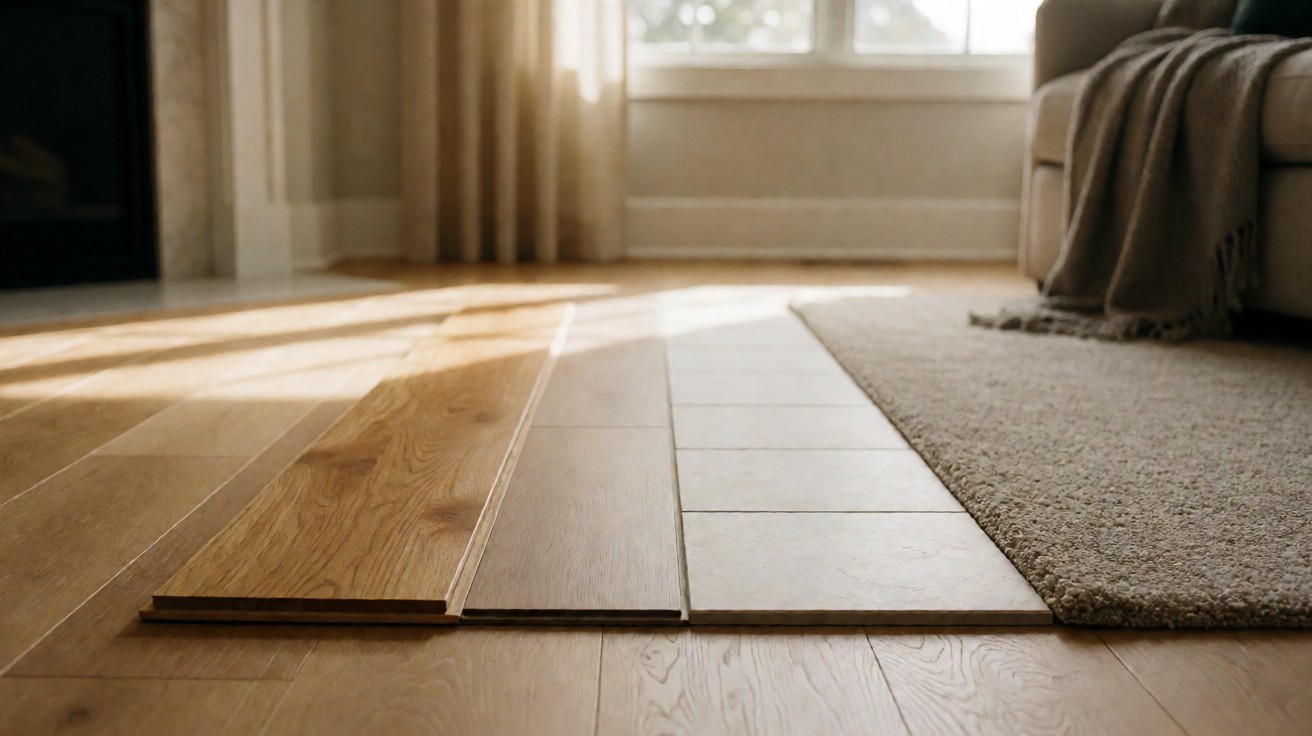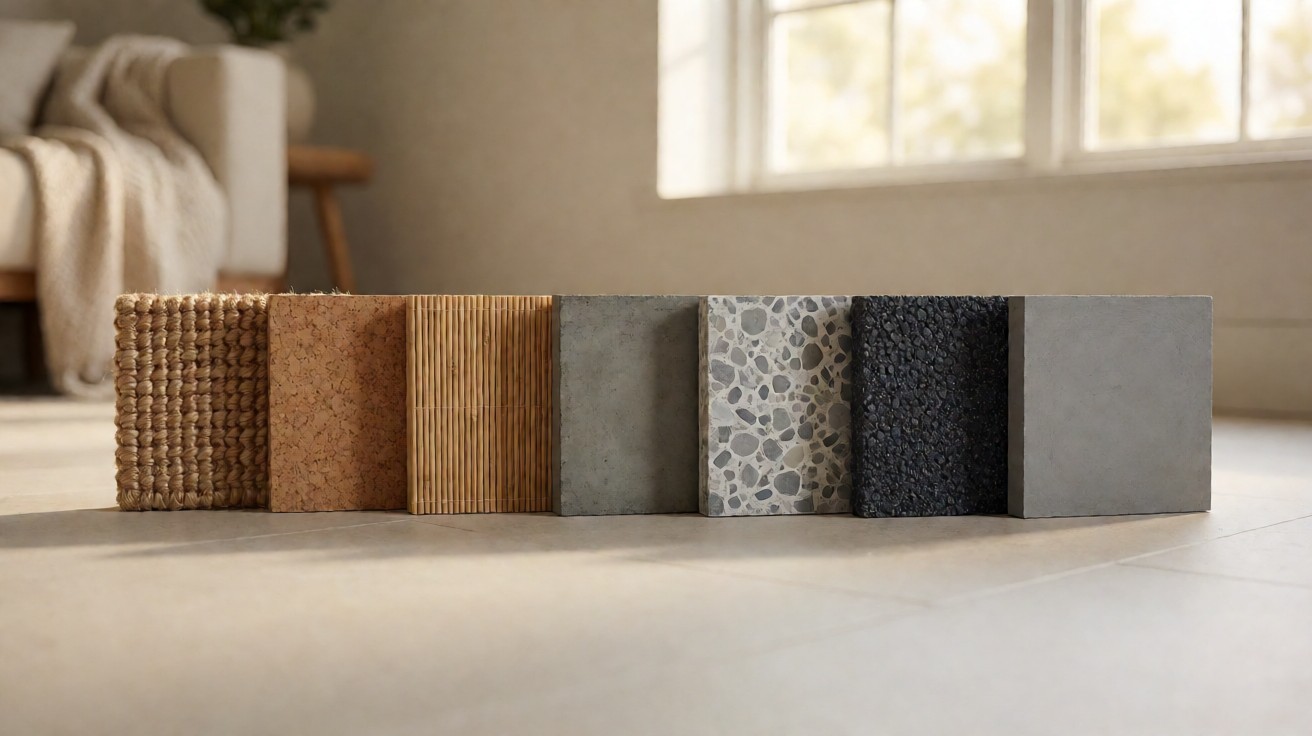

Specialty flooring is everything outside hardwood, tile, vinyl, laminate, and carpet, and these options fail in completely different places from each other. That is the thing worth understanding before comparing them on price or appearance: these are not eight versions of a floor. Some are mineral and some are plants and some are synthetic polymers, and that single distinction predicts water behaviour, repair method, lifespan, and how the floor looks after ten years before you have compared a single specification. This page sorts the category and points each one to the page that goes deep on it.
The Taxonomy That Actually Predicts Behaviour
Specialty flooring splits cleanly into three families, and the family tells you most of what you need to know. The plant family is cork, bamboo, and natural fibre carpet: harvested or grown, structurally fibrous, warm to the touch, and moderately vulnerable to standing water. The mineral family is natural stone, terrazzo, polished concrete, and microcement: fired, quarried, or cast, rigid, dimensionally stable, and largely indifferent to water provided it is sealed correctly. The synthetic family is rubber, sheet vinyl, LVT, and linoleum: manufactured polymers, the most water-tolerant and the most repairable in the category, and the least able to be refinished.
Nothing in that summary is about quality. Cork is not a worse floor than concrete, and rubber is not a better one. What the taxonomy does is let you eliminate quickly. If the room will see standing water, the plant family is out and you are choosing between mineral and synthetic. If the floor will carry a heavy dropped object, the mineral family is out. If you want to sand and recoat in twenty years, the synthetic family is out. Those three eliminations remove most of the category before a single product gets compared.
The Mineral Family: Stone, Terrazzo, Concrete, and Coatings
The mineral family is defined by rigidity and by the fact that none of it comes from a living plant. Natural stone is the oldest material in this category and the only one in it that predates the building trade; the natural stone flooring page covers the family properly, and the comparison against the manufactured imitation is a decision worth making explicitly rather than on price. Terrazzo is a poured composite where the aggregate is chosen by the buyer, which makes it the only material here with a fully custom colour palette, at the price of an installed concrete floor. The terrazzo flooring page covers the binder and aggregate choices that set the price. Polished concrete goes the other way and removes choice almost entirely in exchange for the lowest waste and lowest material cost in the category.
Microcement and resin sit on the boundary of this family because they are thin coatings rather than structural floors, which is the whole subject of the microcement and resin flooring page. What unites the mineral group is behaviour: every one of these floors is hard, cold underfoot, dimensionally stable, indifferent to foot traffic, and dependent on the substrate it sits on. Choosing inside the mineral family is mostly a choice about whether you want to see the slab.
The Plant Family: Cork, Bamboo, and Natural Fibre
The plant family is defined by warmth and by a shared susceptibility to standing water. Cork and natural fibre are both structurally fibrous, which is where their softness and their acoustic benefit come from, and both need dry rooms and careful cleaning. The natural fiber carpet page covers the four plant fibres that qualify. The cork flooring page covers the material that most fully exploits this structure, including why it dents and recovers rather than scratching.
Bamboo is the plant family member that behaves least like a plant, because it is a pressed and sometimes resin-bound product with the hardness of a dense hardwood and the dimensional movement of grass. The bamboo flooring page covers the solid versus strand-woven construction that decides its durability, and the honest summary is that it is the least plant-like option in this category in both its performance and its market reception.
Water Tolerance, Ranked Honestly
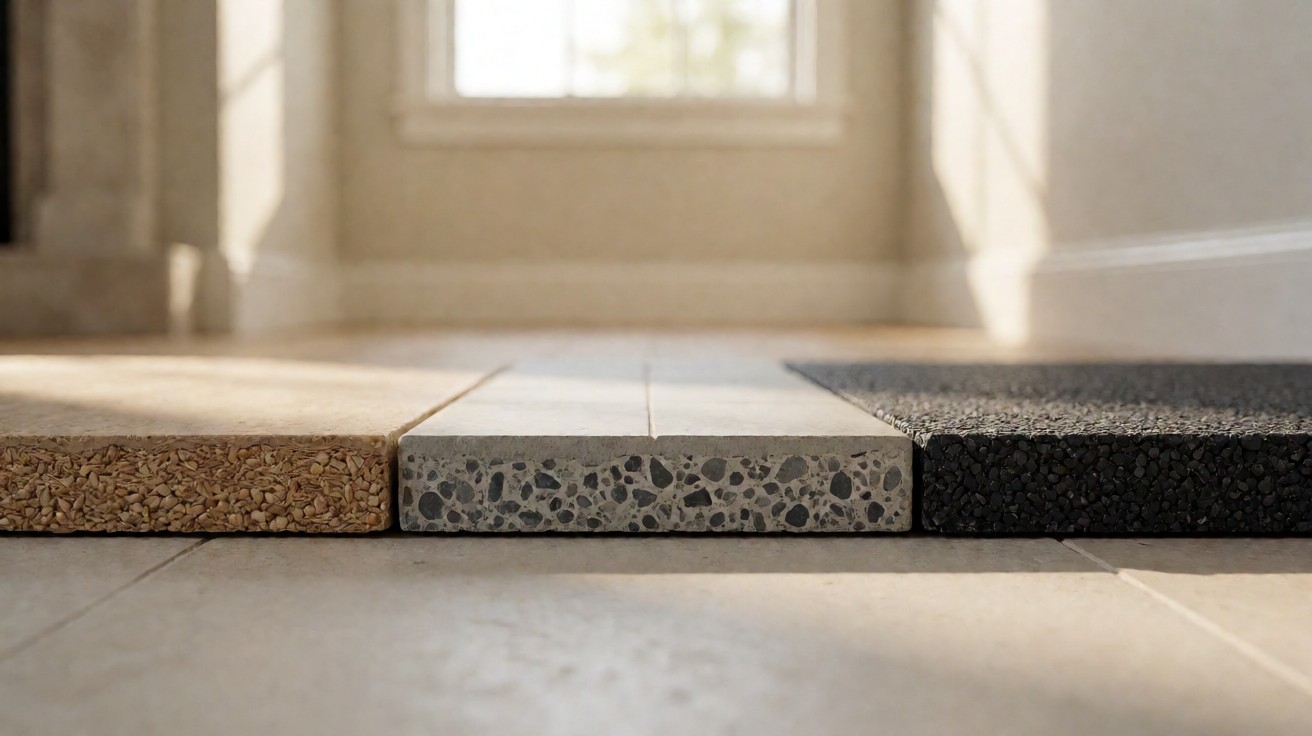
Water tolerance is the axis most often used to choose a specialty floor and the one most often answered wrong. The honest ordering is: vitrified tile and porcelain at the top with no sealing needed; synthetic rubber, LVT, sheet vinyl, and linoleum next, all non-porous by construction; then polished concrete, terrazzo, and natural stone, which are mineral and dense but still need a sealer and still react to acid; then microcement and resin, which are waterproof as a system but depend entirely on substrate integrity; and last the plant family, where cork absorbs, bamboo swells, and natural fibre stains permanently.
The trap in this ranking is that the middle looks far safer than it is. Stone and concrete are frequently sold as waterproof, and untreated they are not. Sealed properly they are extremely good in a wet room. Sealed badly, or with the wrong sealer for the stone, they will grey, etch, and hold a stain within a couple of years. The rubber flooring page covers the one option in this category that is genuinely waterproof by material rather than by treatment, which is why it keeps appearing in laundry rooms and mudrooms.
Repair and Replacement: The Axis Buyers Skip
Ask what happens when a piece is damaged, because the answer separates this category more sharply than any other. Manufactured products replace invisibly: an LVT plank, a ceramic tile, or a rubber tile from the same batch is indistinguishable from its neighbours and can be swapped in an afternoon. Panelled or seamless products repair rather than replace: a microcement or polished concrete patch can often be ground and blended into the surrounding floor, or in the case of natural stone, a small defect can be filled with a colour-matched compound at close range.
Plant fibre and quarried stone are the difficult end. A damaged cork plank means sourcing a matching plank, which is realistic within the first two years and progressively harder afterwards. A broken stone slab cannot be matched at all, ever, because each piece is unique. And natural fibre carpet cannot be patched invisibly at all. Before choosing a specialty floor for a house you expect to hold, it is worth asking how long the manufacturer or supplier expects to keep matching stock, because that number is what determines whether a future repair is a non-event or a renovation.
| Material | Family | Water | Damaged Piece | Resurfacing |
|---|---|---|---|---|
| Natural stone | Mineral | Seal required | No match possible | No |
| Polished concrete | Mineral | Good, densified | Patch and blend | Regrind |
| Terrazzo | Mineral | Good if sealed | Patch and blend | Regrind |
| Microcement and resin | Mineral or synthetic | System dependent | Patch and blend | Recoat |
| Cork | Plant | Poor unsealed | Match if stock exists | Resand and refinish |
| Bamboo | Plant | Poor | Match if stock exists | No |
| Natural fibre carpet | Plant | Poor, stains | Not patchable | No |
| Rubber | Synthetic | Excellent | Tile swaps cleanly | No |
The Synthetic Family: Rubber, Vinyl, and Linoleum
The synthetic family is defined by being manufactured to a specification rather than quarried or harvested, and that produces the most consistent material behaviour in the entire flooring market. Rubber is the specialist member and the one that reaches the highest service life of anything residential, at the cost of an aesthetic that has to be accepted rather than designed around. The rubber flooring page covers the residential grades and the format decision.
The rest of this family, sheet vinyl, luxury vinyl tile, and linoleum, is covered on the vinyl and laminate sides of this site and is included here only to mark the boundary of the specialty category. What they share with rubber is non-porosity and invisibility of repair. What they lack, and what keeps rubber in the specialty list, is rubber’s thirty-to-fifty-year service life and its total absence of a finish layer to wear through.
Comfort and Noise, Which Decide More Rooms Than Appearance
Two of the strongest technical arguments in this category are underfoot and acoustic, and both of them favour the same side of the taxonomy. Plant fibre and rubber are the only materials here that genuinely absorb impact. Cork is the warmest and the most forgiving of a dropped pan, rubber is the thinnest and the most acoustically effective, and natural fibre carpet absorbs more than all of them. Every mineral option is hard and cold, and every one of them will transmit footfall to the room below.
The practical consequence is that a finished-basement rec room and an upstairs bedroom are specialty-floor rooms for entirely different reasons. The basement wants hardness and water tolerance because it will take a dropped tool and the slab may be damp. The bedroom wants softness and warmth underfoot and quiet, and the same material in both rooms gets one of the two right. If the material is being chosen by appearance alone, the room is the variable most likely being ignored.
Where Each One Fails
The most useful thing a specialist category can do is be honest about failure, because the failures are specific and predictable. Plant fibre fails through water and through staining. Mineral floors fail through slab movement and through etching, and a polished concrete floor is only as good as the slab under it. Synthetic rubber fails aesthetically rather than structurally: it is very hard to make a charcoal rubber floor look like anything other than what it is, which is the honest limitation rather than a defect.
Two failure modes apply across the whole category. The first is the substrate assumption: polished concrete, terrazzo, and microcement all depend on a slab that was in good condition before anyone arrived, and none of them can fix one that was not. The second is the traffic assumption: every material here is being asked to handle furniture, grit, and dropped objects, and a floor specified for a formal room will not survive a family kitchen at the same grade. The cork flooring page is the clearest example in the category of a material whose wear life is entirely a function of felt pads and cleaning habits rather than of its hardness.
Cost, Honestly Framed
Specialty flooring runs from about $3 per square foot for plank-format bamboo to $25 per square foot for a resin floor installed, and the spread is wide enough that a per-square-foot comparison tells you very little. The better framing is cost per year against expected service life, because the category contains both a material that lasts thirty years with no attention and several that need a recoat on a schedule. A material that costs twice as much and lasts three times as long is the cheaper floor, and that calculation favours mineral options and rubber in most cases.
The second cost variable is labour, and it moves the number more than material does. Sheet vinyl and cork plank install quickly. Terrazzo and microcement are only as expensive as the substrate preparation they require. Polished concrete is priced almost entirely on the condition of the slab. Any quote in this category should be read for what it includes in preparation, because a materially cheap floor on a badly prepared substrate is an expensive floor.
Choosing, and Where to Go Next
If the decision is already made on the material, the next page is the one for that material, and each of them covers the construction, the failure modes, and the specification details at a depth this page deliberately does not repeat. If the decision is still open, the eliminations above are the efficient route: rule out the families the room cannot accept, then compare what remains on the axis the room actually cares about, which is usually comfort and maintenance rather than appearance.
| If the room is | Start with | Then compare |
|---|---|---|
| Bedroom or study | Cork, bamboo, natural fibre carpet | Comfort and warmth, then budget |
| Basement or rec room | Polished concrete, rubber, cork | Moisture tolerance, then look |
| Curbless shower or bathroom | Rubber, terrazzo, microcement, LVT | Waterproofing system, then slip |
| Laundry or mudroom | Rubber, sheet vinyl, LVT | Format and wear, not appearance |
| Open-plan living | Polished concrete, terrazzo, cork | Slab condition first, then finish |
| Formal room, long hold | Natural stone, terrazzo | Patina over pattern |