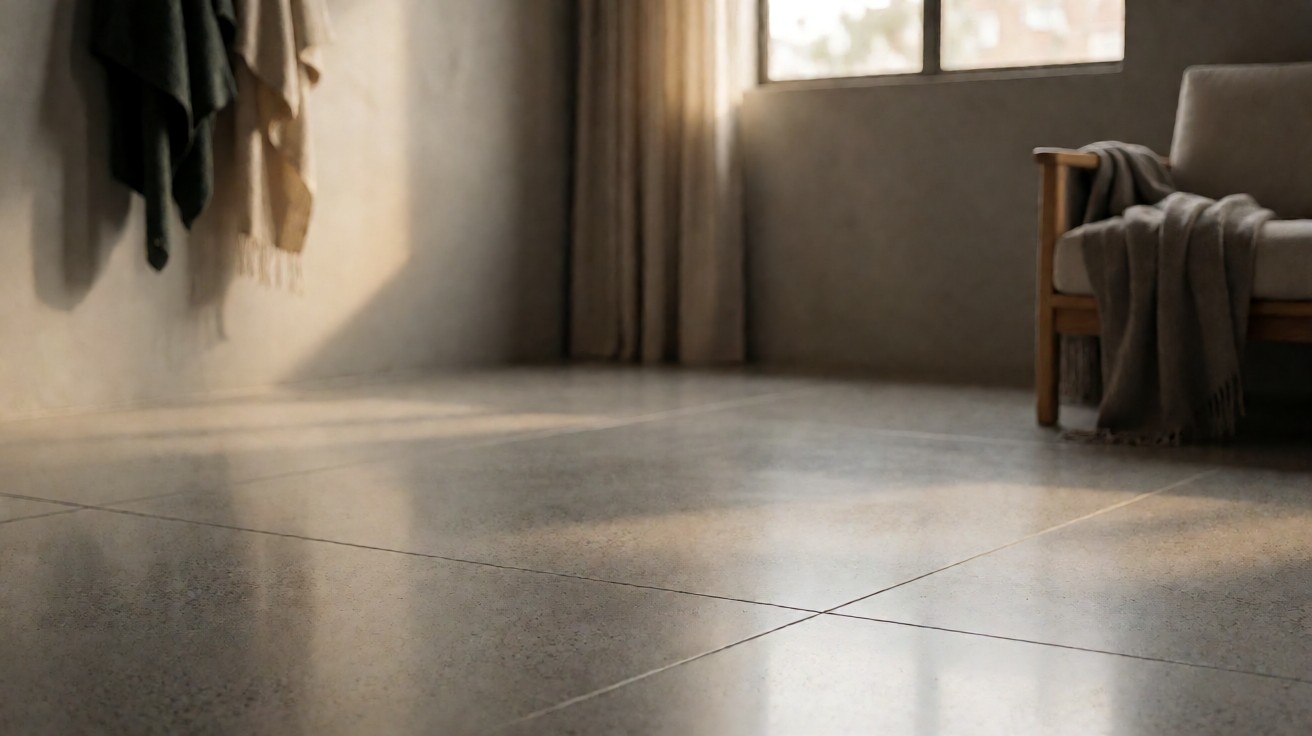

Polished concrete is your own slab ground, densified, and polished, so it runs $4 to $12 per square foot and can last fifty years with almost no upkeep.
What Polished Concrete Actually Is
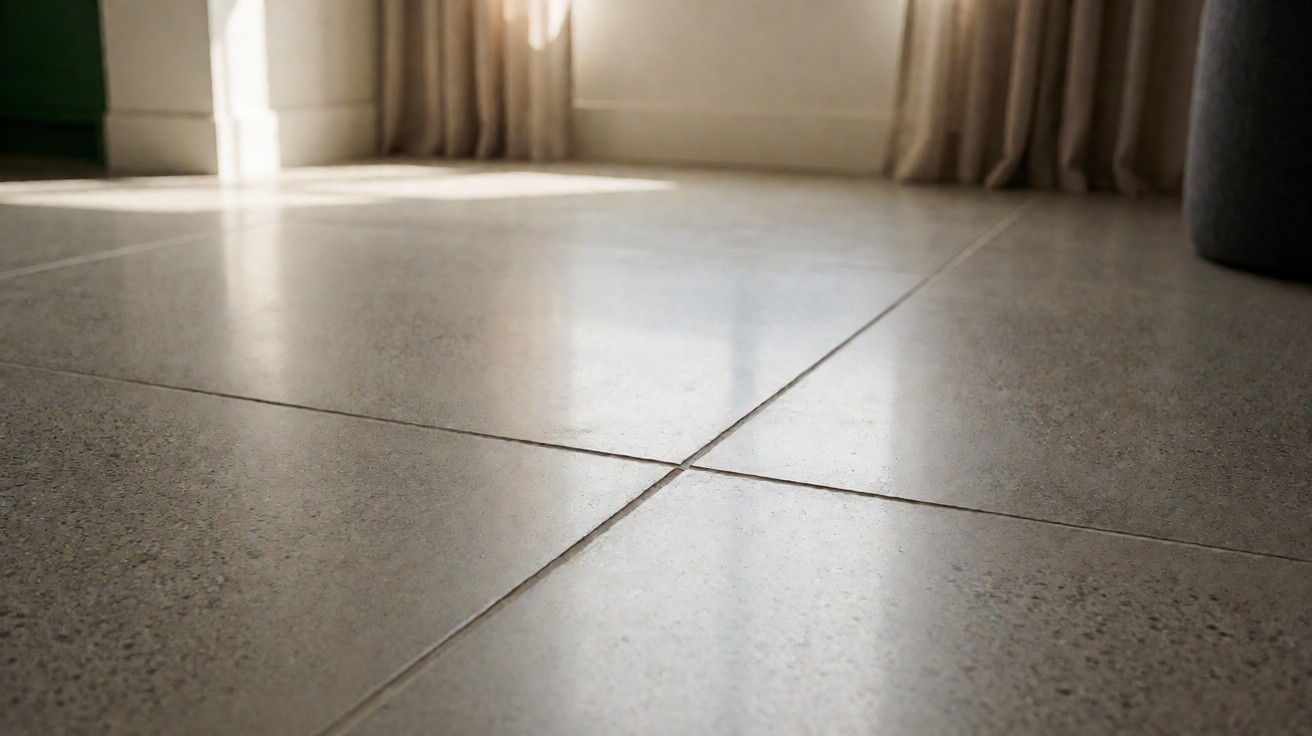
This finish is not a material laid on top of anything. It is the structural slab itself, ground back with metal bond and resin bond diamond abrasives until the cement paste is refined into a hard, flat, reflective surface that reads as a finished floor.
The right answer to what this floor is: the slab itself, refined. Grinding also exposes what the concrete is actually made of, because when the first pass stops at 30 to 60 grit the surface mortar is cut away and the coarse aggregate underneath begins to show as exposed stone.
By 120 to 200 grit the exposed aggregate is fully visible. That is the level most people picture when they hear polished concrete, and it is the level where the floor starts to look like a slab of stone rather than a painted floor.
At 400 to 800 grit the grinder polishes the cement paste around the aggregate instead of cutting it away, and the surface turns reflective without adding a film of anything.
The whole sequence removes only 1/32 to 1/16 inch of surface, so the finish lives inside the original slab rather than on top of it.
Nothing peels. Nothing delaminates.
| Gloss Level | Final Grit | Appearance | Maintenance Profile |
|---|---|---|---|
| Satin | 800 grit | Soft sheen, hides dust well | Easiest; dust does not show |
| Semi-gloss | 1,500 grit | Reflective but not mirror | Moderate; shows scuffs faintly |
| Polished | 3,000 grit | Near-mirror reflection | Most demanding; shows everything |
The Grit Sequence, Step by Step
Each grit step is a separate machine pass, and the crew earns most of its money by not skipping one.
A typical residential sequence runs 30, 60, 120, 200, 400, and 800 grit, with resin bond diamonds used for the finer steps because they cut faster and leave a more even scratch pattern on a cured slab.
The grit number is the particle size of the diamond dust bonded to the tool. A coarser number cuts faster and leaves more texture, and a finer number polishes.
Skipping from 60 straight to 400 leaves swirl marks that no amount of polishing removes, because the scratches from the coarse step are still too deep to level out.
Expect 1 to 3 passes per grit step on a good slab, and more if the slab is soft, was poured badly, or carries years of patch material.
The dust from the coarse steps is cement paste and, in any slab containing sand, respirable silica. The exposure limit that matters for anyone in the room during the work is 0.05 mg/m3 as an 8 hour time weighted average for respirable crystalline silica.
If a crew does not talk about dust containment, that is a question to ask before the machines arrive, and it is a question worth asking in a house with anyone in it.
Densifiers, Guarders, and Sealers
A ground slab is more porous than a slab nobody ever touched, because grinding opens the surface paste the finish was sitting on.
The first chemistry is the densifier, normally a lithium silicate solution, which reacts with free lime in the paste and forms extra calcium silicate hydrate. Coverage runs roughly 100 to 200 sq ft per gallon, and it is normally applied in 2 coats.
The second chemistry is the guarder, a hardener that fills the micro pores left open by grinding. 2 coats of guarder are typical, and the surface has to cure between them.
The third chemistry is the sealer, the only layer you can actually see. It sits on the hardened paste, and it is the layer that takes the wear.
Sealers are either water based acrylic penetrating sealers or solvent based polyurethane. A penetrating sealer soaks in and leaves the sheen where the grinding left it, while a film sealer adds gloss but is the first thing to scratch.
A properly sealed floor holds its slip performance and its stain resistance for roughly 3 to 5 years, which is why resealing on that cycle is a planned line item rather than a repair.
If the floor will be dyed, the dye goes on before the guarder, not after.
Colour: Dye and Stain
Concrete dye is a translucent, water based pigment that soaks into the surface and produces a mottled, clouded variation that reads as concrete rather than as paint. Concrete stain is an acid reactive stain that chemically alters the surface and produces a more variegated, earthier effect with genuine depth.
Both are integral to the slab rather than surface films, so both fade rather than peel. That distinction decides how you live with a coloured floor for the next decade.
Expect the dye colour to soften by perhaps 20 to 30 percent in the first 2 years, particularly in traffic lanes, and expect a periodic re dye in those lanes to be part of maintenance rather than a failure.
If the floor is dyed, the timing of the work matters. Dye goes on after the densifier and before the guarder, and the slab should be at least 24 hours past its last wet stage before pigment is applied.
Slab Conditions That Decide the Result
The slab is the finish, so slab conditions that would be irrelevant under a plank become the entire design. A patched area shows as a different colour and a different porosity, permanently, and no amount of grinding makes one patch match another.
The strength of the concrete sets the limits of what the grinder can do. Residential slabs typically run 3,000 to 7,000 psi compressive strength at 28 days, and anything below 3,000 psi is soft enough that the aggregate tears out instead of polishing.
ASTM C94 governs ready mixed concrete and ASTM C150 governs Portland cement, and between them they fix what a slab should be able to take. If a slab is rated well below 3,000 psi, grinding it to a high polish is asking for aggregate pull out and a floor that never shines evenly.
Flatness matters as much as strength. The working tolerance for a slab that will be ground is about 1/8 inch in 10 feet, measured with a straightedge, and ASTM C1569 sets out the standard test method for that measurement. ACI 302.1 covers the placement of concrete slabs and the joint locations that a grinder will eventually run into.
Moisture is the other limit. A slab that has not dried enough will grind into dust rather than into a hard surface, and the test that governs it is ASTM F2170, which measures relative humidity inside the slab. The number to insist on is 75 percent or less before densifier goes down.
Imagine a garage slab in Phoenix that was sealed with an epoxy coating in 2004 and now has to be ground back before it can be polished. The crew starts at 30 grit and cuts through the coating into the slab.
Every hour of that extra cutting is billed to the owner as prep work on a floor that was supposed to be a grind and polish, which is why a 2004 coating can add 20 to 30 percent to the final invoice.
A slab that was poured badly and has surface scaling, dusting, or soft spots will grind unevenly and never reach a uniform gloss. All three are visible in a finished floor and none of them can be corrected afterwards.
This is why a polished concrete specification should include a slab assessment before grinding begins, not after. The contractor should walk the slab, identify the patches, joints, and any previous repair, and either price their treatment or decline the job.
A contractor who quotes a polished concrete floor sight unseen, without seeing the slab, is guessing at the single variable that decides whether the project succeeds.
Where Polished Concrete Belongs in a Home
Polished concrete is at its best where a hard, cool, reflective surface is an advantage and where the architecture already carries the volume: main living areas in an open plan home, a loft, a converted basement, which the best flooring for basements page covers, a large entry hall, and a kitchen in a house where the slab was poured well.
It handles foot traffic better than any wood product, it handles water better than wood, it needs no waxing and no recoating, and a fifty year old slab can be reground and refinished at any point in its life.
If the slab is the finish, then the room has to work with it. Living room flooring over concrete covers the layout and sightline decisions that come before anyone talks about gloss.
For a house where the slab is the weakest part of the build, the best flooring over concrete slabs comparison sets out which materials hide a bad slab and which ones expose it.
It is a poor choice for a bedroom, a child’s room, or any space where the comfort of the floor is the point. Concrete is hard and cold, and it transmits impact noise rather than absorbing it.
It is also difficult in a home with pets in a room where claws and tracked grit are constant, because the surface shows scratches and the saw cut joints collect debris.
The honest summary is that polished concrete is a material chosen for how it looks and how little it needs, which makes it excellent in a designed space and a poor compromise in a family room.
| Room | Suitability | Reason |
|---|---|---|
| Open-plan living area | Excellent | Reflective surface reinforces volume; low maintenance |
| Loft or converted basement | Excellent | The slab is already the visual language of the space |
| Entry hall | Excellent | Handles grit and foot traffic indefinitely |
| Kitchen | Good | Water-tolerant, provided the slab is sealed |
| Bedroom | Fair | Hard and cold; comfort is not its strength |
| Child’s room | Poor | Hard surface, cold surface, little forgiveness |
| Bathroom | Poor | Sealing is critical and slip resistance must be specified |
Slip Resistance and Wet Areas
Polished concrete is inherently slippery when wet, and this is the safety issue most buyers do not consider. A high gloss floor in a wet area is a slip hazard, and the sealer that makes it look good is exactly what makes it slippery when wet.
For a bathroom or an entryway that gets wet in winter, the specification should call for a slip resistance additive in the sealer and a lower gloss finish, and the surface should be textured rather than mirror smooth. DCOF values under ANSI A326.3 are the way to verify this, and the answer belongs in the specification rather than in an assumption.
The threshold in that standard is a measured wet DCOF of 0.42 or greater for a level interior space expected to be walked on when wet. Below 0.42 the surface is treated as suitable only where it will be kept dry when walked upon.
The standard also says plainly that a DCOF figure is a comparison tool, not a prediction that a floor will not slip, because contamination, drainage, footwear, and maintenance all move the number in service. A high gloss finish that starts at a slip coefficient of 0.42 or better when wet can fall below 0.30 within months if a dirty mop is used on it.
ADA accessibility rules come in on top of that, because a 1/4 inch maximum height change at a threshold and a 1/2 inch maximum vertical step decide whether a doorway between a hall and a bath is buildable at all.
For a kitchen the same concern is much smaller, because kitchen floors get water briefly rather than continuously. What does matter in a kitchen is staining, because an unsealed polished slab takes a wine or oil stain in a way no coating on any other flooring type does.
If the slab is polished, it needs the densifier and the sealer, and the sealer needs a maintenance schedule.
Cost and Installation
Polished concrete costs between $4 and $12 per square foot installed, and the number is decided almost entirely by the condition of the slab. A new, well poured slab with no patching grinds and finishes at the lower end.
An old slab with several patches, previous adhesive residue, or a failed coating grinds slowly and needs more steps to reach an even gloss, and that is where the cost climbs. Adding a dye adds material cost but no labor.
Installing a new slab specifically to polish it later is rarely economical, because the two operations together cost more than a good engineered floor, which is the comparison worth making before choosing this route.
Labor is the bulk of the cost, and it is a grinding crew with large diamond impregnated machines, not a flooring installer. The work cannot be done in a lived in house without significant disruption, and the contractor needs access to power and water on the slab itself.
Confirm both before signing rather than during the work, because a crew that cannot reach a drain will stop grinding.
Polished Concrete Versus Alternatives
Against microcement and resin flooring, the distinction is the substrate and the thickness. Polished concrete refines an existing slab and removes material, while microcement is a cementitious coating applied over a substrate, typically 2 to 3 mm thick, which allows a uniform colour but adds a layer that can delaminate.
The two look similar in a photograph and they differ substantially in what happens when something goes wrong. A terrazzo floor is the other slab based option, and the real difference is that terrazzo carries stone chips in the mix while polished concrete exposes whatever aggregate the pour already contained. The terrazzo versus concrete flooring comparison covers that difference in detail.
Against engineered hardwood, polished concrete wins on longevity, water tolerance, and zero maintenance, and loses on comfort, warmth, acoustics, and resale perception.
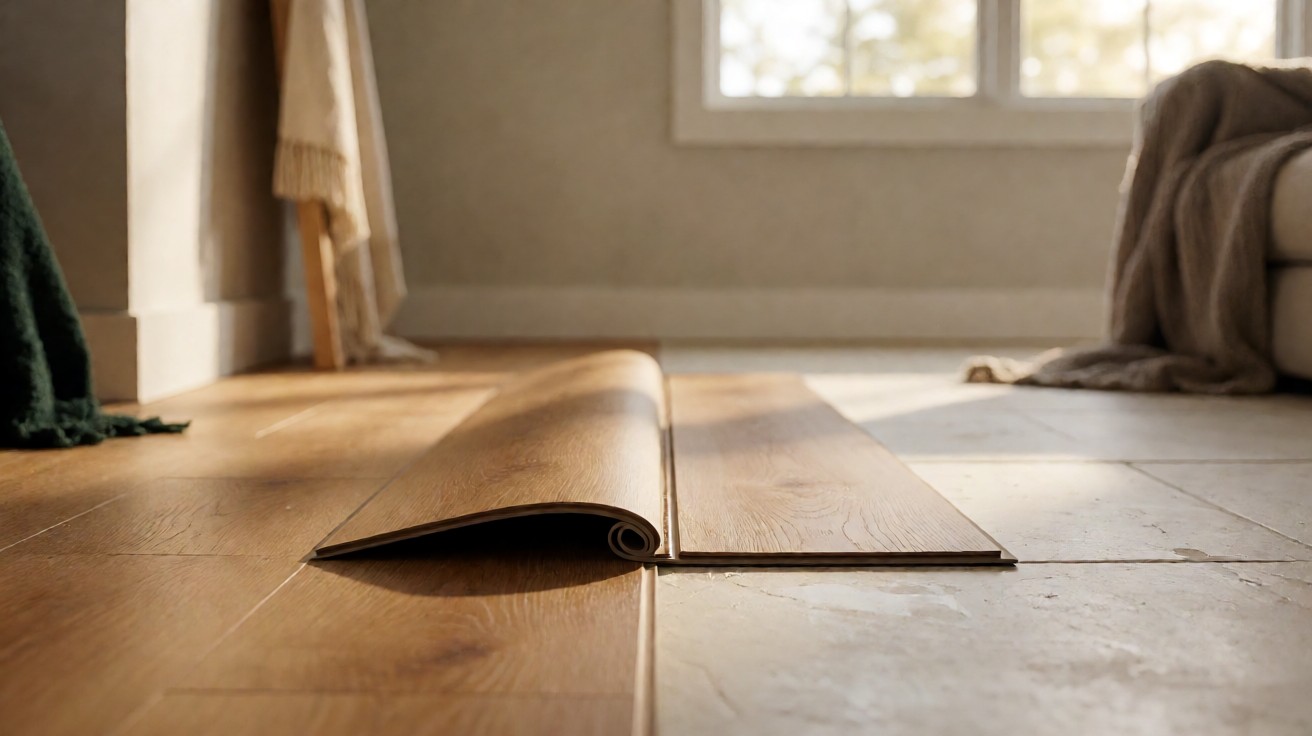
Against polished porcelain or large format tile, the two are visually close. The tile is easier to install over a bad slab, gives a grout line to hide slab joints, and is far more forgiving if the slab moves, and it can be replaced in sections. A slab cannot.
Comfort, Acoustics, and Air Quality
Concrete is hard and it is cold underfoot in winter, and both facts are measurable. Impact sound transmission is rated under ASTM E492 and ASTM E989, and a bare slab with no resilient layer scores poorly against the same assembly finished in engineered wood.
Adding a floating resilient layer under a finished floor is the usual fix, but under a polished concrete floor there is nowhere to put it, because the whole point is that the slab is the surface.
A typical assembly with engineered wood over a 3/4 inch subfloor tests around IIC 60 to IIC 65, and a bare slab tested the same way lands near IIC 20.
That is the trade nobody mentions. You get a floor that is acoustically hard and thermally hard in exchange for a floor that will still be there in 2080.
Air quality during the work matters too. Grinding generates fine cement dust and respirable silica, so rooms should be isolated, and a floor that has been ground is a floor that needs a thorough vacuum before anyone moves back in.
Sealers and densifiers are the other indoor air question. A low VOC sealer certified under the GreenGuard program keeps the solvent load down in a house where someone has chemical sensitivity, and it is worth naming a product that carries that certification instead of accepting whatever is on the truck.
Maintenance Over a Fifty-Year Life
A properly densified and sealed polished concrete floor needs almost nothing, and that is genuinely its strongest practical argument. There is no wax schedule, no recoating interval, no buffing, and no finish to strip.
A dry dust mop or a vacuum with a hard floor setting handles ordinary traffic, and a damp mop with a pH neutral cleaner handles anything wet. Most owners end up sealing once after installation and then resealing every 3 to 5 years as a routine measure, which is optional rather than necessary if the floor has not worn.
The cleaning chemistry should stay between pH 6.5 and 7.5, and neutral is not an optional preference. Acidic or high pH cleaners etch the cement paste and will eventually dull the surface.
Grunt work matters just as much. Tracked grit under shoes acts like sandpaper on a hard floor, and a grit free entry mat is the cheapest maintenance product in the building.
The one genuinely unavoidable change is colour. Dye fades in traffic lanes over roughly 5 to 7 years, and if the floor is dyed a periodic re dye in those lanes is normal maintenance rather than a defect.
IICRC guidance on resilient and hard surface cleaning sets the same discipline: neutral cleaner, soft pad, no grit. Undyed densified floors do not have the fading issue and are the choice for anyone who does not want to think about appearance for a decade.
Choosing and Specifying a Polished Concrete Contractor
The selection question is entirely about the slab assessment, and it should be the first thing discussed rather than the last. A contractor should visit, look at the slab, and tell you honestly whether it is a good candidate.
Some slabs are not. Heavy scaling, an uneven cure, an unpatched repair, or a slab poured over soft fill cannot be ground to an acceptable result, and a contractor who takes the job anyway is telling you something important about their standards.
Ask for the grit sequence they intend to use, whether the densifier is lithium silicate, what the sheen level will be, what the sealer spec is, and whether the price includes the stain or only the grind.
Ask what the ambient temperature and relative humidity will be on install day, because densifier and sealer need the slab at 50 °F or warmer and the room below 75 percent relative humidity, and a cold morning in February can delay a job by a week.
Ask whether they have ground that specific slab type before, and whether they can show you a completed job in a building of similar age.
The final question worth asking is what they recommend if the slab does not grind evenly, and the quality of that answer predicts the quality of the project better than anything else on the list.
Once the finish is chosen, what polished concrete costs on the slab you already have is where the number lands, and material versus installed cost is the way to compare it against a tile or hardwood quote.
If you want the longer version of that decision, start with How to Clean Polished Concrete Floors.
Last updated: November 2026