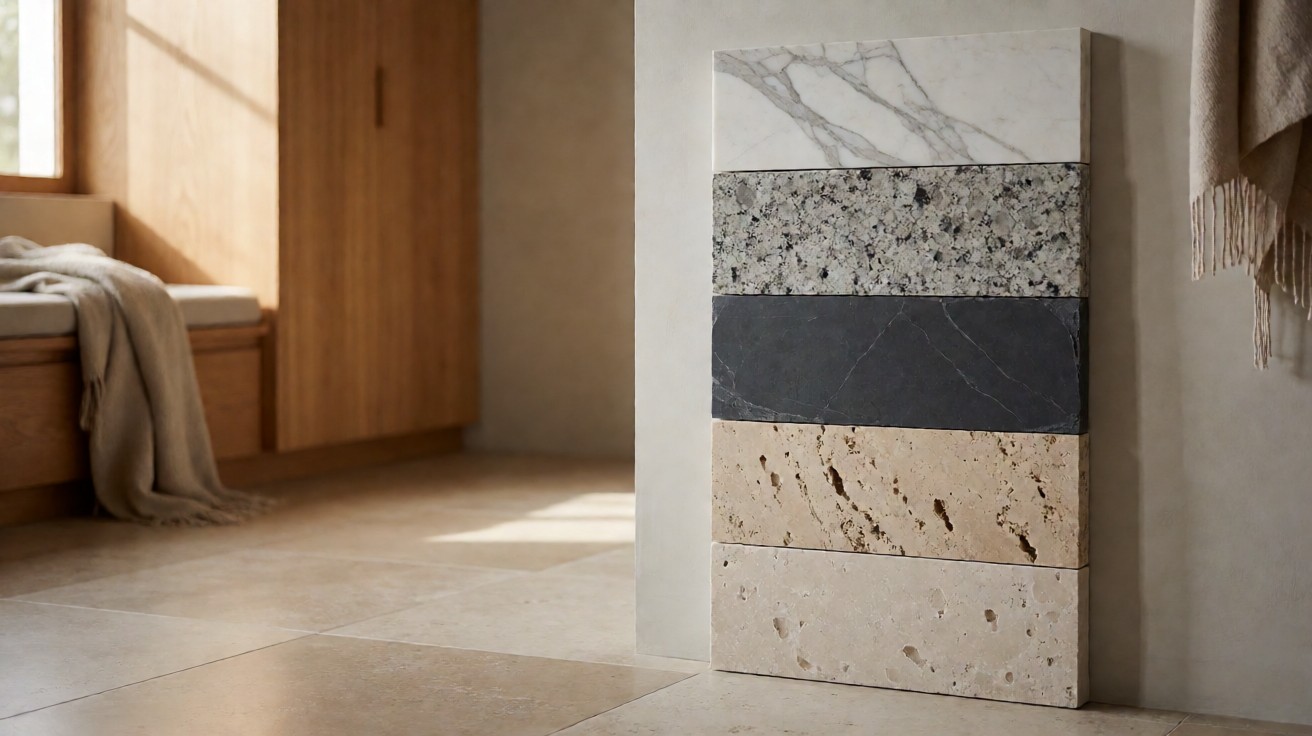

Natural stone flooring is a single category hiding five distinct stones, and the buyer who thinks they have chosen stone has not yet chosen stone itself.
Walk into a tile showroom and ask for natural stone and you will see five different materials marketed under the same name. They differ in mineral composition, in hardness, in porosity, in acid sensitivity, and in how they age.
Some are appropriate for a kitchen, some are inappropriate even for a bathroom, and at least one of them is dangerous outside. The category is broad, the distinction matters, and the labels in the showroom are not always precise.
This page covers what makes a stone floor natural, before the family breakdown. For the comparison against porcelain or ceramic as a material, the natural stone versus porcelain page is the reference.
For the family breakdown stone by stone, the marble, granite, slate, travertine, and limestone page walks through each one. And for the cleaning and sealing routine, the tile flooring guide sits above both as the umbrella.
What Natural Stone Actually Is
Natural stone is rock, cut and finished into tiles or slabs. That is the entire difference from a porcelain or ceramic tile, which is a manufactured clay body pressed into shape and fired. The stone is the stone: it came out of a quarry, was cut into a usable size, and was finished to the texture the buyer ordered.
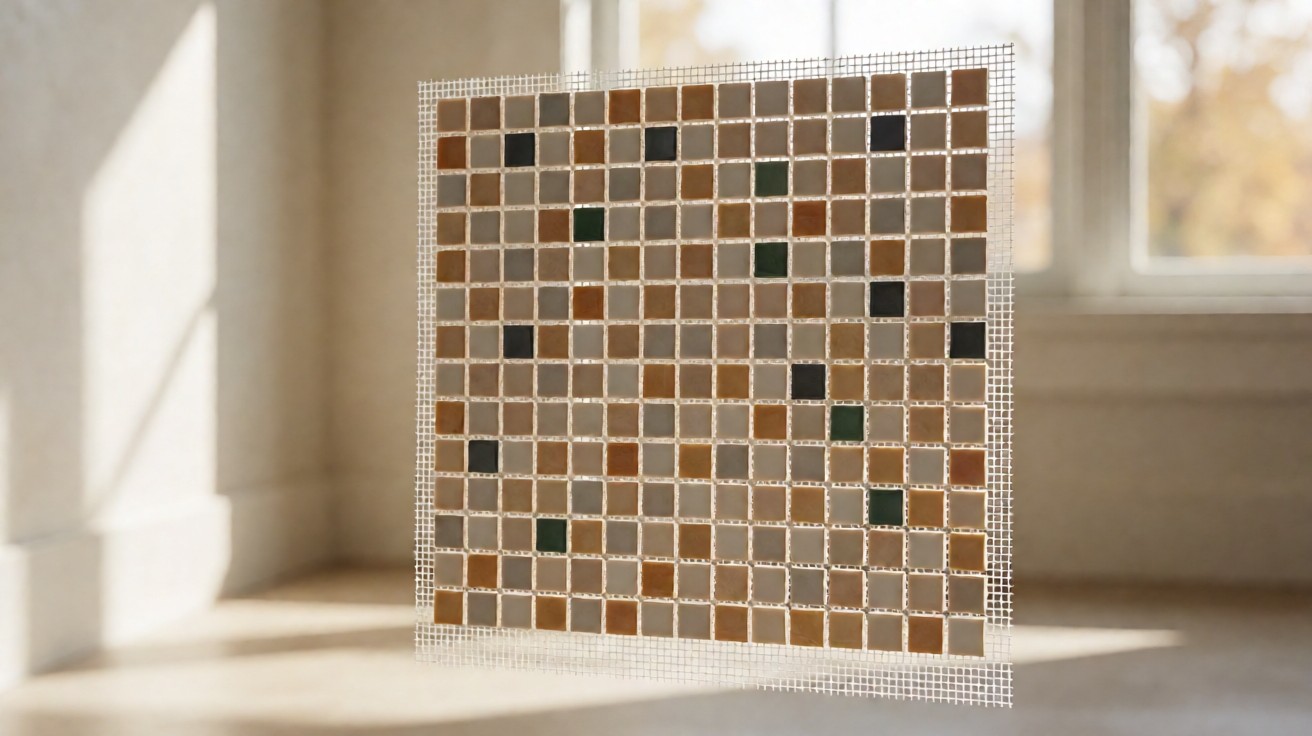
The consequence is that no two stone tiles are identical, even within the same shipment. Stone has natural variation in colour and pattern, and a first-quality shipment is sorted to keep the variation within a range. A commercial-grade shipment is unsorted, and the variation is part of the look. A utility grade is the off-colour or off-pattern tiles that did not make the first-quality cut.
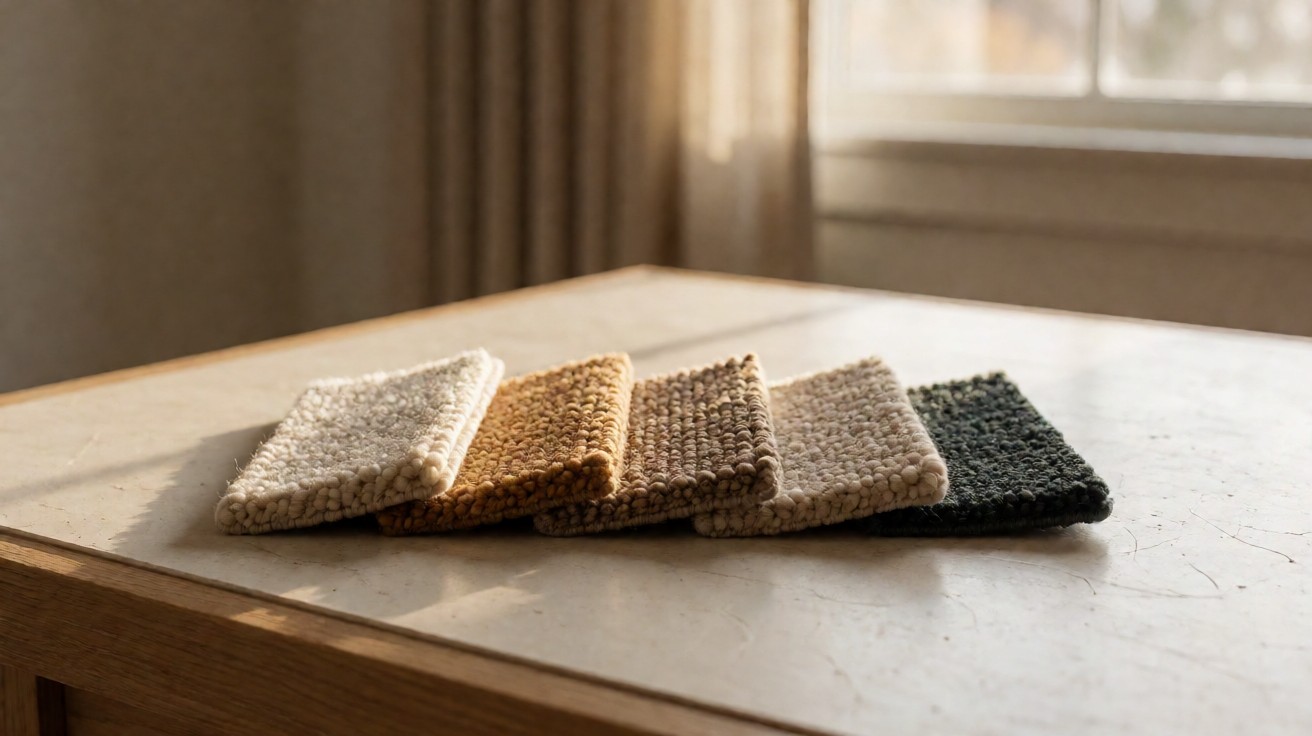
What this means in a home is that natural stone is a purchase that must be made with the actual slabs or tiles in front of the buyer, not just from a sample. The sample shows the colour range and the finish. The slab shows the specific stone you are buying.
Quarrying, Sizing, and How a Stone Tile Reaches a Showroom
Stone moves from a quarry to a tile in a sequence that explains why some shipments look different from others even at the same supplier.
Block extraction is the first step. A quarry produces blocks of stone in standard sizes, typically 3 to 8 feet on a side, depending on the stone. Granite and marble quarries produce large blocks because those stones form in large masses. Limestone and travertine quarries produce smaller blocks because the stone is layered. The block size sets the maximum slab size the stone can produce.
Slab cutting is the second step. The block is cut into slabs on a gang saw, typically at 0.75 to 1.25 inches thick for tile and 1.25 to 2 inches for countertop and stair applications. The slab is then finished on one face to the specified texture, polished, honed, or leathered. Slabs of large blocks can be 5 by 8 feet or more.
Tile cutting is the third step. Slabs are cut into tiles of the specified size, typically 12 by 12, 12 by 24, 16 by 16, or 18 by 18 inches.
Some stones are sold as larger tiles in the 24 inch range, which requires a larger slab and a more expensive cut. The sorting into grades happens at this step, with first-quality tiles sorted by colour and pattern.
Finishes and What They Do
The finish on a stone tile is set during finishing, before the tile is sold, and the same stone looks and behaves differently in each finish.
Polished is the highest gloss and the most reflective. It is the finish most associated with marble in luxury installations. It shows scratches, particularly in darker stones, and it can be slippery when wet. The polish closes the surface pores slightly, which reduces the porosity compared to the same stone in a honed finish.
Honed is matte or low-gloss. It is the most forgiving finish for a working floor because it does not show scratches and it has better wet slip resistance than a polished surface. Most residential stone floors are sold in a honed finish for this reason.
Leathered is a textured finish that retains the natural cleft or sawn surface and adds depth to the colour. It is the most modern-looking finish and is common on granite, marble, and some slates. It is harder to clean than a polished or honed finish because the texture traps dust.
Beyond these three, there are specialty finishes including flame-finished, sandblasted, and bush-hammered, mostly used on exterior stone or feature walls rather than floors. A flame finish is rough and slip-resistant. Sandblasted and bush-hammered add deliberate texture.
The Stones Sold Under the Label
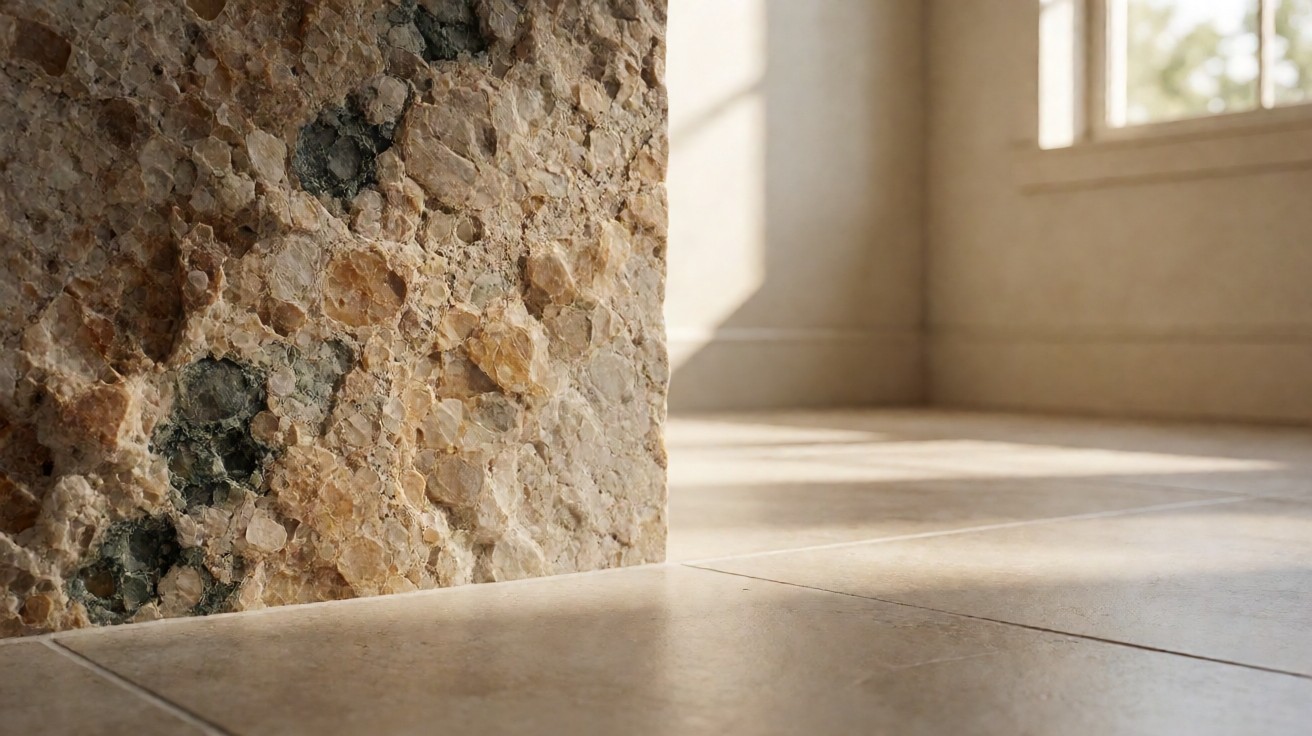
Five stones are sold most often as natural stone flooring, and each behaves differently in a home. The five: marble, granite, slate, travertine, and limestone, are the family members that any “natural stone” tile selection will narrow down to.
Marble is calcium carbonate, soft relative to granite, and reactive to acids. Granite is igneous, hard, and non-porous. Slate is metamorphosed and layered, with a natural cleft surface that gives a slip-resistant texture. Travertine is sedimentary, with voids in the body that are filled at the factory. Limestone is sedimentary and softer, with a neutral colour palette.
The full breakdown of each stone is in the marble, granite, slate, travertine, and limestone page.
How Stones Are Tested and Specified
Natural stone sold commercially carries one or more ASTM specifications, and the relevant ones for flooring are the porosity and the flexural strength.
ASTM C97 is the absorption test. It measures how much water the stone absorbs as a percentage of weight, and the lower the number the better. Granite and slate are below 0.5%, marble is typically 0.5 to 1.5%, and limestone and travertine range from 1% to 10% depending on the variety.
ASTM C99 is the modulus of rupture test. It measures how much bending stress the stone can take before breaking, which is most relevant for floor installations because a stone tile can flex slightly over an uneven subfloor. Marble and limestone score lower, granite and slate score higher.
ASTM C503 is the marble specification. ASTM C615 is the granite specification. These are the two stones most often graded by a third-party standard. Travertine, slate, and limestone have their own specifications. Asking for the ASTM reference on a price quote is the right step before committing.
Where Natural Stone Wins and Where It Loses
Natural stone is the right answer in two places and the wrong answer in many more, and being honest about the second category saves a homeowner disappointment.
Stone wins in a wet bathroom where the look is what the homeowner is paying for and the budget supports sealing. Stone wins in a luxury kitchen or entryway where the buyer is committed to the maintenance routine. Stone also wins on a covered patio or an outdoor room where the geological look is the goal.
Stone loses in a busy family kitchen with children and red sauce, where marble will etch within months regardless of sealing. Stone loses in a high-traffic commercial location, where porcelain is harder and cheaper to maintain.
Stone loses in a basement on concrete that wicks moisture, where the porosity of marble and limestone is a real problem. And stone loses where the budget cannot support the sealing routine, because the floor looks tired within a year without it.
The Quick Reference: Stone by Behaviour
| Stone | Hardness | Porosity | Acid sensitivity | Room fit |
|---|---|---|---|---|
| Marble | Soft (3 to 5) | Low to moderate | High | Bathroom, formal areas |
| Granite | Hard (6 to 7) | Very low | None | Kitchen, entry, anywhere |
| Slate | Medium (3 to 5) | Very low when sealed | None | Kitchen, entry, exterior |
| Travertine | Soft (3 to 4) | High | Moderate | Sunroom, warm climate |
| Limestone | Soft (2 to 4) | Moderate to high | Moderate | Bedroom, formal living |
The table is what each stone does, but the family breakdown page is the detailed reference.
Stone Grade and How Cost Tracks
Natural stone is sorted into grades and priced by the grade, and the grade is set by the variation and the defects, not by the stone type. Two shipments of the same marble at the same quarry can differ in price by 40% based on the grade alone.
First quality is the sort that matches the sample in colour and pattern, with defect tolerance typically under 5%. Commercial grade allows more variation and minor defects, often with colour that does not match the showroom sample exactly. Utility grade is the off-cut stones that are usable but less consistent, often sold at a significant discount.
The practical effect is that a sample viewed in a showroom shows first-quality stone. The shipment may be commercial or utility. The contract should specify the grade, not just the stone type.
| Grade | Variation tolerance | Defect tolerance | Typical price factor | Best use |
|---|---|---|---|---|
| First quality | Tight (sort to sample) | Under 5% | 1.0x | Visible floors, feature areas |
| Commercial grade | Moderate | 5 to 15% | 0.7x to 0.85x | Rustic looks, large rooms |
| Utility grade | Wide | Over 15% | 0.5x to 0.7x | Hidden areas, budget renovations |
How the Stone Choice Interacts with Installation
The stone choice changes the install. Marble and limestone require a substrate that is flat and rigid, because the tile is brittle and breaks over an uneven base. Granite and slate are less brittle, but they are heavier, which means a stronger mortar and a more careful substrate preparation.
Travertine installed unfilled needs a thicker grout joint to absorb the variation between tiles, while travertine installed filled can use a standard 1/8 inch joint. A polished marble install needs white mortar to avoid bleed-through, while a honed install can use grey. The finish and the stone together decide the mortar spec and the joint width.
The skill of the installer is most consequential on stone. A trained tile installer is not necessarily a trained stone installer, and stone-specific skills include handling weight, sealing during install, and matching the natural variation in the layout. Most homeowners hire through a stone importer that does both the supply and the install.
Is natural stone more expensive than tile?
Yes, usually two to four times as much per square foot. Stone tile can run $20 to $60+ per square foot in material with labour on top, while porcelain or ceramic in similar sizes can run $5 to $25 per square foot in material.
The premium reflects the raw material cost, the quarrying and finishing, and the lower yield per kiln. Stone is also a long-lived floor, so the lifetime cost evens out, but the upfront cost is real.
Does natural stone need sealing?
Yes, every natural stone floor is sealed after installation and most are resealed on a schedule. Granite and slate are typically resealed every 3 to 5 years, marble every 12 to 18 months, and limestone and travertine every 6 to 18 months depending on traffic.
The schedule is checked by dropping water on the stone: if the water beads, the seal is intact, and if it soaks in within minutes, the floor needs resealing.
Can natural stone be installed over radiant heat?
Most stones can. Granite and slate transfer heat efficiently and are the most common choices over radiant heat. Marble and limestone work but require a careful install because the temperature changes can stress the tile at the grout joint.
The floor must be brought up to temperature slowly on first use, and the heating system must be sized for the stone type. Porcelain is also a good choice over radiant heat and is more dimensionally stable than stone.
How This Fits With the Rest of the Choice
This page is the umbrella for natural stone as a category. It does not cover the family breakdown stone by stone, the comparison with porcelain, or the cleaning routine.
For the family breakdown, the marble, granite, slate, travertine, and limestone page walks through each stone. For the comparison with porcelain or ceramic, the natural stone versus porcelain page is the reference. For the umbrella material, the tile flooring guide sits above both. And for the cleaning and sealing routine, the cleaning guide covers the maintenance plan.