A vinyl spec sheet tells you almost everything you need to know about a floor before you buy it, but only if you know which number to read first and why.
Most buyers evaluate a vinyl floor by look, thickness, and price, which means they judge it on the three things that are easiest to fake. The checks that actually predict whether a floor will disappoint take about thirty seconds each, need no expertise, and are all possible standing in a showroom with a sample and the spec sheet.
This is that sequence. It assumes you have decided on vinyl and are now choosing between products; if the material itself is still open, the vinyl flooring guide covers that decision first. For the background on what the layers actually are, the construction explainer explains the four layers this checklist is reading.
What to Check First
The order matters, because each step filters out the products that would have been a waste of money, and the cheapest checks come first.
Read the wear layer in mils on the spec sheet. Then pick up the plank and look at the cut edge. Then press and flex it. Then check the locking edge and the certification. If a product fails at any of those four points, you can stop looking at it, and if it passes all four you can buy with reasonable confidence.
The whole sequence takes a few minutes. The reason most people skip it is that the differences between a good and a bad vinyl floor are invisible in a showroom sample until the bad one has worn through, which is three years too late.
Check the Wear Layer on the Spec Sheet
Find the number of mils on the wear layer. This is the top clear coat, the only thing that takes the abrasion, and it is the single most reliable predictor of how the floor will look after a few years in a busy room.
Residential vinyl runs from about 6 to 20 mils, and commercial products go from 20 upward.
The rule of thumb is that a light residential room is fine at 6 mils, a normal family home wants 12, and a hallway, a room with pets, or a rental wants 20 or more. Below 6 mils is a thin product and it will wear through in a traffic lane.
If the spec sheet does not state a wear layer figure, that is itself the answer. It means the manufacturer is not publishing the one number that matters, and in that case assume the bottom of the range rather than the top.
Lift It and Read the Core
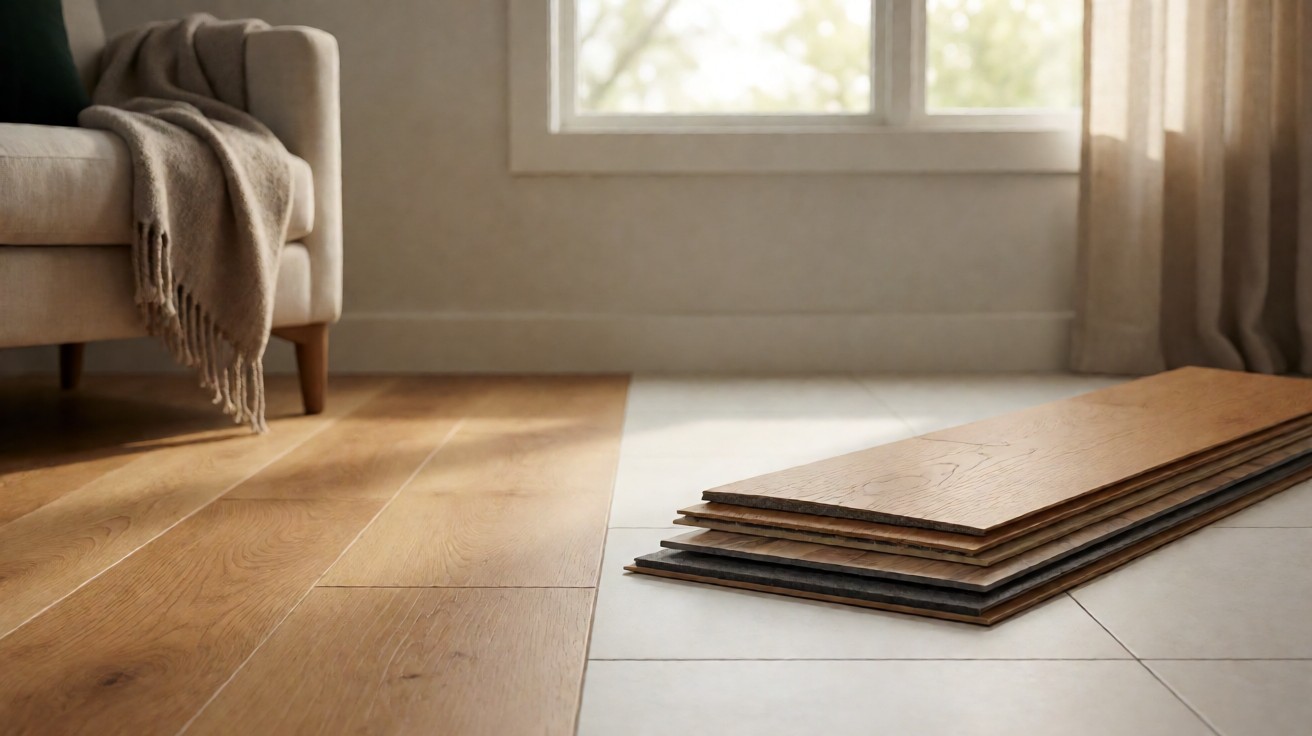
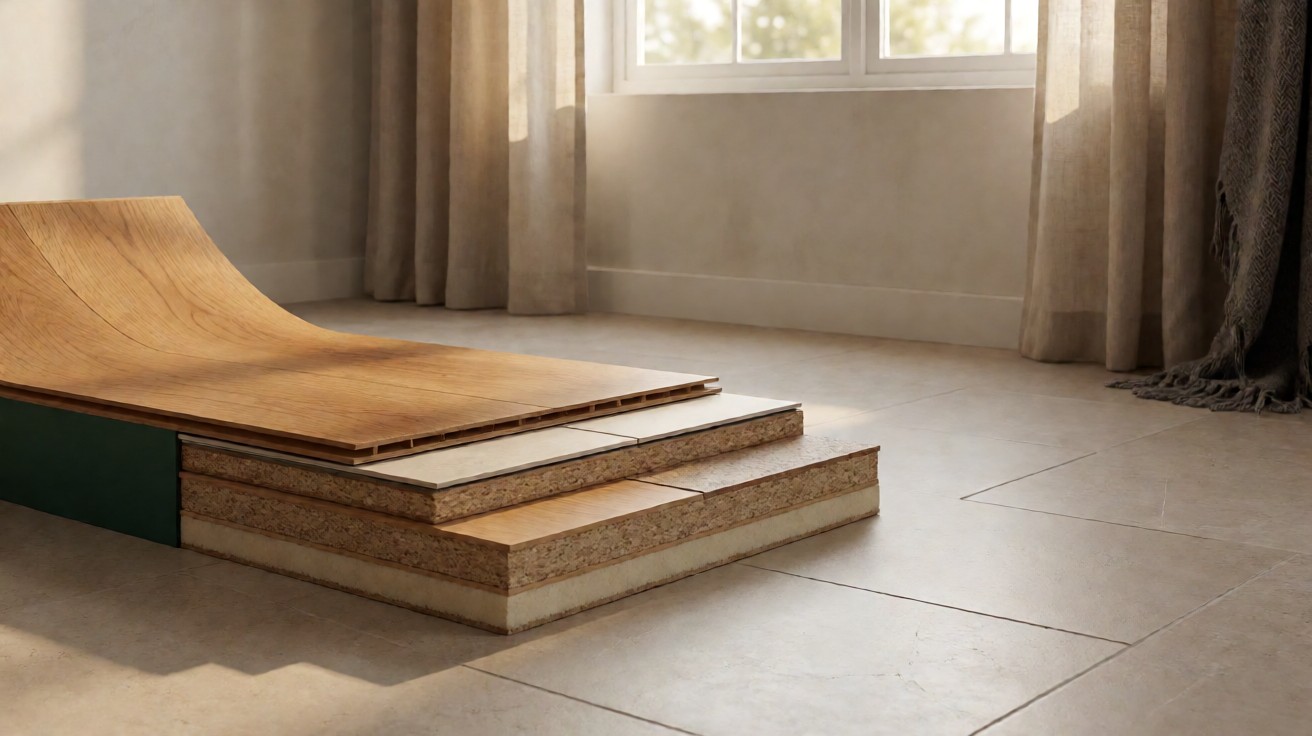
Pick up the plank and look at the cut edge. A rigid-core plank has a thick, dense body that is visibly the bulk of the product, and a stone polymer composite looks speckled and mineral while a wood polymer composite looks fibrous and warmer.
A flexible sheet vinyl is thin, soft, and backed with foam or felt, and it is a fundamentally different product rather than a cheaper version of the same thing.
Then press and flex it. A stone-core plank is rigid and does not flex much, which is the point, and a wood-core plank flexes slightly more. If it bends like a piece of rubber, it is a thin sheet product and it will not be the waterproof floor the label implies.
Also check the total thickness. Anything described as rigid-core should be around 5 or 6 millimetres. A product advertised as a rigid plank at 3 millimetres is mislabelled, and that mislabelling is worth walking away from.

Judge the Backing and the Locking Edge
Look at the bottom of the plank. A rigid plank should have a bonded foam or polyethylene backing, which is what takes the sound out of footsteps and softens the feel. If the backing is paper-thin or missing, the floor will be harder and louder than a sample in good lighting suggests, and that is a real difference in a room you will sit in.
Then examine the edge the way two planks join. Run a thumbnail along it and press the two edges together. A good click-lock edge has a clean, continuous profile that meshes without forcing, and a poor one has a lip or a mismatch that will make the floor rock underfoot in a traffic lane.
On a glued product, the edge matters less, because the adhesive and the subfloor are holding it. On a floating product it is the whole structural joint, and it is the first thing to fail when a cheap floor starts clicking and shifting a year later.
The Showroom Sample Trap
A sample in a bright showroom is close to useless for judging durability, and this catches people constantly. The same 6-mil floor and the same 20-mil floor look the same, feel almost the same, and photograph the same. The difference only becomes visible after a few years of traffic.
The second half of the trap is the lighting. A sample held under showroom lights, away from a window, shows colour and finish that will not match the room you are putting it in. Take a photo of it in the shop and, if the seller allows it, in the room you are furnishing, and compare the two before you commit.
The rule that follows is simple: judge a vinyl floor on the two numbers and the cut edge, not on the sample in your hand. The sample tells you whether you like the colour and the finish. It does not tell you whether it will last.
VOCs and Certifications
Look for a certification mark and check that it names a real standard. FloorScore, tested by SCS Global Services against the California Section 01350 method, is the common residential one, and it measures the finished product for volatile organic compounds. It is a genuine mark and worth looking for.
Be sceptical of the word “certified” on its own, and of any low-emission claim with no standard named on the label. Green-sounding words without a test method behind them mean nothing, and the difference is easy to verify: ask which standard, and the honest answer names one.
This matters more for vinyl than for other flooring because vinyl is a petroleum-derived plastic and genuinely does emit. A certified product is not a different chemistry, but it is a measurable one, and it is a reasonable thing to insist on in a bedroom or a family room.
The Seven Checks in One Table
The whole method fits on one card. Each check is a few seconds, and together they catch nearly everything that would otherwise surface in year three.
| # | Check | What good looks like | What it proves |
|---|---|---|---|
| 1 | Wear layer in mils | 12 or more for a family home | Durability |
| 2 | Core cross-section | Rigid and dense, 5 to 6 mm | Waterproofing and stiffness |
| 3 | Press and flex | Does not bend like rubber | It is really a rigid product |
| 4 | Backing | Foam or PE layer bonded on | Comfort and sound |
| 5 | Locking edge | Meshes without forcing | Joints do not fail early |
| 6 | VOC certification | A named standard, not “certified” | Emissions are measured |
| 7 | Sample equals product | Same board as the quote | You judge what you buy |
Red Flags That Mean Walk Away
There are a handful of signals that a vinyl product is not worth your time, and they are quick to spot once you know them.
No stated wear layer figure is the biggest one, because the durability claim cannot be checked. A rigid plank under about 5 millimetres is a second. Product that bends like rubber while described as rigid is a third. A locking edge with a visible lip or a rough, unfinished cut is a fourth.
Beyond the product, there are retail signals. A seller who cannot or will not tell you the wear layer in mils is either carrying the wrong product for the room or does not know what they are selling, and either way you should buy elsewhere.
So is a sample that is not the same product as the one quoted, and a price dramatically below the market, because the saving usually came out of the wear layer or the core.
Quick Reference by Question
This table maps a reader goal to the check that answers it. This table makes that assignment concrete.
| Situation | Rating or build | Reason |
|---|---|---|
| To know how long it will last | Read the wear layer mils | The only reliable durability number |
| To know if it is waterproof | Look at the core cross-section | PVC sheet is not the same as a rigid core |
| To know if it is comfortable | Press the surface, check the backing | A missing backing means a harder, louder floor |
| To know it will not fall apart | Test the locking edge | The joint fails before the surface on a cheap plank |
| To avoid fumes | Ask which VOC standard is certified | A named standard, not the word certified alone |
| To avoid being oversold | Confirm sample equals quoted product | A display sample is often a different product |
| To judge long-term quality | Check thickness is around 5 to 6 mm | A rigid plank under 5 mm is mislabelled |
What the Sample Cannot Tell You
It is worth being blunt about the limits of what you can learn from a showroom, because the checks above have a blind spot.
No sample tells you how the floor will look after five years, because the difference between a 6-mil and a 20-mil wear layer is invisible until one of them wears through. No sample tells you how it will look in your room, because showroom lighting is chosen to flatter.
And no sample tells you how it will handle your specific household, because a family with two large dogs and a family with no pets put the same wear on a floor in completely different ways.
That is exactly why the checks above lean on numbers and construction rather than on appearance. The wear layer in mils is the one claim a seller makes that can be verified before you pay, and the core cross-section is the one construction fact that predicts behaviour. Everything else you evaluate with your eyes is a matter of taste and should be treated as such.
A Short Showroom Checklist
Put the sequence in one list and it fits comfortably inside a few minutes.
Read the wear layer in mils and check it against the traffic. Turn the plank over and look at the core cross-section. Press and flex it. Look at the backing. Run a thumbnail along the locking edge and press two planks together. Ask which VOC standard is certified. Confirm the sample is the product being quoted.
That is the whole method. It does not require any expertise, it needs nothing but the sample and the spec sheet, and it catches nearly everything that would otherwise be discovered in year three. If a product passes all seven checks it is a safe choice, and the only remaining question is whether it suits the room aesthetically.
What is the most important number on a vinyl flooring spec sheet?
The wear layer thickness in mils. It is the top clear coat that takes every footstep, and it is the number that predicts how the floor will look after years of use. Below about 6 mils is thin for residential use, 12 mils is a solid family-home choice, and 20 mils or more is the commercial-grade answer for a busy room, pets, or a rental.
How can I tell if vinyl flooring is good quality?
Turn it over. A quality rigid-core plank has a thick, dense body that is the bulk of the product, a bonded foam backing you can see, and a clean interlocking edge that meshes without forcing.
A thin sheet feels different entirely: soft, floppy, and no thicker than a few millimetres. Read the wear layer, look at the core, and press the surface, and the difference is obvious.
How This Fits With the Rest of the Choice
This page is the buying process for vinyl. It assumes the material decision is already made, and it does not explain what the layers are in the first place.
If the material is still open, the vinyl flooring guide covers it. For the background on the four layers this checklist reads, the construction explainer is the reference. If you are choosing between the rigid-core types, the SPC guide and the WPC guide cover the two cores in detail.