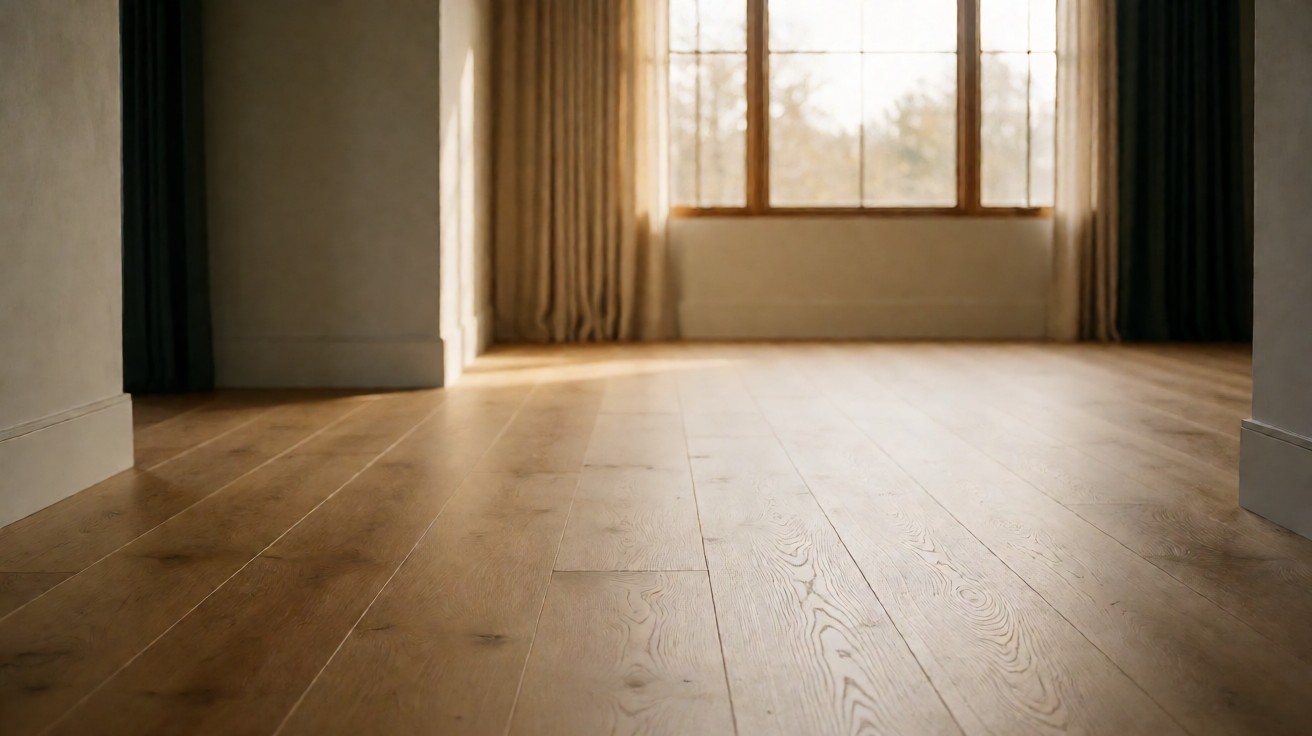

Plank width is the first thing a designer sees and the last thing most buyers compare. The number of boards in a box, the coverage rate, and the cost per square foot all shift with width, but the decision is really about what you want a room to feel like. Wide boards run long and calm. Narrow boards run busy and traditional.
Because hardwood is sold in discrete widths, this is not just an aesthetic preference. Width changes how many seams cross a room, how much the floor expands and contracts, what a repair looks like, and whether a textured surface stays readable. Those knock-on effects are what separate a considered choice from a default.
This guide works through the trade-offs honestly, including the cases where wide plank is the wrong answer. It assumes the material question is settled; if it is not, the broader hardwood guide comes first.
Wide Plank vs. Narrow Plank: The Short Answer
Choose wide plank for an open, contemporary feel, longer grain runs, and fewer seams. It makes a room look larger and calmer but costs more per square foot and leaves fewer options when a board is damaged.
Choose narrow plank for a traditional, cottage, or colonial look, or when the floor is a busy visual field and you want the texture to carry it. Narrow boards are cheaper, easier to install, and far easier to repair plank by plank.
Both are defensible in almost any room. The genuinely wrong choices are narrow plank trying to look minimal in a very large open plan, or wide plank laid in a small hall where a single bad board is conspicuous and hard to source.
What Actually Changes With Width
Width is measured across the face of the board in inches, and hardwood is commonly sold from about two inches up to nine or more.
The practical effects fall into four groups: how the room reads, how the floor moves, how it wears, and what it costs.
How the room reads is the first thing people notice. A wide board presents one long face, so the grain runs a long distance and the eye reads the floor as a large continuous surface. A narrow board interrupts that run constantly, which makes the floor feel busier and more textured whether or not you wanted it.
How the floor moves is the part buyers miss. Every seam between boards is a place the floor can move independently. Narrow plank has far more seams per square foot, so it tolerates seasonal movement better, which matters in older homes with less stable subfloors. Wide plank has fewer seams but each board is longer, so it needs a flatter subfloor and more careful acclimation.
How It Reads in Different Rooms
In an open-plan living space, wide plank is almost always the stronger choice. Fewer seams mean the room reads as one surface, which makes the floor look larger and lets the furniture carry the visual weight.
In a small room, the same wide boards can look oversized, and narrow plank gives the space more visual detail rather than less.
In a formal or traditional house, narrow plank suits the architecture. Colonial, farmhouse, and traditional interiors were drawn with narrow boards in mind, and wide planks can make those rooms feel like they were renovated rather than built.
For a narrow hall or a corridor, plank width is a cost and safety consideration as much as a design one. A damaged wide board in a hall is conspicuous and expensive to replace, because matching its colour and grain to a floor that has faded is hard.
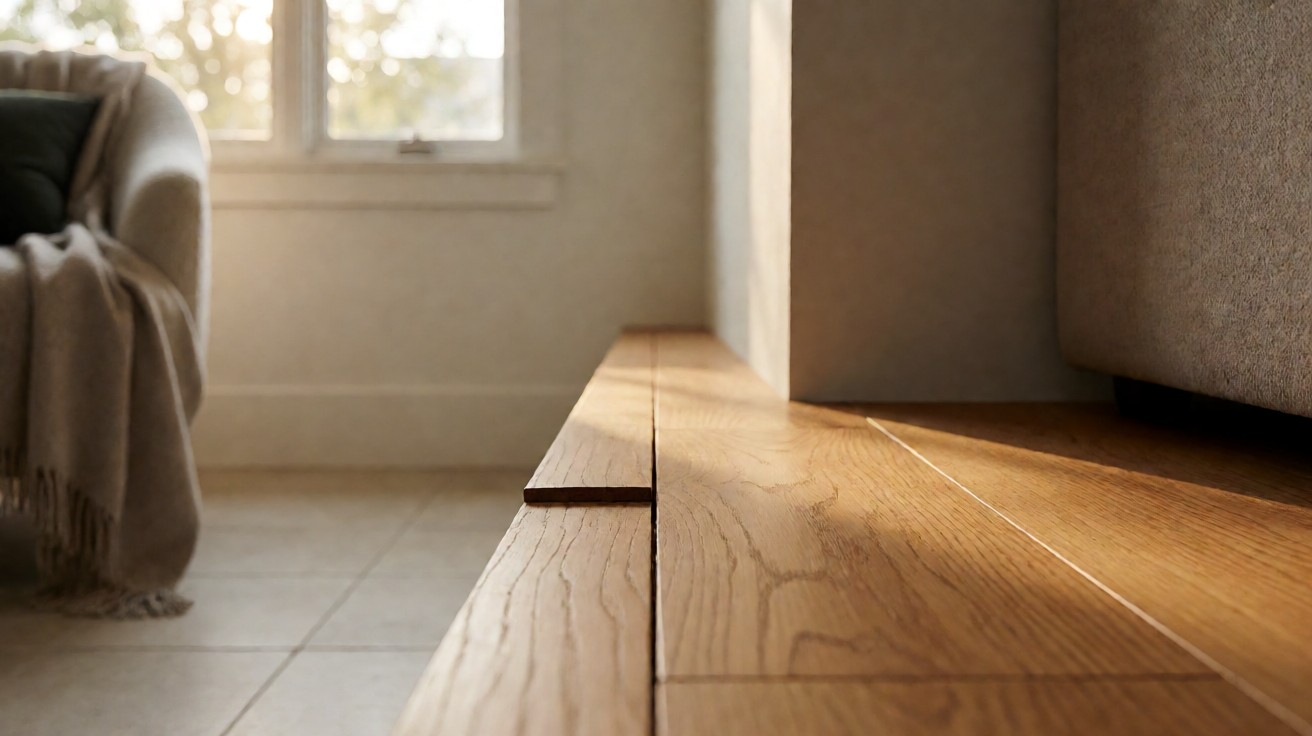
How Width Affects Wear and Repair
Wide plank wears more gracefully in one sense and less in another. Because the surface is one long board, a worn area spreads across the whole face rather than concentrating on a busy traffic strip. But because each board is a large visible element, any single damaged board stands out against its neighbours.
Narrow plank is far easier to repair plank by plank. A damaged narrow board is small, less noticeable, and cheap to replace. It is a genuinely better choice in a home with pets, active children, or a high-risk entryway, because localised damage is a small fix rather than a large one.
There is also a matching problem that catches people years later. Hardwood fades and darkens with light exposure, and a replacement board from a new batch rarely matches a floor that has aged for five years.
Narrow boards let you replace a small piece. A wide board makes that same repair a visible event, though. Keeping a spare few boards flat and conditioned is sensible either way.
Cost, Coverage, and Waste
Wide plank costs more per square foot for several reasons. Larger boards are harder to mill, grade, and dry evenly, and more material is wasted at the cut. Narrow boards are faster to produce and install, and the yield is higher. The per-square-foot gap is real and widens as you go up in width.
Coverage also changes. The same box covers more area in narrow boards than in wide ones, because you can usually order what you need by the linear foot in wide plank but buy by the box in narrow. This makes wide plank less forgiving of a bad measurement, so an accurate floor plan matters more.
The practical summary is below.
| Factor | Wide plank | Narrow plank |
|---|---|---|
| Room feel | Open, calm, contemporary | Busy, traditional, warm |
| Grain run | Long and continuous | Short and interrupted |
| Seams per sq ft | Fewer | Many more |
| Moves with seasons | Less tolerant, needs flat subfloor | More tolerant of subfloor movement |
| Cost per sq ft | Higher | Lower |
| Single-board repair | Hard to match, visible | Easy, discreet |
| Best in | Open plans, large rooms | Small rooms, halls, traditional homes |
| Waste from cutting | Higher, less forgiving | Lower, forgiving |
The Table of Trade-Offs
Where the two genuinely divide is on movement and repair. Narrow plank tolerates a slightly less perfect subfloor, because each small board can move a little without lifting a neighbour. A single damaged board is also a cheap fix.
Wide plank needs a flatter, more stable floor, but gives back a calmer, more contemporary room. Neither is more durable. They simply fail differently.
Both can carry a textured or wire-brushed surface, but the two exaggerate the texture differently. Wide boards give a deep grain run room to read as a sweep, while narrow boards turn fine texture into a busy field. If you are comparing surfaces as well as widths, the surface comparison is worth reading alongside this one.
Matching Width to Plank Pattern and Layout
If your design includes a pattern such as herringbone, chevron, or a wide-plank parquet, the width is not a free choice; the pattern is built from the board. A six-inch herringbone looks completely different from a three-inch herringbone, and the two suit different rooms.
Wide plank laid straight is a strong, quiet statement and reads best running along the longest axis of the room, which visually stretches it. Narrow plank laid straight is more forgiving, because its many seams hide a slightly uneven floor and it can run in any direction without dominating.
If you are mixing plank widths within a home, do it deliberately. A wide plank in the public rooms and a narrower plank in bedrooms and halls is a common and workable scheme, as long as the colour and finish match closely.
Pattern and plank width have to be chosen together, because the pattern is built from the board. The relationship is not fixed, but these pairings are common and each produces a distinctly different floor.
| Pattern | Board width that suits it | What the floor reads as |
|---|---|---|
| Straight lay, long run | Wide, five inches up | Calm, stretched, contemporary |
| Straight lay, small room | Narrow, two to three inches | Detailed, traditional, less stark |
| Herringbone | Narrow, three to five inches | Precise, woven, directional |
| Chevron | Narrow, three to five inches | Sharper, continuous V-lines |
| Wide-plank parquet or basketweave | Wide, six inches up | Architectural, geometric |
| Random or reclaimed lay | Any, matched by tone | Historic, deliberately irregular |
How to Choose Width for Your Home
Measure the longest continuous run of the main room and consider it in the direction you would lay the boards. If that run is generous and the house is open and modern, wide plank will pay you back in scale. If the rooms are smaller, traditional, or you want easy repairs, narrow plank is the safer, cheaper, and often more appropriate choice.
Ask the retailer for a board at least twelve inches long in the species and finish you want, and look at it on the floor of the showroom rather than in the rack. A board held at arm’s length in a warehouse tells you almost nothing about how the finished floor will read.
Is wide plank always more expensive than narrow?
Almost always in hardwood, yes. Wide boards cost more per square foot because they are harder to produce and yield less material per log. The gap narrows as you go up in price and quality, because the premium for a premium product dominates the width premium. It is not a fixed dollar difference; it is a percentage that shrinks as the flooring gets more expensive.
Does plank width change how long the floor lasts?
Not inherently. Lifespan is set by the species, the finish, and above all whether the floor was installed correctly to the manufacturer’s requirements. Width affects how a worn floor looks and how damage is repaired, which changes the perceived useful life of a specific board, but a correctly installed narrow floor and a correctly installed wide floor last about as long as each other.
What Width Does to Perceived Room Size
Width changes how large a room feels more than almost any other finish decision. It does so by changing how the eye reads the floor as a single object.
A wide board is one large element; a narrow board is a repeating pattern. Large elements make surfaces read as continuous and expansive, while a repeating pattern makes the eye work and the surface read as busy.
This is why wide plank is the default recommendation for open plans and why narrow plank is often the better answer in a small room. It is also why a wide-plank floor can make a modest room feel exposed rather than spacious: it removes the visual detail that was giving the space scale.
The effect is strongest when the boards run along the longest axis of the room, which visually lengthens it, and weakest when the run is short. If your main room is nearly square, plank width matters a lot more than plank direction.
Where This Fits With the Rest of the Hardwood Choice
Width is a dimension choice, and it interacts with the species, the construction, and the finish you have already decided. It is also one of the few choices that, like colour, is expensive to change once the floor is down.
The complete hardwood guide covers species, grades, and plank dimensions together, including how construction interacts with the width options here. If you are weighing wood against other materials entirely, the head-to-head material comparison sets hardwood plank against the alternatives on the factors that decide most rooms.
Surface texture is the other finish decision that width amplifies, and the hand-scraped versus wire-brushed versus smooth comparison covers how each surface reads across wide and narrow boards.