

You are choosing between two flooring products, and one carries a 15 year residential warranty while the other carries a 10 year commercial warranty in writing.
The answer is that a residential warranty and a commercial warranty are two different kinds of promise, and the one that matters depends on who owns the floor and who walks on it. The difference is not the length, and it is not the number of years at all.
Residential Vs Commercial Flooring Warranties
Most homeowners assume that a commercial warranty is simply a longer or stronger version of a residential one, and that is wrong in both directions. A commercial warranty is usually shorter than a residential one. It is also prorated differently, transfers differently, and covers a different thing.
Two different promises.
A residential warranty protects a person who lives in the house. A commercial warranty protects a business that operates in the building. Those are different risks, and the documents are written for different claimants.
That is why the comparison has to be made on what each document actually promises, rather than on the length of the term. The length is the least informative number on the page.
What Does A Residential Warranty Actually Cover?
A residential warranty is written for an owner-occupier. It covers manufacturing defects and a stated amount of finish wear over a stated period, and it is usually transferable to a new owner when the house is sold.
That transferability matters more than it appears. In a resale market, a warranty that survives a change of ownership is a real economic asset, and a warranty that dies with the original purchaser is worth less than it looks on the sales sheet.
Category error, not condition.
Residential terms also tend to exclude commercial use outright, and they tend to exclude the kind of traffic that a business generates. A residential product installed in a shop can be perfectly installed and still fall outside the terms it was sold under.
What Does A Commercial Warranty Actually Cover?
Different risk, different document.
A commercial warranty is written for a business. It covers the product in a commercial setting, which means it covers the wear that a business generates rather than excluding it, and it is written for the operator rather than the occupant.
Commercial terms are usually prorated, so the payout declines as the years pass. That is the opposite of the assumption most homeowners bring to the comparison, and it is the reason a 10 year commercial term is not weaker than a 15 year residential one.
Commercial warranties also tend to be non-transferable and tied to the named installation. A business that sells the premises does not take the warranty with it, and a business that moves the floor to another site usually voids it.
| Term | Typical Residential | Typical Commercial |
|---|---|---|
| Length | Often 10 to 25 years, sometimes longer | Often 5 to 15 years |
| What it covers | Manufacturing defects and a stated wear allowance | Product performance in a commercial setting |
| Payout structure | Usually a replacement or a credit against the original purchase | Usually prorated, declining over the term |
| Transfer on sale | Often transferable to a new owner | Usually non-transferable, tied to the named site |
| Traffic rating required | The product rating must match the room | The product must be certified for commercial traffic |
Read that table as a description of who the document is written for. The columns differ because the claimants differ, not because one document is more generous than the other.
The Rating That Decides Which Warranty Applies
The rating decides the promise.
Before comparing terms, you have to know which product rating you are buying, because the rating decides which warranty schedule applies. A product installed in the wrong setting carries the wrong promise, and the panel itself is not the problem.
Laminate is the clearest example. Laminate certification runs AC1 through AC5 under NALFA certification standards, with AC5 the commercial class. The number is a traffic rating, and the commercial classification carries the commercial warranty schedule rather than the residential one.
An AC5 product installed in a home often carries the commercial warranty, and the residential one does not apply. The panel is not the weaker product, the promise is, and the owner who bought it for a quiet house has bought a warranty written for a shop.
Vinyl works on a similar principle, but the rating is usually expressed as a wear layer thickness in mils rather than a class. A mil is one thousandth of an inch, so a 20 mil wear layer is 0.020 inch, which is 0.508 mm of material. Commercial lines commonly run 28 mil, which is 0.711 mm.
That difference is not cosmetic. A thicker wear layer is a specification of how much surface the product can lose before the warranty’s wear-through clause becomes relevant, and it is the number that a commercial setting depends on.
Is The Rating Printed On The Box?
Not always, and not prominently. The rating is normally on the technical data sheet rather than the packaging, which means the box tells you the look and the data sheet tells you the promise. Ask for the data sheet before the purchase rather than after the failure.
The same applies to tile, where the relevant specification is the absorption class rather than the traffic class. ANSI A137.1 defines porcelain as the tile class under 0.5 percent water absorption, and that classification decides whether the product is rated for a wet commercial area at all.
Do The Two Warranties Diverge On Water?
Water is where they diverge.
Water is the exclusion that separates residential and commercial terms most sharply, because the two settings generate different kinds of water. A house generates water from a sink, a pet, or a washing machine hose. A business generates it from a mop bucket, a delivery entrance, or a staff kitchen.
Most warranties exclude flood, standing water, and moisture that arrives from below the floor, and that exclusion applies in both columns. What differs is the allowance for surface water, where a commercial product is usually specified for a wet area and a residential one is not.
The number that decides whether a slab passes or fails is the relative humidity reading, and the test method is ASTM F2170. Per that method, a concrete slab sits within limit at 75 percent relative humidity without a vapor barrier, and at 80 percent with one in place.
For a business that operates over a slab, that reading is not a formality. A commercial floor over a slab that reads over the limit is out of specification before the first tile is set, and no commercial warranty will respond to the failure that follows.
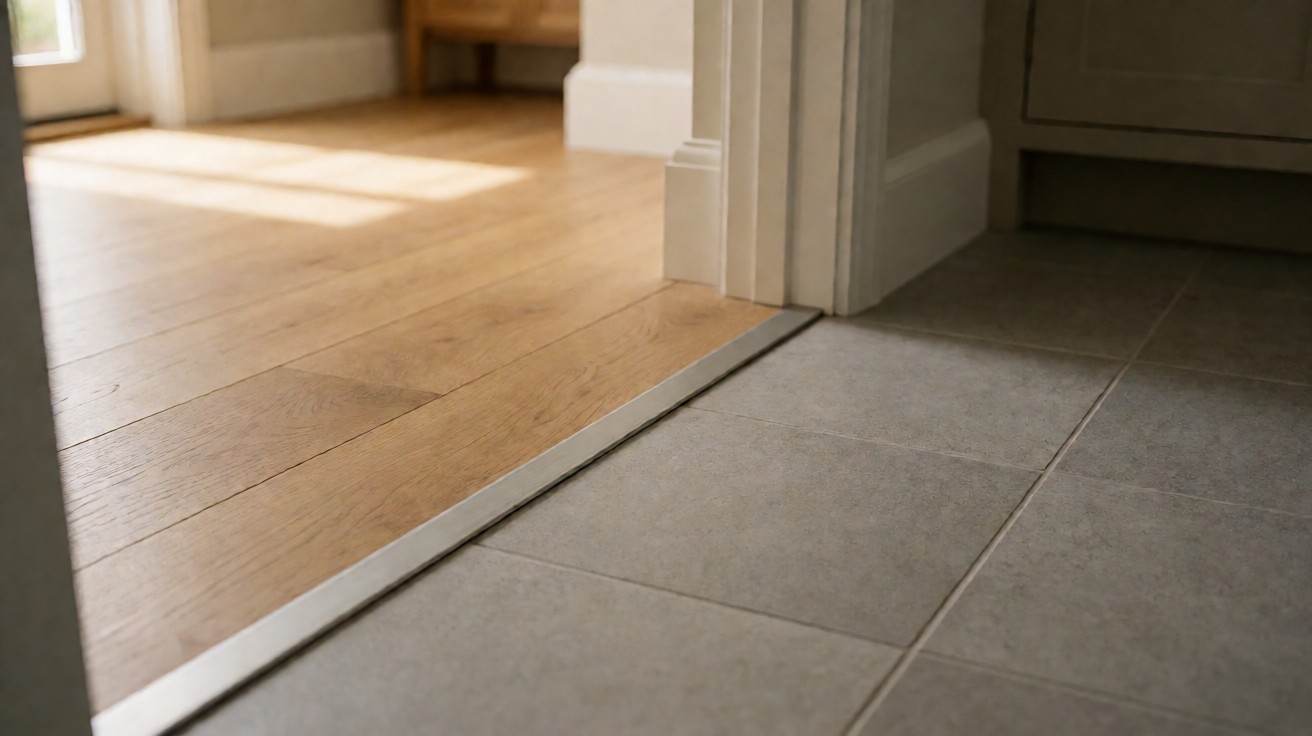
How Installation Terms Differ Between The Two
Different standards apply.
Both warranties depend on the installation being within specification, but the standards that define that specification are different. A residential installation is commonly judged against the manufacturer’s instructions. A commercial installation is commonly judged against a published installation standard as well.
ANSI A108.02 sets tile subfloor flatness at 1/8 inch in 10 feet, and ASTM E1155 expresses the same measurement as Floor Flatness and Floor Levelness numbers rather than inches over a span. For resilient sheet and tile over a slab, FF35 and FL25 are the commonly specified pair.
That figure matters more commercially than residentially, because a commercial floor is walked on by a far larger number of people and by equipment. A subfloor that is just inside tolerance for a bedroom can be outside tolerance for a retail floor over the same span.
The commercial warranty also tends to require a documented installation, including moisture readings and acclimation records, because the claimant is a business with a paperwork trail rather than a household with a receipt. Installation guides commonly call for 48 hours of acclimation before the first plank clicks.
The Claim Process Is Different Too
| Document | Residential Claim | Commercial Claim |
|---|---|---|
| Proof of purchase | Receipt with the lot or batch number | Purchase order with the specification reference |
| Product record | Technical data sheet | Data sheet plus the certification class |
| Installation record | Installer quotation | Moisture readings, acclimation record, and maintenance log |
| Defect evidence | Photographs of the affected area | Photographs plus the specification that named the product |
A residential claim is usually filed by the owner against the manufacturer, with the installer involved only if the failure is traced to the work. A commercial claim is usually filed by a business against the manufacturer, with the installer and the specifier both potentially in the chain.
That difference shows up in the documentation. A residential claim needs the receipt and the lot number. A commercial claim typically needs the purchase order, the installation record, the maintenance log, and the specification that named the product.
For a business, that means the file has to be built before the failure rather than after it. A commercial warranty is not a document you read when something breaks. It is a document that decides whether your file is complete enough to claim at all.
Who Pays When The Floor Fails Early
Four parties, three of them responsible.
When a floor fails in its first year, the question is almost always which of the three parties is responsible, and the answer determines who pays. The manufacturer is responsible for a defect in the product. The installer is responsible for work outside the instructions. The owner is responsible for use outside the rating.
A commercial setting adds a fourth possibility, which is that the product was correctly specified and correctly installed but was simply the wrong class for the room. That failure is not a defect in anyone’s work, and it is the one that a commercial warranty was written to answer.
When The Setting Is Residential But The Traffic Is Not
A home office that doubles as a client-facing space is the case that causes the most confusion, because the setting is residential and the traffic may not be. The honest answer is that the product has to match the traffic rather than the address, and where the traffic is genuinely commercial the commercial schedule is the one that fits.
How Do You Choose Between The Two?
The rule is the setting.
The decision rule is straightforward once the two documents are understood. If the floor is going into a home you live in, the residential warranty is the right document and its transferability is the term worth checking. If the floor is going into a business, the commercial warranty is the right document and its prorated payout is the term worth checking.
If the floor is going into a home that will be let, neither document is automatically right, and the residential warranty may exclude the use outright. That is the case where the warranty terms have to be read before the purchase, because the use case is what decides.
If the floor is going into a home office that doubles as a client-facing space, the honest answer is that the setting is residential but the traffic may not be. Where the traffic is genuinely commercial, the commercial schedule is the one that matches the risk.
Four Questions To Ask Before You Commit
Ask whether the product is certified for the setting it is going into, and ask for the certification class rather than the sales category. Ask whether the warranty transfers on sale, and what that transfer requires. Ask whether the payout is prorated, and what the proration schedule is. Ask what documentation the claim requires, and whether you can produce it.
Those four questions separate the products that are genuinely rated for a commercial setting from the products that are merely marketed for one. The marketing category is not the certification, and the certification is what the warranty refers to.
The flooring buying guide covers how to compare products on specification rather than on category, and the manufacturer warranties guide covers the four layers of a warranty document so the terms can be read before they are relied on.
What To Keep For Either Warranty
Whatever the setting, the file is the same, and it is built at the point of purchase rather than at the point of failure. Keep the receipt with the batch or lot numbers, the technical data sheet, the warranty document as issued, and the installation quotation.
Keep the moisture readings and the acclimation record. For a commercial installation these are typically mandatory, and for a residential one they are the evidence that the installation began within the limit the warranty requires.
Keep the maintenance guidance and follow it. A commercial floor that has been cleaned with a prohibited product, or a residential floor that has been steam cleaned against the instruction, has been handed the argument the exclusion was written to win.
Photograph the floor before anything is moved into the room, because a documented installation that passes inspection is the document that answers whether a defect was there before the floor went down.
Where The Warranty Terms Are Actually Published
Warranty terms are not always easy to find before the purchase, and the placement is inconsistent across manufacturers. For a product line, the terms are normally published on the manufacturer’s own site rather than on the retailer’s page, and they are usually attached to the technical data sheet rather than to the sales page.
That matters because the sales page describes the product and the data sheet describes the promise. If a retailer cannot produce the warranty document for a product, the product is not fully specified, and that gap is worth closing before the deposit goes down.
The same applies to the certification class. A product that is marketed as commercial but carries no published certification is a marketing claim rather than a specification, and the warranty will refer to the specification rather than the marketing.
The Practical Test To Apply Before You Buy
The most useful thing to take from a residential versus commercial warranty comparison is not which term is longer. It is which document is written for the person who will be standing in the room when the failure happens.
A residential warranty protects a household from a defective product. A commercial warranty protects a business from a defective product in a demanding setting. Both are narrower than they appear on a sales sheet, and both are wider than the marketing suggests in the direction of installation compliance.
Once that is understood, the comparison stops being a choice between two numbers and becomes a choice between two use cases. The product that matches the use case carries the warranty that matches it, and the product that does not is a claim waiting to be denied.
That is the practical test to apply before the deposit goes down. If the setting and the rating do not match, no length of warranty fixes it, because the exclusion that voids the claim is written into the document before you sign.