

Ask a flooring contractor about licensing, insurance, subfloor testing, acclimation, and the warranty split before you sign. These questions decide the project.
The cheapest quote is rarely the cheapest project. A floor fails at the edges of the agreement, not in the middle of the material.
The right answer is to ask what the price assumes. The questions below test that assumption in the order that protects you most.
Why the Questions Matter More Than the Quote
An estimate shows you the line item. It does not show you the exclusion. That gap is where most flooring disputes start.
A quote is a price on an assumption. The assumption is that the subfloor is flat, the slab is dry, the material is on site, and the crew is available. Every one of those assumptions can be wrong, and the questions below are how you test them before the money moves.
If a contractor answers each question directly, you are in good hands. If they resist one, that resistance is the exclusion you were about to sign. Write the answer down, and keep the written version of the estimate.
Two things travel with this list. The flooring buying guide covers how the buying decision and the install decision meet, and the flooring installer guide covers how to choose who you are asking.
Who Will Actually Be on Site?
The person who sells you the floor is not always the person who installs it. A showroom salesperson may hand the job to a crew you have never met.
Ask who will be in the room, and who holds the warranty on their work.
When the answer is a subcontractor, ask who carries the warranty if the subcontractor is unavailable. The company that took your money should stand behind the work, whoever swings the hammer.
A good answer names the crew or the subcontractor, and names who is responsible when that crew is not available. A vague answer is a risk you cannot price.
What Should I Ask Before You Start?
Before any work begins, ask three things in writing: who is on site, who is responsible for the work, and how you reach that person on day one. If the answer changes during the project, ask for the change in writing too.
If the crew will not be named until the morning of the install, that is a flag. You are not hiring a surprise.
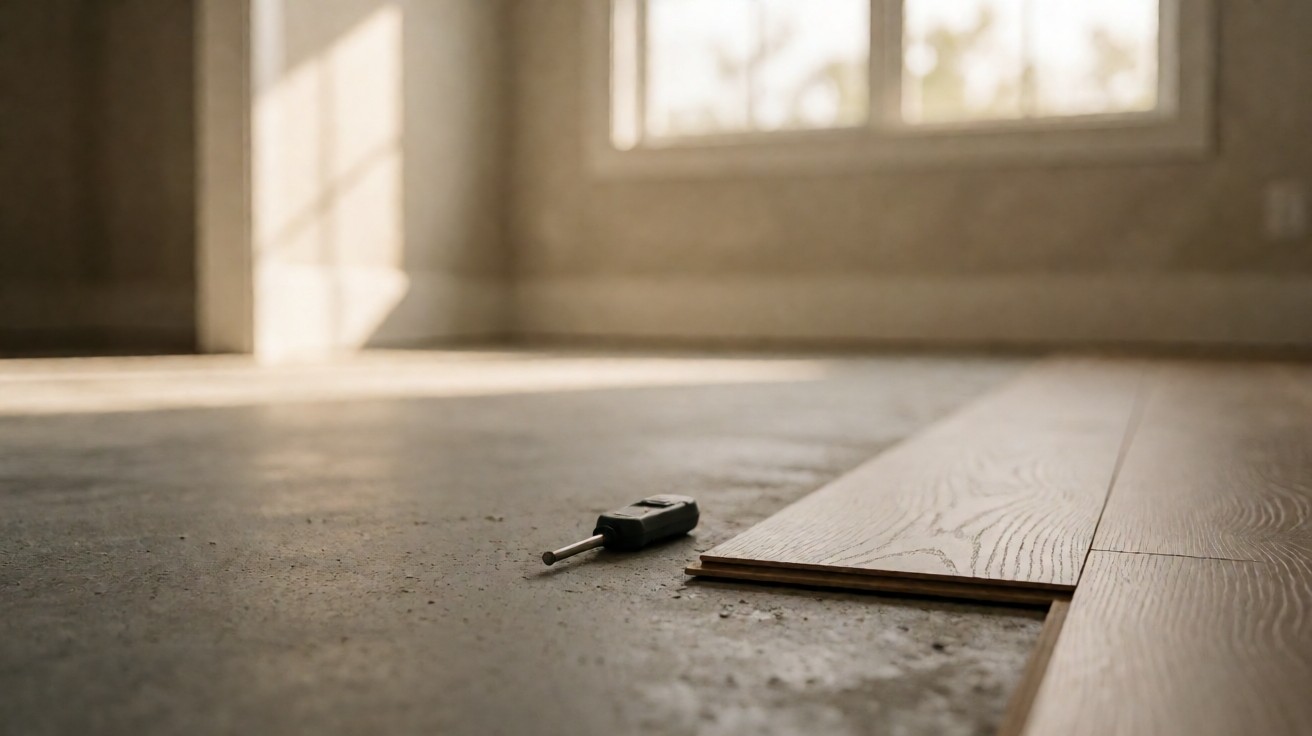
How Will You Test the Subfloor Before We Sign?
Moisture is the most common reason a wood or laminate floor fails, and the most common reason a contractor walks away from a warranty claim.
On a concrete slab, the test is a relative humidity probe driven into the slab. That is ASTM F2170, the in-situ method, and it measures the moisture inside the slab rather than at the surface. The older surface test, a calcium chloride kit, follows ASTM F1869 and measures what is coming off the slab.
Manufacturers set the limit. The Maple Flooring Manufacturers Association publishes 85 percent relative humidity for a floating floor and 75 percent for a glue-down floor. Wood flooring guidelines from the National Wood Flooring Association put the occupied space at 30 to 50 percent relative humidity and 60 to 80 degrees Fahrenheit.
Flatness matters as much as moisture. The usual tolerance is 1/8 inch in 6 feet or 3/16 inch in 10 feet. A floor that fails that tolerance needs grinding or patching, and that is a separate charge.
Ask what will be tested, which method, and what the limit is. If the answer is a number, ask who pays when the slab is over it. The subfloor flatness guide covers how that tolerance is measured and why it matters.
| Test | Method | Typical limit |
|---|---|---|
| Concrete slab moisture | ASTM F2170 relative humidity probe | 85 percent RH floating, 75 percent glue-down |
| Surface moisture emission | ASTM F1869 calcium chloride | 3 to 5 pounds per 1,000 square feet |
| Subfloor flatness | Straightedge or floor flatness number | 1/8 inch in 6 feet or 3/16 inch in 10 feet |
| Occupied space conditions | Thermometer and hygrometer | 60 to 80 degrees Fahrenheit |
Are You Licensed, Bonded, and Insured?
Licensing, bonding, and insurance are three separate protections, and most homeowners ask about one and assume the other two.
A license means the contractor is registered with the state or locality. Ask for the license number and verify it on the issuing authority’s website. In some states the threshold is low: in Massachusetts, a home improvement contractor must register for work over 1,000 dollars.
A bond is a surety that pays if the contractor does not finish. Insurance is what pays if someone is hurt or something is damaged. Ask for a certificate of insurance and call the carrier to confirm it is current.
Ask specifically for general liability and workers compensation. If a worker is injured on your property and the contractor carries no workers compensation, your homeowner policy may be the one that answers. That is a risk you did not agree to take.
A good answer gives the license number and the insurance carrier without hesitation, and puts both on the contract. If the contractor says the certificate is in the truck, that is not an answer.
What Exactly Is in the Written Estimate?
The estimate should read like a scope of work, not a lump sum. Ask what is included, and then ask what is not.
A complete estimate names the material, the labor, the subfloor preparation, the moisture mitigation, the transition and trim pieces, the removal and disposal of the old floor, the protection of adjacent rooms, and the cleanup.
Ask: what is excluded from this estimate?
The most common exclusions are subfloor repair, moisture mitigation, moving heavy appliances, door trimming, and hauling away the old floor. If any of those is excluded, the price you are comparing is not the price you will pay.
A good answer lists the exclusions in writing, with a price or a method for pricing each one. A good answer is also the one that tells you the exclusion before you sign.
The flooring quote comparison guide takes that line-item list apart and shows you what each entry should say. The flooring installation estimate guide shows how to read each line before you sign.
| Item | Usually included | Often excluded |
|---|---|---|
| Flooring material | Yes, by line item | No |
| Installation labor | Yes, by square foot | No |
| Subfloor preparation | Sometimes | Often |
| Moisture mitigation | Rarely | Often |
| Transitions and trim | Sometimes | Often |
| Removal and disposal | Sometimes | Often |
| Moving appliances | Rarely | Often |
| Cleanup | Usually | No |
How Long Does the Flooring Sit Before Installation?
Wood is a material that moves with the humidity of the room it lives in. If it is installed at the wrong moisture content, it gaps in winter and cups in summer, and the cause is written into the install rather than the product.
The rule is that the flooring acclimates in the conditioned space, not in a garage or a truck. Ask when the material will be delivered and whether the heating and cooling will be running.
Wood flooring guidelines from the National Wood Flooring Association set the occupied range at 30 to 50 percent relative humidity and 60 to 80 degrees Fahrenheit. Many engineered wood installation guides call for a minimum of 72 hours in the space, and 7 to 10 days is the safer window when the room has just been painted or the HVAC has just come online.
For a whole home, ask for the heating and cooling to run for about 14 days before the wood arrives. A floor installed into a space that is still drying out will move after the fact, and the movement will look like a defect.
A good answer gives a delivery date and a conditioned space. A good answer also says what happens if the room is not conditioned, in writing.
How Long Should Wood Acclimate?
Acclimation is not a fixed number of days, it is a condition. The floor is ready when the space is at its normal occupied humidity and temperature, and the flooring has been in that space long enough to reach the same moisture content.
If the room is 60 to 80 degrees Fahrenheit and 30 to 50 percent relative humidity, and the floor has been there for several days, it is ready.
If the space is not conditioned, no number of days will fix it. Ask for the conditions in writing, and hold the delivery until they are met.
What Warranty Do You Give Me on the Work?
There are two warranties on a floor, and they come from two different parties. The material warranty comes from the manufacturer and covers the product. The workmanship warranty comes from the installer and covers the work.
They are separate. A manufacturer warranty does not cover a bad install, and an installer warranty does not cover a bad board. Ask which one you are getting, in writing, and who handles the claim.
Ask: what is the workmanship warranty, in writing, and who do I call?
A material warranty commonly runs from 5 to 50 years depending on the product. A workmanship warranty commonly runs from 1 to 5 years. The flooring manufacturer warranty guide covers what a manufacturer warranty promises, and the warranty exclusions guide covers what it leaves out.
A good answer gives the workmanship warranty in writing, names the party who handles the claim, and says what it covers. A good answer also tells you what is excluded, because the exclusion is the part that will matter.
| Warranty | Who backs it | What it covers |
|---|---|---|
| Material | Manufacturer | The product itself, typically 5 to 50 years |
| Workmanship | Installer | The installation, typically 1 to 5 years |
| Moisture | Often excluded | Damage from slab or room moisture |
| Subfloor movement | Often excluded | Damage from an unprepared subfloor |
What Is the Timeline, and What Can Delay It?
A single room can be a 1 to 3 day job. A whole home takes longer, and the honest estimate names the start date and the risk.
The most common delays are moisture that fails the test, subfloor repair that was not in the scope, weather that stops a delivery, and material that is not on site. Ask which of those is likely on your project.
Ask: what is the start date, and what would push it out?
A good answer gives a start date, names the risks, and says how you will be told if one of them happens. A good answer does not promise a date that depends on a slab nobody has tested.
How Are Change Orders and Surprises Priced?
The subfloor that looked fine under the old carpet may not be fine under the new floor. When that happens, the price changes, and the change is the most common place a project goes wrong.
Ask how changes are priced, and when you approve them. The rule to hold is simple: no work on a change until the price is written and you have signed it.
Some surprises have a legal shape. Asbestos-backed 9 by 9 inch tile, common in older homes, requires licensed abatement before it can be disturbed. If your project touches it, the cost and the crew change.
Ask: how are changes priced, and when do I approve them?
A good answer requires written approval before the work, and gives you a price before the crew starts. A good answer also says what happens if the surprise is bigger than the estimate allows.
What Is the Payment Schedule?
Never pay 100 percent upfront. A deposit of 30 to 50 percent is normal, and the balance is due on completion.
Ask what the deposit is, and what triggers the final payment. The trigger should be completion and your acceptance, not a calendar date.
On the final payment, ask for a lien waiver. If the contractor hires subcontractors or buys material on your account, a lien waiver protects you from a claim you did not make.
Ask: what is the deposit, and what is due at completion?
A good answer states the deposit, states the completion trigger, and offers a lien waiver on the final payment. A good answer does not ask for the balance before the work is done.
What Happens When Something Goes Wrong?
Ask who you call if the floor fails, and how fast they come back. The answer tells you whether you hired a business or a transaction.
A good answer names the contact, gives a response time, and says what happens if the cause is disputed. The material warranty and the workmanship warranty decide who pays, and the installer decides how fast the room is usable again.
Who Pays for a Repair?
The answer depends on the cause. If a board is defective, the material warranty applies. If the install was wrong, the workmanship warranty applies. If the slab was wet, neither may apply. Ask the contractor to say which warranty covers the repair you are worried about.
If the contractor says the cause does not matter because they will fix it anyway, get that promise in writing before you sign.
The Closing Checklist
Before you sign, put each of these in the file. If one is missing, that is the question to ask again.
- License number, and the state or locality that issued it.
- Certificate of insurance for general liability and workers compensation, verified with the carrier.
- Written estimate with the exclusions listed.
- Subfloor test method and limit, in writing.
- Acclimation plan with the delivery date and the conditioned space.
- Workmanship warranty, in writing, with the claim contact.
- Start date and the named risks to the schedule.
- Change order procedure requiring written approval.
- Payment schedule with the deposit and the completion trigger.
- Lien waiver on the final payment.
Walk away from the quote that answers the price and not the scope. A contractor who answers every question directly is telling you the project is priced on a real assumption, and that is the only quote worth signing.