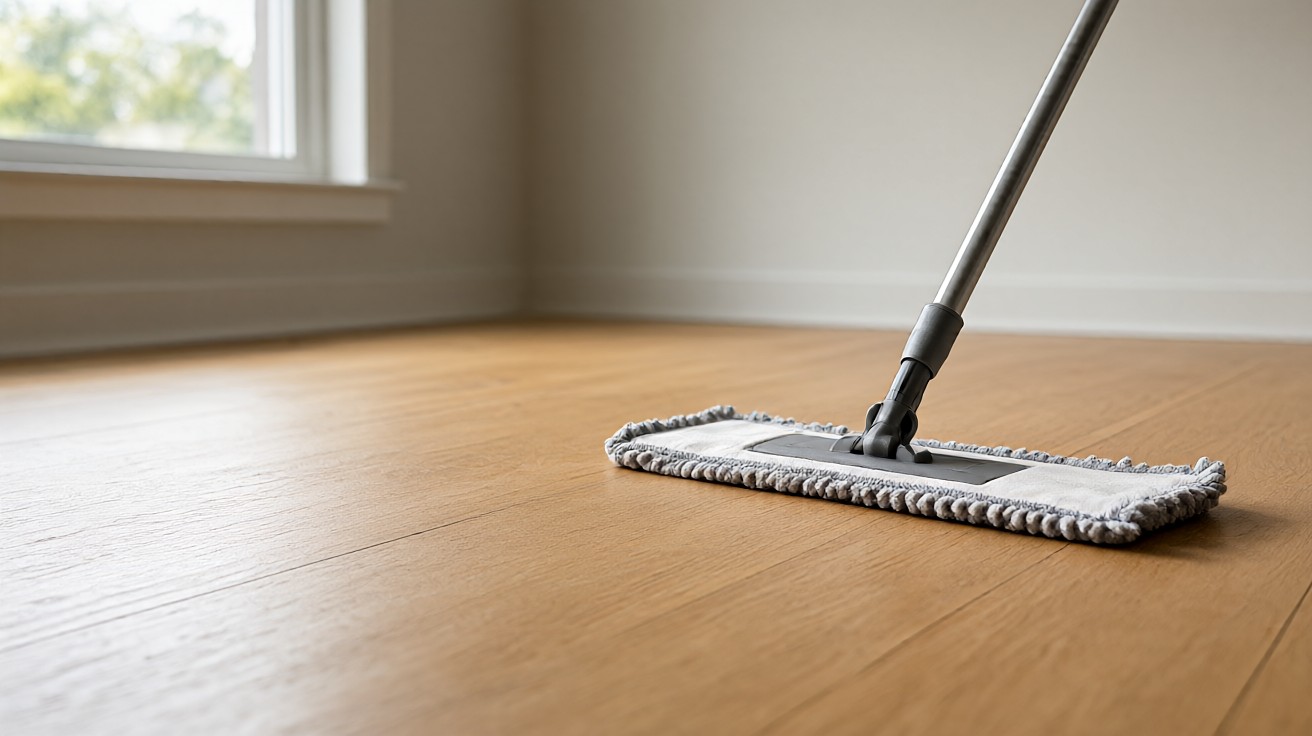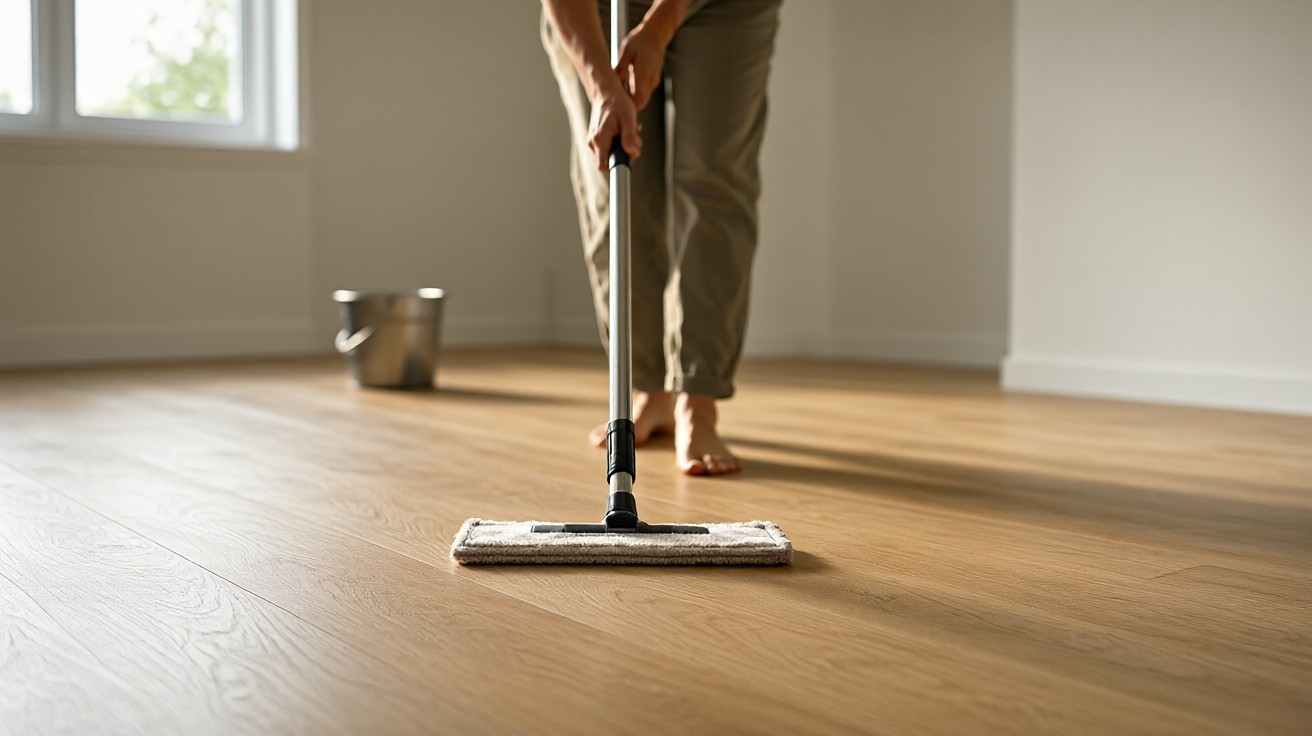

Streaks come from too much water, dirty mop heads, and the wrong cleaner. Fix the mop, the water amount, and the drying step, and floors dry clear every time.
A streak is not a cleaning failure. It is a drying pattern. Water evaporates unevenly, and whatever is dissolved in it, soap, mineral film, or dust, gets left behind as the water leaves. The fix is to put down less liquid, lift more of it back up, and let the surface dry fast and even.
Why Floors Streak After Mopping
The Three Things That Leave A Film
Most streaks trace to one of three causes. Each one leaves a different pattern, so the pattern itself tells you what went wrong.
First, too much water. A flooded floor dries in patches. The wet patches evaporate slower, and the dissolved soil migrates to the edges of each patch, leaving rings and tide marks. Second, a dirty mop head. Cotton and even microfiber hold soil in the pile.
Once the head is loaded, every pass redistributes that soil instead of removing it, and the floor dries with a grey haze. Third, the wrong cleaner. High pH or high surfactant products, especially anything that promises shine, leave a residue that water alone cannot rinse. That residue catches light and reads as a streak.
Hard water makes all three worse. Calcium and magnesium in the water dry as white mineral spots, which is why a floor can look streaky even after a careful mop.
If your tap water is hard, the final rinse should be distilled or filtered water, or a small amount of white vinegar in the rinse water, about 60 milliliters per 4 liters, to cut the mineral film.
What You Need Before You Start
Gather the kit before the water touches the floor. Stopping mid job to find a clean head is how a floor gets over wet.
| Item | Why It Matters | Notes |
|---|---|---|
| Flat microfiber mop | Lays down a thin, even film of water | Replace cotton string mops for streak free work |
| Two mop heads or pads | One for the wet pass, one for the dry pass | Wash between rooms if you only have one |
| Two buckets | Separates clean rinse water from dirty wash water | Label them so you do not mix them up |
| pH neutral cleaner | Cleans without leaving a film | Check the label for pH 7 to 8 |
| Distilled or filtered water | Prevents mineral spots on the final pass | Especially important in hard water areas |
| Dry microfiber cloth or pad | Lifts remaining moisture for a fast even dry | Larger is faster |
Check the floor finish first. Sealed hardwood, laminate, vinyl, and tile each tolerate a different amount of water. If you are unsure whether the finish is intact, test a small hidden area with a damp cloth and watch for darkening or swelling.
Step By Step Mopping Method
How Wet Should The Mop Be?
Wring the mop until it is barely damp. It should feel like a well wrung out cloth, not a sponge. If you can squeeze water out of it by hand, it is too wet. The goal is a film of water thin enough that it disappears within 30 to 60 seconds.
Dip, wring, and test on a small section. If the floor stays visibly wet for more than a minute, wring again. This single habit prevents more streaks than any cleaner.
The Pass Sequence
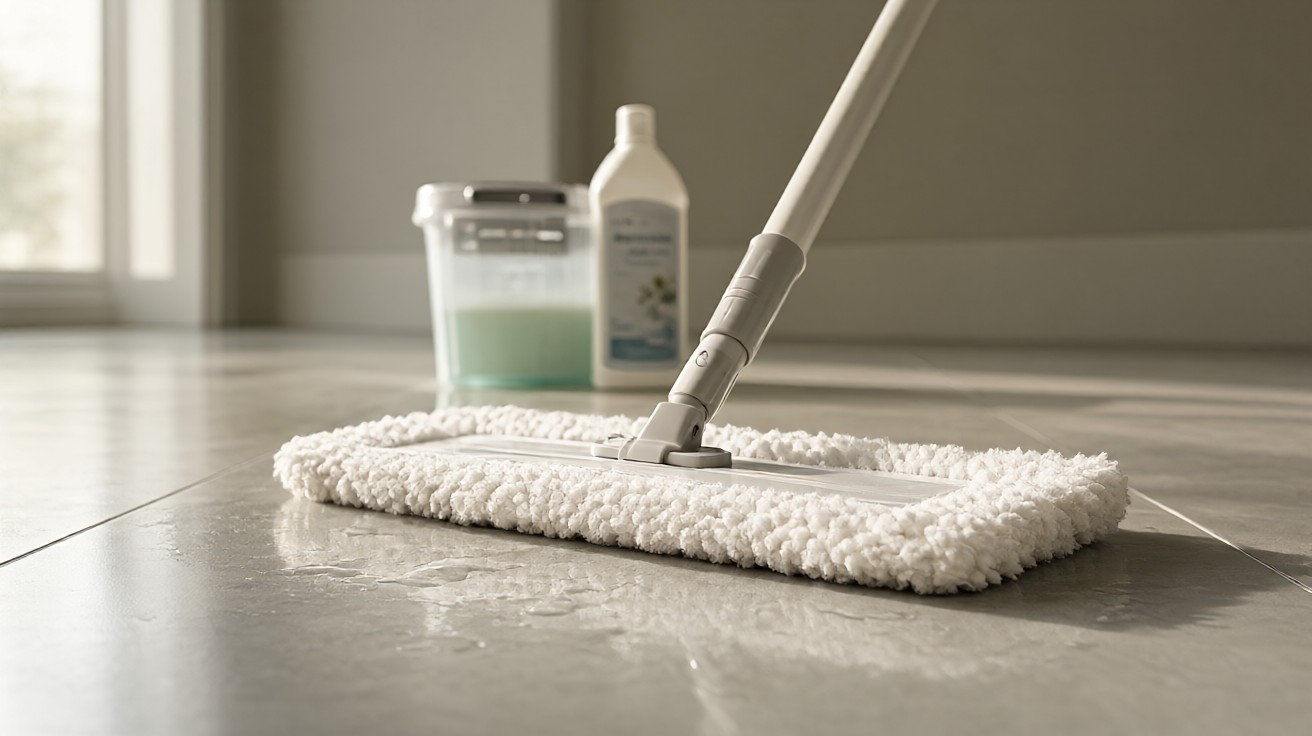
Work in small sections, about 1 to 1.5 square meters at a time. Mop the section with the damp pad, then immediately follow with the dry pad. Do not let a section dry on its own. The dry pass is the step most people skip, and it is the step that removes the film.
Overlap each pass by about 10 centimeters so you do not leave dry stripes. Keep the mop moving in the direction of the grain on wood, and in straight lines on tile. Do not scrub in circles. Circles leave swirl marks that catch the light.
Change or rinse the wet pad every room, or sooner if it looks dirty. A loaded pad stops cleaning and starts painting. On a large floor, keep a spare pad in the bucket and swap rather than rinsing mid job.
Choosing The Right Cleaner
Match the cleaner to the floor, not to the stain. A neutral pH cleaner, between 7 and 8, is safe for sealed wood, laminate, vinyl, and tile. Acidic cleaners, below pH 7, can etch stone and dull some finishes. Alkaline cleaners, above pH 9, can strip sealers and leave a film.
Use the dose on the label. Doubling the dose does not clean twice as well. It leaves twice the residue. If a floor looks dull after mopping, the most common cause is overdosing, not under cleaning.
Skip products that promise shine, polish, or rejuvenation on a floor that is already finished. Those products add a layer that builds up over weeks and streaks on every later mop. If you want a shine, buff the dry floor with a clean dry microfiber pad instead.
What pH Should A Floor Cleaner Have?
A floor cleaner should sit between pH 7 and pH 8. NWFA guidance for wood floors, TCNA guidance for tile, and EPLF bulletins for laminate all land in that neutral band. Below pH 7 is acidic and can etch stone or dull a finish. Above pH 9 is alkaline and can strip sealers. That 7 to 8 band is the safest default when you do not know the finish.
Use 30 milliliters of cleaner per 4 liters of water unless the label says otherwise. A 1 to 128 dilution is standard for many neutral cleaners. Stronger is not better. It is residue.
Water Temperature And Amount
Use warm water, not hot. Hot water evaporates too fast, which leaves the dissolved residue behind before it can be wiped away. Warm water dissolves soil better than cold and stays on the surface long enough to be lifted.
Use less water than you think. A flat mop with a damp pad needs only a shallow bucket, about 4 liters for a whole room. Refill rather than topping up dirty water. Once the wash water looks cloudy, it is no longer cleaning, it is spreading.
On wood and laminate, never let water sit. Wipe it up within 60 seconds. On tile and vinyl, you have more margin, but a fast dry still gives a clearer result.
Drying The Floor The Right Way
Drying is half the job. A floor that air dries will streak, because air drying is uneven. Use the dry pad pass, then open windows or run a fan to move air across the surface. On a humid day, a fan is not optional.
For a small area, a dry microfiber cloth on hands and knees gives the best result. Work in the direction of the grain on wood. On tile, work across the tiles and then along the grout lines.
Do not walk on a drying floor. Footprints in a damp film dry as permanent marks. If you must cross, use clean dry socks and step lightly.
Common Mistakes That Cause Streaks
Why Does My Floor Still Look Cloudy?
If the floor is cloudy after a careful mop, the cause is usually one of these. A mop head that was not rinsed clean. A cleaner that was overdosed. Hard water mineral film. Or a wax or polish buildup from earlier products.
Test each by mopping a small area with plain distilled water and a fresh pad. If the cloud clears, the cleaner or water was the problem. If it does not, the buildup is on the finish and needs a dedicated stripper or a professional refinish.
Another common cause is mopping a floor that was not vacuumed first. Grit and sand dragged under a wet pad scratch the finish and leave dull tracks that look like streaks. Always vacuum or dust mop before wet mopping.
Do not mix cleaners. Combining a neutral cleaner with a bleach or ammonia product can leave a residue that is hard to remove, and the fumes are a hazard. Use one product, rinse well, and only switch products after a full rinse.
Mopping Different Floor Types
| Floor Type | Water Tolerance | Best Method | Avoid |
|---|---|---|---|
| Sealed hardwood | Very low | Damp microfiber, dry pass immediately | Standing water, steam mops, wax |
| Laminate | Very low | Barely damp pad, fast dry | Wet mopping, soaking |
| Luxury vinyl plank | Moderate | Damp mop with neutral cleaner | Abrasive pads, high heat |
| Ceramic and porcelain tile | High | Damp mop, dry pass for shine | Acid on unsealed grout |
| Natural stone | Low to moderate | pH neutral stone cleaner, damp mop | Acidic or alkaline cleaners |
| Polished concrete | Moderate | Damp mop, microfiber dry pass | Harsh degreasers |
For more detail on specific materials, see how to clean laminate floors, how to clean ceramic and porcelain tile, and how to clean engineered hardwood floors.
How Often To Mop
Mop high traffic areas once a week. Bedrooms and low traffic rooms can go two weeks. Kitchens and entryways may need a mid week spot mop. Over mopping wears the finish faster than under mopping, so match the schedule to the dirt, not the calendar.
Between mops, dust mop or vacuum with a hard floor attachment. Removing dry soil before it becomes wet mud is the cheapest way to keep floors clear.
Fixing Streaks After They Happen
If a floor is already streaked, do not mop again with the same method. Strip the film first. Mop with plain warm water and a fresh pad, then dry pass. If the film remains, add 60 milliliters of white vinegar per 4 liters of water and repeat. Rinse with distilled water and dry.
For a wax or polish buildup, use a product made to remove that specific buildup, following the label, and test in a hidden area first. Do not use ammonia or bleach on a finished floor unless the manufacturer allows it.
If streaks keep returning on one floor, check the mop head. Wash microfiber with no fabric softener, which coats the fibers and ruins absorbency. Replace heads that have gone flat or grey. A tired head cannot lift water evenly, and no cleaner fixes that.
Quick Reference Checklist
Before you start: vacuum first, mix a neutral cleaner at the label dose, fill two buckets, and lay out a dry pad. While mopping: wring until barely damp, work in small sections, dry pass immediately, overlap 10 centimeters, change the pad when it looks dirty. After mopping: fan or open windows, stay off the floor until dry, store the pad clean and dry.
Typical reference values for streak free mopping: 30 minutes dwell time, 4 hours full dry, 10 mm water film limit, 2 pad layers, 8 percent humidity rise, 3 days finish cure, 5 kg mop pressure, and 12 inches overlap. These follow NWFA, TCNA, EPLF, ASTM D4263, and ISO 37131 guidance.