
You have chosen the new floor, and the quote for installing it does not include taking up the old one. That missing line is where budgets fail.
Removal and disposal usually runs 1.50 to 4.00 dollars per square foot, and it is priced by area because the answer is labour, not material. Whether it is worth doing yourself comes down to one question: is the old floor floating or glued down?
What Flooring Removal Actually Involves
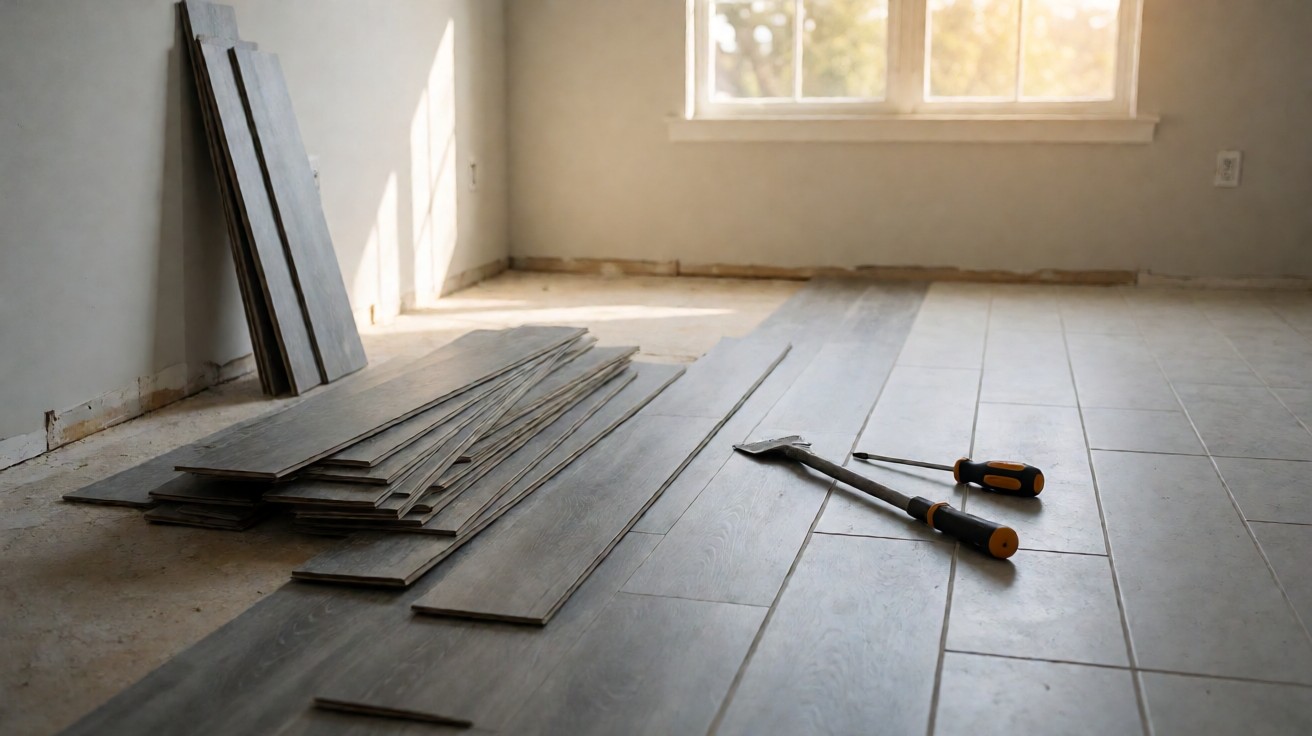
Removal is not structural demolition. Nobody is breaking up a slab or cutting joists. It is the labour of lifting the old floor, stripping whatever holds it to the subfloor, and getting that debris off the property.
That labour scales with square footage and with the obstacles inside the footprint. A 200 square foot bathroom carries the same area as a 200 square foot family room and takes the same demolition time in far less space.
Three items add time the area does not predict: perimeter cuts to free the material, thresholds and door openings, and the route out. A third-floor bedroom carries a stair run.
Debris handling is a separate line. Some jobs need a roll-off at the kerb, others need a crew bagging waste into a truck bed and still paying the minimum charge.
Why Removal Is Priced Per Square Foot And Not Per Room
A residential tear-out crew of two commonly bills 35 to 65 dollars an hour each. That is 70 to 130 dollars an hour of floor time before equipment, supervision, and disposal minimums land on top.
Area is the only measurement that scales cleanly. Here is the arithmetic on a 200 square foot room: three hours of crew time at 80 dollars an hour is 240 dollars of labour, which is 1.20 per square foot.
A 30 square foot closet needs the same drive time, the same protection and the same minimum disposal ticket. Priced per room it looks like a bargain. Priced per square foot it is 8 dollars.
Per-room pricing is not dishonest, but it hides the variable you care about. Per-square-foot pricing forces the quote to declare whether threshold cuts, adhesive stripping and disposal are inside the rate.
It also explains why two quotes for the same house can differ by a thousand dollars and both look reasonable. Comparing material versus installed price figures only works when the scope behind them is identical.
Removal Cost By Old Flooring Type
Flooring removal cost varies by old material because the labour does. Tack-strip carpet pulls off in minutes. Tile set in mortar has to be broken up, carried out, and swept, and it weighs four times as much.
| Old flooring | Dollars per sq ft | Disposal | Do it yourself |
|---|---|---|---|
| Carpet on tack strip | 0.75 to 1.50 | Heavy, cheap per ton | Usually |
| Carpet tile, glued | 1.50 to 2.75 | Sticky, special loads | Partly |
| Floating laminate or LVP | 0.50 to 1.00 | Light, bulky | Yes |
| Sheet vinyl | 0.75 to 1.75 | Medium weight | Rarely |
| Glued vinyl or VCT | 2.00 to 3.50 | Sticky, tariff risk | No |
| Ceramic tile on a slab | 2.50 to 4.50 | Very heavy | No |
| Engineered hardwood | 1.50 to 2.75 | Heavy, clean | No |
| Solid hardwood, nailed | 2.00 to 3.50 | Heavy, clean | No |
Read the last column against the floor you actually have. If it is floating, removal is an afternoon and disposal is a rental. If it is glued, removal is a day and disposal is a bin.
Two materials sit outside that table because contractors price them by special rule. Radiant-heated floors cannot be ripped up without damaging the heating element, and 9×9 or 9×12 asbestos-suspect tile is a testing problem before it is a demolition problem.
Ceramic tile is the heavy case. At roughly 4 pounds per square foot, 200 square feet of tile comes out near 800 pounds before any mortar or backer board.
Floating Or Glued: Can You Pull It Up Yourself
A floating floor is not fastened to the subfloor. The planks or tiles interlock and sit on underlayment, so they come up in the reverse order they went down.
Floating comes up. Glued does not.
If your floor is floating you can usually do a whole room in an afternoon with a floor bar, a pull bar and knee pads. If it is glued down, the same afternoon produces half-detached planks and a subfloor still covered in mastic.
Sheet vinyl sits awkwardly in the middle. A loose-laid sheet with a lifted perimeter comes up in an afternoon. A sheet in a kitchen or bathroom is usually perimeter-bonded, often has a second layer underneath, and has to be scored and pried.
Adhesive is the dividing line, not material type. Click-lock LVP, laminate and engineered wood are all floating. Glued carpet tile and set VCT are permanently bonded.
You can test it in ninety seconds. Pry up a board at the edge of the room. If it lifts with no resistance it is floating. If it tears and leaves glue strings, it is glued down.
Adhesive Residue And What It Leaves Behind
Residue is the real cost driver in a removal quote, because it does not show up in a photograph and it is not in the square footage.
Tar and asphalt mastic from old black carpet comes off a slab as a grey film that never fully lifts. Water-soluble carpet adhesive can be scrubbed off, but the dried version under it needs grinding. Vinyl adhesive is thin enough that scraping it takes the slab surface with it.
If you leave residue behind, one of two things happens. You install over it, which raises the floor by a quarter inch, kills doorway clearance, and leaves a floor that moves over a soft spot. Or you pay someone to remove it, and the removal line grows.
Bonded resilient floors cannot go over asphalt mastic at all. The residue migrates into the new material and the floor buckles along the seams within a season.
If the old floor is on a slab, what goes on top changes what has to happen underneath. Flooring over concrete slabs follows that sequence, and it starts with what the previous floor left behind.
Disposal: Weight, Bins, And What The Transfer Station Charges
Disposal is priced by weight and by volume, and flooring is light for its volume and heavy for its area.
Weight, not volume, is what the hauler charges on.
Carpet with pad runs about 3 to 5 pounds per square yard. Engineered wood runs about 2.5 pounds per square foot, tile with mortar near 4. That spread is why the same 200 square feet can be one bin or four.
| Old flooring | Weight per area | 200 sq ft load | Disposal note |
|---|---|---|---|
| Carpet with pad | 3 to 5 lb per sq yd | 100 to 120 lb | Cheapest per ton |
| Engineered wood | 2.5 lb per sq ft | 500 lb | Clean fill in many areas |
| Tile with mortar | 4 lb per sq ft | 800 lb | Volume-limited, not weight |
| Sheet vinyl | 1.2 lb per sq ft | 240 lb | Wet loads weigh more |
| Carpet tile | 1.8 lb per sq ft | 360 lb | Priced as sticky debris |
A 10-yard roll-off typically carries 3 to 5 tons before it is overfilled, which is 6,000 to 10,000 pounds. That is plenty for 200 square feet of carpet and nowhere near enough for the same area of tile with mortar.
Overage is charged by the ton on top of the base rate, commonly 50 to 100 dollars per ton, and some haulers bill the full rate again once the limit is passed.
A transfer station charges a minimum ticket whether your load weighs 200 pounds or 2,000, and many will not take flooring waste at all. If you haul it yourself, call first and ask about drop fees by material.
Carpet is the easiest waste to place and the least legal to place carelessly. The carpet guide covers what the material is made of, and recycling rules follow the fibre content.
Tile and mortar are the opposite case, and the tile guide covers the material. A load of crushed porcelain is often sold as clean fill, which is cheap, or refused as mixed debris.
Stairs, Tight Access, And Built-In Furniture
These are the three things that turn a cheap removal into an expensive one, because none of them is in the square footage.
Per step, not per square foot.
A stair run is priced by dismantling the tread and riser, protecting the stringer, and carrying each piece down. Expect two to four times the room rate per step, so a 12 step run prices like a second small room.
Tight access costs money whenever there is no room to swing a breaker. A 36 inch hallway with a boxed-out duct means hand tools and short breaking cycles. A third-floor walk-up with no lift means the debris goes down twelve steps on foot.
Built-in furniture is a demolition job hiding inside a flooring job. A 30 inch vanity or a knee wall is half an hour with a reciprocating saw, and none of it is in a square foot count.
| Obstacle | Typical added cost | Why it is different |
|---|---|---|
| Stair step | 40 to 120 per step | Dismantle and carry down |
| Hallway under 36 inches | 100 to 400 per room | Hand tools, no swing room |
| Built-in cabinet or vanity | 60 to 150 each | Saw work, not floor work |
| Basement or third-floor access | 150 to 400 per load | Carry distance, no lift |
| Adhesive residue | 1.00 to 2.50 per sq ft | Grinding or resurfacing |
| Minimum disposal ticket | 30 to 60 per load | Billed below the weight limit |
If you want one number to watch, it is the per-step and per-obstacle rate rather than the square foot rate. A quote at 1.40 per square foot with a stated obstacle allowance beats a quote at 1.10 that quietly excludes it.
What The Subfloor Has To Pass Before The New Floor Goes Down
Removal is also the moment the subfloor gets inspected, and what that inspection finds is often worth more than the removal itself.
ASTM F710 is the standard practice for preparing concrete subfloors before resilient flooring is installed. Its substance is simple: sound, smooth, flat, clean, and within a pH band of 7 to 10 measured at the surface.
Outside that band the adhesive does not cure properly, and the failure shows up months later as the whole sheet lifting at the seams. Ground concrete is harder and needs a primer; a patched area that has not cured will telegraph through a thin sheet.
Moisture gets the same treatment. ASTM F2170 in-slab relative humidity above 75 percent means the slab is still releasing water, and a resilient floor installed over it will blister. A reading above 85 percent means the water is arriving from somewhere else in the room.
ANSI A326.3 is the dynamic coefficient of friction test used to rate a dry walking surface. Accessibility codes reference 0.42 as the figure for a level interior surface.
That rating attaches to a material and a finish, not to a room, so it has to be rechecked. Grind residue off a slab and the texture has changed. Pour a self-leveling compound and you have a surface nobody measured.
IICRC S100 governs what happens to a subfloor that has taken water. It sets drying targets rather than a single moisture number, and it limits how long a wet building stays wet.
Installing over a subfloor that failed to dry is how a small removal problem turns into replacing the whole floor. Sequence matters more than speed here.
Older buildings have their own rules. Below-grade 9×9 and 9×12 tile is an asbestos suspect until sampling says otherwise, and in some US regions and Canadian provinces that sampling must happen before demolition. Pre-1978 painted surfaces can carry lead, and disturbing them can pull certified work into the job.
DIY Removal: When It Saves Money And When It Does Not
The honest version of this question starts with your own labour rate. A contractor doing tear-out bills 35 to 65 dollars an hour. If the job takes you six hours, you avoided 210 to 390 dollars of billable time by spending a Saturday on it.
Then add the equipment. A scraper, a shop vac, a wet saw and a 10-yard bin run 250 to 450 dollars for a weekend, and the bin alone is often a third of the demolition bill.
So the case for doing it yourself is strongest when the floor is floating, the room has no stairs, and the debris fits in a vehicle you already own. DIY versus professional install runs the same comparison job by job.
It stops working where the floor is glued, because the adhesive has to come off too and grinding a 200 square foot slab is a different skill from pulling a plank. It stops working with a 12 step run, a built-in nobody wants to touch, or 800 pounds of tile that will not go in the car.
Getting Removal Quotes You Can Compare
Two quotes are only comparable when they contain the same scope, and removal quotes hide scope more often than installation quotes do.
Ask for the rate per square foot, the material it assumes, and whether disposal sits inside it. Then ask what it excludes: thresholds, stair steps, adhesive removal, built-ins, hauler minimums.
Ask how the debris is billed, by the bin, by the weight or by the load. A per-load charge is easier to predict than a by-the-ton overage, and a quote naming the hauler beats one saying disposal included.
Ask whether the crew photographs the subfloor before leaving. It settles the argument about whose fault a defect is months later, when the new floor has already been paid for.
Same Contract Or Separate Line, And Why It Matters
Putting removal and installation in one contract is worth a premium, and the reason is not convenience.
A new floor is only as good as the subfloor it was set into, and most manufacturers make the installer responsible for that subfloor at handover. If a different company stripped the floor and left adhesive behind, the installer can refuse to stand behind the failure.
There is a defensible middle case. A demolition contractor removes and disposes, then the installer prepares the slab as a paid extra with a written scope and photographs. Scope is what protects you, not the boundary between contracts.
Separate is also fine when the second company is only hauling debris off the property, because that work never touches the substrate and cannot be blamed for it.
How Removal Shares Your Project Budget
Removal typically takes 8 to 15 percent of a mid-range re-flooring budget, and more when the old floor is set tile on a slab. That share moves with two numbers: the installed price and the removal rate.
Take a 600 square foot living room with glued carpet over a slab. Removal at 2.00 per square foot is 1,200 dollars, plus a 300 dollar bin. LVP at 5.50 per square foot installed is 3,300 dollars. The project is 4,800 dollars, and removal is 1,500 of it, which is 31 percent.
That is why removal feels expensive on a cheap floor and cheap on an expensive one. Over solid hardwood at 18 dollars per square foot, the same 600 square feet of demolition is under 4 percent of the project.
Get the area before you compare anything, because the square footage calculator holds the room list and the stair count, and both move the removal rate more than the material does.
Removal is the line on a flooring quote that gets estimated last and discovered first. Read it while the subfloor is still covered, because once the floor is up it is a change order instead of a price.