
Porcelain and ceramic tile are both clay, but porcelain is fired hot enough to vitrify the body, and that one change explains nearly every practical difference. Ceramic tile is fired at lower temperatures and remains a porous, partially vitrified body that absorbs water and depends on a glaze for its surface performance. Porcelain vitrifies all the way through, so it absorbs almost nothing and wears from within rather than wearing through a glaze. Everything a buyer is actually deciding between, from whether the tile can go in a shower to how long it will look new, comes from that difference in firing. The porcelain flooring guide covers the material in full.
Water Absorption and Why It Decides Everything
ANSI A108.3 and ASTM C373 set the test, and the threshold that matters in practice is 0.5 percent water absorption. A tile that absorbs below that is defined as porcelain, which in plain terms means the water cannot find a path into the body. A ceramic tile absorbs considerably more, commonly between 3 and 8 percent for a typical wall tile, and it is still dimensionally stable, still durable, and still completely appropriate for a floor in a dry room. It simply is not the same material in a wet one.
The consequences are immediate and mechanical. Water that enters a ceramic body carries dissolved salts with it, and as the water moves out through the surface it deposits those salts, which is the mechanism behind the efflorescence that appears as white haze on a new grout line and on the tile face. A vitrified porcelain body has no transport path, so it neither absorbs nor deposits. This is why a porcelain tile can sit in a shower indefinitely while the same layout in ceramic will show haze, discoloration, and eventually a tile that has lost adhesion to the mortar bed.
| Property | Ceramic Tile | Porcelain Tile |
|---|---|---|
| Water absorption | Typically 3 to 8 percent | Under 0.5 percent |
| Body structure | Partially vitrified, porous core | Vitrified through the full thickness |
| Surface layer | Separate glaze carries the colour | Colour through body or surface skin |
| Wear behaviour | Wears through the glaze over time | Wears from within, far slower |
| Sealing | Sometimes required, glaze-dependent | Never required |
| Typical use | Walls, and dry-room floors | Floors, wet rooms, anywhere |
How the Surface Wears
A ceramic floor tile has a glaze sitting on top of a body, and the glaze is the part that gets scratched, chipped, and worn through. Once the glaze is gone, the porous body underneath is exposed and the tile now behaves exactly like the material it is: absorbent, stainable, and no longer water-tight. That transition happens slowly over years in a residential room and it is not reversible.
Porcelain wears differently because the colour-bearing material extends through the body. Where a glaze has worn through, porcelain simply shows more of the same material underneath, which is why a twenty-year-old porcelain tile in a busy hallway still reads as the same colour. This is also why a through-body porcelain is more resistant to chipping at an edge, which is the most common porcelain failure, and why a glaze-on-glaze-biscuit is a category the buyer should check rather than assume.
Strength, and the Mistake of Assuming Porcelain Is Unbreakable
Porcelain is denser and stronger than ceramic in compression, and that is genuine. The mistake is treating it as unbreakable. Porcelain has a very low strain to failure compared with a resilient material like wood, which means it does not flex and does not distribute impact; a sharp blow at the wrong angle on an edge shatters it, and it shatters rather than dents. A dropped cast-iron pan on a ceramic tile of the same quality will usually chip the glaze; the same blow on porcelain removes a piece.
The practical implication is about handling and support rather than about the material being weak. Porcelain should be carried on edge rather than dragged, it should be cut with a wet saw and a diamond blade rather than snapped, and the subfloor beneath it must be flat enough that the tile is not supported only at its corners. A tile supported at two points and empty in the middle will break under a foot load long before it breaks under a dropped object.
Slip Resistance and Outdoor Use
Both materials can be made with a textured surface for slip resistance, and DCOF values under ANSI A326.3 are the way to compare them rather than by eye. The threshold in that standard is a measured wet DCOF of 0.42 or greater for a level interior space expected to be walked on when wet. Below that, the standard treats the surface as suitable only where it will be kept dry when walked upon. The standard also states plainly that a DCOF figure is a comparison tool and is not by itself a prediction that a floor will not slip, because contamination, drainage, footwear, and maintenance all move the number in service. Because porcelain is denser and vitrified, it is easier to achieve a high slip resistance in porcelain than in ceramic, which matters on a shower floor or a pool surround where a glazed surface that goes smooth with wear is a genuine hazard. Where a floor will be wet regularly, specifying a slip-resistance class is not optional.
The same density that makes porcelain tough also makes it a reasonable choice for covered outdoor areas in temperate climates, because it absorbs little and tolerates freeze-thaw cycles that would damage a ceramic with a porous body. Neither material should be assumed suitable for an uncovered exterior surface, where the thermal cycling and the water ingress both go well beyond what a floor tile is specified for.
Where Each Belongs in a Home
Ceramic tile is a wall and dry-room floor material, and it is excellent at both. Bathroom walls, kitchen backsplashes, laundry walls, and any floor that will not see standing water are all correctly served by ceramic, at a lower price than porcelain and in a wider range of colours and gloss levels because the glaze does the work. Porcelain is a floor and wet-room material, and for floors it is simply the better product.
There are two situations where porcelain is not automatically right. In a room where the design intent is a specific large decorative glaze pattern that the manufacturer has not reproduced in porcelain, ceramic is the only way to get that look. And where budget is genuinely constrained in a dry room, a good ceramic floor tile will serve for many years, which makes it a reasonable choice rather than a compromise. The glazed versus unglazed guide covers the finish choices that sit underneath this whole decision.
Thickness, Backing, and Installation
Thickness is not a quality signal. A 6 mm porcelain tile and a 10 mm porcelain tile from the same manufacturer have the same absorption and the same wear behaviour; the thicker one is more expensive and more rigid, which reduces lippage over a slightly uneven subfloor but increases the cost of handling. Ceramic tiles follow the same logic. What actually matters is whether the tile is rectified, meaning the edges are mechanically squared after firing, because a rectified tile can be laid with a narrower joint and a rectified edge is a prerequisite for a large-format installation.
Both materials can be sold with a backer attached. A backer improves handling and can reduce the adhesive and mortar needed, and for porcelain the reduction is often worthwhile because porcelain is heavy and a thin-bed adhesive plus a backer is generally more economical than a thick-bed mortar. Neither material is more forgiving of a bad subfloor than the other, which is a point worth repeating because a wet room gets a tile failure far more often from substrate movement than from the tile itself.
Cost, and What the Price Difference Actually Buys
Porcelain runs roughly 30 to 60 percent more than a comparable ceramic tile, and the reason is manufacturing energy rather than scarcity. It is fired at temperatures above 1200 degrees Celsius, the firing cycle is longer, and yield is lower because a warped vitrified tile cannot be corrected. That energy cost is real and it is the honest reason porcelain is not simply a cheaper better version of ceramic.
What the premium buys on a floor is the absence of the maintenance clock. A ceramic floor tile in a kitchen will begin to show wear in the traffic lane within a decade depending on the glaze, and once the glaze is through, the options are a deep refinish that may not match or a replacement. The same traffic on porcelain produces a gradually more polished surface with no colour change. Over a twenty-year hold, that difference usually justifies the premium in a room where the floor will actually be walked on.
| Room | Better Choice | Reason |
|---|---|---|
| Bathroom floor or shower | Porcelain | No absorption, no efflorescence, no sealing |
| Kitchen floor | Porcelain | Stain and acid resistance, glaze cannot wear through |
| Entryway, laundry | Porcelain | Tracked water is absorbed by nothing |
| Bathroom and kitchen walls | Ceramic | Wider colour and gloss range, lower cost |
| Dry-room floor, budget limited | Ceramic | Serviceable for many years at lower cost |
| Floor in a high traffic corridor | Porcelain | Wears from within rather than through |
One further practical difference shows up during installation. Porcelain is denser, so it is noticeably heavier to lift, and the cutting is slower because vitrified clay resists a blade far more than ceramic does. On a large bathroom floor that difference is measurable in hours, and it belongs in the labour comparison alongside the material price. Ceramic lays faster because it cuts faster, which is one reason a large-format ceramic installation has historically been a straightforward job and a large-format porcelain one is not.
The Short Version
For any floor, porcelain is the better material. It absorbs nothing, needs no sealing, wears from within rather than through a glaze, resists acid and stain, and a damaged tile can be replaced invisibly from stored stock. The premium is real, it is partly explained by the energy cost of firing, and on a floor it is paid back through the absence of a maintenance clock.
For walls, ceramic is very often the better buy. It carries a wider range of colours, gloss levels, and decorative glazes than porcelain because the glaze does the colouring work, and it costs meaningfully less for a surface that will never be walked on or wet. The distinction that matters most to carry away is simple: on a horizontal surface or in a wet room, ask for the absorption figure before you agree a price.
Common Mistakes When Buying Either
The most common mistake is buying on price per square foot without reading the absorption figure, and the second is assuming a large, thin, inexpensive tile is porcelain because it looks like porcelain. Many stone-look tiles are a thin glazed ceramic printed with a stone image, and they are sold in sizes and weights that suggest a porcelain body. The droplet test on the actual sample settles it in ten seconds, and a seller who objects to a water bottle has told you what you need to know about that seller.
The other recurring error is specifying a porcelain floor in a room that will never see water, on the assumption that it is the superior product. It is a superior product, but the measurable benefit is absorption and wear, and in a dry formal room with light traffic neither of those is the binding constraint. Spending that difference on a better slab of stone, where the variation is what the buyer actually wants, produces a better room for the same money.
How to Tell Them Apart When You Buy
Look at the box, not the sample. A compliant porcelain tile states its water absorption class on the carton or in the technical data sheet, and in North America it carries a PEI rating and a stated absorption figure. A seller who cannot produce the absorption number has not got the specification, and that number is the entire basis of the distinction.
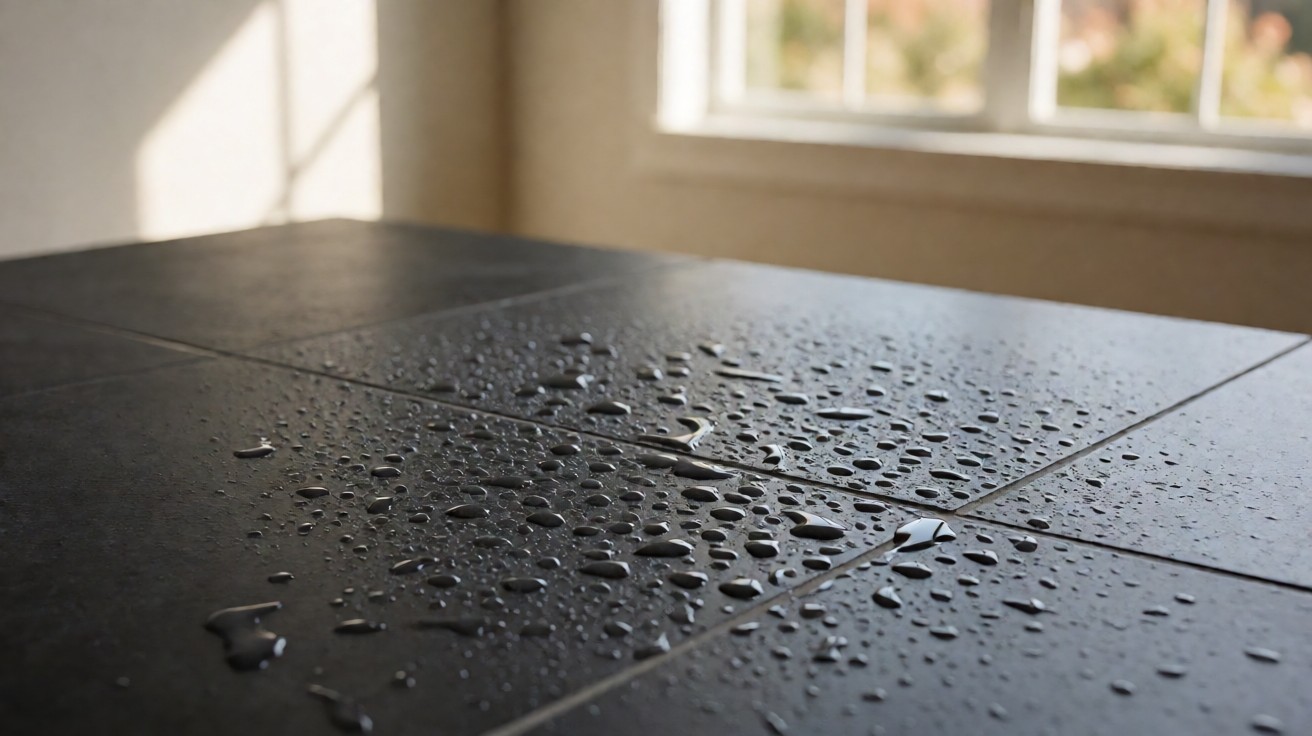
Two quick field checks work if the paperwork is absent. The droplet test: porcelain beads the water, ceramic darkens where the water sits. And the edge test: break a spare offcut or look at the cut edge, where porcelain shows a dense uniform body and ceramic shows a visibly different, often lighter, porous core beneath the glaze. Neither test replaces the specification, but both will catch a mislabelled tile immediately.