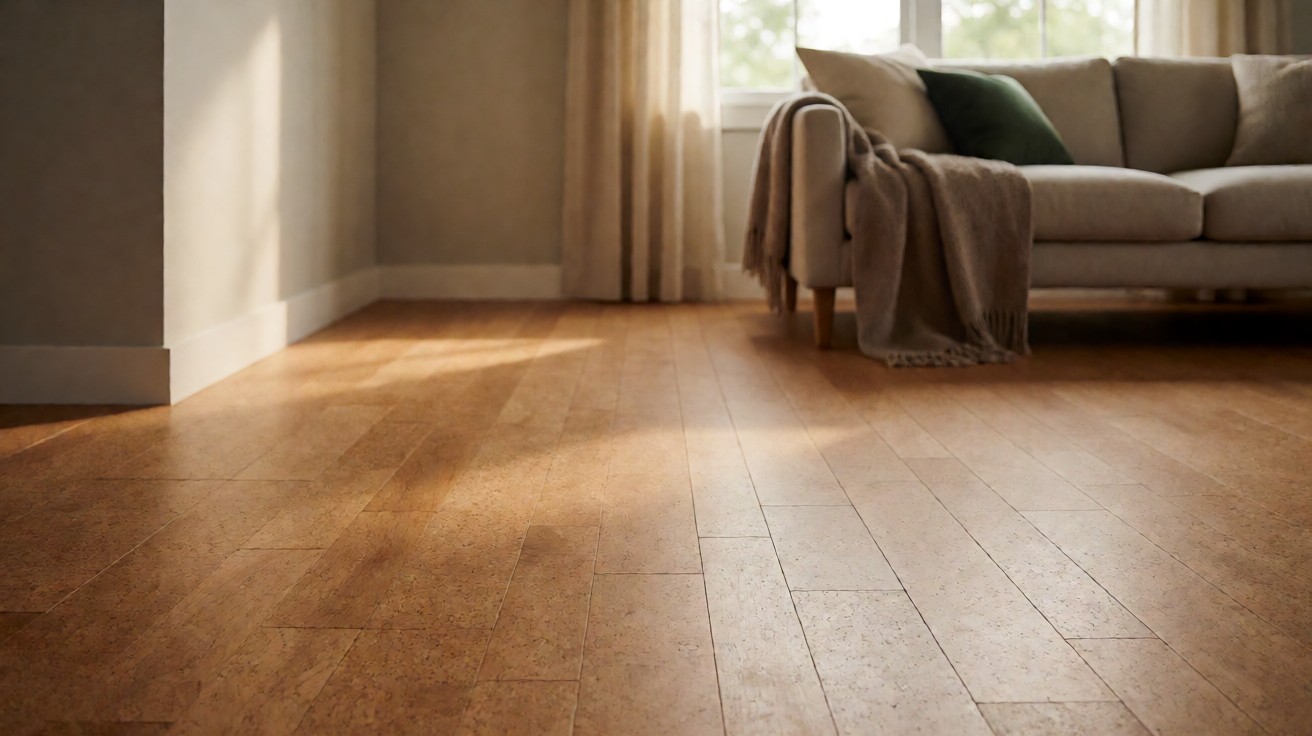

Cork flooring is harvested from the bark of the cork oak tree, and it is the only common flooring material that regrows without the tree ever being cut down. That single fact drives everything else about the material: the bark is lightweight, compressible, and dense with air pockets, which is what makes cork warm underfoot and forgiving underfoot impact. It is also why cork dents rather than scratches, why it needs careful moisture control, and why it looks different from every other floor in the room. Cork is not trying to be hardwood. It is a soft, resilient, repairable natural material that behaves in ways you have to plan for.
What Cork Flooring Is Made Of
Cork flooring is made from the bark of Quercus suber, the cork oak, which grows in Portugal, Spain, and North Africa. A single cork oak produces roughly 800 to 1,000 pounds of usable bark, and the bark is harvested by hand every nine years without cutting the tree down. After each harvest the tree regenerates a new bark layer, so the same tree can be tapped for bark across a 150-year lifespan. This is the reason cork is routinely described as a renewable material: the harvest cycle is measured in years, not decades, and the tree is never killed for it.
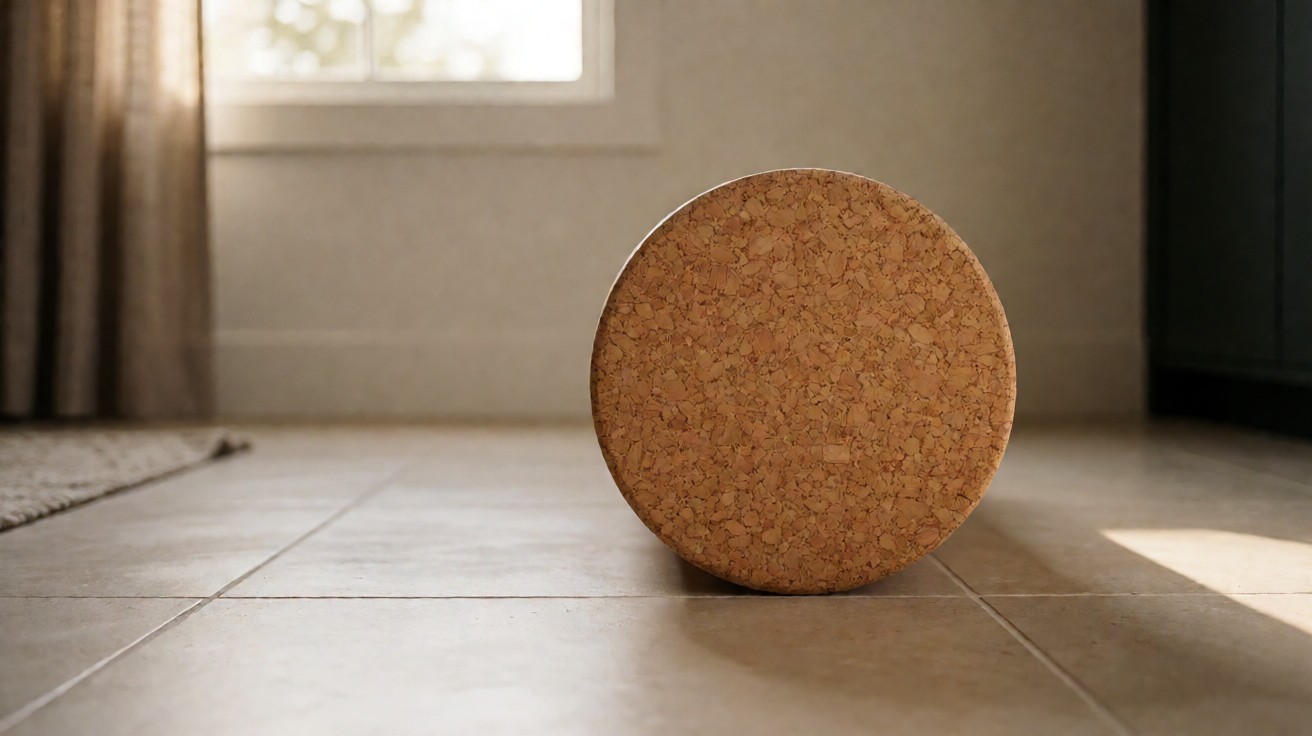
The bark is not used raw. It goes through a process of steam cooking, which makes it pliable, then granulation, which breaks it into small irregular granules, then compression under heat and pressure into a block. The granules are bound by the suberin already present in the bark, so most cork flooring uses no added formaldehyde adhesive at all. The figure below shows the compressed granule structure that results, and that structure is the reason cork dents instead of scratching and rebounds rather than staying permanently compressed.
How Cork Is Manufactured
There are three common ways cork reaches a residential floor, and they differ more than the names suggest. Floating cork is a thick panel, usually 3/8 inch or thicker, with a high-density core and a soft cork surface bonded on top; it installs by simply laying it over an existing subfloor and clicking the panels together, which makes it the easiest cork to install and also the most expensive. Cork tile is a 12-by-12 or 18-by-18 square of compressed cork, glued to the subfloor and finished on site; it is the mid-range option and it is what most installers use for a standard residential project. Cork plank is a tongue-and-groove plank of cork veneer over a backing, which reads more like a wood floor and is the cheapest form of cork to buy.
| Format | Typical Thickness | Installation | Best For |
|---|---|---|---|
| Floating cork panel | 3/8 inch or thicker | Clicks together over existing floor | DIY, renovation over old flooring |
| Cork tile | 3/16 to 1/4 inch | Adhesive-set to subfloor | Standard residential rooms, kitchens |
| Cork plank | 3/8 inch with backing | Floating click | Budget buyers wanting a wood look |
Moisture Behavior
Cork is the single most important thing to understand about this material, and it cuts both ways. Untreated cork is porous and absorbs water, which means a wet spill that sits on the surface can swell the material and leave a permanent mark. But cork also swells when it absorbs moisture and shrinks when it dries, and the granule structure means it can take a moisture excursion and return to its original dimensions without delaminating. That resilience is why cork flooring is rated as a bathroom floor by the standards bodies, and also why it still fails if it is left wet for too long.
Where Cork Works and Where It Does Not
The practical rule is that cork belongs in dry, climate-controlled rooms: bedrooms, living rooms, studies, and dining rooms. It works in kitchens and half-baths when it is sealed and the exposure is occasional. It should not go into a full bathroom, a basement that is known to get damp, or a laundry room. If a wet room is genuinely the requirement, a non-porous material is the right answer, and the trade-off with cork is losing the warmth and cushioning underfoot. For a room where the floor is walked on barefoot for hours, cork is one of the few natural materials that genuinely improves comfort over tile.
| Room | Suitability | Condition | Why |
|---|---|---|---|
| Bedroom | Excellent | None | Warm, quiet, and barefoot traffic is where cork is strongest |
| Living room | Excellent | Felt pads under furniture | Resilient surface hides everyday wear |
| Home office or study | Excellent | Rolling casters, not hard feet | Acoustic comfort under long hours of use |
| Dining room | Good | Seal if spills are likely | Traffic is moderate and spills are occasional |
| Kitchen | Fair | Must be sealed | Spills are regular, so unsealed cork stains |
| Full bathroom or laundry | Poor | Not recommended | Standing water overwhelms the material |
| Damp basement | Poor | Not recommended | Persistent humidity causes swelling and mold risk |
Durability, Dents, and What “Wears Out” Means
Cork is rated in the mid range for wear life: roughly 10 to 15 years in a residential room before the surface needs to be recoated, and 20 to 30 years before the material itself has to be replaced. That is shorter than tile and comparable to good laminate. What makes cork distinctive is not how long it lasts but how it ages. Cork does not scratch the way wood scratches. It dents, and dents rebound. Move a heavy chair that has rolled across cork for a year and the dent often lifts most of the way on its own once the load is removed.
The reverse is also true: this resilience has a limit. A point load left in place, like a furniture leg with a narrow foot, will leave a permanent dent. The standard practical advice is to use felt pads under every furniture leg, which is more important with cork than with almost any other floor, and to use casters rather than hard feet on any rolling furniture. Cork also resists deep staining less well than most surfaces: a red wine spill or a permanent marker leaves a mark that does not lift with a damp cloth. This is the main reason to seal cork if it is going in a kitchen or anywhere with spill risk.
Sealing, Finishing, and Refinishing
Cork is normally shipped either sealed or unsealed. Sealed cork comes with a factory-applied finish that takes traffic well and can be cleaned like a hard floor; unsealed cork is cheaper and feels noticeably more natural underfoot but absorbs more and stains more readily. Unsealed cork is typically finished on site with a penetrating sealer such as water-based polyurethane, and it needs one to two additional coats depending on the product and the traffic level.
Refinishing is cork’s practical advantage over hardwood, and it is larger than most buyers expect. If a cork floor is worn, it can usually be sanded lightly and refinished without replacing it, and the repair is far cheaper than the original installation. A light resanding removes the existing finish and the very top of the material, which is enough to remove most wear marks and to make the whole floor look uniform again. That recoverability is the strongest argument for cork in a house with children or pets, because the expensive part of replacing a floor is the labor and the disposal, not the material.
Acoustic and Thermal Performance
Cork is one of the best-performing acoustic materials available as a floor covering. The granule structure with its trapped air pockets absorbs impact sound better than hardwood, laminate, or tile, and a cork floor over a cork underlayment can improve the impact insulation class of an assembly by a measurable margin. For a room above a bedroom, a cork floor with a resilient underlayment is one of the more effective ways to reduce footstep noise in a wood-frame building without structural work.
Thermal performance works in the opposite direction and is also useful to know about. Cork has low thermal conductivity, so it feels warm to the touch in a cold room and does not pull heat out of your feet the way tile does. In a room with a concrete slab subfloor, that means a cork floor noticeably mitigates the cold feel of the slab in winter. It also means that cork is a poor choice over a floor with radiant heating, because the material resists heat transfer; if the room has radiant heat, cork will feel considerably cooler than hardwood over the same assembly.
Cork Versus Cork-Look Alternatives
Most flooring sold as cork is not fully cork. Recycled cork and cork-rubber composites blend cork granule with PVC or rubber to improve water resistance and durability, and they are widely sold and legitimately good products. The trade-off is real: the composite is more water-resistant and harder-wearing than pure cork, but it is a denser, less resilient surface that does not have cork’s dent-recovery or underfoot warmth. Some cork-look flooring is actually printed fiberboard or porcelain with a cork visual, which is not cork at all and should be sold as something other than cork.
The same question about resilience under load applies to other soft natural floors, and the natural fiber carpet page covers how jute, sisal, and seagrass behave when water reaches them. For a buyer, the practical question is whether the softness matters. In a bedroom, a study, or a living room where people walk barefoot, pure cork or a high-cork-content composite is worth the extra care. In a rental, a hallway, or a room where furniture gets dragged around, a cork composite or a durable cork-look tile is the more sensible choice. Whatever the label says, the specification sheet should state the cork content as a percentage, and a product claiming cork flooring while listing no cork content is a fiberboard or ceramic product with a cork image printed on it.
Cost and Installation
Cork flooring costs roughly $3 to $8 per square foot for material, depending on format, with floating cork panels at the top of that range and cork plank at the bottom. Installation for floating cork is inexpensive because it clicks together and no adhesive or finishing work is needed, running $1.50 to $3 per square foot. Adhesive-set cork tile requires more labor and, if the cork is unsealed, two to three coats of finish on site, which can add $2 to $4 per square foot of labor. For a 12-by-15-foot living room, a fully installed cork floor typically runs $1,600 to $3,600 all-in.
Cork is also cheap to live with, which is the part the upfront number does not capture. There is no waxing schedule, no required recoating for the first several years, and when the floor does eventually need attention, a light resand and refinish costs a fraction of replacement. Over a 20-year life in a residential room, cork frequently costs less in total than a cheaper floor that has to be replaced once in that period.
Where Cork Flooring Belongs in a Home
Cork is at its best in the rooms where people are barefoot and the floor is not exposed to water: bedrooms, home offices, studies, living rooms, and upstairs halls. In those rooms it is genuinely one of the most comfortable hard floorings available, and it is warm in winter in a way that tile is not. It is a reasonable choice in a dining room and a kitchen if it is sealed, and a poor choice in a full bathroom, a laundry room, or a basement with any history of damp.
For a household with young children or pets, cork’s two practical weaknesses, dents and staining, are both manageable, and both become difficult to manage with the felt pads and prompt cleanup habits that the material requires. A hard, washable, zero-maintenance floor is the opposite of what cork is for, and the rubber flooring page covers the material that does deliver that profile. For a household that wants a hard, washable, zero-maintenance floor, cork is the wrong material and there is no version of that preference that cork satisfies. The decision is less about quality and more about how much daily maintenance the household intends to do. Cork rewards attention and punishes neglect, and knowing which one describes the home is most of the decision.