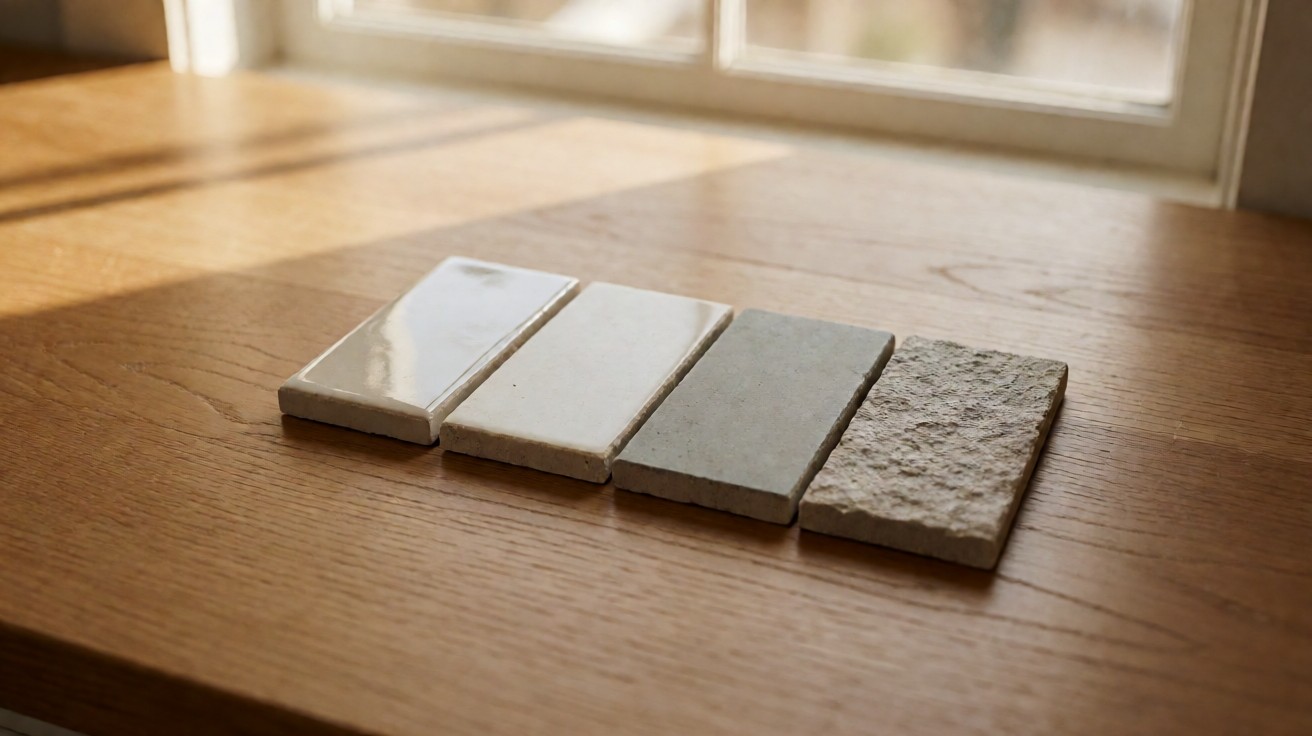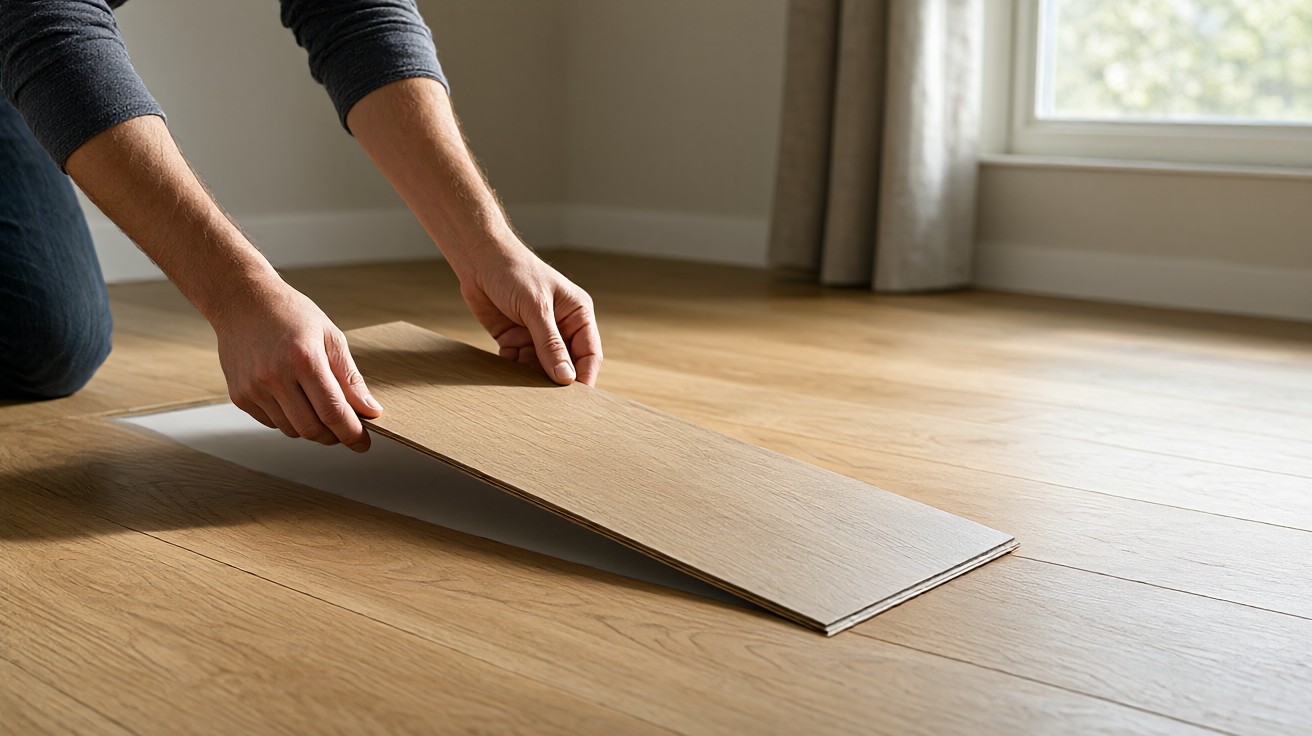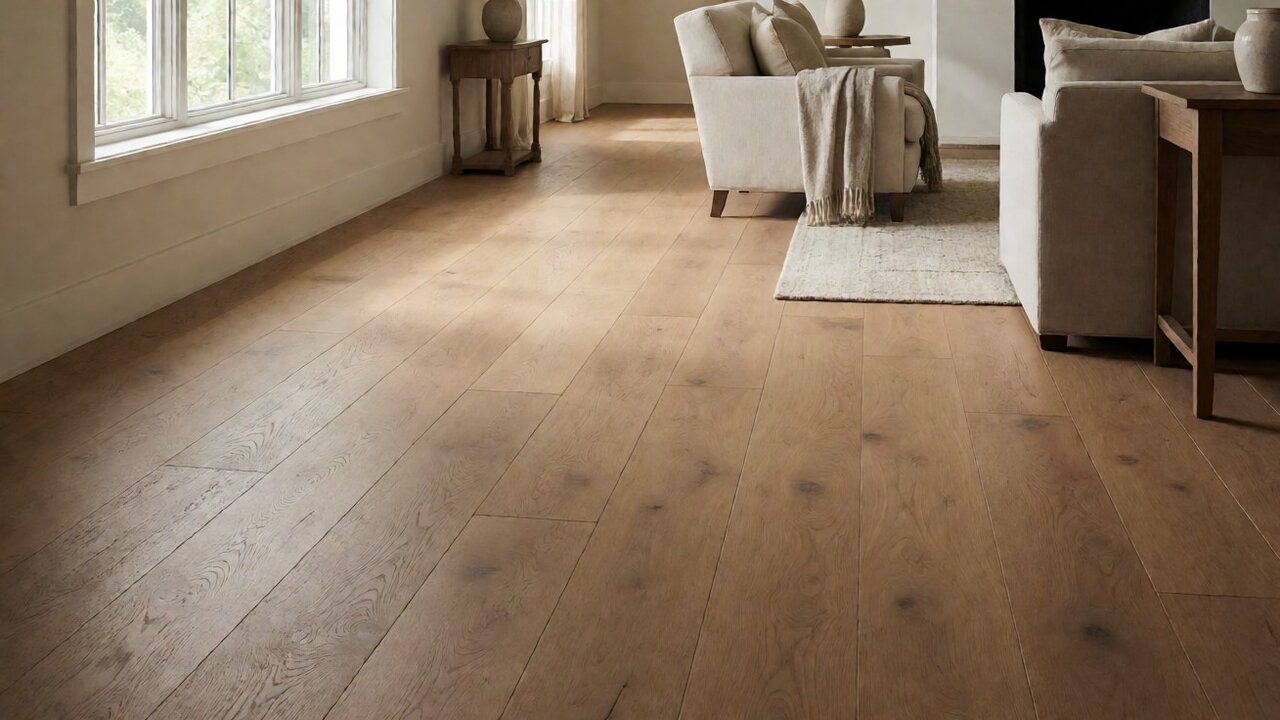

A flooring spec sheet lists dozens of numbers, but only a handful of those numbers decide whether the floor survives your home, your family, and your budget.
The short answer: porcelain tile for wet areas, vinyl with a 12-mil or thicker wear layer for busy areas, wood or cork for comfort. Match the material to the space.
What Performance Means for a Floor
Performance is not a single score. It is the set of measurable properties that decide whether a floor keeps its appearance and structure under the loads, moisture, and traffic of a specific room.
Every material has a strong axis and a weak one. Porcelain tile resists water and abrasion but feels hard and cold. Solid hardwood feels warm and repairs well but dents and swells. Vinyl handles water and traffic but can fade in direct sun. The job of a spec sheet is to make those trade-offs visible before you buy.
If you treat performance as one number, you will overpay for the wrong property. A buyer who only reads “waterproof” may install a floor that is waterproof yet too soft for a busy kitchen. A buyer who only reads “durable” may install a floor that is hard but unsafe when wet.
How to Read a Spec Sheet
Start with the test method, not the headline. A number without a standard is a marketing claim. A number with a standard, a test condition, and a pass or fail threshold is a spec you can compare.
Look for four fields on every line: the property (what is measured), the method (how it is measured), the result (the number), and the condition (load, temperature, time). If any field is missing, treat the claim as unverified.
Standards referenced here include EN 13329 for laminate AC ratings, ANSI A326.3 for DCOF, ASTM C373 for tile water absorption, NWFA guidance for hardwood, and ISO 10582 for resilient floors. Each gives a test method, not just a label.
What Does a Missing Test Condition Mean?
If any field is missing, treat the claim as unverified. A number without a standard is a marketing claim.
Which Numbers Are Comparable Across Materials?
Some numbers compare across materials and some do not. Wear layer in mils compares vinyl to vinyl but means nothing on tile. Janka hardness compares wood to wood but not to laminate. Water absorption compares tile to tile. Use each number only inside its own material family, then compare families on the room requirements.
Durability: Hardness, Abrasion, and Wear Layers
Durability is resistance to the damage that happens every day: grit under shoes, dragged furniture, dropped objects, and repeated foot traffic. Three specs cover most of it.
For wood, Janka hardness measures the force needed to embed a steel ball halfway into the surface. Red oak rates about 1,290 pounds. See hardwood Janka hardness ratings explained for species tables. Harder species resist denting better, but hardness does not predict scratch resistance, and a very hard floor can still show wear if the finish is thin.
For laminate, the AC rating under EN 13329 runs from AC1 to AC5. AC3 suits residential traffic, AC4 suits heavy residential and light commercial, and AC5 suits commercial. The number is a wear test result, not a thickness or a price tier, so a thin AC4 plank can outlast a thick AC3 plank.
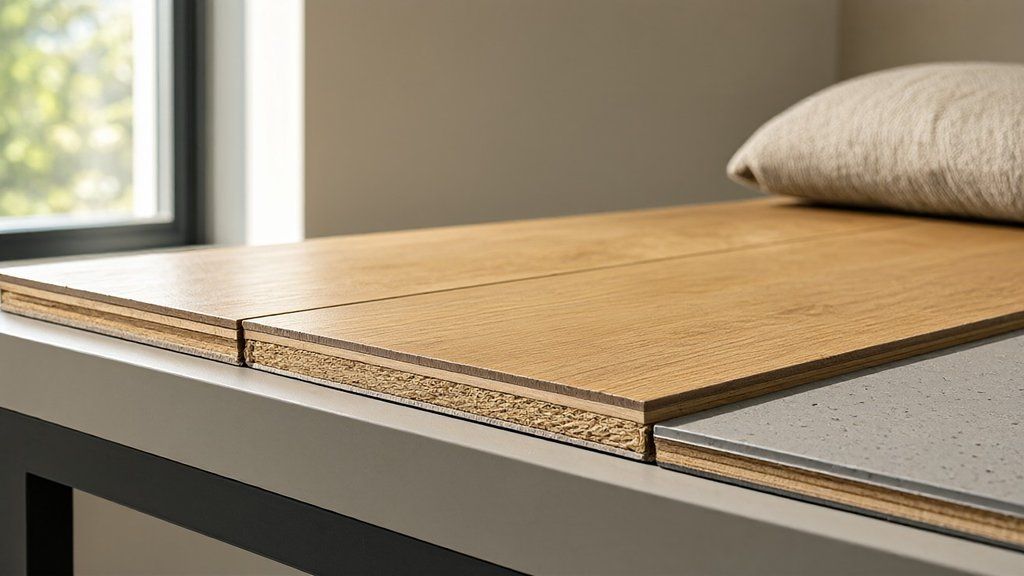
For vinyl, the wear layer is measured in mils. See understanding vinyl wear-layer thickness for room-by-room guidance. Wear layer mils measure the clear urethane film thickness on vinyl.
Residential products commonly run 6 to 12 mils, heavy residential 12 to 20 mils, and commercial 20 mils or more. The wear layer is the clear urethane film on top; once it is gone the printed design wears with it.
| Spec | Material family | What it measures | Typical useful range |
|---|---|---|---|
| Janka hardness | Hardwood | Resistance to denting | 1,000 to 1,800 lbf for common species |
| AC rating | Laminate | Abrasion resistance | AC3 residential, AC4 heavy residential, AC5 commercial |
| Wear layer | Vinyl | Thickness of protective film | 6 to 12 mils residential, 20+ mils commercial |
| Water absorption | Tile | Porosity | Less than 0.5 percent for porcelain |
If you are choosing between two products in the same family, the higher number on the relevant spec usually wins. If you are choosing across families, the room decides which spec matters most. Compare families first with flooring types compared.
Water Resistance: What Waterproof Actually Means
Water resistance is a system property, not a material property. A waterproof plank installed over a wet subfloor with open seams will still fail. Read water claims as three separate questions: does the material absorb water, does the surface let water through, and can water reach the subfloor.
Porcelain tile absorbs less than 0.5 percent water by weight under ASTM C373, which is why it suits wet rooms. See tile abrasion and breaking-strength ratings for test details. Ceramic tile and natural stone absorb more and need sealing or a membrane. Vinyl and laminate handle surface water well, but water that reaches the core or the subfloor can cause swelling, mold, or adhesive failure.
For wood, water is the main enemy. Solid hardwood swells and cups when humidity swings. Engineered hardwood is more stable but still not waterproof. If the room has standing water risk, wood is the wrong family regardless of finish.
Concrete subfloors should reach at least 3000 psi compressive strength before tile installation, because a weak slab cracks tile regardless of the tile’s breaking strength.
| Claim on the box | What it usually means | What to verify |
|---|---|---|
| Waterproof | Material resists surface water for a stated time | Test method, exposure time, seam treatment |
| Water-resistant | Handles spills if wiped promptly | Time limit and core material |
| Moisture-proof subfloor | System handles vapor from below | Membrane spec and test data |
If a product says waterproof but names no test, treat it as water-resistant until proven otherwise. If the warranty excludes subfloor moisture, the waterproof claim is about the plank only.
Comfort Underfoot: Hardness, Thermal, and Sound
Comfort is the property most buyers notice after installation and least often spec in advance. It has three parts: how hard the surface feels, how warm it feels, and how much sound it transmits.
Hardness and comfort trade off directly. A floor that resists dents, like porcelain or dense hardwood, feels hard underfoot and tiring to stand on. A floor that feels soft, like cork or carpet, dents more easily. If someone stands for long periods in a kitchen, a slightly softer resilient floor or a cushioned underlayment can matter more than a higher hardness number.
Thermal comfort depends on conductivity and on what is under the floor. Tile and stone feel cold because they conduct heat away from the foot. Wood and vinyl feel warmer.
Over a concrete slab, a floor with higher thermal resistance or an insulated underlayment changes the feel dramatically. If radiant heat is planned, check the material’s maximum surface temperature and its compatibility with the system. Subfloor deflection limits also apply: L/360 for ceramic tile and L/720 for natural stone, so a bouncy floor can crack tile even when the tile spec is perfect.
Sound is measured two ways. Impact insulation class, or IIC, measures how much impact sound, like footsteps, passes through to the room below. A higher IIC means a quieter downstairs neighbor.
Airborne sound transmission class, or STC, measures voices and music. Many multifamily buildings require IIC 50 or higher, and some require 60. An acoustic underlayment can raise IIC by 10 to 20 points, but only if it is installed with the right perimeter isolation.
How Much Sound Is Too Much for a Shared Floor?
Many multifamily buildings require IIC 50 or higher, and some require 60. If the floor sits over a living space, sound can be the deciding spec even when durability is equal.
Safety: Slip Resistance and Indoor Air Quality
Tile installation needs a flatness tolerance of 1/8 inch in 10 feet, and hardwood needs 3 to 5 days of acclimation. These small numbers decide whether the floor performs as specified.
Slip resistance is measured by dynamic coefficient of friction, or DCOF, under ANSI A326.3. A DCOF of 0.42 or higher is the common threshold for interior wet areas. Textured or matte surfaces usually score higher than polished ones. If the room gets wet, like a bathroom or entry, read DCOF before color or pattern.
Indoor air quality is governed by VOC emissions. Look for FloorScore, GREENGUARD Gold, or CA Section 01350 compliance. These programs test emissions over 14 days, not just the material content. A floor with low VOC certification is the safer choice for bedrooms and for households with children or sensitive occupants.
If a product has no VOC certification and no test data, assume it may off-gas and ventilate heavily during and after installation. If the room is a bedroom or nursery, prefer a certified product even at higher cost.
Specs That Are Marketing, Not Measurement
Some common words are not specs at all. “Lifetime warranty,” “scratch-proof,” “pet-proof,” and “waterproof” describe outcomes without naming a test. They may be true in a narrow sense and still not help you compare products.
A warranty is a legal document, not a performance test. Read what it excludes: subfloor moisture, improper installation, commercial use in a residential product, and damage from furniture without pads. If the excluded list is longer than the covered list, the warranty is marketing.
Scratch-proof and pet-proof claims usually rest on a single test, often a Taber abrasion or a scratch test with a specific tool. The result may not match your dog’s nails or your chair legs. Treat these as directional, not absolute.
If a spec is not tied to a named standard, budget for the risk. Either pay for the verified alternative or accept that the claim is unproven.
Reading Two Numbers Together
Single specs mislead because they ignore interaction. A hard surface with a low DCOF is dangerous when wet. A waterproof surface with a thin wear layer will look worn long before it leaks. A sound-rated assembly with the wrong underlayment can still transmit noise.
Read specs in pairs. Hardness with slip resistance. Wear layer with total thickness. Water absorption with seam and subfloor protection. IIC with the exact underlayment and installation method that earned the rating. VOC with the adhesive and finish used in the same project.
If two products trade one spec for another, the room breaks the tie. A bathroom wants water absorption and DCOF over hardness. A hallway wants hardness and wear layer over thermal comfort. A bedroom wants VOC and sound over abrasion resistance.
A Room-First Spec Checklist
Imagine you are finishing a basement playroom over concrete. Water risk, cold floors, and noise from above all matter. Tile wins on water, vinyl wins on warmth, and carpet wins on sound. No single material wins all three.
- Water exposure: standing water, splashes, or dry.
- Traffic: light, moderate, or heavy, including pets and rolling loads.
- Subfloor: concrete, wood, or existing finish, and its moisture level.
- Sound: shared wall or floor below, or slab on grade.
- Comfort: standing time, barefoot use, radiant heat.
- Air quality: bedrooms, nurseries, or sensitive occupants.
- Maintenance: willingness to seal, refinish, or replace.
If a room has three or more demanding conditions, no single material wins all of them. Expect to compromise or to split materials by zone.
When Specs Disagree with the Room
Sometimes the best spec on paper is the wrong floor. A high-Janka hardwood is still wrong in a bathroom. A high-DCOF tile is still cold in a bedroom. A waterproof vinyl is still wrong over a wet slab without moisture mitigation.
When specs and room conflict, the room wins. Use the spec to choose within a suitable family, not to justify an unsuitable one. If the family is wrong, no number rescues it.
If you are unsure, test a sample in the actual room for a week. Check how it feels barefoot, how it sounds when walked on, and how it looks in the room’s light. A sample exposes comfort and appearance issues that spec sheets cannot.
Quick Answer: Which Specs to Trust First
Trust the spec that matches the room’s biggest risk. For wet rooms, trust water absorption and DCOF. For busy rooms, trust wear layer, AC rating, or Janka. For shared floors, trust IIC with the real underlayment. For bedrooms, trust VOC certification. Read everything else as supporting detail.
If you only have time for one number, make it the one whose failure mode is expensive to fix. Water damage, slip injuries, and noise complaints cost more than a worn finish.
Water first. Then wear. Then sound.