
Walk into a modern interior and the floor is likely to be a smooth, polished, pale concrete surface. Someone will call it terrazzo. In most of those cases, it is not terrazzo at all.
It is polished concrete, and the word is being used the way people use “stove” to mean any heater that burns. The two are related, they are finished the same way, and that is the whole reason the names get mixed up.
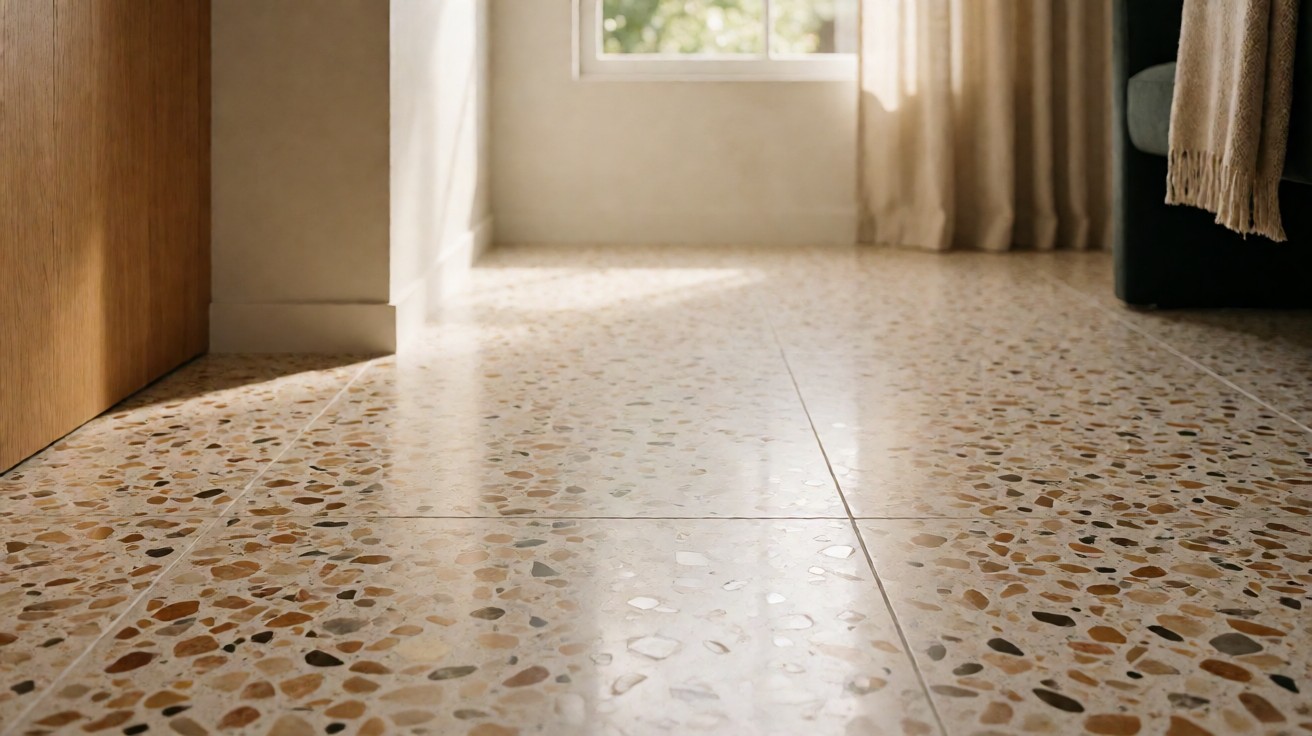
Real terrazzo is a decorative product. It is a cement or epoxy matrix that is poured on site and troweled, with chips of marble, glass, or granite added into the mix so that, once the floor is ground and polished, the aggregate shows through the surface.
It is made to order, and it can be patterned. Polished concrete is the slab you already have, ground down and sealed. There is no aggregate in it. It is a monolithic, uniform surface, and you can dye it to shift the tone.
So the choice is not a material question. It is a design question. This guide separates the two, tells you how to actually tell them apart, and covers the cost, lead time, durability, and the look each one gives you.
Terrazzo vs. Polished Concrete: The Short Answer
If you want the patterned, ornamental surface, the embedded aggregate, and are prepared to pay for a made-to-order floor, choose terrazzo.
If you want the clean, monolithic, industrial look at a lower cost, on an existing slab, and on a fast timeline, choose polished concrete.
The real dividing line is whether you want chips. If the floor is going to have the aggregate running through it and a pattern that was mixed for the room, that is terrazzo. If it is just the bare slab, ground and sealed, that is polished concrete, whatever name the installer puts on the quote.
The Confusion That Makes This a Real Question
This is one of the most common flooring mis-specified decisions, and it is not anyone’s fault. The two look enough alike, are finished with the same grinding and polishing, and even use overlapping terminology that “terrazzo” has become a catchall for any smooth polished concrete floor.
The trouble is that a client who wants the aggregate of a real terrazzo will sometimes be quoted a polished concrete floor, because the installer reads the brief loosely.
Or a designer who wants a clean monolithic concrete floor will be told it is terrazzo, because that is the word the market uses for the finish. Either way, the client signs for one thing and gets the other.
The fix is to ask one question on the quote: does this include aggregate? If yes, it is terrazzo. If no, it is polished concrete. That single word removes the confusion.
What Genuine Terrazzo Actually Is
Real terrazzo is a floor that is built, not just finished. The installer lays a trowel or cast matrix, either a cementitious mix or a modern epoxy one, and works chips of marble, glass, or granite into it.
The matrix can be poured over the existing floor or cast into place with a pattern. The aggregate is placed, set, and then the whole surface is ground down and polished, until the chips emerge above the matrix.
Because it is made to order, terrazzo is a design product. The mix can be controlled so that a colour field is surrounded by a border, a geometric pattern is drawn in with a second aggregate, or a custom image is set into the floor.
That is what makes it different from a bare slab. You can pattern it, and you can make it read as a decorative element rather than a surface.
The trade-off is that the matrix and the chips are part of the product, so terrazzo is the more expensive and the longer-lead product. It is poured and set on site, not rolled out of a warehouse.
The modern epoxy matrix is the reason terrazzo has come back to high-end commercial interiors, because it cures fast and can be very thin, but it also means the floor is custom, not off the shelf.
What Polished Concrete Actually Is
Polished concrete is not a product you order. It is a finish you apply to the slab that is already there. The existing concrete is exposed, if the floor is above a joist it is a poured slab, and that slab is ground down with progressively finer diamond abrasives and then sealed. The result is a dense, mirror-like, hard surface.
There is no aggregate in it, because the slab itself is just concrete. You can shift the tone by applying a stain or a dye, or you can add a thin colour coat, but the surface is a monolithic, uniform field. That uniformity is the whole appeal, because it reads as a clean, contemporary, industrial finish without the ornamental noise of a patterned floor.
The practical reason polished concrete is so popular is that it is cheaper and faster than terrazzo. You are not building a new product, you are finishing the one that is already on the ground. That makes it the default choice for a warehouse, a loft, a gym, or any space where the slab is already poured and the budget is firm.
The Chip Test: How to Tell Them Apart
Because the word is used loosely, the most useful test is the simplest one. Look at the surface and ask whether there are aggregate chips showing through.
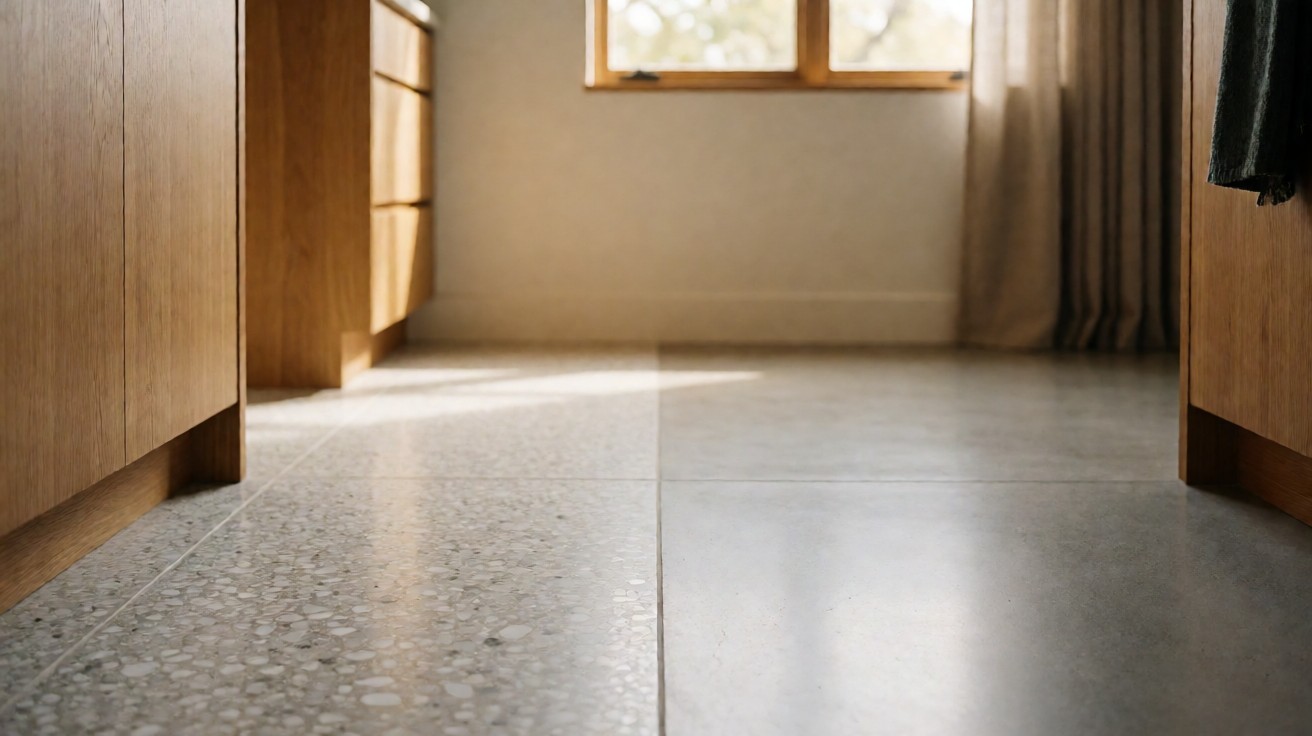
If the surface shows the flecks and chips of stone, glass, or marble running through the field, that is terrazzo. If the surface is a uniform, dense grey, or a dyed tone, with no chips, that is polished concrete. That is the entire difference, and it is the question you should put on every quote.
The second test is the pattern. Polished concrete is not patterned, it is a single continuous surface. Terrazzo can be, and on a project that wants a border or a geometric centre, it is. A floor that was mixed to show a design is terrazzo even if it is being sold as a “concrete finish.”
Cost, Lead Time and How They Compare
Polished concrete is the cheaper and the faster option, and the gap is large. Because you are finishing the slab that is already there, the lead time is short, the labour is the grinding and sealing, and there is no cast matrix or custom aggregate to source.
Terrazzo is made to order, which is what makes it the premium product. The matrix has to be mixed and set, the aggregate has to be sourced and placed, and the surface has to be cut back and polished by hand.
The result is a floor that costs significantly more per square metre and takes significantly longer to lay. The comparison below sets the two side by side.
In practice, a well-executed polished concrete floor in a warehouse or a loft is one of the most cost-effective high-end finishes available, because the material is the slab you already paid for. A terrazzo floor is a genuine design investment, and it is priced like one.
Durability, Wear and Re-grinding
Both finishes are extremely hard and both age well, but they are hard in different ways.
Terrazzo, especially on an epoxy matrix, is one of the hardest floors in a commercial building. The aggregate is very abrasion resistant, and because the surface is continuously ground and re-densified, a worn area can be ground and polished again to bring it back to spec. That is a big maintenance advantage, because the floor can be refreshed rather than replaced.
Polished concrete is also very durable, but it is a sealed surface. Over years of heavy use the seal wears and the concrete can be pitted by abrasion or by a small amount of moisture wicking up from below.
When the finish wears, the remedy is to grind and re-seal, which is cheaper than re-laying the floor but is not as forgiving as the continuous re-grinding of a terrazzo. The practical difference is that a very busy floor will re-ground and re-seal a concrete floor on a longer cycle than a terrazzo one.
Feel, Pattern and the Look Each Gives
The two finishes feel almost the same underfoot, because they are both dense, hard, and polished. The difference is in the way they look and in what they can do.
Polished concrete is monolithic and clean. It reads as one continuous surface, and it suits a contemporary or industrial room, a loft, a gym, or a warehouse where the finish is the point and you do not want a pattern.
Dyeing the slab can shift it from grey to a warm sand or a deep red, which is the closest a concrete floor gets to a “patterned” look, but it is still a uniform field.
Terrazzo is the ornamental option. The aggregate can be arranged in a field and a border, and the chips themselves can be a warm beige marble, a clear glass, or a coloured stone.
That is the difference, because a terrazzo floor can be a piece of decoration, not just a finish. It is the one you choose when the floor is meant to be looked at, not just walked on.
The comparison below sets the two side by side across the factors that actually decide it.
| Factor | Terrazzo | Polished concrete |
|---|---|---|
| What it is | Matrix + aggregate, made to spec on site | Existing slab, ground and sealed |
| Aggregate | Yes, embedded and polished out | None |
| Pattern | Yes, can be designed and bordered | No, monolithic field only |
| Cost | Higher, premium made-to-order product | Lower, the slab is already there |
| Lead time | Long, cast and set on site | Short, grind and seal |
| Re-grind and refresh | Very good, the surface re-polishes | Good, grind and re-seal on a longer cycle |
| Best in | Design-led commercial, high-end interiors | Warehouse, loft, gym, industrial look |
Format by Room
The two finishes suit very different rooms, and once you name the room the decision often makes itself. This table turns that into a direct assignment, which is usually faster than reasoning about aggregate and lead time in the abstract.
| Room or space | Finish | Why it fits |
|---|---|---|
| Warehouse | Polished concrete | Existing slab, high traffic, low budget |
| Loft or industrial space | Polished concrete | Clean monolithic look, the slab is already there |
| Gym or studio | Polished concrete | Durable, seamless, fast to specify |
| Showroom or retail | Terrazzo | The floor is a design element, can be patterned |
| High-end residential | Terrazzo | The ornamental, made-to-order surface |
| Office lobby | Terrazzo | Very hard, re-grindable, premium finish |
| Tight budget | Polished concrete | Low material cost, short lead time |
| Pattern or border wanted | Terrazzo | Only the made-to-order mix can carry a pattern |
How to Choose for Your Project
The decision usually makes itself once you answer one question: do you want chips? If the floor is going to be ornamental, patterned, or a made-to-order decorative surface, that is terrazzo. If it is going to be the clean monolithic finish on an existing slab, on a firm budget and a short timeline, that is polished concrete.
Whichever you choose, both are the kind of floor that a subfloor and a moisture check matter as much as the finish itself. Both need a dry, even, well-prepared base, and a concrete slab that wicks moisture will trouble a polished floor for years after it is laid.
That part is covered in the material comparison, and the tile guide is the useful next step if you are weighing terrazzo against a hard tile floor for the same room.
Is terrazzo just fancy concrete?
No, and that is the whole point. A polished concrete floor is the slab you have, ground and sealed. Terrazzo is a product you pour, with a matrix and aggregate added to it, made to spec on site.
The word “terrazzo” is used loosely to describe any polished concrete, which is why the two are so often confused. If the floor has the chips and the pattern, it is terrazzo. If it is a bare slab, it is polished concrete.
Is polished concrete cheaper than terrazzo?
Yes, and it is also faster. Because you are finishing the slab that is already there, the material cost is low and the lead time is short. Terrazzo is poured and set on site, with the aggregate sourced for it, which makes it the premium option of the two.
For a firm budget, polished concrete is the sensible choice. For a design-led project where the floor is the feature, the cost of terrazzo is the price of that feature.
Where This Fits in the Rest of the Choice
This page settles the terrazzo-versus-polished-concrete decision, which is a two-product choice. It does not cover either material in depth on its own, and it does not cover the subfloor or moisture testing that both need. Those are separate pages.
If you are comparing hard floors more broadly, the material comparison sets terrazzo, polished concrete, tile, and the other options side by side, and the tile flooring guide covers the hard tile alternative.
If the decision is about what will actually sit on the slab you have, the room-specific pages will tell you which of these two finishes suits the space you are putting it in.