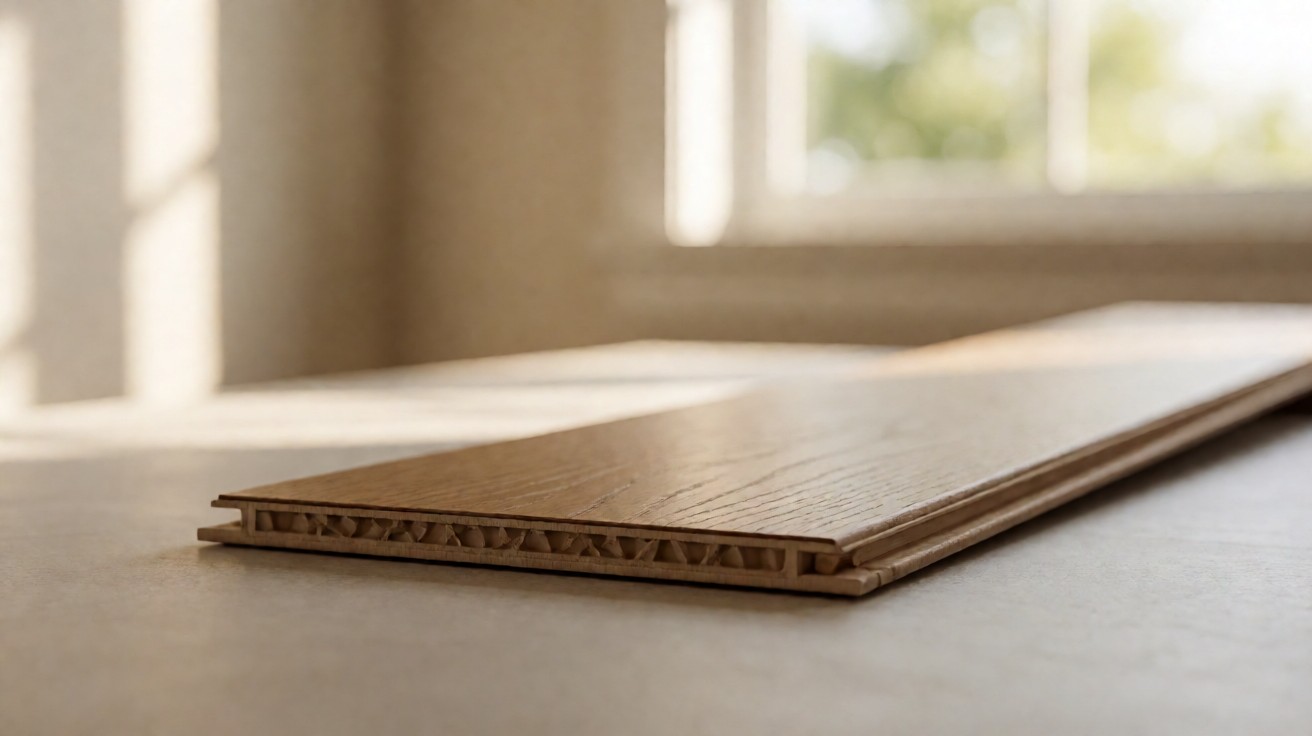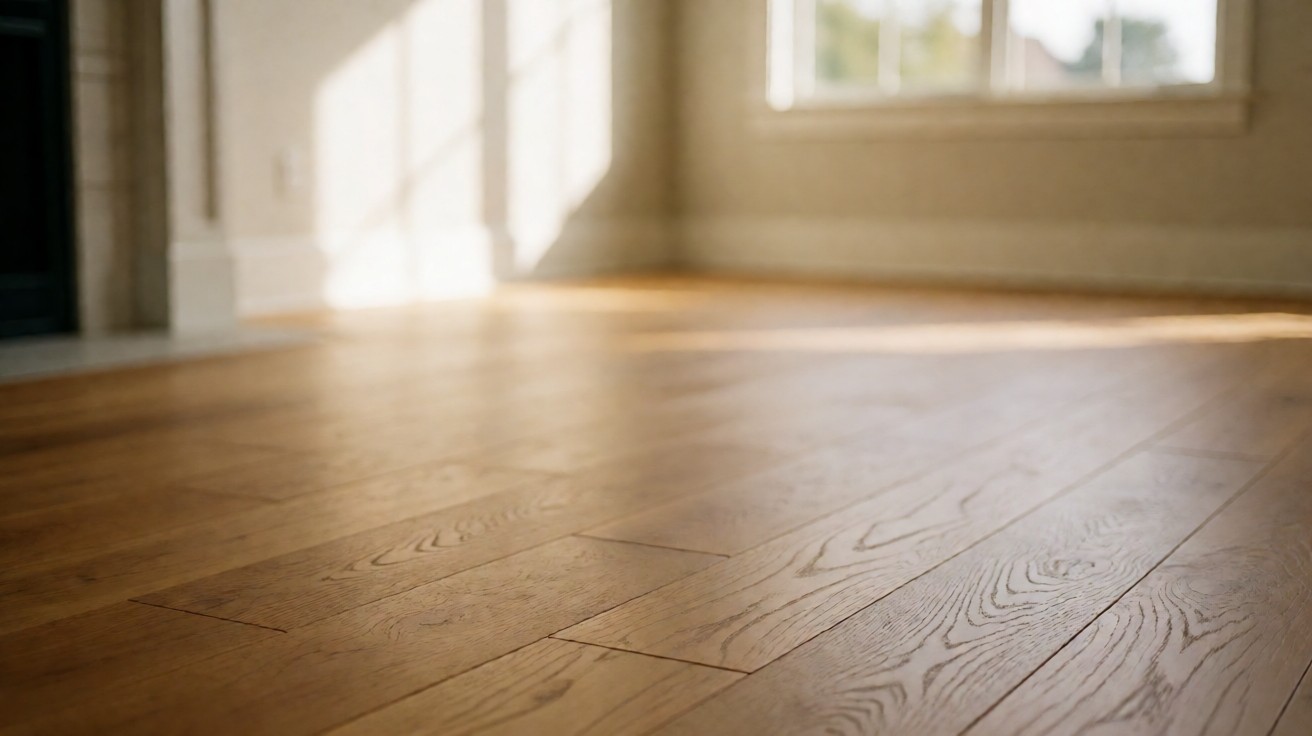

A bottle of floor cleaner and a bottle of surface spray can both promise a spotless floor, and only one of them protects the finish you paid for.
The deciding variable is not the brand on the bottle. It is the pH of the solution, the surfactant behind it, and whether the chemistry is water-based or solvent-based. Match those three to the material on the floor and the finish lasts; mismatch them and the damage is permanent.
Read The Label, Not The Brand
Product names and marketing claims are not specifications. A “hardwood floor cleaner” and a “multi-surface cleaner” can share the same surfactant and differ only in fragrance. The specification sheet, usually called the technical data sheet (TDS), is where the cleaning chemistry is actually defined.
The three numbers that matter are the pH of the diluted solution, the surfactant class, and the VOC content. The brand name carries none of those.
Compare cleaners by those three numbers, not by price or packaging. A neutral cleaner at pH 7 to 9 with a nonionic surfactant and VOC content below 1% is the right starting point for most sealed hard floors, and it costs about the same as the heavily scented alternative.
The expensive bottle is not the safer one; the bottle whose TDS matches the floor is.
pH Is The Deciding Variable
pH is the single most useful number on a cleaner label. It measures how acidic or alkaline the solution is on a 0 to 14 scale, where 7 is neutral.
The finish on a sealed wood floor, the polyurethane on vinyl, and the glaze on tile all have a pH window they tolerate, and a cleaner outside that window attacks the finish before it attacks the dirt.
What Is A Safe pH Range For Most Floors?
For most sealed hard floors the safe window sits between pH 7 and pH 9 on the diluted solution. The Natural Stone Institute prescribes a neutral cleaner for natural stone, and acid-sensitive stones such as marble, limestone, and travertine etch even when sealed.
On the alkaline side, a cleaner at pH 11 or higher is a stripper, not a daily cleaner, because it begins to soften floor finish and break down the sealer in grout.
A pH of 7 to 9 is the chemistry of routine care; pH 2 to 4 is the chemistry of descaling; pH 10 to 13 is the chemistry of stripping.
Always read the pH of the diluted solution, not the concentrate. A concentrate at pH 11 that is diluted one part to four parts water lands near pH 8, which is safe. A concentrate at pH 11 used at full strength is a stripper. The dilution ratio on the label is part of the pH specification, not a suggestion.
Water-Based, Solvent-Based, And Why It Matters
Water-based cleaners dominate floor care for a reason. They carry the soil in water, the surfactant lifts it, and the water evaporates. Solvent-based cleaners carry the soil in a volatile solvent instead, and that solvent evaporates faster and dissolves oils, adhesives, and some finishes that water cannot touch.
The trade is contact time and ventilation: a water-based cleaner needs dwell time, a solvent-based cleaner needs air exchange.
Check the VOC content before using a solvent-based product indoors. A water-based cleaner such as Bona Deep Clean carries a VOC content below 1% and is certified to GREENGUARD Gold.
A solvent-based cleaner can carry 30% to 60% VOC by weight, which is why the EPA Safer Choice criteria set a flash point of at least 140 degrees F (60 degrees C) measured under ASTM E502 closed cup, and why a solvent-based cleaner is reserved for targeted spots rather than whole floors.
Water-based for the floor, solvent-based for the scuff or the adhesive residue.
Match The Cleaner Chemistry To The Material
The table below is the decision the article is built around. Read it left to right: identify the material, read the safe chemistry, check the pH window, check whether a rinse is required, and read the reason. The reason column is the part that prevents a repeat mistake.
| Flooring material | Safe cleaner chemistry | pH range | Rinse required? | Why |
|---|---|---|---|---|
| Solid hardwood (sealed) | Water-based neutral cleaner | 7 to 9 | No (no-rinse formula) | Acid or alkaline cleaner strips the finish film |
| Engineered hardwood | Water-based neutral cleaner | 7 to 9 | No (no-rinse formula) | Same finish systems as solid wood |
| Laminate | Water-based neutral, low moisture | 7 to 9 | No | Water under seams swells the HDF core |
| LVP / LVT / SPC / WPC | Water-based neutral cleaner | 7 to 10 | No | Resilient wear layer resists chemistry, seams do not |
| Sheet vinyl | Water-based neutral cleaner | 7 to 10 | No | Solvent strippers soften the wear layer |
| Ceramic / porcelain tile | Neutral cleaner; acid for grout scale only | 7 to 10 for tile; 2 to 4 for grout | Yes on grout | Acid left on tile leaves a film that lowers wet DCOF |
| Natural stone (marble, travertine, limestone) | Stone-specific neutral cleaner | 7 to 8 | Yes | Acid below neutral etches calcite stone |
| Carpet (synthetic pile) | IICRC S100 carpet cleaning solution | 6 to 8 | Extraction rinse | Residue attracts soil and stiffens pile |
How To Test A Cleaner Before You Commit A Room
A spot test costs nothing and prevents a whole-floor mistake. Pick an area under a piece of furniture or inside a closet, apply the cleaner at the diluted ratio, leave it for the full dwell time, and wipe it dry. Look for three things: a change in gloss, a change in color, and a sticky or powdery residue.
Any of the three means the chemistry is wrong for that finish, and the cleaner goes back on the shelf.
When Should You Rinse After Cleaning?
Rinse whenever the cleaner leaves a film, whenever the chemistry is alkaline or acidic, and whenever the material is porous. A no-rinse neutral cleaner at pH 7 to 9 on a sealed wood floor needs no rinse because the surfactant is formulated to evaporate clean.
An alkaline cleaner at pH 10 to 12 on tile, an acidic cleaner at pH 2 to 4 on grout, and any cleaner on unsealed stone or grout all need a water rinse. Carpet always needs an extraction rinse, because the IICRC S100 standard for professional cleaning of textile floor coverings treats residue as a soil attractant, not a byproduct.
The rinse test is simple: after the floor dries, wipe a clean white cloth across it. A film on the cloth means the cleaner is staying on the floor, and the next application will build on top of it. Rinse once more and re-test.
Hardwood And Engineered Wood: Stay Above Neutral, Not Below
The finish is the floor, not the wood. A sealed hardwood floor is a polyurethane or oil finish over wood, and the cleaner has to be safe for the finish, not for the wood underneath.
That is why a water-based neutral cleaner at pH 7 to 9 is the right chemistry and why an acidic cleaner is the wrong one, even a mild one. The finish tolerates mild alkalinity better than acidity.
A hardwood manufacturer’s TDS is the authority here. Bona Professional Series Hardwood Floor Cleaner is formulated at pH 4.9 to 5.5 and is sold for use on polyurethane-finished wood, which shows that a product can sit below neutral and still be finish-safe when the rest of the formula is engineered for it.
Bona Deep Clean, by contrast, sits at pH 7.0 to 8.0 with a VOC content below 1%, a solids content of 1%, and a density of 8.35 lbs per gallon, and it is diluted one part concentrate to four parts water with a drying time of 15 to 20 minutes. The same brand, two different pH windows, two different jobs.
Read the TDS, not the front label. The companion guide on how to clean hardwood floors walks through the full routine.
Never use a solvent-based cleaner on a wood finish unless the manufacturer’s TDS names that solvent. Acetone and alcohol will soften polyurethane, and an oil soap will leave a film that dulls the finish within a few months.
If a scuff will not come off with a neutral cleaner and a microfiber pad, the answer is a finish repair, not a stronger chemical.
Laminate, Vinyl, And Resilient Floors: No Rinse, But Check The Dilution
Resilient floors forgive chemistry and punish water. The wear layer on LVP, LVT, SPC, and WPC resists a neutral cleaner at pH 7 to 10, and sheet vinyl resists the same range.
The failure mode is not the cleaner, it is the water: a flooded mop pushes water into the seams and the core swells. The cleaner is fine; the volume of liquid is the problem.
Use a spray-and-mop method rather than a bucket. Spray the cleaner onto a microfiber pad or a lightly damp mop, work a small section, and move on. A spray bottle keeps the liquid where it belongs, on the surface. A bucket invites a wet mop and a wet mop invites a swollen seam.
The no-rinse neutral cleaner is the right chemistry for these floors, and a pH of 7 to 10 covers the common products without risk to the wear layer.
Check the dilution ratio before assuming a product is safe. A concentrate at pH 11 that is diluted one part to four parts water lands near pH 8, which is safe on resilient. The same concentrate used at full strength is a stripper and will soften the wear layer. The label’s dilution ratio is part of the specification.
Tile And Grout: Abrasives And Acids In The Same Bucket
Tile and grout are two different materials with two different rules. The tile body, whether ceramic or porcelain, tolerates a neutral cleaner at pH 7 to 10 and a mild abrasive. The grout, which is cementitious, tolerates an acidic cleaner at pH 2 to 4 for mineral scale and a neutral cleaner for routine soil.
The mistake is to use the acid on both: acid on grout cleans it, acid left on tile leaves a film that lowers the wet dynamic coefficient of friction.
ANSI A137.1 requires 0.42 or higher wet DCOF for level interior tile walked on while wet, measured per ANSI A326.3, and that figure is a tile specification, not a guarantee that the floor will not slip.
A cleaner that leaves a residue film can push a floor below that threshold, which is why tile floors need a rinse after any acidic or alkaline treatment.
Abrasive level matters as much as chemistry. A 400 grit abrasive, roughly 30 microns of average particle size on the 3M grit comparison chart, is the practical ceiling for a scrubbing pad on a glazed tile. Below that, a white pad is a light scrub; above it, a green or black pad cuts the glaze.
On grout, a 400 to 800 grit abrasive with a neutral cleaner lifts soil without cutting the cement. The grout is the softer material and the one that sets the abrasive limit.
Natural Stone: Why Acid Etches The Finish
Acid is the enemy of calcite stone. Marble, limestone, and travertine are calcium carbonate, and any acid, even a mild one below a neutral pH of 7, reacts with the surface and etches it. The etch is chemical damage, not a stain, and no cleaner removes it.
The Floors Now care guidance for natural stone is direct: use a pH-neutral cleaner approved for the specific stone, finish, sealer, and grout, and never use vinegar, lemon, acidic bathroom or grout cleaner, abrasive powder, or an improvised mixture. A penetrating sealer improves stain resistance but does not make stone stain-proof, scratch-proof, or etch-proof.
Granite and quartzite are harder and more acid-tolerant, but the safe rule is the same: a neutral cleaner at pH 7 to 8, diluted exactly as directed, with no flooding and a rinse if the label instructs one. The full sequence is in the guide on how to clean natural stone floors.
Carpet And Pile: What IICRC S100 Says About Chemistry
Carpet chemistry is its own field. The IICRC S100 standard covers professional cleaning of textile floor coverings, and the Carpet and Rug Institute (CRI) publishes the residential carpet standard that sets the cleaning and drying expectations.
A synthetic carpet cleaner sits at pH 6 to 8, because a higher pH can yellow nylon and a lower pH can leave a sticky residue that attracts soil. Wool carpet is more sensitive and needs a pH of 5 to 8 with a temperature limit of 90 to 105 degrees F during washing.
Wet-cleaned carpet should be dry within 12 hours under the CRI residential standard, and the CRI Seal of Approval program tests cleaners for residue and re-soiling.
The chemistry decision on carpet is not about the surface, it is about the fiber. Nylon tolerates a wider pH range than wool, olefin tolerates almost anything, and a natural fiber needs the gentlest chemistry. Match the cleaner to the fiber and the pile recovers; mismatch it and the pile mats and yellows.
Certifications That Carry Actual Numbers
A certification is only as useful as the number behind it. Three programs publish real thresholds that a cleaner can be checked against, and each one is a plain-text attribution, not a hyperlink.
| Certification | Published threshold | What it tells a cleaner buyer |
|---|---|---|
| GREENGUARD Gold (UL 2818) | TVOC 0.22 mg per m3; formaldehyde 9 micrograms per m3; total aldehydes 0.043 ppm | Low-emission chemistry for occupied spaces |
| EPA Safer Choice | pH between 2 and 11.5; flash point at least 140 degrees F (60 degrees C) per ASTM E502 closed cup | Product-class criteria, not a brand endorsement |
| ASTM D5343 | Soap scum removal on ceramic tile only; diagnostic screening values, relative to controls | A cleaner claim on tile is comparative, not absolute |
| ANSI A326.3 (test method) | 0.42 wet DCOF threshold belongs to ANSI A137.1, not to this test method | Do not attribute the 0.42 figure to the test method |
| ASTM F710 | Concrete subfloor accepted for resilient flooring; slab tested for pH before installation | Cleaner residue on a slab can fail acceptance |
| ASTM C373 | Porcelain water absorption at or below 0.5% | Low-porosity tile holds a film; rinse after cleaning |
One Cleaner, Whole House: When A Single Product Works Everywhere
Can You Use One Neutral Cleaner On Every Floor In The House?
Sometimes, yes. A single no-rinse neutral cleaner at pH 7 to 9 with a nonionic surfactant and a VOC content below 1% is safe on sealed wood, laminate, vinyl, and tile. The one place it fails is natural stone, where the cleaner must be stone-specific, and carpet, where the chemistry is fiber-specific.
Two bottles cover a whole house: one neutral cleaner for the hard floors and one stone cleaner for the stone.
The same bottle does not work at every dilution. A concentrate at pH 11 diluted one part to four parts water is a safe neutral cleaner; the same concentrate at full strength is a stripper. The dilution ratio is the second half of the pH specification, and using it wrong is the most common cleaning mistake. Check the ratio every time.
Where To Go Next
For the step-by-step procedure on each material, the flooring cleaning and maintenance hub is the right starting point. The guide on how to clean hardwood floors covers the full wood routine, and the guide on how to clean natural stone floors covers the stone routine.
This page is the selection guide; those pages are the procedures, and the two should not be confused.