
Most flooring projects go wrong before the floor is down, and the fixes start with the quantity math, the durability spec, and the warranty fine print.
For a straight layout you should order 10 percent extra and 15 to 20 percent for a diagonal one, match the durability class to the room, and read the warranty exclusions before you pay.
Why Most Flooring Regrets Start Before the Purchase
A flooring regret is rarely about the floor itself. It is usually about a number that was guessed, a sample that was trusted, or a warranty that was assumed to cover more than it does.
The purchase is where those errors enter the project. Once the installer opens the cartons, the quantity, the grade, and the finish are already fixed, and the cost of correcting them has moved from the supplier to you.
That is why the mistakes worth avoiding are the ones you make at the counter, not the ones you make with a pry bar.
Nine of them show up again and again, and each one has a check that catches it before the order is placed.
Buying by the Sample Instead of the Installed Look
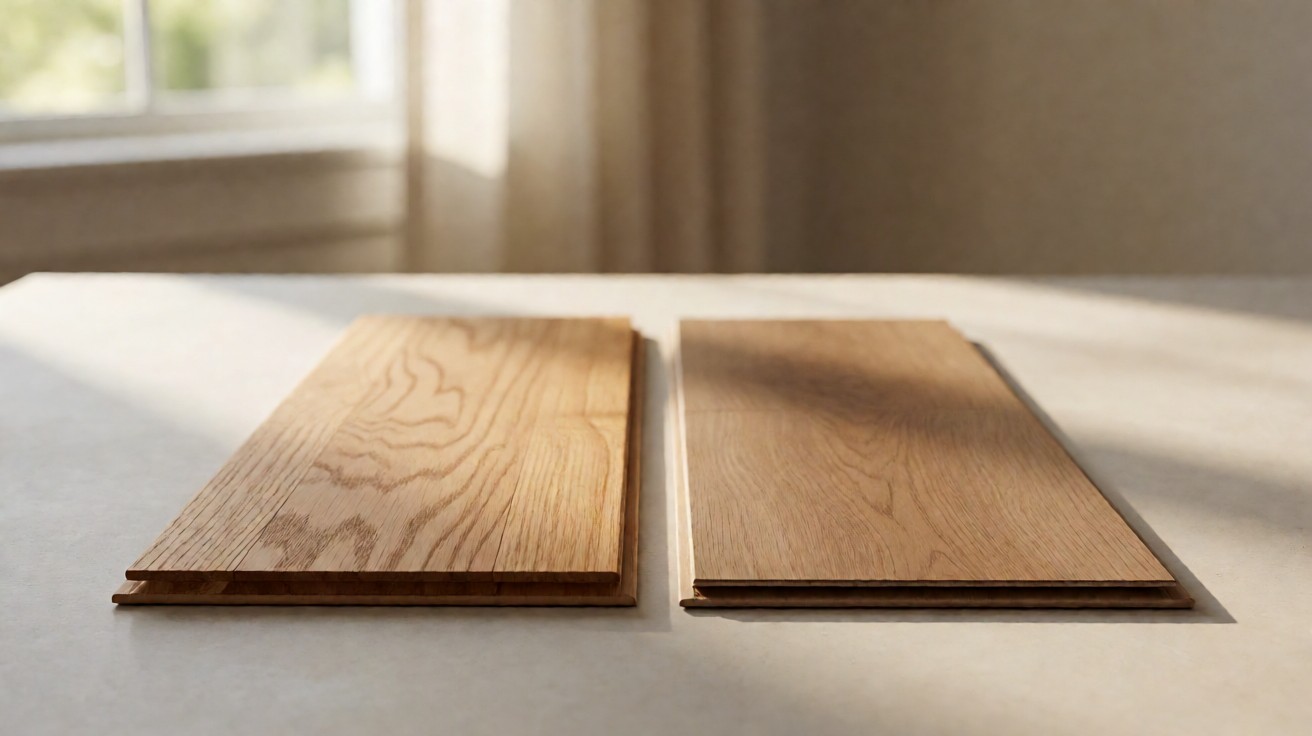
A sample is a two-inch promise. It shows the color and the grain under showroom light, but it cannot show how 300 square feet of that color will read across a room.
The mistake is treating the sample as the product. A board chosen from a rack can look flat and lifeless once it is laid wall to wall, or it can read much darker under your own lighting than it did in the store.
If you choose by the sample alone, you are choosing a color without the room. Lay a test patch of the real product on the actual floor, in the actual light, before you commit to a full order. The sample ordering and comparison guide walks through how to do that.
Ordering the Wrong Quantity of Flooring
The most common quantity error is ordering the measured area and nothing more. A room that measures 200 square feet does not take 200 square feet of flooring once the boards are cut.
NWFA Technical Guidelines use a 5 percent baseline for straight layouts, plus 5 percent for diagonal, as summarized by Craft Calcs citing NWFA. TCNA guidance is higher: 10 percent for straight residential work and 15 to 20 percent for diagonal, per Craft Calcs citing TCNA.
How Much Extra Should You Order Beyond the Measured Area?
Start from the measured area, then add the waste factor for your layout, then add a little more for the boards you will reject for color or grade. A straight lay in a simple room can run close to the 10 percent TCNA figure, and a diagonal or a room with many corners needs the higher end.
The box-count arithmetic for a specific room is worked through on our page about how to calculate the number of flooring boxes needed, and the leftover question is covered on the page about how much extra flooring to keep after installation.

Choosing Durability That Does Not Match the Room
Durability ratings are not a quality ranking. They are a match between the product and the traffic the room will actually see.
Laminate is rated on two systems. The North American standard NALFA LF-01 certifies four tiers from Residential to Heavy Commercial, and the European EN 13329 classes run from AC1 to AC5.
How Many Wear Cycles Does a Residential Room Actually Need?
Per the AIA E03C Floor Covering Reference Manual, the NALFA tiers are Residential at 1800 cycles, Light Commercial at 2500, and Commercial at 4000. The EN 13329 classes per EPLF are AC1 at 900, AC2 at 1800, AC3 at 2500, AC4 at 4000, and AC5 at 6500 cycles.
| System | Class | Cycles |
|---|---|---|
| NALFA LF-01 | Residential | 1800 |
| NALFA LF-01 | Light Commercial | 2500 |
| NALFA LF-01 | Commercial | 4000 |
| EN 13329 | AC1 | 900 |
| EN 13329 | AC2 | 1800 |
| EN 13329 | AC3 | 2500 |
| EN 13329 | AC4 | 4000 |
| EN 13329 | AC5 | 6500 |
NALFA LF-01 tiers and EN 13329 classes, per the AIA E03C reference manual.
A living room that sees one family does not need the same rating as a hallway that sees the whole house. Match the tier to the room, not to the label.
The NALFA white paper on wear resistance and AC ratings makes the point that laminate is a highly durable product in which wear-through to the decorative layer is rare, so an AC rating alone is not a reliable prediction of how one home will perform.
The Tise 2026 report on AC ratings records the industry position: AC3 is sufficient for most residential homes, AC4 and AC5 are specified for commercial projects, and AC6 is a proprietary class with a 12-year warranty.
Mistaking a Soft Hardwood for a Hard One
Hardness in wood is measured by the Janka test, which records the force needed to embed a steel ball halfway into the surface. The test is run per ASTM D2393, and the USDA Wood Handbook publishes the figures.
The numbers matter because a soft species dents under a chair leg and a hard one does not.
| Species | Janka (lbf) |
|---|---|
| Shagbark hickory | 1880 |
| Sugar maple | 1450 |
| White oak | 1360 |
| White ash | 1320 |
| American beech | 1300 |
| Red oak | 1290 |
| Yellow birch | 1260 |
| Black walnut | 1010 |
| Black cherry | 950 |
| Red maple | 950 |
USDA Wood Handbook Janka figures, tested per ASTM D2393.
Black walnut at 1010 lbf and black cherry at 950 lbf will show denting in a dining room that white oak at 1360 lbf handles without a mark.
When a chair leg lands on a soft species, the dent stays. If you want a warm species, plan for the dents or pick a harder one. Shagbark hickory at 1880 lbf and sugar maple at 1450 lbf sit at the top of the range.
Believing the Headline Warranty Number
A 25-year warranty sounds like 25 years of full coverage. It is usually 25 years of declining coverage.
What Does a Prorated Warranty Actually Pay Out in Later Years?
Provenza Floors publishes a 25-year residential finish warranty that is prorated: 100 percent in years 1 and 2, declining to 10 percent in years 24 and 25. Its commercial finish warranty runs 3 years, paid at 100, 50, and 10 percent by period.
| Warranty | Period | Coverage paid |
|---|---|---|
| Residential finish, 25 years | Years 1-2 | 100 percent |
| Residential finish, 25 years | Years 24-25 | 10 percent |
| Commercial finish, 3 years | Year 1 | 100 percent |
| Commercial finish, 3 years | Year 2 | 50 percent |
| Commercial finish, 3 years | Year 3 | 10 percent |
Provenza Floors published proration structure.
The headline number is the length, not the value. A warranty that pays 10 percent in year 24 is a very different promise from one that pays 100 percent for 25 years.
NFM Signature Flooring publishes a 25-year residential and 10-year light commercial warranty that is non-transferable, and it requires the installer to inspect the material before installation. Its floors stay under light traffic for 24 hours and off wet mopping for 48 hours.
Mannington’s Restoration Collection laminate spec sheet lists a 25-year residential and 5-year light commercial warranty with an AC4 rating, NALFA certification, and FloorScore certification.
Skipping the Fine Print on Warranty Exclusions
The exclusions are where a warranty ends. Provenza Floors lists moisture exposure, pet damage, and rental use among its exclusions, and names Airbnb and Vrbo specifically.
Its coverage also requires installation by a licensed or certified contractor, and it requires the floor to be acclimated at 65 to 85 F and 35 to 55 percent relative humidity.
If your project is a rental, or if the floor will sit in a humid room, the exclusion list changes the decision before the price does.
The full exclusion catalog lives on our page about what flooring warranties commonly exclude, and the coverage question is answered on our page about flooring manufacturer warranties explained.
Buying Clearance Stock Without Checking Replacement Stock
Clearance pricing is often a dye lot or a discontinued line. That is fine if you will never need another board, and expensive if you do.
Why Do Two Boxes of the Same Product Look Different?
Per the AIA E03C reference manual, packaging must list the material color or pattern and the batch number. Two boxes with different batch numbers can read differently under the same light, which is the source of the two-boxes-look-different complaint.
Before you buy clearance stock, ask whether the same batch can still be ordered. If it cannot, buy enough to finish the room plus repairs, and expect the replacement to be a close match rather than an exact one.
The availability and replacement-stock check is worked through on our page about how to check product availability and replacement stock.
Comparing Quotes by the Total Price Only
Two quotes with the same total can carry very different scopes. One may include the underlayment, the transition strips, the disposal of the old floor, and the furniture move; the other may stop at the material.
What Should a Flooring Quote Include?
Compare quotes line by line: material, underlayment, trim and transitions, installation, removal and disposal, and any travel or stair charge.
A quote that is 20 percent cheaper because it omits the disposal and the transitions is not cheaper once you pay for those separately.
Our page on how to compare flooring quotes fairly sets out the line items to ask for.
Purchasing Without Confirming Lead Time and Availability
Lead time is the gap between the order and the truck. A product that is out of stock can hold a room for weeks, and a special order can hold it for longer.
How Long Does Flooring Take to Arrive?
Confirm the stock status, the delivery window, and the lead time for any special order before you schedule the installer. If the floor is not on site when the crew is, you are paying for a day that produces nothing.
The buying process, from measurement to delivery, is laid out on our flooring buying guide.
The Pre-Purchase Mistake Checklist
| Mistake | What Goes Wrong | How to Avoid It |
|---|---|---|
| Ordering the measured area only | The order runs short by the waste factor and the install stops mid-room | Add 10 percent for a straight layout and 15 to 20 percent for a diagonal one |
| Trusting a two-inch sample | The color reads flat or dark once it is laid wall to wall | Lay a test patch on the real floor in the real light first |
| Matching durability to the label | A soft product goes into a hard-use room | Match the NALFA tier or AC class to the traffic the room will see |
| Choosing a soft hardwood species | Chair legs and pets dent the surface | Check the Janka figure before you commit |
| Believing the headline warranty | Coverage declines to 10 percent by year 24 | Read the proration schedule before you buy |
| Skipping the exclusion list | Moisture, pet, and rental claims are denied | Read the exclusions against your actual use |
| Buying clearance stock | No matching batch exists for repairs | Confirm replacement stock before you commit |
| Comparing quote totals only | A cheaper quote omits disposal or trim | Compare line items, not totals |
| Not confirming lead time | The installer arrives before the floor does | Confirm stock and delivery before you schedule |
Work the list in order. The quantity check and the durability check are the two that change the order itself; the rest change what you agree to pay for.
If a check fails, the order is not ready. Keep the list on your phone and run it before you sign anything.
Which Mistake Matters Most for Your Project
The mistake that costs the most depends on the project. If the room is a rental, the warranty exclusions matter more than the species. If the layout is diagonal, the quantity math matters more than the quote comparison.
If you are buying a warm, soft species for a dining room, the Janka number matters more than the headline warranty.
Work the checklist in the order above, and the mistake that would have cost you the most is the one you check first.