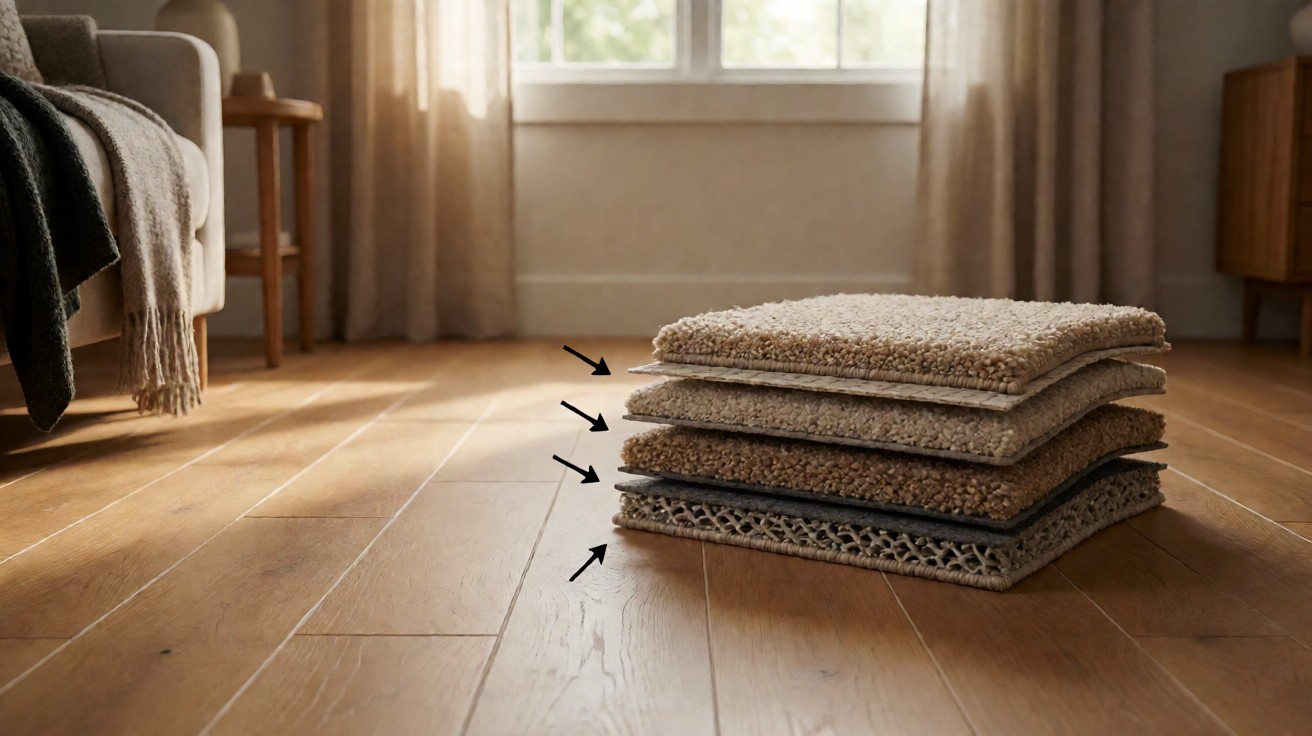

Carpet quality is determined by three numbers that are rarely on the price tag, and density, pile height, and twist, in that order, carry the difference.
Density is the mass of yarn in a given volume of carpet, measured in ounces per square yard. Pile height is the length of the yarn from the backing to the tip. Twist is the number of times the yarn is twisted per inch of length.
Each one predicts a different behavior: density predicts how the carpet will crush under traffic, pile height predicts whether the carpet reads as a plush or as a tight commercial finish, and twist predicts whether the yarn will matte down or hold its shape over years of use.
Spec sheets for residential carpet usually show the face weight, the yarn twist, and the pile height. Spec sheets for commercial carpet go deeper. Either way, the three numbers together tell you most of what you need to know before buying.
For the fibre behind the yarn, the nylon versus polyester versus triexta versus olefin versus wool carpet page covers that choice, and the carpet construction explainer sits above it as the umbrella.
Density: The Number Buyers Rarely Ask About
Density is the weight of yarn packed into a square yard of carpet. A higher density means more yarn, more support for the yarn, and more resistance to crushing under furniture and traffic. Density is calculated from the face weight and the pile height, and a typical residential carpet has a density between 1500 and 4000, with the higher numbers being commercial-grade.
A density of 1500 to 2500 is light residential, suitable for a bedroom or a closet. A density of 2500 to 3500 is mainstream residential and handles a family room or a hallway. A density above 3500 is dense residential or light commercial and handles heavy traffic for years without crushing. Carpet density below 1500 is a thin product that will crush quickly.
Density correlates with price but not perfectly. A high-density carpet with an inexpensive yarn can cost less per square yard than a low-density carpet with an expensive yarn, and the quality difference between the two comes down to the density, not the fibre. Most homeowners focus on fibre because it is more visible. They should focus on density because it predicts the wear pattern.
Pile Height: How Long the Yarn Stands
Pile height is the length of the yarn, measured from the backing to the tip. Lower pile heights mean shorter, denser yarn; higher pile heights mean longer, looser yarn. The same yarn type behaves differently at different pile heights.
Low pile, under 0.25 inches, is the tightest construction. It is commercial-grade, traffic-friendly, and it is what is installed in offices and hotels. It does not have the feel of a residential carpet underfoot, and most homeowners reject it for that reason.
Medium pile, 0.25 to 0.5 inches, is the residential mainstream. It is what most carpets sold at retail fall into, and it is the pile height that feels like residential carpet on bare feet while still handling normal traffic.
High pile, 0.5 inches and up, is the plush and shag range. It feels luxurious underfoot and it is the most fashionable residential carpet at any given moment. It also crushes under furniture and is harder to clean, because the long yarn traps dirt and is harder to vacuum thoroughly. A high pile carpet is a beautiful bedroom choice and a poor family room choice.
Twist: The Number That Predicts Long-Term Look
Twist is the number of turns in the yarn per inch of length. It is the most under-appreciated of the three numbers, and it is the one that determines whether the yarn holds its shape over years of use or flattens into an indistinct surface.
A high-twist yarn, 5 to 7 twists per inch, holds its shape. The yarn springs back into standing position after being compressed, and the carpet keeps its texture for years. Most residential carpet falls into this range, and the difference between carpet at 4.5 twists and carpet at 6 twists is visible after a year of use.
A low-twist yarn, under 4 twists per inch, flattens. The yarn loses its spring, the carpet looks different in the traffic lanes, and the change is permanent. Low-twist carpet is sold less often today than it was twenty years ago because the look it produces is widely disliked.
The fancy carpet sold as frieze or saxony is typically a high-twist product with a long pile, which is the combination that gives the carpet the “shaggy but defined” look. The texture is partly the yarn type and partly the twist.
Putting the Three Numbers Together
The three numbers are not independent, and the practical combinations run across typical carpet types.
A residential cut-pile carpet is typically medium density (2500 to 3500), medium pile height (0.3 to 0.5 inches), medium twist (4 to 6 twists per inch). It is the workhorse and the most common product on shelves.
A residential frieze or saxony is typically medium density with high pile height (0.5 to 0.75 inches) and high twist (5 to 7 twists per inch). It is the more fashionable end of residential carpet.
A commercial carpet tile is typically high density (3500+), low pile height (under 0.25 inches), high twist (5 to 7). It is dense enough to survive rolling traffic and tight enough to look like a finished surface.
A berber is typically high density with low pile height and low twist. The yarn is looped rather than cut, which preserves its shape even at low twist, and the dense construction handles traffic well.
Face Weight, Pile Height, Density: How They Relate
Density is calculated from face weight and pile height, and the relationship is what makes a single number insufficient on its own.
A carpet with a heavy face weight and a long pile height can be lower density than a carpet with a moderate face weight and a short pile height, because the same mass of yarn spread over a longer height is less dense than the same mass spread over a shorter height. Density is the real quality number.
The simple test is to bend the carpet sample back to back, like closing a book. If the backing shows through easily, the carpet is low density. If the backing is barely visible, the carpet is high density. Most residential carpet passes this test, but a sample compared to another sample reveals the difference.
Foot Traffic and Where the Three Numbers Win
The three numbers matter most in the rooms that take the most traffic, and the priority order for a homeowner is density first, twist second, pile height third.
A family room, hallway, or stairs wants a high-density, high-twist carpet with a moderate pile height. The crush resistance of density handles the rolling traffic, and the high twist keeps the yarn standing through years of footfall.
A bedroom wants a higher pile height and accepts a lower density. The traffic is light, and the comfort underfoot is part of the room.
A stairs carpet is the most demanding residential location. The carpet gets compressed at the bend of each step, which is exactly where density and twist matter. Most stair installs use a shorter, denser carpet than the adjacent floor, and high-twist commercial yarn is a common upgrade.
The Three Numbers Across Carpet Types
| Carpet type | Typical density | Typical pile height (in) | Typical twist (per inch) |
|---|---|---|---|
| Residential cut-pile | 2500 to 3500 | 0.3 to 0.5 | 4 to 6 |
| Frieze or saxony | 2500 to 3500 | 0.5 to 0.75 | 5 to 7 |
| Berber (looped) | 3000 to 4500 | 0.25 to 0.4 | 3 to 5 |
| Commercial carpet tile | 3500 to 5000+ | 0.1 to 0.25 | 5 to 7 |
| Plush or shag | 2000 to 3000 | 0.75 to 1.5 | 4 to 6 |
| Cut-loop pattern | 2500 to 4000 | 0.25 to 0.5 | 4 to 6 |
Most residential carpet falls into the cut-pile or frieze rows. The ones above and below are specialty products for specific uses.
The Face Weight Trap
Face weight is the number most carpet samples display, and it is the number most likely to mislead the buyer. Face weight is the mass of yarn per square yard of carpet, and a heavier face weight is not necessarily a higher-quality carpet.
Two carpets can both show a face weight of 40 ounces per square yard, and one can be dense enough for a decade of traffic while the other crushes within a year.
The difference is the pile height: the same 40 ounces spread over a 0.5 inch pile is denser than 40 ounces spread over a 1.0 inch pile, because the same mass is packed into less volume.
Density is calculated from face weight and pile height together, and it is the right number to compare. Most carpet spec sheets show the face weight because it is more visible, and a buyer comparing two samples at the same face weight should ask for the density.
| Face weight (oz/yd²) | Pile height (in) | Density | What to expect |
|---|---|---|---|
| 30 | 0.5 | 2400 | Light residential, low traffic |
| 40 | 0.5 | 3200 | Mid-range family home |
| 40 | 0.75 | 2133 | Same face weight, lower density |
| 50 | 0.5 | 4000 | Dense residential or light commercial |
| 60 | 0.5 | 4800 | Commercial grade, heavy traffic |
| 60 | 1.0 | 2400 | Same face weight, lower density |
The table shows the same face weight producing very different densities with different pile heights. Two rows with the same face weight and different densities show the same yarn at different scales, and the higher density row will outlast the lower density row in any traffic comparison.
The Twist Test at the Showroom
At a showroom, the only honest test of a carpet sample is the twist test and the back-of-the-back density test, both of which take ten seconds and require no equipment.
The twist test is to look at a single tuft of yarn at the edge of the sample. Count the turns per inch. A 6-twist yarn looks tight and defined. A 3-twist yarn looks loose and slightly fuzzy. The difference is visible without a ruler.
The back-of-the-back test is to fold the sample so the backing is visible at the bend and the yarn is on the outside. A high-density carpet looks like a thick fabric. A low-density carpet looks like the backing is going to show through. The test fails on a thin sample every time.
Is higher face weight better?
Not necessarily. Face weight is the mass of yarn per square yard, and a heavy face weight with a long pile height can be lower density than a moderate face weight with a short pile height. Density is the quality number that incorporates both. Two carpets with similar face weights and very different densities will wear differently, and the denser one will wear better.
What is the best carpet for stairs?
A high-density, high-twist carpet with a short pile height. Stairs are the most demanding residential location because the carpet gets compressed at the bend of each step, and a tall pile flattens visibly over time.
A stair carpet at 0.25 inch pile height with 6 twists per inch and 3500 density will look new for a decade; a stair carpet at 0.75 inch pile height will look tired in a year. Many homes run a stair carpet that is shorter and denser than the adjoining hallway carpet, even when both are the same style.
Does frieze carpet hide wear better than saxony?
Yes, slightly. Frieze carpet is a high-twist cut-pile with a longer yarn length, and the twist and the long yarn combine to scatter light, which hides small variations in surface.
Saxony is a more uniform cut-pile with less twist, and a saxony surface shows footprints and vacuum marks more visibly. For a high-traffic family room, a frieze is the more forgiving option. For a formal living room where traffic is light, a saxony reads more refined.
How This Fits With the Rest of the Choice
This page covers the three numbers that determine carpet quality. It does not cover the fibre choice, the style choice, or the underlay that supports the carpet from below.
For the fibre, the nylon versus polyester versus triexta versus olefin versus wool carpet page walks through the material choices. For the cut, loop, frieze, or textured style, the cut pile versus loop pile versus frieze versus textured carpet page covers the style.
For the carpet as a whole, the carpet flooring guide sits above all three as the umbrella. And for the underlay that supports the carpet, the carpet padding and underlay guide is the reference.