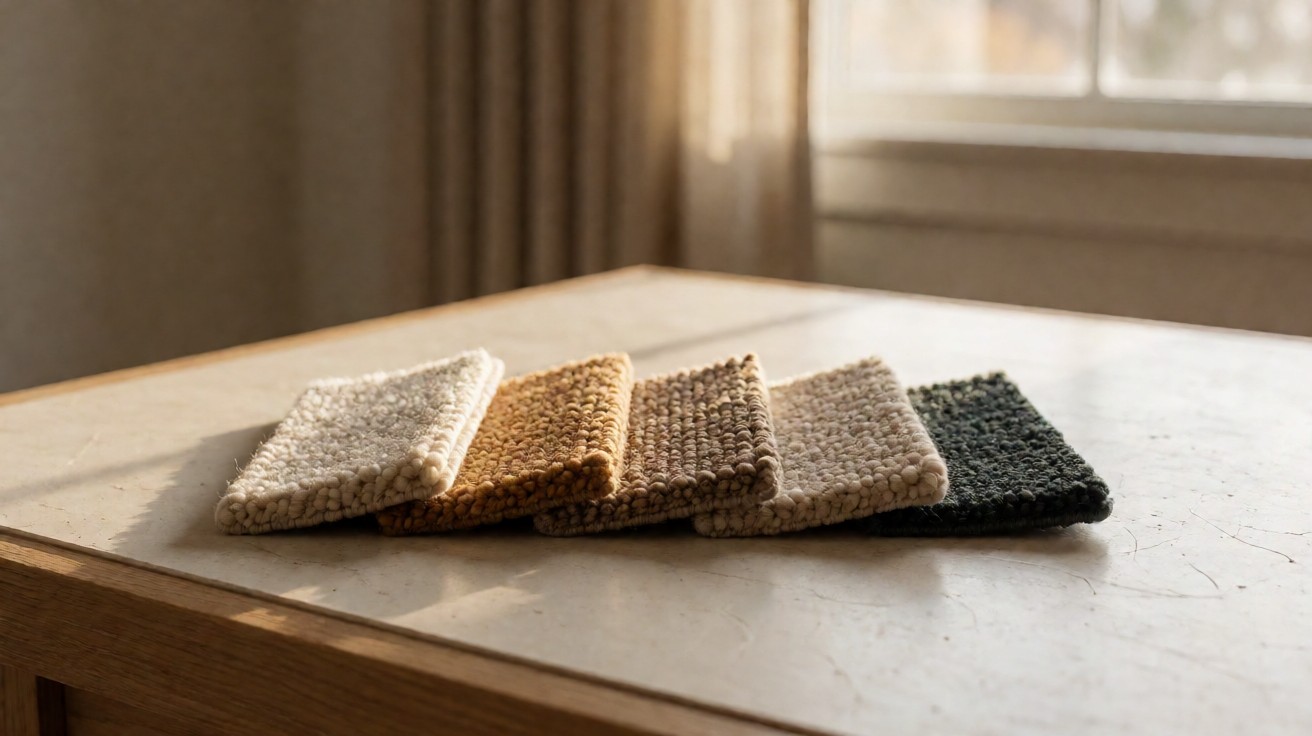

Nylon, polyester, triexta, olefin, and wool are the five carpet fibers you will meet in almost any showroom, and they are not variations on one product. They are five different materials with almost opposite strengths, which is why the most useful carpet question is not which fiber is best but which weakness your room is most likely to exploit.
That framing matters because the two properties buyers confuse, abrasion resistance and stain resistance, pull in opposite directions by fiber. Nylon resists wear better than anything else and is the hardest to stain. Polyester resists stains easily and wears out sooner in heavy traffic. The rest sit between, or trade one property for another deliberately.
This guide is about the fiber itself. It assumes carpet is the right floor for your room; if it is not, the broader carpet guide and the material comparison linked below will tell you more useful things. Pile style, padding, and format are separate decisions.
Nylon vs. Polyester vs. Triexta vs. Olefin vs. Wool: The Short Answer
Choose nylon for busy rooms that get walked on: hallways, stairs, family rooms, and homes with kids or pets. It outlasts every other fiber when wear is the problem.
Choose polyester for stain-prone rooms on a budget: kitchens with spills, entryways, and basements. It shrugs off most stains and costs less than nylon. Choose triexta when you want a softer feel and a stain-and-wear balance between the two, which is why it suits ordinary bedrooms and living rooms so well.
Choose olefin for water and damp: basements, mudrooms, garages, and cheap area mats. Choose wool only when you want natural fiber and can accept its price and its lower stain resistance.
Nylon: The Abrasion Workhorse
Nylon is the most durable carpet fiber available for home use, and it is the default for a reason. It resists abrasion far better than polyester, olefin, or wool, which means it holds its texture and colour through years of foot traffic instead of flattening into a bald track.
Nylon is also naturally flexible and abrasion-resistant because of its molecular structure, which lets a fibre bend and recover rather than snapping. That recovery is what keeps a nylon carpet looking new in a traffic lane instead of showing a worn path.
The reason people avoid nylon is almost always price or stain fear. Modern stain treatments on nylon have improved a great deal, and a quality nylon in a light colour with a good pad can handle normal household life. It remains the safest choice for a room that takes a beating.
Polyester: Value and Stain, Less Wear
Polyester is the budget-friendly workhorse of the carpet aisle, and its main advantages are stain resistance and cost. It does not absorb water the way natural fibers do, so most spills sit on the surface long enough to be blotted rather than soaking in.
Where polyester falls short is abrasion. In a high-traffic room it will show wear, crushing, and a duller surface sooner than nylon, often in a few years where nylon would still look presentable. In a low-traffic room that difference may never matter, which is why polyester is a perfectly good choice in a bedroom.
Polyester also offers the widest colour range of the synthetics and holds dye very well, so it is the fibre to choose if you want a saturated, non-neutral colour on a budget.
Triexta: The In-Between That Suits Many Homes
Triexta is a blended fiber that combines a soft, wool-like polyester component with a nylon component, engineered specifically to hold the stain resistance of polyester while approaching the durability of nylon. It is the reason a middle-priced carpet in a modern showroom often claims to be the best of both.
In practice, triexta is a strong default for a house that does not have one extreme room. It is softer to the touch than nylon, more stain resistant than plain nylon, and more wear-resistant than plain polyester. If you have one carpet through a bedroom-to-hallway floor plan and you do not want to think hard about it, triexta is engineered for exactly that case.
Olefin: Waterproof and Cheap, for Basements and Mats
Olefin, also called polypropylene, is the fibre of choice where water is the main enemy. It is essentially hydrophobic: it absorbs almost no water, which makes it the go-to for basements, garages, and outdoor-adjacent mats where you want something that shrugs off damp.
It is also the least durable of the five in heavy traffic, and it is prone to matting and crushing in a busy hallway, because the fibre is more prone to flatten. For a basement that gets wet, olefin wins on practical grounds, but it is not the carpet for a main living room.
Wool: Natural, Cool, and Premium
Wool is the natural fibre option, and it brings properties the synthetics cannot: it regulates temperature by absorbing and releasing moisture, it is naturally fire resistant without chemical treatment, and it has a dense, resilient hand that feels distinctly different from plastic.
The trade-offs are real. Wool absorbs moisture readily, which makes it the least stain resistant of the five and the most prone to a spill sinking in. It is also the most expensive, often by a wide margin, and because it is a natural fibre it can be more sensitive to certain harsh cleaners.
For most families, wool is a luxury and a commitment. In a cold-climate bedroom, a low-traffic room, or for someone who specifically wants natural materials, it is a genuinely different product rather than a premium version of the same one.
Abrasion vs. Stain: The Two Different Resistances
This is the core of the fiber decision, and it is where most carpet buying advice gets muddled. Abrasion resistance is about wear from foot traffic. Stain resistance is about whether a spill sits on the surface or sinks into the fibre. They are different properties, and no single fiber maximises both.
Nylon maximises abrasion. Polyester maximises stain. Triexta splits the difference deliberately. Wool maximises neither but adds natural feel and moisture handling. So the honest way to choose is to ask which failure your room will actually produce: a worn track from traffic, or a stubborn mark from a spill.
A hallway or family room produces wear. A kitchen, entryway, or dining room produces stains. That is the whole decision, and it should be made room by room rather than once for the house.
Colourfastness and Fading Over Time
All carpet fades over years, because even a solution-dyed fibre is being exposed to years of light and foot traffic. How fast depends on the colour and the room.
A dark colour shows soil rather than fading, and a mid-tone shows the middle. A carpet under a window or a glass door will fade on that side first, which is worth thinking about before choosing a pale colour in a sunroom.
Solution-dyed fibres, where the colour is in the fibre all the way through rather than on the surface, fade more slowly than surface-dyed. Most good carpet today is solution-dyed, and any reputable dealer will tell you. The practical advice is to avoid very pale carpet in direct, permanent sun, because it will look tired long before it wears out.
Moisture, Static and Allergy Behaviour
Fiber affects how a carpet handles moisture and, in some cases, static. Nylon and wool absorb some moisture, with wool absorbing the most, while polyester and olefin absorb very little. That is why wool feels cooler and more comfortable in a cold room, and why olefin is the sensible choice in a damp basement.
Synthetic fibers, especially nylon and olefin, carry static more than wool does, which matters in a dry winter climate. Wool is the least static-prone of the five.
On allergies, be careful. No carpet is hypoallergenic, and the fiber itself is a smaller factor than people assume. What actually holds allergens is the pile height and the padding, because deeper, denser, more forgiving surfaces trap less loose dust than a thin, stiff, cheap carpet. A good nylon with a thick pad does more for allergy comfort than the fiber label alone suggests.
The Comparison at a Glance
The table below is the fiber decision in one view.
| Factor | Nylon | Polyester | Triexta | Olefin | Wool |
|---|---|---|---|---|---|
| Abrasion resistance | Best | Fair | Good | Low | Good |
| Stain resistance | Good with treatment | Best | Very good | Best | Lowest |
| Moisture absorption | Some | Very low | Low | Almost none | Highest |
| Feel | Firm | Soft | Soft, wool-like | Coarse | Dense, natural |
| Static tendency | Higher | Moderate | Moderate | Highest | Lowest |
| Cost relative | Higher | Low | Mid | Lowest | Highest |
| Best in | Hallways, family rooms, stairs | Kitchens, entryways, budgets | Bedrooms, general living | Basements, mats, garages | Bedrooms, natural-material homes |
The fiber trade is really the abrasion-versus-stain trade, and it is worth seeing it as its own ledger. This is the view that should drive the purchase decision.
| Fiber | Wins at | Weakest at | Choose it when the room is |
|---|---|---|---|
| Nylon | Abrasion | Stain (without treatment) | High traffic: hallway, stairs, family room |
| Polyester | Stain, value | Abrasion | Spill-prone: kitchen, entryway |
| Triexta | Balance of both | Neither extreme | Mixed traffic: bedroom, living room |
| Olefin | Water resistance | Wear, feel | Damp: basement, garage, mats |
| Wool | Feel, moisture, natural | Stain, cost | Quiet, natural-material preference |
How to Choose Fiber for Your Home
Go room by room and decide which failure is most likely in each space. For the room with the most foot traffic, choose nylon or triexta. For the room where spills happen, choose polyester or triexta.
For a basement or covered patio, olefin is the practical answer. For a quiet room where you specifically want natural materials and are not worried about stains, wool is a real choice.
Whichever you pick, remember that fiber is only one part of the system. The padding underneath changes how the carpet feels underfoot, how well it resists crushing, and how long it lasts almost as much as the fiber does. A good carpet on a bad pad will disappoint you faster than a mid fibre on a good pad.
Finally, judge the carpet by touch and by the sample, not only the label. Lay the sample down, walk on it, and rub your fingers across it to feel the twist and density. A well-twisted yarn feels firm and holds its shape; a loose, fuzzy yarn wears out faster regardless of what the tag says.
Is nylon better than polyester for carpet?
For durability, yes, and it is not close in heavy traffic. Nylon resists abrasion several times better than polyester, which is why it is specified for stairs and busy corridors. For stain resistance, the advantage flips: polyester is easier to clean and often cheaper.
The honest answer is that nylon is the better all-round fiber for a busy home, and polyester is the better budget choice for a room with moderate traffic that sees the occasional spill.
Is triexta really better than both nylon and polyester?
Triexta is engineered to occupy the middle: softer than nylon, more wear resistant than polyester, and more stain resistant than nylon without the polyester price. For most ordinary rooms it is genuinely an excellent default.
It does not beat the best nylon in a brutal hallway or the best polyester in a stain-heavy kitchen, but it removes the need to compromise between the two for a normal bedroom or living room.
How This Fits With the Rest of the Carpet Choice
Fiber is one of three carpet decisions, and it is the one with the biggest effect on longevity. The other two, pile style and padding, change how the carpet looks and feels more than how long it lasts.
The complete carpet flooring guide covers how carpet is constructed, the role of padding, and how to match carpet to a room and a household. If you are still weighing carpet against the hard-floor options, the head-to-head material comparison sets carpet against hardwood, tile, vinyl, and laminate on comfort, warmth, acoustics, and maintenance.