
Standard and premium laminate can look identical in a showroom and cost twice as much. The difference is not the photograph, the colour name, or the marketing.
It is whether the pattern is printed onto the board or sits on a separate protective layer you can see at the cut edge. That one structural fact explains most of the price gap and most of the durability gap.
Once you know to look, the tiers become easy to judge. The wear layer thickness, the core density, the print resolution, and the precision of the locking edge are all things you can check on a sample or a spec sheet. You do not need to trust the word premium.
This guide sets out what physically differs between the tiers and when that difference is worth paying for. It is about construction, not shopping advice. If you have not decided on laminate at all, the broader laminate guide is the place to start.
Standard vs. Premium Laminate: The Short Answer
Buy premium laminate in high-traffic rooms, in wet-adjacent rooms, and when the floor needs to survive fifteen years of family life. Buy standard laminate in a bedroom, a guest room, or a low-traffic space where the floor will be replaced or covered before it wears through.
Do not pay a premium for colour depth alone. A print-resolution difference is visible close up but disappears across a room, and many standard planks now ship with a perfectly good wood look. Pay for the wear layer and the core, which are the two things that determine whether the floor still looks acceptable in year ten.
The test of whether premium was worth it is simple: after a few years of use, can you still see the wood pattern where the traffic is, or has the surface worn to a dull, generic surface with the pattern showing through?
The Wear Layer Is the Real Difference
Every laminate plank has a clear, hard surface layer that takes the wear, and the thickness and composition of that layer is the single biggest factor in how long the floor lasts. It is measured in the product specification and it is the number to compare when you are deciding between tiers.
A premium plank typically uses a substantial melamine overlay, sometimes called a high-pressure laminate, that is a distinct film bonded to the printed decor layer.
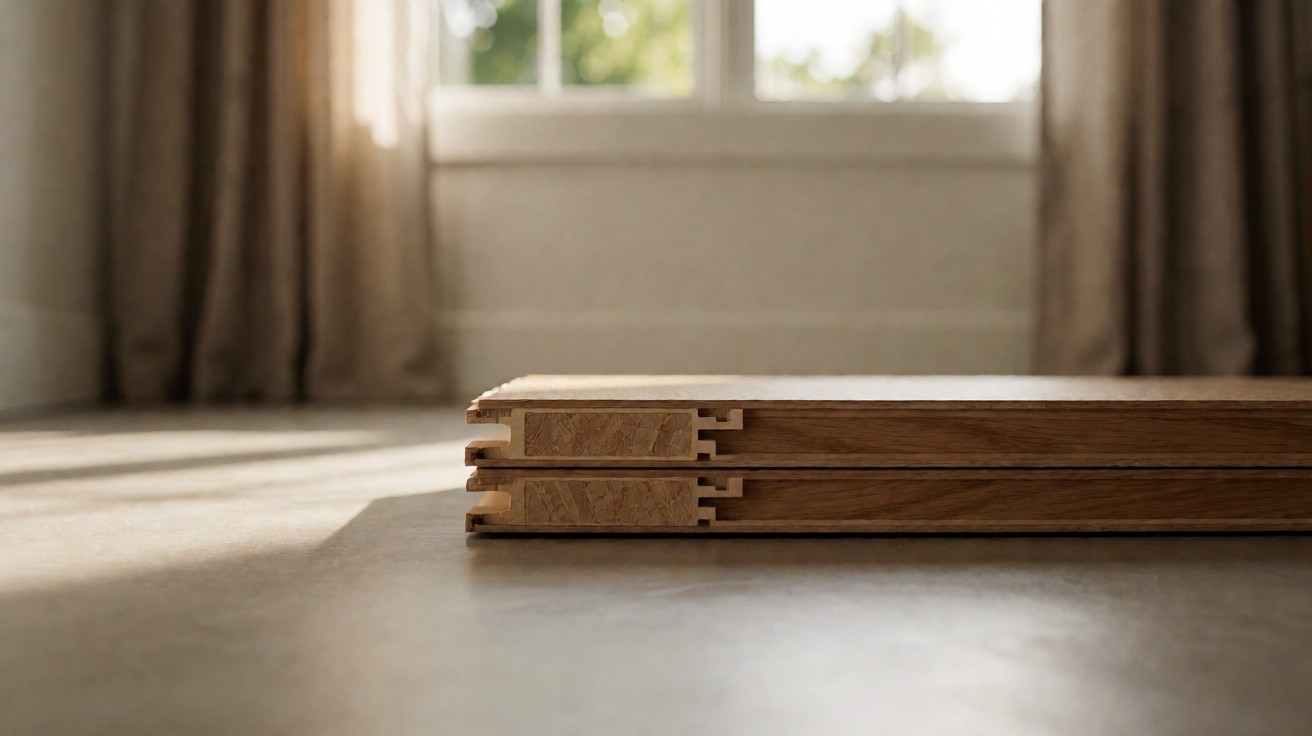
You can see it at the cut edge of a sample board as a thin, distinct top layer. A cheap plank is often a direct-decorated product where the pattern is printed straight onto the fibreboard core with a thinner, harder-wearing surface treated in.
The practical consequence is scuff and scratch resistance. A thick overlay resists a scuff as a surface layer, so a shoe mark or a pet claw hits the overlay rather than the printed pattern underneath.
On a thin-wear direct-print, the wear goes through to the decor and you see the fibreboard colour emerge. That is why budget laminate tends to look worn and flat while premium boards still show grain.
Core Density and How It Feels and Locks
The middle of a laminate plank is a high-density fibreboard core, and its density determines how rigid the board is and how well the locking edge holds. A denser core gives a plank that feels more solid underfoot, resists edge chipping during installation, and stays flat across a slightly uneven subfloor.
The premium tier uses a denser, better-controlled core. The standard tier is lighter and slightly more forgiving to install but noticeably more flexible, which is a trade you feel when you walk on the floor and when a heavy chair is dragged across it.
Density also affects the locking system. A precise 5G-style profile on a dense core clicks cleanly and holds; a looser profile on a lighter core can develop a hollow feel and more movement over time. You do not need a scale to judge this. Flex the sample gently and see how much give it has and how crisp the joint feels.
Print Resolution and How Cheap Decor Betrays Itself
The wood pattern is a printed decor layer. Premium planks print at a higher resolution and usually pair that print with a textured or synchronised surface, so the grain has a tactile quality that matches the visual. Cheap planks use lower-resolution prints with a flatter surface, which is why they can look slightly repetitive and plastic up close.
This is the difference you notice most on a showroom sample and least in a furnished room. It matters if the floor will be seen close up every day, like a small hallway or a bedroom where you walk barefoot. It matters much less in a living room where the floor is furniture-draped from waist height.
Look at the pattern repeat. Good decor hides its tiling across boards; cheap decor often shows the same grain motif appearing every few planks in a way that looks unnatural.
Edge Precision and Why Joints Matter
A laminate floor is only as good as the joints between its planks, and the locking edge is where premium engineering shows. A precise profile produces a tight, barely visible joint; a loose one leaves a visible groove that collects dirt and takes moisture.
Micro-bevels are a related detail. A chamfered edge, even a small one, breaks up the joint line so the floor reads as individual planks rather than one continuous sheet. Premium boards usually have a cleaner, more consistent micro-bevel; cheaper ones can have a chamfer that varies plank to plank or, in the worst cases, no chamfer at all so the joints read as stripes.
This is also where the water story connects. A tighter joint is a better joint against moisture, which is one reason a premium plank and a standard plank can behave differently in the same kitchen even when both are sold as water-resistant.
What Standard Laminate Does Perfectly Well
Standard laminate is not a compromise to be embarrassed about. In a bedroom, a guest room, a home office, or a rarely-used second home, it looks the same as premium, wears fine, and saves real money. The wear layer is more than adequate for foot traffic that is light or occasional.
It is the right choice when the floor is a background surface in the room, when the budget needs to stretch further in a more visible area, and when you plan to replace the flooring within its expected service life anyway. Paying premium in these cases buys resilience you will never use.
Judged honestly, a good standard plank in the right room is the value purchase of the flooring aisle. The mistake is only buying standard for a hard room, not buying it at all.
Where Premium Earns Its Money
Premium earns its price in three specific situations. High traffic, where a family room, hallway, or stair-adjacent space wears the surface every day and the pattern needs to survive it.
Wet adjacency, where a kitchen or entry sees enough water that a better joint and a thicker overlay genuinely matter. And longevity, where you want the floor to stay presentable past the ten-year mark rather than re-covering it.
The honest way to think about the price is per year of acceptable appearance, not per square foot. A premium plank costing twice as much that holds its surface for fifteen years is cheaper per good year than a standard plank that needs covering in eight. That calculation only favours premium in a hard room, which is the whole point.
The table below is the decision in short form.
| Factor | Standard laminate | Premium laminate |
|---|---|---|
| Surface construction | Direct-decor, thin wear treatment | Separate overlay, thick wear layer |
| Core | Lighter HDF, more flexible | Denser HDF, more rigid |
| Print and texture | Lower resolution, flatter feel | High resolution, synchronised texture |
| Locking edge | Looser profile, more give | Precise profile, tight joint |
| Scuff resistance | Wears to the pattern sooner | Overlay holds off scuffs |
| Best in | Bedrooms, guest rooms, offices | High traffic, kitchen, longevity |
| Buy it when | Background floor, light use | Hard room or long-term floor |
How to Inspect a Premium Versus Standard Plank
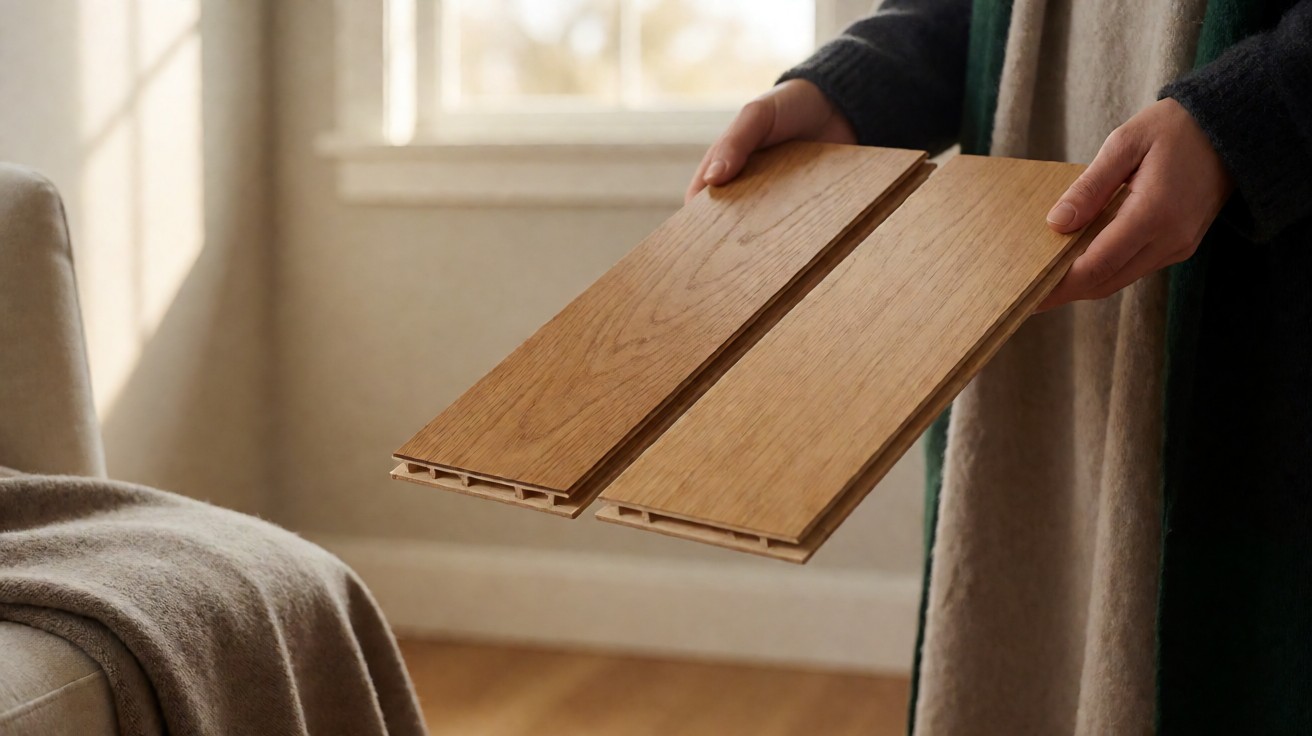
Ask to see the cut edge of a sample board, not just the face. That single view tells you whether there is a distinct overlay layer and how pronounced it is, and it is the fastest honest test of what you are buying.
Flex the board gently in your hands. More flex means a lighter core and a looser edge, and more give underfoot later. Run a thumbnail along the joint profile and the micro-bevel to feel whether the machining is crisp or rough.
Finally, read the specification for the wear layer thickness and the core type rather than the marketing words. Two planks can both be called premium or both be called commercial grade, and the numbers will tell you whether the label is earned.
The comparison below is the practical version of that check, for a homeowner who is deciding how much the gap actually buys.
| What to inspect | Standard laminate typically shows | Premium laminate typically shows |
|---|---|---|
| Cut edge of a sample | Pattern printed onto the core | A distinct overlay film above the decor |
| Bend in the hand | Noticeable flex, soft feel | Rigid, minimal flex |
| Locking profile | Slightly loose, more hollow over time | Crisp click, tight joint |
| Micro-bevel | Rough or absent on some planks | Consistent, crisp chamfer |
| Decor repeat | Same motif may reappear nearby | Repeat hidden across boards |
| Wear layer on the spec | Thin, direct-decor | Thick overlay, HPL or wear film |
Standard Laminate Versus Waterproof Vinyl
It is worth naming the comparison that eventually matters, because it is not really premium against standard laminate. In a wet room the real alternative is waterproof vinyl, a synthetic-core product that does not swell at all, which the water-resistance comparison covers in detail.
Premium laminate wins in a dry or moderately damp room, because it feels warmer and more convincingly wooden than vinyl and often costs less than a comparable synthetic-core plank. Waterproof vinyl wins in a kitchen or laundry, because its water tolerance is structural rather than a coating. If your room has plumbing, the tier debate is the wrong debate.
How This Fits With the Rest of the Laminate Choice
Tier is a quality decision about one material, and it sits alongside the larger questions of wear rating, water rating, and room fit. Buying premium is only sensible once the standard product would genuinely not suit the room.
The complete laminate flooring guide covers how laminate is built, the AC wear rating, and what to check on a sample. If the room you are fitting is wet, the water-resistant versus waterproof laminate comparison decides whether any laminate is right at all, whatever its tier.
And if you are still deciding between laminate and the other families, the head-to-head material comparison sets them side by side on the factors that decide most rooms.