
Water-resistant and waterproof laminate sound like a small difference in wording. They are not. The difference is whether the core of the board can swell when it gets wet, and everything else follows from that. A water-resistant laminate is a wood-fibre board with a good coat on top. A waterproof laminate is a different material that happens to look like wood.
That distinction decides where each product belongs. In a bedroom with an occasional spill, water-resistant laminate is more than enough. In a kitchen, a laundry, or a basement where water is a recurring possibility, the question is not whether the surface resists a splash but whether the board underneath can be trusted with standing moisture at all.
This guide is about laminate specifically. It explains what each rating protects against, where the failure actually happens, and how to read the claim on a product sheet without taking the marketing at face value. If you have not yet chosen laminate, the broader laminate guide comes first.
Water-Resistant vs. Waterproof Laminate: The Short Answer
Choose water-resistant laminate for dry rooms and light, quick spills: bedrooms, living rooms, home offices, and hallways with no plumbing nearby. Choose waterproof laminate for kitchens, laundry rooms, bathrooms above the floor line, mudrooms, basements, and any room where a leak or a forgotten cup is a realistic event.
The real question is not the label but the core. If the product data sheet does not tell you what the core is made of, ask. A board built on a high-density fibreboard core is water-resistant no matter how the box is worded. A board built on a composite or stone-plastic core is waterproof because it contains no wood fibre to swell.
Neither is a better floor in the abstract. They are different products suited to different rooms, and buying the wrong one wastes money on a floor that was never going to survive its location.
Why Laminate Is Never Truly Waterproof
Standard laminate is built on a high-density fibreboard core, usually called HDF. That core is compressed wood fibre, and wood fibre swells when it drinks water. It is the same principle that makes a wooden door stick in a damp winter, and it is why no amount of good coating turns an HDF-core board into a waterproof product.
What a good water-resistant coating does is slow the uptake. It buys time. If you wipe a spill promptly, the surface has not had long enough to pass significant moisture into the core. That is a genuinely useful property for a busy family floor, but it is a delay, not a barrier.
The failure is rarely a dramatic flood. It is a small, repeated amount of water at the plank edges and joints over time, which is exactly where an HDF core is weakest. This is why a floor can look fine for years and then show swelling along a seam or near a doorway.
What Water-Resistant Actually Buys You
Water resistance is a time-based protection, and it is genuinely valuable when you understand it as such. It covers the ordinary accidents of a lived-in house: a spilled drink wiped up within a minute or two, a damp mop that lingers too long, a leak that gets caught before it soaks through.
The protection depends on the quality of the seal. Premium water-resistant laminates seal the locking profile at the tongue and groove, so a joint does not wick moisture along a groove. Budget laminates often leave the core edge more exposed, which is where they fail first.
It does not cover immersion, running water from a leak that is not caught, or a flood. Any of those can saturate an HDF core faster than the coating can protect it, and once the core swells the plank is permanently deformed.
What Waterproof Laminate Actually Means
True waterproof laminate replaces the wood-fibre core with a synthetic one. Rigid-core vinyl planks and similar composite laminates use a core made from stone powder, plastic, or a mineral-polymer blend. There is no wood fibre to swell, which is the entire mechanism.
The practical consequences follow directly. The plank will not swell, cup, or delaminate from standing water of the duration a household can produce. It also behaves differently to install and to remove, and it is a different product from a coated HDF board in almost every way except appearance.
One caution is warranted. Many products marketed as waterproof laminate are still a thin wear surface over a wood-based board with a very good seal. Marketing language in this category is loose, which is why the core specification is the only reliable guide. Check the technical data sheet for what the core is made of.
The Swelling Failure: What Water Does at the Edge
When an HDF laminate plank takes up moisture, it expands unevenly. The edges and the ends of the plank, which are cut to precise dimensions and often slightly less sealed than the faces, respond first. The plank swells at the edge, pushes against its neighbours, and eventually lifts or cups.
This is why the visible damage to a wet laminate floor almost always appears at a seam, a doorway threshold, or around a sink rather than in the middle of the room. The middle of the plank had a sealed surface over it. The edge did not.
By the time you can see swelling, the core is already saturated and the plank cannot be flattened back to its original shape. The damage is cumulative and mostly not reversible, which is why prevention and prompt drying matter far more than the rating on the box.
Which Rooms Need Which Rating
Match the rating to the room, the same way you would match any flooring choice to its conditions. The table below is the practical map.
| Room | Recommended rating | Reason |
|---|---|---|
| Bedroom | Water-resistant | Dry, low spill risk |
| Living room, family room | Water-resistant | Occasional spills, wiped promptly |
| Home office | Water-resistant | Dry, minimal risk |
| Hallway, entryway | Water-resistant, good quality | Foot traffic, some tracked-in moisture |
| Kitchen | Waterproof | Sink, dishwasher, recurring spills |
| Laundry room | Waterproof | Constant moisture and a drain |
| Bathroom (above floor line) | Waterproof | Bath splashes and toilet overflow risk |
| Mudroom | Waterproof | Wet shoes, coats, outdoor moisture |
| Basement, finished | Waterproof | Damp, occasional flooding risk |
If a room has plumbing in it or sits below grade, waterproof is the correct default. The cost difference between the two ratings is small compared to replacing a swollen floor, and the failed boards are rarely reusable.
Reading a Water-Resistance Claim
When a product claims water resistance, ask three questions. Is the core wood-based or synthetic? Are the tongue-and-groove edges sealed? What does the manufacturer say about standing water and about wet mopping, specifically?
Be cautious with words like spill-proof and fully waterproof on a wood-core board. Those terms describe a marketing position rather than a physical property. A reasonable manufacturer will state a time limit for a spill, for example how long the surface can sit wet before it should be wiped, and that number is more useful than the headline word.
The most reliable single clue is the core. If the technical sheet says high-density fibreboard, HDF, or particleboard, the board is wood-based and water-resistant at best, whatever else the label claims. The table below is a quick decoder for the common wording.
| What the label says | What it usually means | Trust it? |
|---|---|---|
| Water-resistant | Coated wood core, delays uptake | Yes, if the core is stated |
| Waterproof surface | Only the top layer resists water | Partly, the core may still swell |
| Spill-proof | Handles a spill wiped up promptly | Reasonable, read the fine print |
| Fully waterproof | Marketing, unless core is synthetic | Only if the core is WPC or SPC |
| 100 percent waterproof | Same as above, stronger language | Verify the core specification |
| WPC or stone-plastic core | Synthetic core, no swelling | Yes, this is the real thing |
Mistakes That Defeat Water Resistance
The most common way to damage a water-resistant floor is mopping it too wet. A damp mop is safe; a wet mop floods the joints with water and defeats the coating every time you use it. Use a well-wrung mop and never leave standing water on the surface.
Be careful at the edges of the room. Water that runs under a baseboard and along a perimeter expansion gap can wick into the core edge, which is the first place to swell. Wipe the perimeter dry rather than assuming the coating covers it.
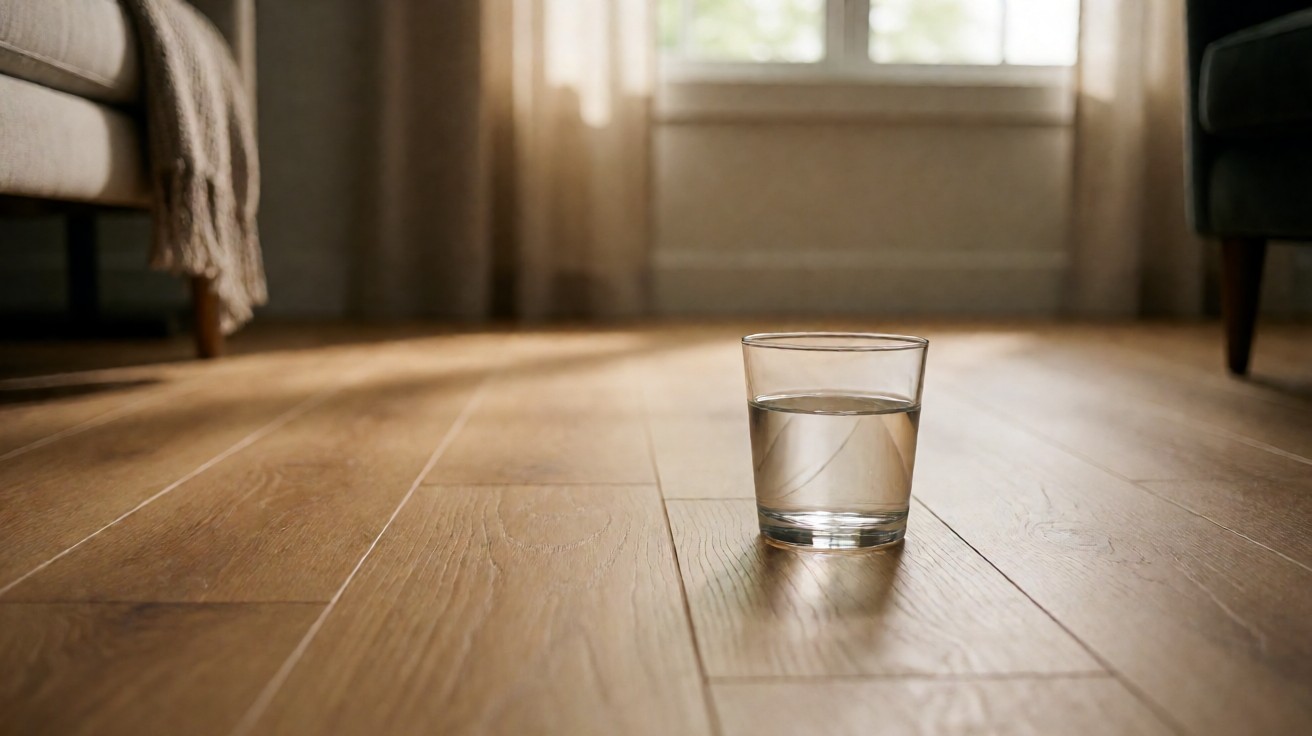
Spills that sit are worse than spills that soak. A cup of water left overnight is far more damaging than the same amount wiped in a minute. This is the entire principle of water resistance, and it is why prompt attention matters more than the rating on the box.
Water-Resistant Laminate Versus Waterproof Vinyl
It is worth naming the honest comparison, because it is the one buyers eventually have to make. If a room needs waterproof performance, a synthetic-core luxury vinyl plank gives that performance as its native construction, without asking you to trust a coating. It is a different product from laminate and it wears differently, which the vinyl comparison covers in depth.
Laminate generally wins on feel underfoot and on a convincing wood look, and it often wins on price in the mid range. Vinyl generally wins on water tolerance and on repairability, since a damaged plank can be lifted and swapped. In a dry room the difference rarely matters; in a wet room it decides the floor.
Spills, Leaks, and Floods Are Different Events
Most people treat water resistance as one on-off property, but it is really three different exposures with three different answers. A spill is water on the surface for minutes, and every laminate rating handles it if you wipe it up. A leak is water for hours or a day, and only a well-sealed board survives it intact.
A flood is water standing for a while and wicking into every joint, seam, and perimeter gap at once. That is the event that saturates a wood core, and it is why a room with a history of flooding wants a synthetic-core product rather than a better-coated laminate.
Between those extremes sits the everyday case of slow, repeated damp: a laundry that sweats, an entryway that tracks in rain, a kitchen sink that drips. That is where water-resistant laminate earns its rating over time, and also where a poor-quality board starts to show at the edges before anything dramatic happens.
Ask which of these three events your room is actually exposed to. The answer tells you more than the label ever will, because it tells you whether time and prompt cleaning are enough, or whether you need a core that does not swell at all.
How This Fits With the Rest of the Laminate Choice
Water rating is one property among several, and it is the one most likely to be misrepresented. Decide it from the core, not the marketing, and let the room conditions decide which rating you need.
The complete laminate flooring guide covers how the material is built, the AC wear rating, and what to check on a sample, including how to read the water claim. If you are weighing laminate against the resilient alternatives, the head-to-head material comparison sets the families side by side on comfort, cost, and water tolerance.
How the floor is fixed to the subfloor also affects how water behaves under it, and the glue-down versus click-lock comparison covers that mechanical difference in detail.
Related reading: the standard vs. premium laminate flooring.