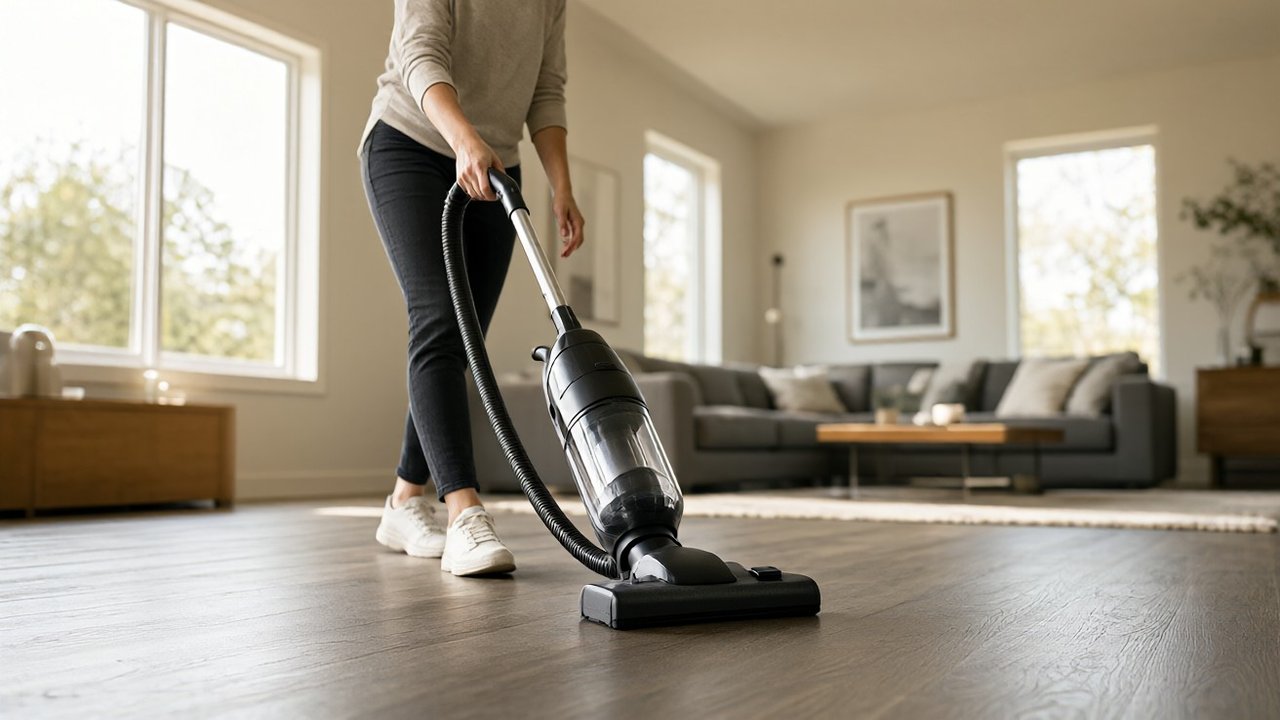

Water spots, a dull film that no mop removes, and joints that have started to lift are the three symptoms almost every laminate floor owner recognizes.
The answer is a damp microfiber mop and a pH neutral cleaner, because laminate is a decorative overlay bonded to an HDF core or MDF core. The surface can take a damp mop. The core can never take standing water.
What Makes Laminate Different To Clean
The Construction That Decides The Rules
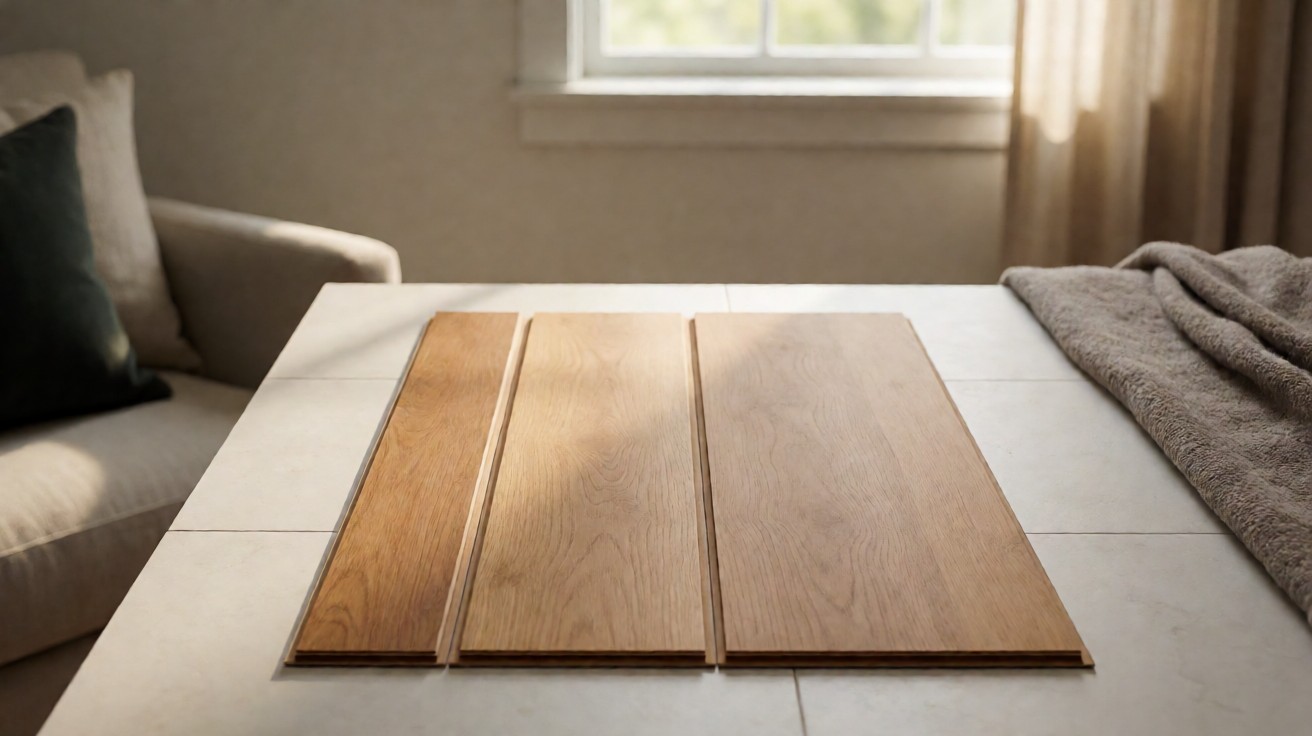
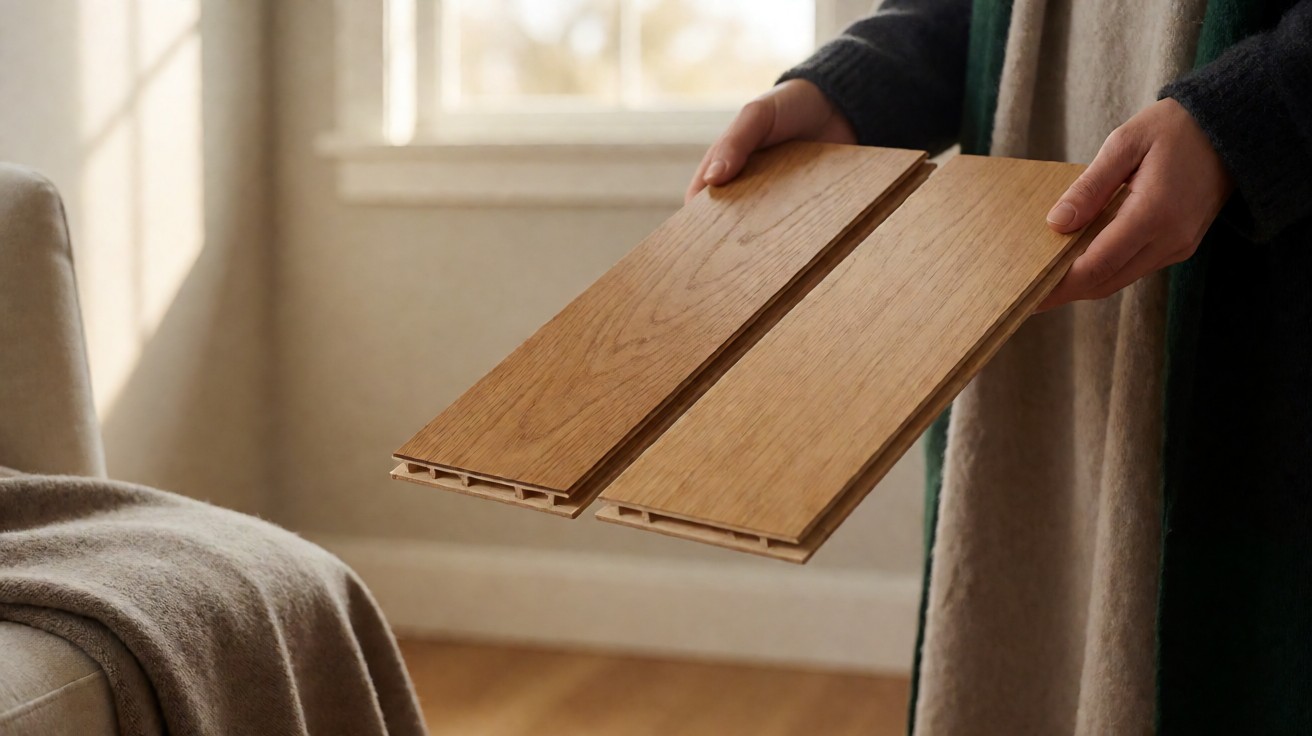
Laminate is not a solid piece of wood with a finish painted onto it. It is a decorative overlay, printed paper or a lacquer film, bonded under heat and pressure to a fiberboard core, and that sandwich decides every cleaning rule that follows.
The top layer behaves well. EPLF describes a laminate surface as hard and impervious, so dirt cannot cling to it and in most cases is easily removed.
The core underneath is the problem. Wood based panels drink water and swell when they take it, and the swell is what lifts a joint.
That is the whole difference in one sentence. Cleaning a laminate floor is a surface job with a hidden water problem under it, and the two pull in opposite directions.
What Does The Overlay Decide?
The overlay also decides what you are allowed to put on the floor. A melamine resin surface and a lacquered surface respond differently to polish, to aftercare products, and to how wet you can safely mop.
| Surface Type | Governing Standard | What It Means For Cleaning |
|---|---|---|
| Melamine resin surface | EN 13329 DPL laminate | No polish, no beeswax, and no film forming aftercare products, per the EPLF technical bulletin |
| Direct print with lacquered surface | EN 15468 PDL laminate | Aftercare products used for lacquered parquet are acceptable, per the same bulletin |
| Any laminate surface | All panels | Never sand, varnish, or wax the floor, and never use abrasive pads, sponges, cloths, or scourers |
The instruction that follows is to follow the document that came with your floor. EPLF frames its own technical bulletin as a guideline rather than a binding rule, and Beaulieu asks homeowners to keep a list of the cleaners they use so they have a record if a claim ever needs one.
The Daily Routine
A Dry Pass, Then A Damp One
Most laminate care is quick, and the reason is that the surface is hard and impervious rather than absorbent. Loose dirt comes off with a vacuum for hard surfaces or a well wrung damp cloth, and stubborn dirt comes off with the cleaner the manufacturer recommends.
Start dry, because that is where the scratches come from. EPLF recommends removing loose surface dirt with a vacuum for hard surfaces, preferably with a suction nozzle for hard surfaces.
Beaulieu puts the same idea differently: sweep, vacuum, or dust mop regularly with a non treated mop, because abrasive and non abrasive particles are the most common threat to your flooring.
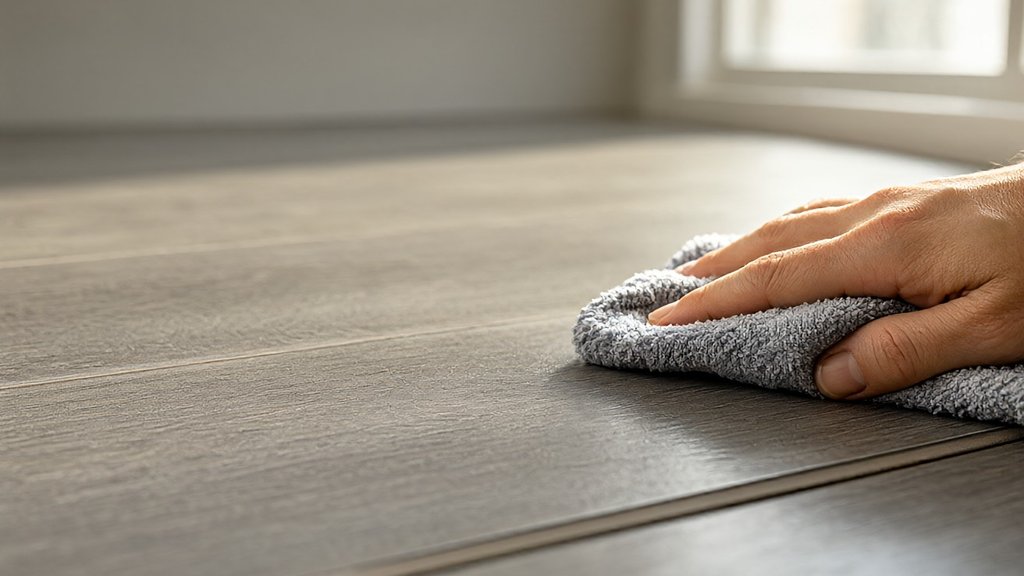
Then add water sparingly. The EPLF bulletin calls the routine wash a moist wipe down, which means wiping the surface with a well wrung damp cloth and a little laminate cleaner in the water.
A damp mop, well wrung, is the tool that matters. It leaves the surface damp and the joint dry.
There are ready made versions of this if you prefer them. EPLF also recommends impregnated cleaning cloths or wet wipes, and Pergo allows a vacuum with the correct hard surface attachment or a dust mop for general cleaning.
Where The Product Goes Matters
Spray the product onto the cloth or the mop head, never onto the floor itself. Beaulieu, Southwind, and Lowe’s all give that same instruction in their own words.
Southwind’s version is explicit: moisten a microfiber mop or cloth by spraying the solution onto the mop head, and do not spray solution directly onto the flooring.
Finish by drying. Southwind advises letting the floor dry completely before you replace protective mats after mopping, and warns against allowing topical moisture to remain on the floor, since it leaves surface spotting behind.
Vacuuming Without Scratching The Surface
The Attachment That Matters
The vacuum is where most laminate scratches start, and the fix is one attachment. Beaulieu’s guidance is specific: vacuum using air suction only, do not use a vacuum with a beater bar head, and be certain that the wheels of the vacuum do not damage the finish.
Southwind is blunter. Vacuums with a beater bar or power rotary brush head should never be used on laminate flooring, and only hard surface attachments designed for hard surfaces belong on it.
Lowe’s says to use a soft bristle brush attachment, and Pergo lists rotating beater bars, floor scrubbers, steamers, jet mops, and buffers among the tools that stay off a laminate floor.
The machine is also a delivery vehicle for grit. EPLF notes that gravel and similar particles act like sandpaper and cause unsightly scratches, which is why a full sized doormat at the front door does more for a laminate floor than any product you can put on it.
Check the machine before you vacuum. Southwind advises checking your broom or vacuum for burrs or debris, and one hard burr in the head tracks across every plank.
The Casters And The Feet
Do not forget the casters. EPLF says office chairs, filing trolleys, and mobile containers need soft treads or castors, which it says are recognizable by their two tone construction, and that old hard or sharp edged castors on existing furniture should be replaced.
EPLF is equally plain about static furniture. Chair legs, table legs, and cupboard feet should be fitted with felt pads.
Beaulieu adds non staining fabric faced glides, casters, or felt pad protectors under the legs of your furniture, with the pads kept free of abrasive dirt and checked periodically so they are changed when they wear.
Scratch prevention starts with keeping pet nails trimmed and with taking off shoes that have spikes or damaged heels before they touch the floor. And Beaulieu’s rule for moving heavy objects, lift rather than slide and use a dolly or protective sheets, is the same rule written for the furniture itself.
How Wet Is Too Wet For A Laminate Core
Three Words, Three Rules
Damp is a condition you can feel on your hand. Wet is a promise you cannot keep. The distance between them is the entire safety margin on a laminate floor.
Beaulieu states the rule most clearly of any of these documents. Never wet mop or flood your floor with water or other products. Standing water must be promptly removed.
There is one exception in that text, and it matters. However, water-resistant laminate can withstand a greater amount of moisture and therefore can be wet mopped.
Three consequences follow. Wet mopping is a manufacturer decision rather than a universal one. Flooding is never allowed. And standing water is the failure state, because it is the only condition where water sits in a joint long enough to cause damage.
Lowe’s describes what standing water does in plain terms: it may cause the joints between the planks to lift. A lifted joint is not cosmetic, because it is an opening for more water.
Is Damp Mopping Always Enough?
For most floors, yes. For a water-resistant laminate with the manufacturer’s permission, you have more room, and the reason is in the panel rather than in the mop.
For a floor that has been wet once and dried, and for a floor where a liquid has reached the joint, damp mopping is not the question at all. The question is what to do about the water already inside.
The core is an HDF core or MDF core of compressed wood fiber, and the locking joint is where that fiber is cut and exposed, so water that reaches the joint has a direct route into the panel.
Edge sealing matters because the cut end of the core is its most exposed fiber, and standing water at the joint is exactly the failure Lowe’s describes when it says the joints may lift.
The beveled edge on each plank leaves a narrow groove at the joint, and that groove holds residue and moisture until somebody takes it out. Lowe’s advice to clean the floor in the same direction as the planks helps, because it works the groove rather than across it.
What The Standards Measure
ISO 24336 is the test method behind the swelling limits in EN 13329, and it is deliberately harsh.
Samples of a laminate floor covering element are partially immersed 50 mm in water at 20 °C for 24 hours. The resulting thickness swelling is measured with a micrometer with an accuracy of 0.05 mm and expressed as a percentage to the nearest 0.1 percent.
It is a destructive test, which tells you how seriously the industry treats water at a joint.
EN 13329 sets the limits that this test feeds, through the classification system built on EN ISO 10874, and the 2023 edition of the standard added resistance to water measured to ISO 4760.
A current class 33 technical datasheet publishes the requirement as thickness swelling of 15 percent or less measured to ISO 24336.
Lowe’s grade levels, Above Grade, On Grade, and Below Grade, describe where the floor sits relative to ground moisture, and a floor installed Below Grade lives closer to the conditions the core dislikes than one installed Above Grade.
| Mopping Method | What It Means On The Floor | What The Manufacturer Guidance Says |
|---|---|---|
| Damp microfiber mop, well wrung | The cloth is damp, the joint stays dry | Beaulieu: a lightly dampened mop can be used for spot cleaning. Lowe’s: laminate floors may be lightly damp mopped when needed |
| Wet mop with a well wrung mop | The floor is wet but no liquid stands | Pergo: wet mop with water only using a well wrung out mop. Beaulieu: water-resistant laminate can be wet mopped |
| Spraying cleaner straight onto the floor | Liquid sits on the surface and pools in the joint | Beaulieu, Southwind, and Lowe’s: apply the solution to a cloth or mop, never directly to the floor |
| Standing water or puddles | Water sits in the joint until it dries | Beaulieu: standing water must be promptly removed. Lowe’s: avoid standing water, it may cause the joints to lift |
| Flooding or saturating the floor | Water reaches the core and the cut edges | Beaulieu: never wet mop or flood your floor with water or other products |
Melamine Overlay, Direct Print, And Lacquered Surfaces
What The Surface Decides
Not all laminate has the same skin, and the skin decides what you can put on it. EPLF splits laminate into two families in its cleaning bulletin, and the split is not cosmetic.
Laminate floorings with a melamine resin surface, an EN 13329 DPL laminate, should not be treated with film forming cleaning and aftercare materials, polish, or beeswax.
Under no circumstances should beeswax or polish be used on that surface, because a film layer sits on top of a surface that was never meant to be coated and will wear unevenly against it.
The other family is a direct print flooring with a lacquered surface, an EN 15468 PDL laminate. For those, EPLF says it is a good idea to treat the floor with the same aftercare materials as are used for lacquered parquet.
Read that as a permission rather than an instruction, because the same bulletin still tells you to follow the laminate flooring manufacturer’s recommendations on aftercare.
How To Tell Which One You Have
The installation paperwork or the product’s own documentation will name the surface, and that document is also the one that carries the warranty.
Beaulieu asks homeowners to keep the original sales receipt or documentation illustrating proof of purchase and installation date, and to keep five (5) planks of the laminate flooring product after installation for testing purposes, so a replacement plank can be color matched.
The pH Neutral Rule And Why Residue Matters
Why pH Neutral Is The Rule
Even the correct cleaner can ruin a laminate floor if it leaves something behind, which is why pH neutral is the term that appears in every one of these documents.
Beaulieu asks you to clean the floor periodically with pH neutral cleaning products made specifically for laminate floors, with the frequency depending on the amount of traffic the floor receives.
Southwind is more prescriptive about the chemistry. After residue removal, use a cleaner formulated for laminate wood that is pH neutral and contains no wax, paraffin, or soap, sodium hydroxide or surfactant.
Acidic and alkaline cleaners work against the panel in different ways, so a pH neutral cleaner protects the overlay and the core at the same time.
Lowe’s makes the same point from the other side, warning that oil soaps and wax based cleaning products leave a dull finish on the floor and should not be used on it.
What Residue Does To A Floor
The reason residue matters is that it changes the floor twice. Beaulieu warns that products which leave a residue could make the floor slippery or sticky and cause it to appear dull.
The same products could damage the flooring, leave a discoloring residue, cause swelling, and warping that voids the warranty.
A dull floor and a slippery floor are the same defect seen from two ends. The dullness is what you notice and complain about. The slipperiness is what somebody notices when they step on it.
Products That Void The Warranty
The List, And Why It Is A List
Every manufacturer guide in this cluster keeps the same short list of products away from a laminate floor, and the reason is always the same: they either attack the core or they leave a film behind.
| Product Or Tool | What The Guidance Says | Practical Result |
|---|---|---|
| Steam mop or steamer | Not suitable with any type of laminate floor, per EPLF. Also excluded by Beaulieu, Southwind, Lowe’s, and Pergo | No exceptions in any of these documents |
| Vinegar | Listed by Beaulieu among products that void coverage | Only usable if your own guide allows it, and only diluted |
| Ammonia | Listed by Beaulieu among products that void coverage | Southwind and Pergo use dilute ammonia for spot work only |
| Bleach | Excluded by Beaulieu, Southwind, and Lowe’s | Use a cleaner formulated for laminate instead |
| Wax, polish, or beeswax | Excluded on melamine resin surfaces, per EPLF. Southwind says there is never a need to wax or refinish | A film on the surface, and a slippery floor |
| Oil soaps, lemon oil, tung oil | Excluded by Beaulieu, Southwind, and Lowe’s | They leave a dull finish on the floor |
| Beater bar or power rotary brush vacuum | Should never be used on laminate flooring, per Southwind and Beaulieu | Use a hard surface attachment instead |
| Abrasive pads, scouring powder, steel wool | Excluded by EPLF, Beaulieu, and Southwind | Use a soft microfiber cloth instead |
| Jet mop or floor scrubber | Excluded by Pergo, Lowe’s, and Southwind | Mop by hand instead |
Where The Manufacturer Guides Disagree
One conflict is worth naming, because it decides what you do on an evening with a juice spill. Beaulieu lists vinegar and ammonia among the products that void coverage.
Southwind and Pergo both use dilute ammonia for spot removal, and Pergo allows a solution of 1 cup of vinegar per gallon of water or 1/3 cup non-sudsing ammonia per gallon of water when a deeper clean is needed.
Both can be true, because the guidance is about routine cleaning and warranty coverage, and a blotted and dried spot treatment is not the same as mopping a floor with it every week.
Southwind offers a milder daily option of 1 part distilled water to 1/2 part white distilled vinegar, sprayed onto the mop head, while still telling you to follow the manufacturer’s instructions.
When two guides conflict, the one that came with your floor wins. Beaulieu is explicit that using the excluded products could damage the flooring, leave a discoloring residue, cause swelling, and warping that voids the warranty.
Southwind puts the warranty side plainly: the company does not warrant any cleaning agents or conditions associated with them.
Spot Cleaning Spills And Stains
Blot, Do Not Rub
Spills are not laminate’s problem. Spills that sit are.
Beaulieu is unambiguous about the clock. Remove spills or liquids immediately using a soft and absorbent cloth, and do not allow spills or liquids to remain on the floor for an extended period of time, because it may cause damage to your flooring.
Lowe’s gives the technique: use a slightly damp white cloth or paper towel to immediately blot up and dry the affected area.
Blot rather than rub, because a dry grit particle dragged across a melamine surface is what turns a stain into a scratch.
Southwind adds the follow up rule: wipe the surface thoroughly to reduce surface spotting.
Which Stain Needs Which Method?
The manufacturer guides agree closely on the method for each type of stain, and the differences are about the chemistry rather than the technique.
| Stain Type | Method From The Manufacturer Guidance | Note |
|---|---|---|
| Chocolate, juice, wine, grease | Lukewarm water and a non abrasive cleaner such as ammonia and water | Follow up with a laminate formulated cleaner |
| Crayons, ink, nail polish, tar, markers, lipstick | Acetone or nail polish remover, or denatured alcohol | Southwind warns against acetone on wall base or quarter round |
| Candle wax or chewing gum | Let it harden, then carefully scrape with a blunt plastic scraper | No chemical needed for the first step |
| Rubber scuff marks, heel marks, shoe polish | A stain remover recommended specifically for laminate flooring, per EPLF | Some stubborn marks will not come up with a laminate cleaner |
Two categories need care rather than a cloth. When the damaged area is larger than 1/4 of an inch, Pergo and Southwind both say to contact a professional to replace an entire plank rather than patch a hole that will keep growing.
Southwind notes that minor damage can be repaired with color matched finishing putty, so small nicks do not need a whole plank.
Do not let a spot treatment become a floor treatment. Pergo warns against pouring liquid directly onto the floor and against an excessively wet mop that will puddle or leave moisture standing.
Southwind warns that furniture glides may cause damage to your flooring, so a chemical that is safe for a spill can be driven into the joint if you soak the plank.
Removing Residue And Build-Up
The Removal Sequence
Residue build-up is the laminate floor version of a dull, sticky patch that no amount of mopping removes, and it has a documented removal procedure rather than a guess.
Southwind’s method starts with dilution. Mix 1 part Ammonia to 3 parts Distilled Water, pour the mixture into a spray bottle, and moisten a microfiber mop or cloth with the solution by spraying it onto the mop head, not directly onto the flooring.
Then clean the floor, and expect more than one pass, because depending on how much build up is on the flooring it may take multiple cleanings to remove all of the residue.
Once the residue is off, switch products. Proceed to a cleaner formulated for laminate wood that is pH neutral that contains no wax, paraffin, or soap, sodium hydroxide or surfactant, and keep using that product for the routine afterwards.
The Glass Test
Before you use any cleaner across a whole room, run the glass test. Southwind’s method is to spray the cleaning product on clear glass and allow it to dry.
If the glass dries clear, you are fine, but if it should dry cloudy, do not use it.
The reason the test works is that residue you would see on glass is the same residue you would see on the floor. The product will dry on your flooring cloudy as well, and over time your floor will have a cloudy appearance.
One more trap sits in the routine itself. Southwind advises washing soiled mop heads without fabric softener, as fabric softener residue may cause streaking on the floors.
Steam Mops And Why The Industry Rejects Them
The One Unanimous Rule
There is one tool in this entire group of documents that every single one rules out, with no exceptions and no conditions attached.
EPLF states it in a single line: steam cleaners are not suitable for use with any type of laminate floor.
Read the words any type carefully, because the ban is not limited to a particular surface type or a particular warranty tier.
The manufacturers agree with the industry body. Beaulieu lists steam mops among the products that void coverage, Southwind says never use a steam mop or steamer on laminate flooring, Lowe’s excludes steam cleaners and jet mops, and Pergo lists steamers among the tools to avoid.
What Steam Does To A Joint
The mechanism is the same one that makes standing water dangerous, amplified. Steam delivers heat and moisture at the same time, drives it into the joint where the core is exposed, and heat accelerates the swelling that ISO 24336 measures in the laboratory.
It does not merely wet the surface, which the damp mopping rules already cover, and it does not merely polish the floor. It puts vapor into the one place in the construction that cannot tolerate moisture, on every pass, with no way to control the amount.
The same machine works fine on the tile in the next room.
Humidity And Seasonal Care
The Two Humidity Ranges
Humidity is the variable you do not control, and it moves in both directions over a year.
EPLF sets the conditions and explains the mechanism in the same paragraph. A room temperature of 18 °C with relative humidity of 50 percent to 70 percent gives the optimal conditions for the floor.
The reason is in the material. With higher humidity the wood material panels of the flooring, as with all wood based products, will tend to swell.
Low humidity does the opposite. Taking into account air conditioning and underfloor heating and coupled with high temperatures, it causes shrinkage. EPLF advises using humidifiers when the heating is on in your home.
Beaulieu works with a wider band: maintain normal interior humidity levels, with the range between 35 percent and 65 percent, and use a humidifier or dehumidifier if necessary.
The two ranges overlap between 50 and 65 percent, which is where most households can sit all year without buying anything.
What Changes Between Seasons
There is a standard behind the seasonal behavior, and it is ISO 24339, which determines the dimensional variations of laminate and textile floor coverings after exposure to humid and dry climate conditions.
Its clauses on flatness, on openings between elements, and on height differences between elements apply only to laminated floor coverings, which is exactly the gap that opens in January and closes in July.
Seasonal care is therefore mostly prevention rather than treatment. Keep the floor clear of a heating vent, run a dehumidifier in a below grade room in summer, and remember that a panel installed Below Grade lives closer to the conditions the core dislikes.
Water-Resistant And Waterproof Laminate Compared For Cleaning
What The Labels Change
Two labels on the box change what you do with a mop, and the difference is mostly about how long water is allowed to sit.
Water-resistant laminate, in Beaulieu’s wording, can withstand a greater amount of moisture and therefore can be wet mopped, with standing water still to be promptly removed.
Waterproof laminate goes further in what the panel itself resists, and the difference shows up in the test rather than in the mop.
For the purchase decision itself, which is a different question from the cleaning routine, the water resistant versus waterproof laminate guide covers what each tier commits a manufacturer to.
What Does Waterproof Change About Cleaning?
The cleaning consequence for both tiers is the same at the limit. Water resistant or waterproof, no document in this cluster permits standing water on the floor, and every one of them says to remove it promptly.
Where the standards come in is at the panel and the joint. EN 13329:2023 added resistance to water according to ISO 4760 as an additional technical property, and that test covers two things: the recovery swell of the surface and the water tightness of the joints.
A current class 33 technical datasheet states the requirement as a recovery swell final average of no more than 3 mm, and no water entry through the connection after exposure to water for 48 hours.
That 48 hour figure is the honest description of what waterproof buys you in a cleaning sense. It is a measured window rather than a license to leave a puddle, and it applies to the joint of a panel tested under laboratory conditions.
For the rest of the house, the flooring cleaning and maintenance guide covers how the other materials respond to the same mop.
The laminate flooring guide covers the material the panel is built from, and the how to clean LVP floors page covers the material that is not laminate.