

You have narrowed the floor down to two colours you like, and one is online for a third less than the showroom price, and the other you can only see in person.
The answer is that the online price is usually real and the online decision is usually wrong, because a screen cannot show you what a floor does in daylight, and the third you saved gets spent on freight damage and returns.
Buying Flooring Online Vs. In A Showroom
Both channels sell the same product, and the difference between them is not really the product. It is the number of things you can settle before you pay, and the number of things you are asked to take on trust instead.
A showroom lets you settle colour, texture, scale and the way a floor relates to a room in daylight. An online listing lets you settle price, availability and delivery cost. Neither channel settles everything, and the honest version of this comparison is a list of what each one is for.
That framing matters because the question is usually asked as if one channel is simply better. It is not. The right answer depends on the product, the room, and how much risk you are willing to carry yourself.
Which Channel Suits Which Buyer?
Before the detail, the short version. Buy in person when colour accuracy is the deciding factor, when the product is a natural material with batch variation, or when the room is large enough that a mistake is expensive.
Buy online when the product is a uniform synthetic with a consistent tone across batches, when the price gap is larger than the freight and returns exposure, or when you already know exactly what you are buying.
| Your Situation | Buy In A Showroom | Buy Online |
|---|---|---|
| Colour is the deciding factor | Yes, without question | Only with a physical sample in hand first |
| Product is natural wood or stone | Yes, because batch variation is real | Rely on the sample being representative, and check the return terms |
| Product is a uniform synthetic plank | Useful but not essential | Often the better value |
| Large room, high cost of being wrong | Yes, see the floor in the room’s own light | Only with a return path that is cheap to use |
| Installer will come to your house | Good, the dealer can brief the installer | Harder, the installer is a third party |
| Discontinued or hard-to-find line | Harder, dealers stock fast lines | Often easier, more sellers carry old stock |
Read that as a starting position rather than a rule. The two rows that decide most purchases are the first and the fourth, and both of them are about how expensive a mistake would be.
What A Screen Can And Cannot Settle
A screen shows you a photograph, and a photograph is a lighting system with an opinion. The same plank photographed under warm evening light in a staged room looks materially different from the same plank under a north-facing window at midday, and both photographs are honest.
What a screen genuinely can settle is scale and geometry. You can compare plank width, see the length of the board, judge whether a herringbone layout is plausible in your room, and confirm that the product is the one you think it is.
Engineered wood and solid wood are graded, and the NWFA Technical Guidelines are the reference for how a board is described and graded.
What a screen cannot settle is the thing that determines whether you will like the floor in ten years, which is how it behaves in your specific light across a day. Colour temperature in a room with a large west-facing window is not a property of the plank. It is a property of the plank in that room.
A 20 mil wear layer is 0.508 mm of material and a 6 mil layer is 0.152 mm, and the two look identical on a screen at a resolution of 1200 pixels across a 12 inch plank.
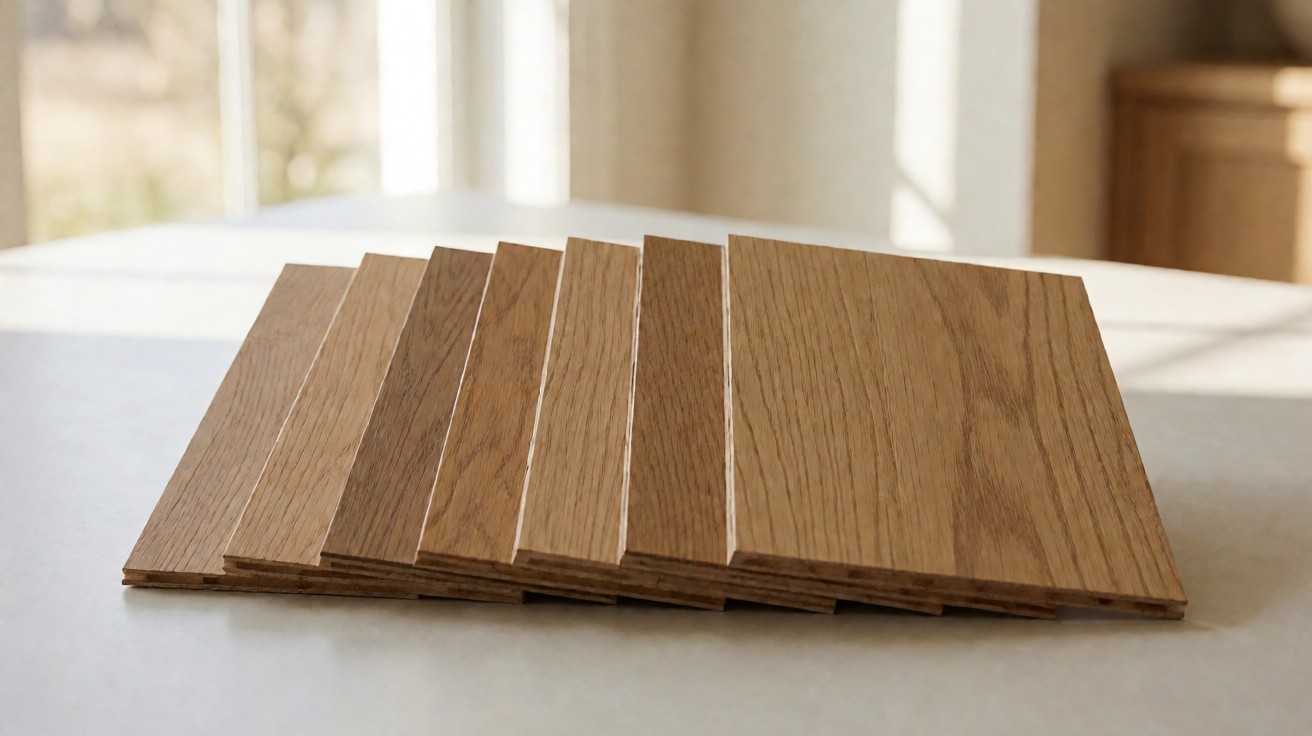
That is why the online channel sells samples, and why the sample is not a formality. A sample taken home and laid in the actual room, in the actual light, at two different times of day, is the cheapest risk reduction available in flooring.
The samples guide covers how to order them and what a sample can and cannot settle, including where the answer stops being useful.
What The Online Channel Genuinely Does Better
Is The Online Price Always Cheaper?
Not always, and the difference is worth computing rather than assuming.
It is worth being specific, because the online channel has genuine advantages that are often dismissed rather than answered.
Laminate carries a traffic class, and the NALFA certification runs AC1 through AC5 with AC5 the commercial class. That class is the number to check when an online listing says a floor is suitable for a busy hallway, because the listing will not tell you which class it is.
Price transparency is real. Two sellers carrying the same line at different prices is easier to establish online, where the price is published, than in a showroom, where it depends on who you speak to and when.
Range is real. A discontinued or hard-to-find line is far more likely to be sitting in an online warehouse than in a local dealer showroom, because the online seller is stocking for a national market. The inventory comparison guide covers how to check whether a line is still being produced.
Comparison is real. You can hold three specifications side by side from three sellers without three appointments, and for a product where specification is the deciding factor, that is worth more than seeing the floor.
Lead time on a non-stock item can be better, because a dealer ordering a special order is waiting on the same factory the online seller is, with an extra handling step in between.
None of those arguments make the online channel wrong. They make it wrong for a specific set of buyers, and the set is narrower than the marketing suggests.
Shipping Damage And Who Absorbs It
What Happens If A Carton Arrives Damaged?
It becomes a claim against the carrier, inside a window that is shorter than most buyers expect.
This is where an online purchase most often goes wrong, and it goes wrong quietly. A pallet of flooring arrives, a corner of a carton is crushed, and inside it several boards are cracked. Nobody noticed, because the damage is inside the box.
The Mail Order Rule (16 CFR 435) and the Negative Option Rule (16 CFR 425) are the two federal rules that protect an online buyer here.
Under the Mail Order Rule, a seller who has promised delivery by a certain date and cannot meet it must offer a refund within 7 working days of the promised date, or give the buyer the choice of a delay with consent or a prompt refund. That is a genuine protection on a delayed order.
Neither rule covers damage on arrival. Damage on arrival is a different claim, and it has to be made against the carrier in a specific window. Most carriers require notification of damage within a set period, commonly 5 to 10 days, and many policies also require the packaging to be retained until the claim is settled.
That last requirement is the one that catches people out. If the installer takes the packaging to the tip, the claim is gone. Keep the cartons until the floor is down and accepted.
A concrete example of the scale. A 400 square foot room in engineered oak is roughly 20 cartons, and a crushed carton can take out 3 to 4 boards. If the installer opens the boxes and finds them, the shortfall is discovered on day one of the job. If the boards are discovered halfway through laying, the job stops and the replacement arrives days later.
So the question to ask an online seller is not about price. It is what happens if a carton arrives damaged, who pays the freight to replace it, and whether replacement pieces come from the same batch. If the answer is vague, the price gap is not what it appears to be.
Returns, Restocking Fees, And The Real Exit Cost
| Cost | Buying In A Showroom | Buying Online |
|---|---|---|
| Restocking fee on a return | Usually none, and the trip is local | Commonly 15% to 25% of the order value |
| Return freight on 20 cartons | Your own van, or a short local haul | Freight billed to you, and often not refundable |
| Freight damage claim window | Not applicable, you carry it home | Often 5 to 10 days, and packaging must be retained |
| Replacement boards from the same batch | Usually available from the same dealer | Depends on the seller holding that batch |
| Delay refund | Not applicable | Mail Order Rule, refund within 7 working days of a missed date |
The advertised return policy is the easy part. The real cost of returning a floor is the freight, and freight on 20 cartons of engineered oak is not free. It is commonly more than the price difference you were trying to save.
Some sellers also publish a restocking fee, commonly 15% to 25%, and some charge for return freight on bulky items regardless. A 20% restocking fee on a 2,000 dollar order is 400 dollars, which is more than the discount you were chasing.
On a 2,000 dollar order of engineered oak, a restocking fee of 20% is 400 dollars, which is more than the discount that sent you online in the first place.
Two rules make this manageable. First, read the return terms before you order, and check specifically whether they apply to a floor that has been unopened, because a different rate for opened product is common and reasonable.
Second, do not install a floor you intend to return. A floor that has been installed is very hard to return, and the moment the first row is down the decision has been made whether or not it was made consciously.
The refund timeline is worth noting too, and it is governed by the Mail Order Rule rather than by the return policy.
Under the Negative Option Rule, a seller who fails to ship within the promised time must obtain consent from the buyer before continuing the shipment, and a buyer who does not consent is entitled to a refund. That timeline matters when a lead time slips, because it is the point at which you can still leave the transaction without a fight.
Lead Time And Stock On A Discontinued Line
Online sellers can usually tell you the batch and date code of the stock they are shipping, and that is worth asking for even when the line is current. A floor from a 2019 batch next to a floor from a 2025 batch is two different floors once they are in the room, and the difference is visible in the colour.
A 20 mil wear layer and a 6 mil wear layer are the same width and the same length in the carton, so the freight on either is the same. The price difference between them is a product difference rather than a shipping difference.
On a discontinued line the lead time question reverses. The product is gone from production, so what matters is not when it ships but whether the seller has it and whether the batch is consistent.
A seller with 20 cartons from a single batch can complete most rooms. A seller with 3 cartons from one batch and 40 from another cannot.
Ask how many cartons are available and from how many batches. If the answer is a single number, ask for the batch count. It is the question that separates a sale from a gamble.
The replacement stock guide covers how to check whether a line is still being produced and what to do about a floor you may need to repair in ten years.
Installation Coordination Across The Two Channels
This is the practical difference that a price comparison misses entirely. A dealer who sells the floor and arranges the installation has one party accountable for the whole job, and one contract.
An online purchase usually splits it. You buy the floor from one party and hire an installer from another, and neither contract covers the other. When the floor arrives with a batch that does not match what was approved, or the installer finds the subfloor is out of tolerance, there is no one to call.
ASTM F2170 is the test method for relative humidity in a concrete slab, and per it a slab sits within limit at 75 percent relative humidity without a vapor barrier and 80 percent with one.
A buyer who splits the purchase across two channels is the one most likely to end up with a floor and a slab that were never assessed together. That fragmentation is not a reason to avoid online buying. It is a reason to keep the records yourself.
Take photographs of every carton on arrival, record the batch numbers, and note the condition of the subfloor before the installer starts. That record is what converts a dispute into a claim.
How the installer is chosen and vetted is covered in the flooring installer guide, and the subfloor conditions that decide the job are covered in the subfloor flatness guide.
The Hybrid Route That Beats Both
The most practical method is not a compromise between the channels. It is using each for what it is genuinely good at, and it costs nothing extra.
Visit a showroom with the specific product in hand, or order a sample, and settle the colour question properly. Buy the sample from an online seller if that is cheaper and faster, then take the decision to a dealer, or buy online once the sample has confirmed what you already suspected.
In practice the hybrid looks like this. You see the floor in a showroom, you like it, and you find the same line cheaper from an online seller with a cheaper return policy. You buy the sample from the online seller, verify it against the showroom board in your own light, and then place the order online with the batch recorded.
That sequence settles the one thing a screen cannot, and it removes the freight-damage exposure from a decision you have already made. The savings survive, because the expensive part of an online purchase was never the price. It was the uncertainty you were carrying.
The Decision Procedure
Run these in order and the channel decision takes about ten minutes rather than an afternoon of store visits.
First, settle whether colour is the deciding factor. If the top two candidates are close in price and you cannot tell them apart on a screen, that is the whole answer, and it points to a showroom or a sample.
Second, check whether the product varies between batches. Engineered wood, solid wood, and natural stone do. A uniform vinyl plank or a ceramic tile from a single dye lot generally does not. That single question eliminates most of the hard cases.
Third, compute the real saving. Take the price difference and subtract the return freight and the restocking fee. If the difference survives, the online channel is viable. If it does not, the showroom is the cheaper option and the search for a better online price was wasted effort.
Fourth, read the damage and delay terms before you order. Ask what happens if a carton arrives damaged, who pays the replacement freight, and what the return window is once the product is opened.
Fifth, if you are installing, decide who handles it. One contract covering the floor and the installation is worth more than a discount, and the fragmentation is the part of online buying that people underestimate.
The product specification comparison is worth running alongside this, because a flooring brands guide explains why the specification should settle the comparison before the price does.
Which Channel Should You Actually Use
Use the showroom when the decision is about how the floor looks in the room, when the product is natural and varies, or when the room is expensive to be wrong about. Use the online channel when the product is uniform, when the price gap survives the return cost, and when you already have a sample in hand.
And use the hybrid when you want the best of both, which is most of the time. See the floor properly, then buy it where the price and the terms are best.
Whichever route you take, the record is what protects you. Batch numbers, photographs of the delivery, the moisture readings from the slab, and the written scope of the installation are what turn a complaint into a claim.
The flooring buying guide covers the documentation to collect at the point of sale, and the lifecycle cost guide covers why the cheapest purchase is often the more expensive floor.