
Flooring is a one-decade-plus commitment for most rooms in a US home, which makes the decision about which material to install one of the more expensive calls a renovation makes. Vinyl, laminate, hardwood, tile, and carpet look similar in a showroom photo, but they are built differently, behave differently when wet, wear differently under traffic, and cost differently when subfloor work and labor are added to the invoice. Picking the wrong one for a bathroom, basement, or kitchen wastes thousands of dollars and years of wear before it has to be replaced.
The five categories differ on three things a buyer can verify before ordering a sample. The first is water performance, which separates waterproof vinyl, porcelain tile, and fully grouted tile from laminate, hardwood, and carpet, all of which can be ruined by a sustained leak. The second is lifespan, which is shortest for carpet, longest for hardwood and tile when installed correctly. The third is cost per square foot installed, where material prices can mislead you without labor and subfloor prep included.
This hub lines the five materials up on the specifications that drive those calls, then points each shortlist to the matching in-depth guide. Read the comparison first, pick the right material for the room, and use the linked guide for the construction, certifications, and installation walkthrough that match the specific product you are buying.
The Five Main Flooring Types At A Glance
Before the room-by-room detail, start with the high-level map. The table below puts each material against its core, its best room, how it handles water, the construction standard that applies, and where it usually lives in a US project. Use it as the index for the rest of the article.
| Flooring Type | Core Construction | Water Behavior | Best Room Match | Key Standard Or Certification |
|---|---|---|---|---|
| Vinyl (sheet, LVP, LVT) | Synthetic PVC layers, often with a rigid SPC or WPC core in modern plank | Waterproof when seams and edges are sealed | Kitchens, bathrooms, laundry, basements, any wet or below-grade room | FloorScore for VOC emissions; ASTM F1700 for solid vinyl tile |
| Laminate | HDF core with printed decor and aluminum-oxide wear layer | Water resistant on most boards, waterproof on rated boards with sealed perimeter | Living areas, hallways, bedrooms, and light-use kitchens | NALFA LF 01 certification tiers |
| Hardwood (solid and engineered) | Solid sawn wood, or plywood core with a real hardwood wear layer | Sensitive to standing water; engineered tolerates moisture better than solid | Living rooms, dining rooms, hallways, bedrooms, stairs | NWFA Installation Guidelines; Janka hardness per ASTM D1037 |
| Tile (ceramic and porcelain) | Fired clay body, glazed or through-body | Fully waterproof once grouted and sealed | Bathrooms, kitchens, mudrooms, entryways, patios | ANSI A137.1 for type, absorption, and breaking strength; visible abrasion class per ASTM C1027 |
| Carpet | Tufted or woven face fiber bonded to a backing, laid over padding | Absorbs water and dries slowly; not for wet rooms | Bedrooms, living rooms, stairs, finished basements with moisture control | CRI Green Label Plus for VOC emissions; FTC Textile Rules for fiber labeling |
Each material is described in plain prose in the sections that follow, but the table is the cheat sheet. Skip to Where To Go Deeper On Each Material if you already know which category fits your project.
Vinyl Flooring: What It Is And Where It Works
Vinyl flooring is a man-made, multi-layer product built around a polyvinyl chloride core and topped with a printed design layer under a clear wear surface. It comes as flexible sheets in 6 to 12 foot rolls, as individual luxury vinyl planks and luxury vinyl tiles in click or glue-down formats, and as peel-and-stick tiles for small projects. Modern rigid planks layer a stone-polymer or wood-polymer core between the backing and the printed film, which stiffens the board enough to install over minor subfloor imperfections without telegraphing through.
Because the printed film is plastic, vinyl tolerates standing water indefinitely when seams and perimeter edges are intact, which is why it is the default pick for full bathrooms, laundry rooms, and basements. The voluntary FloorScore certification from SCS Global Services tests finished products for 35 individual volatile organic compounds against the California Section 01350 method, and FloorScore-certified rigid planks and tile are common in the residential market. Indoor air quality testing in this scheme is independent of any phthalate restriction, which is worth knowing if phthalate content matters to you.
Vinyl works in nearly every room because it does not warp when wet, does not need to acclimate to humidity the way wood does, and comes in formats thin enough to fit under most doors without trimming. The trade-offs are at the edges of the board: lower-end sheet vinyl can telegraph subfloor waves, peel-and-stick tiles shift when exposed to heat cycles, and even rigid plank will dent under very heavy furniture or thin chair casters. For the long read on construction, wear-layer thickness, formats, and project costs, see the vinyl flooring guide.
Laminate Flooring: What It Is And Where It Works
Laminate is a rigid board made by heat pressing paper and resin layers onto a wood fiber core. The European standard EN 13329 defines the product as a rigid floor covering with a substrate, a decor layer, a surface layer, and worked edges that join into a larger field. North America uses the parallel NALFA LF 01 standard, which tests and certifies four usage tiers: residential, light commercial, commercial, and heavy commercial. Wear resistance is the headline number, with LF 01 requiring at least 1,500 cycles for residential grade and stepping up to higher thresholds for each certification tier.
Standard laminate is water resistant, not waterproof. A puddle wiped within 30 minutes causes no problem, but standing water that reaches the high-density fiberboard core swells the plank permanently. Newer waterproof rated products add a hydrophobic core treatment and a waxed edge profile to extend that window, though most manufacturer warranties still exclude damage from appliance leaks or floods. Laminate cannot be sanded or refinished, so the plank you drop is the plank you replace.
Laminate fits living areas, hallways, bedrooms, and home offices. It is the strongest pick when you want a wood look at a lower price than engineered hardwood and where dents from dropped objects are less likely than in a kitchen. The deep construction, certification tiers, and installation walkthrough live in the laminate flooring guide.
Hardwood Flooring: What It Is And Where It Works
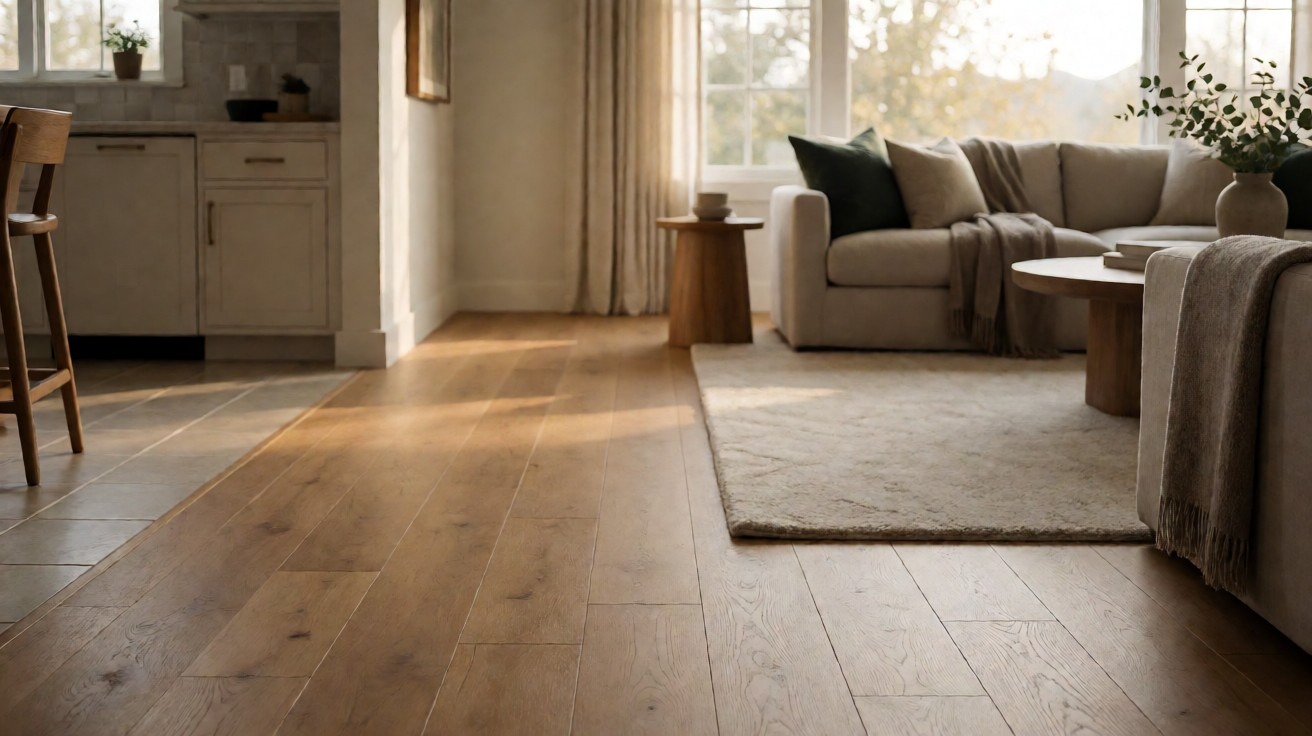
Hardwood is the only category on this list that is genuinely cut from a tree. Solid hardwood is a single piece of sawn lumber, usually 3/4 inch thick, while engineered hardwood layers a thin real-wood wear surface over a plywood or HDF core. Both are considered hardwood in everyday usage, and the trade association for the product is the National Wood Flooring Association, which publishes the installation guidelines most US installers follow.
Wood species are compared on the Janka hardness scale, a lab test that measures the force required to press a steel ball halfway into a wood sample. Red Oak, the trade reference, scores 1,290 pounds-force on the scale; Hickory lands around 1,820, Hard Maple at about 1,450, White Oak at 1,360, and Walnut near 1,010. Janka rates denting resistance, not scratch resistance, which is determined by the finish sitting on top of the wood.
Hardwood reacts to humidity, expands and contracts seasonally, and never tolerates standing water. Solid boards are nailed down on or above grade and are not for basements; engineered boards can float, glue down, or staple down and tolerate below-grade rooms when the moisture is controlled. The trade-off for that sensitivity is what hardwood offers that nothing else does: it can be sanded and refinished multiple times over a 50 to 100 year service life. For the species breakdown, the construction differences, and full installation guidance, see the hardwood flooring guide.
Tile Flooring: What It Is And Where It Works
Ceramic and porcelain tile are both fired-clay products, but the spec that separates them is water absorption. The ANSI A137.1 standard, administered by the Tile Council of North America, classifies porcelain as tile that absorbs 0.5 percent or less of its weight in water under ASTM C373. Ceramic is anything above that, and wall-grade ceramic can climb above 7 percent absorption. Porcelain is denser, harder, and more resistant to staining, which is why it is the default for kitchens, bathrooms, and outdoor use.
The visible abrasion classification (often still called a PEI rating in retail) runs from 0 through 5 and is measured under ASTM C1027 by tumbling abrasive media against a glazed surface. Class 2 suits residential walls and soft-soled foot traffic, Class 3 is the typical residential floor, Class 4 covers most commercial interiors, and Class 5 is for airports, malls, and similar heavy traffic spaces. The classification applies to the glaze, not the body, and does not measure slip resistance, water absorption, or breaking strength, so it never replaces the manufacturer’s full spec sheet.
Tile is fully waterproof once grouted and sealed, lasts 50 years and up in a residential setting, and tolerates radiant heat better than almost any other floor. The downsides are weight (concrete subfloor or additional reinforcement is required above second story), coldness underfoot in winter, and a hard surface that drops dishes and amplifies noise. The format, installation, mortar, and grout details live in the tile flooring guide.
Carpet Flooring: What It Is And Where It Works
Carpet is a textile floor covering made of face yarn tufted or woven into a backing, then installed over a separate cushion or pad. Face yarn is most often nylon, polyester, polypropylene (olefin), or wool. Nylon is the workhorse: it resists crushing, holds up to traffic, and can be recycled into new carpet. Polyester is softer but less resilient; olefin handles moisture but flattens under heavy traffic; wool is the natural high-end pick and is naturally flame resistant.
Carpet absorbs sound and feels warm underfoot, which is why it is the default pick for bedrooms and stairs. It does not survive wet rooms, traps dust and allergens, and shows wear at stair edges before anywhere else. Indoor air quality matters for carpet more than for any other category here: the CRI Green Label Plus program tests carpet, pad, and adhesives against the California Section 01350 method on 35 volatile organic compounds, the same standard FloorScore uses for hard surfaces. Fiber content is regulated under FTC textile labeling rules, so the fiber percentages on the back of the sample are a legal statement.
Carpet adds comfort and sound control in living rooms, bedrooms, finished basements, and stairs, but it does not belong in kitchens, full bathrooms, mudrooms, or entryways. A full carpet reference covers fiber-by-fiber comparison, padding options, stain treatment, and installation methods.
How The Five Materials Compare On Durability, Water, And Comfort
The next table lines the five up against the specifications most buyers actually weigh: how long the floor lasts in normal residential service, how it handles water, whether it can be refinished, and how it feels underfoot. Lifespan figures come from manufacturer warranties plus trade-association guidance; the comfort column is qualitative because no two feet will agree on it.
| Flooring Type | Typical Lifespan (residential) | Water Performance | Refinish Or Repair | Underfoot Feel | Best Use Case |
|---|---|---|---|---|---|
| Vinyl (LVP, LVT, sheet) | 15 to 25 years; 10 plus year manufacturer warranties are common | Waterproof when seams and perimeter are intact | Planks can be replaced individually; surface cannot be refinished | Hard, slightly softer than tile due to foam or cork backing | Kitchens, bathrooms, basements, laundry, rental turnovers |
| Laminate | 15 to 25 years residential; high-traffic rentals can show wear at 10 | Water resistant standard; waterproof rated boards extend the window | Planks can be replaced individually; cannot be refinished | Hard, hollow sound without a quality underlayment | Living areas, bedrooms, hallways, light-use kitchens |
| Hardwood (solid and engineered) | 50 to 100 years with periodic refinishing; 25 year finish warranties are typical | Sensitive to standing water; engineered tolerates brief moisture better than solid | Sanded and refinished 3 to 7 times over the floor life | Firm but warmer than tile; quiet underfoot | Living rooms, dining rooms, bedrooms, hallways, stairs |
| Tile (ceramic and porcelain) | 50 plus years; many installations outlast the homeowner | Waterproof once grouted and sealed | Individual tiles can be replaced; surface cannot be refinished | Hard and cold; pair with radiant heat for comfort | Bathrooms, kitchens, mudrooms, entryways, patios |
| Carpet | 8 to 15 years before wear or stain dictates replacement | Absorbs and retains water; not for wet rooms | Stretched-in carpet can be lifted and reinstalled in the same room | Soft, warm, sound absorbing | Bedrooms, living rooms, stairs, finished basements |
Cross-reference the table against the room list and the household profile. A family with two dogs, an active kitchen, and a basement playroom makes a different combination of choices than a single owner-occupant in a one-bedroom condo.
What Flooring Costs In A Real Project
Flooring cost shows up in three different numbers on the invoice: materials only, labor only, and the combined total per square foot installed. All three matter, because the material premium in tile or hardwood often flips when labor is included; a mid-priced engineered hardwood floor with cheap labor can cost less installed than a budget laminate with pro labor. The figures below come from US national averages published in the Angi (formerly HomeAdvisor) cost guides and refresh over time, so treat them as a midpoint for budgeting, not as a quote. As of recent Angi cost guides, typical per-square-foot ranges for labor and materials combined run roughly:
| Flooring Type | Typical Material Range (per sq ft) | Typical Labor Range (per sq ft) | Installed Total (per sq ft) | Cost Drivers |
|---|---|---|---|---|
| Vinyl (LVP, LVT, sheet) | $2 to $7 standard plank; $1.50 to $4 sheet; peel-and-stick less | $1.50 to $6 depending on subfloor and room layout | $3 to $13 typical, mid-range install around $6 to $10 | Subfloor leveling, transitions, door trimming, removal of old floor |
| Laminate | $1.50 to $5 mid-grade; waterproof rated boards at the top | $2 to $5 typical | $4 to $10 typical, mid-range install around $6 to $8 | Underlayment, transitions, threshold work, plus padding when not attached |
| Hardwood (solid and engineered) | $4 to $12 engineered; $6 to $15 plus solid, exotics higher | $4 to $9 typical; nail-down adds time over glue | $8 to $25 common, mid-range install around $12 to $18 | Species and grade, subfloor type, board width, refinishing not included |
| Tile (ceramic and porcelain) | $1 to $15 per sq ft for tile itself; mid-grade $3 to $7 | $7 to $15 for pro install due to layout, cuts, and grout | $10 to $35 common for pro install, mid-range around $15 to $25 | Tile size, pattern complexity, subfloor reinforcement, thinset and grout type |
| Carpet (including padding) | $1 to $5 mid-grade carpet; $1 to $4 padding | $1 to $3 typical install | $3 to $10 typical for install and mid-grade materials combined | Carpet grade, pad thickness, stairs at per-step pricing, furniture moving |
The numbers above are residential mid-market ranges for typical rooms. Project-level costs move sharply with subfloor work: a bath with a concrete slab that needs self-leveling, a house with asbestos tile that needs abatement per the EPA asbestos guidance for families, or a room with a complicated stair layout can push labor above the typical band. Always get three written estimates that spell out materials, labor, subfloor prep, transitions, and removal of the existing floor.
How To Choose The Right Flooring For Your Project
The honest answer to which floor is best is that there is no single answer; the right floor depends on room, budget, climate, and how long you plan to stay in the home. A few decision rules narrow the field quickly.
Water and humidity come first. Bathrooms, laundry, mudrooms, and basements should almost always default to porcelain tile or waterproof rated vinyl. Hardwood, laminate, and carpet fail consistently in those rooms when the appliance hose, the basement sump, or the shower pan finally leaks.
For kitchens, weigh water against comfort. Tile is the most durable kitchen floor and cleans up the fastest; engineered hardwood feels warm but needs more attention; waterproof rigid vinyl is the middle ground that looks like wood and tolerates spills. Standard laminate in a kitchen holds up only if every spill gets wiped within minutes.
For living areas, comfort and noise drive the choice. Carpet is quiet and warm underfoot but has a shorter service life and higher maintenance. Hardwood and engineered wood offer the longest life and the strongest resale argument in most US markets. Tile and rigid vinyl are quieter with the right underlayment but feel hard.
If you might sell within 10 years, choose for resale, not preference. The material buyers most consistently look for in a US listing is hardwood in living areas, tile or vinyl in kitchens and bathrooms, and carpet only in bedrooms. Loud personal-taste floors (dark stained pine, brightly colored carpet) lower offers in many markets.
For indoor air quality, look for a third-party certification. FloorScore covers hard surfaces (vinyl, laminate, ceramic, hardwood, engineered). CRI Green Label Plus covers carpet and pad. CARB Phase 2 covers the formaldehyde emissions from composite wood products. These are independent tests, not marketing claims, and they are updated as standards revise.
Check the subfloor before you pick the floor. Concrete slabs need moisture testing. The standard method is ASTM F2170, the in-situ relative humidity test, and most manufacturers require readings under 75 to 80 percent before installing glue-down or floating floors. Wood subfloors need to be flat within 3/16 inch over 10 feet for most products, and the manufacturer will void the warranty if you skip that step.
Where To Go Deeper On Each Material
The five sections above give you the comparison. Once you have a shortlist, the in-depth guide for that material goes deeper on construction, certification marks, installation walkthrough, subfloor preparation, and total project cost.
- Vinyl: How to choose vinyl flooring for any room and budget
- Laminate: Laminate flooring guide: construction, durability, limits
- Hardwood: Hardwood flooring guide: solid vs. engineered
- Tile: Tile flooring guide: ceramic vs. porcelain vs. stone
- Carpet: Carpet flooring guide: fiber types, padding, stains
Common Questions About Comparing Flooring Types
The questions below come up most often when buyers compare these five materials. Each answer keeps it brief and points back to the matching material guide for the full read.
Is Vinyl Flooring Better Than Laminate For Kitchens And Basements?
In most cases, yes. Rigid vinyl plank and sheet vinyl are waterproof through the wear layer and edges, while standard laminate swells when water reaches the HDF core. Newer waterproof laminate uses a hydrophobic core treatment and a sealed perimeter to extend the threshold, but vinyl remains the safer pick in any room where standing water is a real possibility. The construction comparison lives in the laminate flooring guide.
Can Hardwood Flooring Be Installed In A Bathroom?
Full bathrooms are the one place hardwood is not recommended. Standing water, steam, and the inevitable overflow degrade even engineered boards over time. A small handful of manufacturers sell bathroom-rated engineered hardwood with very specific installation requirements, but the default bathroom spec across the trade remains porcelain tile. The hardwood flooring guide covers where each construction is and is not appropriate.
Is Tile Flooring Too Cold And Hard For A Living Room?
Tile is cold and hard underfoot by default. Cold is fixable with a radiant heating mat set beneath the tile, which pairs especially well with porcelain. Hard is partly personal preference; tile over a quality uncoupling membrane has some give, but it will never match the comfort of carpet or cushioned vinyl. For most living rooms, hardwood or rigid vinyl reads as warmer and feels softer without giving up too much durability.
How Often Does Carpet Need To Be Replaced?
Residential carpet typically lasts 8 to 15 years before visible wear, matting, or permanent staining forces replacement. High-traffic stairs and family rooms tend to wear out first; bedrooms can run past 15 years with a mid-grade carpet and good pad. There is no way to refinish carpet, so the answer is full-room replacement or, with stretched-in installation, lifting and reinstalling the same carpet in a different room.
How Long Does Each Flooring Type Last In A Normal Home?
Realistic service life under normal residential use: vinyl 15 to 25 years, laminate 15 to 25 years, hardwood 50 to 100 years with refinishing, tile 50 plus years, and carpet 8 to 15 years. Hardwood is the longest lived material on this list by a wide margin, which is why it shows up in century-old homes. Vinyl and laminate are the shortest lived, though new waterproof products may push that window longer as more field data comes in.
Find The Right Flooring For Your Room
The right floor for a given project comes down to three questions: which room needs it, what is the subfloor doing right now, and how long do you plan to live with the result. Answer those in that order, pick a category from the comparison table near the top of the article, then read the in-depth material guide for the construction, certifications, and installation walkthrough that match the product you want underfoot.